Tokyo recovers only part of its steep losses
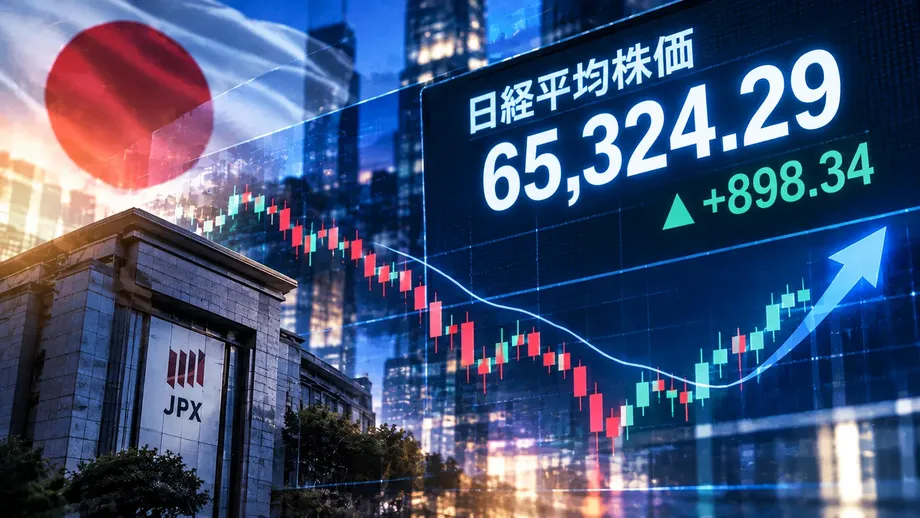
Japan's Nikkei 225 rose 898.34 points, or 1.39%, to close at 65,324.29 on Friday, October 16, 2026, ending six consecutive sessions of losses. Buying spread across 32 of the Tokyo Stock Exchange's 33 industry groups, with Tokyo Electron, SoftBank Group and Advantest helping lead the recovery.
Contents
- Tokyo recovers only part of its steep losses
- How the selling gathered pace
- Buyers returned, then the rally lost strength
- A broad advance with powerful individual drivers
- Why CoreWeave's borrowing shook chip shares
- Inflation and oil added another layer of pressure
- Company results created winners and losers
- Currencies, bonds and South Korea reflected the strain
- The next tests arrive with earnings and inflation
- Key Points
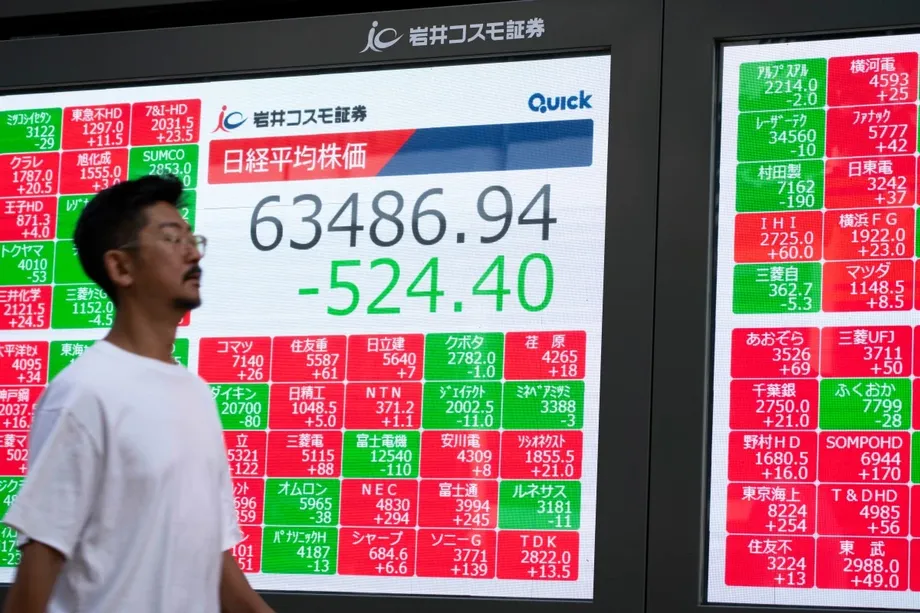
The rebound recovered just 27.1% of Thursday's 3,318.34 point plunge, the third largest daily point loss in the index's history. Across Thursday and Friday together, the Nikkei remained 2,420 points lower. Investors bought shares after sharp falls, while concerns about the debt supporting artificial intelligence investment continued to weigh on the market.
The broader Topix rose 66.66 points, or 1.67%, to 4,066.00, reclaiming the 4,000 level. Trading volume on the Prime Market reached 2.37905 billion shares, with turnover of 7.6686 trillion yen.
Friday's recovery followed an overnight improvement on Wall Street, where the Dow Jones Industrial Average gained 556.21 points. Comments from Nvidia chief executive Jensen Huang about the financial position of AI infrastructure provider CoreWeave also helped calm investors after concerns about its borrowing had spread through technology markets.
The Nikkei nevertheless finished the week down 5.37%, its biggest weekly decline since July 17. Friday's buying restored some ground, while leaving investors facing the same central issue: whether companies spending heavily on AI equipment can generate enough income to support those investments.
How the selling gathered pace
Tokyo's losses combined several pressures: stronger American inflation, expectations of higher interest rates, concern about CoreWeave's finances and growing competition in memory chips. The Nikkei had traded above 70,000 on October 5, before retreating sharply.
- October 5: The Nikkei traded above 70,000 for the first time in about three months.
- October 14: Plans by Chinese chipmaker CXMT to introduce server memory products before the end of the year added to concerns about competition. US September inflation was reported at 3.7%.
- October 15: The Nikkei fell 3,318.34 points to 64,425.95, completing six sessions of losses. Its intraday low was 64,092.74.
- October 16: The index rebounded to 65,324.29, after reaching 65,712.30 at 2:01 p.m.
Thursday's selling was especially severe among companies tied to AI and semiconductors. At midday, Advantest was down more than 15%, Tokyo Electron about 8%, SoftBank Group more than 10% and Kioxia more than 12%.
The weakness crossed borders. In the preceding US session, the Philadelphia Semiconductor Index fell 4.3%, while Nvidia lost 3% and Oracle about 9%. South Korea's Kospi dropped 7.5% on Thursday as Samsung Electronics and SK Hynix came under heavy selling pressure.
Buyers returned, then the rally lost strength
The Nikkei stood at 65,550.68 at Friday's midday break, up 1.75%. It later extended its gain to 1,286.35 points before giving back about 388 points from its afternoon high by the close. Selling to secure profits before the weekend and lingering concern about AI profitability limited the advance.
Daisuke Hashizume, senior strategist at Daiwa Securities, attributed the recovery primarily to buying after the previous session's steep losses.
The shares rebounded as investors bought back stocks after sharp losses in the previous session… there were no other factors for the gains,
Hashizume said investors were also cautious ahead of company earnings and the US midterm elections in November. He identified the possible effect of the election outcome on President Donald Trump's proposals for $5,000 payments to US adults and increased military spending as issues markets were watching.
US stocks had offered some support overnight, although their gains varied. The Dow rose about 1.08%, compared with 0.33% for the S&P 500 and 0.08% for the Nasdaq Composite. The Nasdaq finished higher after earlier weakness, while easing US Treasury yields helped steady sentiment.
A broad advance with powerful individual drivers
Tokyo Electron contributed 134.00 points to Friday's Nikkei gain, roughly 14.9% of the total. SoftBank Group added 74.43 points, Ibiden 74.30, BayCurrent 50.57 and Advantest 40.99. Together, those five stocks supplied about 41.7% of the index's advance.
The Nikkei uses adjusted share prices to determine each company's influence. Companies with higher adjusted share prices can therefore move the index more than others, even when buying extends across much of the market. Fast Retailing illustrated the opposite effect on Friday, subtracting 66.34 points.
Across the Prime Market, 1,292 shares rose, representing more than four fifths of listed stocks. Closing tallies put the number of decliners between 224 and 229. Electric power and gas was the only industry group to fall; other products led the gains, followed by machinery, insurance and transportation equipment.
Banks and manufacturers also participated. At midday, Mitsubishi UFJ Financial Group was up 1.64% and Mizuho Financial Group 1.71%, while Toyota Motor advanced during the session. Kioxia finished 3.84% higher at 13,375 yen, and SoftBank Group gained 1.90% to 4,944 yen.
Why CoreWeave's borrowing shook chip shares
CoreWeave supplies computing infrastructure used for AI, including access to data centres and powerful chips. Its expansion links the finances of an infrastructure operator to demand for equipment made by companies elsewhere in the technology industry.
Market commentator Kazuyuki Suzuki identified a sharp rise in the yield on CoreWeave bonds as a central source of the week's anxiety. He cited a bond maturing in 2032, with a fixed coupon of 9%, whose market yield had risen into the 15% range.
A coupon is the interest payment set in a bond's terms. A market yield changes as the bond's trading price changes. When investors demand a higher yield to hold a company's debt, it can signal greater concern about repayment and make new borrowing more expensive.
Suzuki also cited a premium above 11% on CoreWeave credit default swaps covering five years. These contracts provide protection against specified debt defaults. Higher premiums mean that protection has become more expensive.
Nvidia's Huang subsequently indicated that CoreWeave's financial strength was improving and its cost of capital was declining. CoreWeave shares rose more than 5% in US trading on Thursday. Japanese chip stocks followed higher on Friday, although investors remained concerned about how quickly spending on AI infrastructure would produce profits.
Inflation and oil added another layer of pressure
US September consumer inflation of 3.7% exceeded market expectations and encouraged traders to price in a greater chance of an interest rate increase. The implied probability of an October increase briefly reached 50% before falling back to 27%.
Higher interest rates can affect AI investment through two channels. They raise the cost of borrowing for companies building expensive facilities, and they make investors less willing to pay high prices today for profits expected much later.
Brent crude remained above $100 a barrel amid continuing conflict in the Middle East. Rising US crude futures also weighed on Friday's Tokyo session. Expensive oil adds costs for transport and production while making the inflation outlook harder for central banks to manage.
The Federal Reserve's next policy meeting is scheduled for October 27 and 28. Comments attributed to Fed chair Warsh, indicating that he would approach policy decisions without a predetermined view, helped reassure investors during Friday's trading. No rate decision had been made.
Company results created winners and losers
BayCurrent stood out from the broader rebound. Its shares were up 17.25% at midday after the consulting company outlined plans to use excess cash for investment and share buybacks. Strong results for the first half of its financial year and its medium term business plan also attracted buyers, and the shares reached their daily upper price limit.
A share buyback means a company purchases its own stock. Investors may welcome that use of cash because it can reduce the number of shares outstanding and increase each remaining share's claim on future earnings.
Software services company SHIFT also reached its daily upper limit after its earnings outlook and plans for an investment fund with Tokyo Gas attracted buying. Takara Holdings advanced after the disclosure of a holding by Oasis Management.
HIOKI moved in the other direction. Its strong cumulative results through the third quarter were followed by a sharp share price fall after it left its forecast for the full year unchanged. Investors were assessing future expectations as closely as recent results.
Maki Sawada, a strategist in Nomura Securities' Investment Content Department, described the market's caution ahead of company results.
Recent volatility reflects typical moves ahead of an earnings season,
Sawada added that investors were leaning toward a stance of reducing risk, and said strong earnings could help ease concerns about AI investment.
Currencies, bonds and South Korea reflected the strain
The dollar traded near 158 yen in Tokyo on Friday. At 5 p.m., it stood at 158.00–158.02 yen, compared with 157.86–157.88 yen at the same time on Thursday. The euro was quoted at $1.1238–$1.1239 and 177.57–177.61 yen.
Japan's benchmark government bond yield for debt maturing in 10 years rose 0.010 percentage point to 2.930% as stocks recovered and bonds were sold. It had briefly fallen to 2.91% during Thursday's retreat. Bond prices and yields move in opposite directions.
South Korea's Kospi rebounded 2.05% to 5,668.06 on Friday, but ended the week down 14.46%, its largest weekly decline since October 2008. That weekly fall was about 2.7 times Japan's 5.37% decline. Samsung Electronics gained 2.62% on Friday and SK Hynix rose 0.79%.
South Korea's Ministry of Economy and Finance said on October 16 that it would monitor whether stock market volatility spread into bonds, foreign exchange and money markets, and strengthen market oversight. The ministry pointed to growth prospects, a continuing current account surplus and company earnings as sources of support.
The next tests arrive with earnings and inflation
Meta Platforms is scheduled to release results for July through September on October 21, US time. Investors will examine its AI spending plans, revenue and profit outlook for signs of how demand for computing infrastructure is translating into business returns.
Japan's September national consumer price index follows on October 23. Bank of Japan policy board member Junko Koeda said on October 15 that policymakers need not be excessively cautious about raising rates. She also placed the neutral interest rate, a level that neither stimulates nor restrains the economy, appreciably above 1%.
For Japanese exporters, a stronger yen can reduce the yen value of earnings received overseas. An inflation reading that increases expectations of Japanese rate rises could therefore affect both the currency and equity prices.
Suzuki placed a possible lower boundary for the Nikkei around 61,000. The index finished Friday below the 26 week moving average of 65,672 cited in his assessment. Earnings on October 21, Japanese inflation on October 23 and the Fed meeting on October 27 and 28 provide the next concrete tests of investor confidence.
Key Points
- The Nikkei rose 898.34 points to 65,324.29, ending six consecutive sessions of losses.
- Friday's gain recovered 27.1% of Thursday's plunge; the index still lost 5.37% for the week.
- Topix gained 1.67%, and 32 of Tokyo's 33 industry groups advanced.
- CoreWeave's financing costs, AI profitability, inflation and oil prices remained central concerns.
- Meta earnings, Japanese inflation data and the October Fed meeting are the next scheduled market tests.