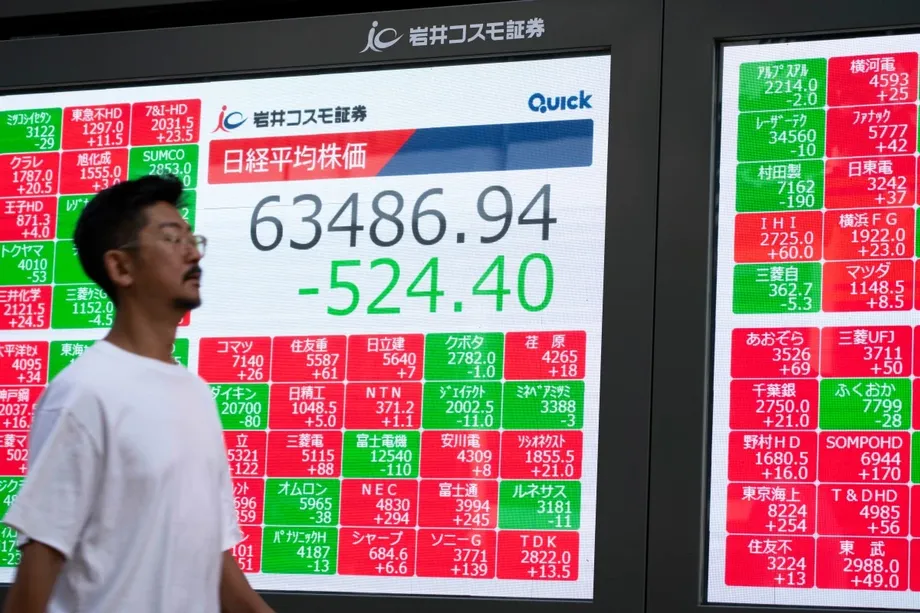
Tokyo's losses deepen as investors question AI profits
Japan's Nikkei Stock Average plunged 3,555.14 points, or 5.25%, to 64,189.15 at 12:55 p.m. on Thursday, October 15, 2026, as concerns about the cost and profitability of artificial intelligence investment drove heavy selling in technology shares. The fall followed five consecutive losing sessions in which the benchmark had already shed more than 2,900 points.
Contents
- Tokyo's losses deepen as investors question AI profits
- A sixth session of losses gathers speed
- Why CoreWeave's bonds mattered to Japanese shares
- Inflation adds pressure to an expensive investment cycle
- Japan's chip and technology shares bear the heaviest losses
- South Korea suffers an even sharper retreat
- Wall Street's technology losses set the direction
- Energy prices keep the inflation problem in view
- Key Points
The broader Topix index dropped 115.50 points, or 2.82%, to 3,981.28. Both measures showed a retreat from Japanese stocks, but the much steeper Nikkei decline reflected the pressure on major technology and semiconductor companies.
A sharp fall in corporate bonds issued by CoreWeave, a U.S. operator of data centers used for AI computing, helped trigger the retreat. Investors were becoming more concerned about how companies would finance huge investments in computing infrastructure and whether revenue would grow fast enough to cover rising costs.
The selling spread across Asia after U.S. technology stocks fell on Wednesday. South Korea's Kospi dropped 8%, while Taiwan's benchmark lost 3.4%. Stronger than expected U.S. inflation added another source of pressure by increasing concerns about borrowing costs.
A sixth session of losses gathers speed
Tokyo's decline began with selling in semiconductor manufacturing equipment shares and worsened after the midday break. The Nikkei finished the morning session at 64,489.06, down 3,255.23 points. By 12:55 p.m., it had fallen another 299.91 points from that morning close.
Thursday's trading carried the benchmark below 65,000 and extended its losing run into a sixth session, with the index reaching its lowest level in about two weeks. The afternoon loss alone exceeded the more than 2,900 points lost across the previous five sessions.
The main developments unfolded across two trading days:
- October 14: U.S. September inflation exceeded expectations, Treasury yields temporarily rose, and the Nasdaq Composite fell about 1.9%.
- October 15, morning: Japanese semiconductor shares sold off, leaving the Nikkei down 3,255.23 points at 64,489.06 at the morning close.
- October 15, 12:55 p.m.: The Nikkei's loss widened to 3,555.14 points, or 5.25%, while the Topix fell 2.82%.
These figures describe trading during the session. A final closing level for Thursday was not given.
Why CoreWeave's bonds mattered to Japanese shares
CoreWeave sits in a part of the AI industry that requires large amounts of money before it can generate returns. Data center operators need computing chips, buildings, electricity supplies and cooling equipment to provide the capacity that AI developers use.
Companies can finance that spending by borrowing, including through corporate bonds. A bond is a loan from investors to a company, which promises interest payments and repayment under agreed terms. When an existing bond's price falls, its yield, the return available to a new buyer at that price, rises.
CoreWeave's falling bond prices brought attention to the cost of financing AI infrastructure. Higher yields can make future borrowing more expensive for companies facing similar concerns. Businesses that must keep raising money to expand can then face a tougher calculation: their investments need to earn enough to cover both operating expenses and financing costs.
Japanese chipmakers and equipment suppliers are exposed to that calculation because their customers depend on continued spending on computing capacity. If investors expect data center operators to face tighter budgets, they may also reduce the prices they are willing to pay for shares in the companies supplying those projects.
CoreWeave's 9.625% bond due in 2032 yielded 14.8%, while its 9.75% bond due in 2031 yielded about 14.9%. No precise size of the decline in its bond prices was given. The concern spreading through stocks centered on financing and future profitability.
Inflation adds pressure to an expensive investment cycle
U.S. consumer prices rose 3.7% in September from a year earlier, compared with 3.4% in August. The increase exceeded economists' expectations and represented an acceleration of 0.3 percentage points in annual inflation.
Persistent inflation can keep interest rates higher for longer because central banks use borrowing costs to restrain demand and price increases. For companies planning substantial investments, higher rates can make new loans and bond financing more expensive.
The yield on the U.S. Treasury note maturing in 10 years briefly rose above 5.32% on Wednesday before easing to 5.10%. It had reached 5.35% earlier in October, its highest level since 2002. Treasury yields influence financing conditions far beyond the U.S. government because investors use them as a reference when assessing other investments.
AI businesses faced two connected concerns: the cost of raising money and the pace at which investment would produce earnings. Investors were worried that revenue growth could fail to keep up with rising costs. Higher borrowing expenses would add to that pressure.
Rising U.S. government debt and inflation worries associated with the energy shock from the Iran war also weighed on the bond market. Even after Treasury yields eased from Wednesday's peak, technology shares across Asia continued to fall.
Japan's chip and technology shares bear the heaviest losses
Kioxia Holdings, the memory chipmaker, fell as much as 11.2% in a trading snapshot. SoftBank Group, an investor in OpenAI, lost 9.6%, while semiconductor equipment maker Tokyo Electron declined 7.5%.
Other readings during the session showed Advantest down 7.4%, Lasertec down 8.8% and electronic component maker Taiyo Yuden down 4.5%. The losses reached several parts of the technology supply chain, including memory, chip testing, manufacturing equipment and investment in AI businesses.
The breadth of the selling matters because the companies perform different jobs. A data center operator purchases computing capacity, a chipmaker produces components, and an equipment supplier sells machinery needed to manufacture them. Expectations of continued AI investment connect their business prospects.
Banking shares also weakened, although their declines were smaller. Mitsubishi UFJ and Sumitomo Mitsui each fell 1.1%, while Mizuho Financial lost 1.8%. The Topix's decline showed that the retreat extended beyond the technology companies suffering the largest losses.
Japan also released a more encouraging economic signal: core machinery orders increased more than expected in August. Those orders are watched as an indicator of business investment. Thursday's market losses showed that concerns about global technology spending and financing outweighed that domestic reading during the session.
South Korea suffers an even sharper retreat
South Korea's Kospi fell 8% to 5,527.12, a larger percentage decline than Japan's Nikkei. Samsung Electronics lost 9.7%, and memory chipmaker SK Hynix dropped 11.1%, putting two major suppliers to the global electronics industry at the center of the selloff.
The Kospi had fallen more than 16% over the preceding month. At Thursday's quoted level, it was also about 39% below the 9,000 threshold it had crossed in June, when enthusiasm for AI helped carry the market to a record high. That comparison shows how far prices had retreated from the earlier surge.
Taiwan's Taiex declined 3.4%. Taiwan Semiconductor Manufacturing Co., or TSMC, fell 1.8% ahead of its earnings report. The company manufactures chips for other businesses, placing its results close to investors' concerns about demand for advanced computing components.
Hong Kong's Hang Seng fell 1.3% to 24,009.28, and the Shanghai Composite dropped 2% to 3,692.65. Australia's S&P/ASX 200 slipped a much smaller 0.2% to 8,710.20. The contrast showed the strongest pressure in markets with prominent chip and AI businesses, while losses elsewhere were more contained.
Wall Street's technology losses set the direction
U.S. trading on Wednesday provided the immediate backdrop to Asia's retreat. The Nasdaq Composite fell about 1.9%, compared with a 1.1% decline in the S&P 500 and a 0.1% dip in the Dow Jones Industrial Average.
Major semiconductor shares suffered larger losses than the broader U.S. market. Nvidia fell 3.2%, Broadcom lost 3.1%, and Advanced Micro Devices declined 5.7%. Those moves preceded selling in Japanese and South Korean companies supplying related products and equipment.
U.S. equity futures were also lower during Asian trading. For investors in Tokyo, Seoul and Taipei, the pressure was arriving through both company financing concerns and a weaker international market backdrop.
The difference between the U.S. indexes helped explain the pattern. Technology shares were under heavier pressure than the broader market on Wednesday, and Asian chip shares carried that weakness into Thursday. Japan's 5.25% Nikkei fall and South Korea's 8% Kospi decline then exceeded the Nasdaq's percentage loss.
Energy prices keep the inflation problem in view
Oil prices fell during Thursday's trading, but remained elevated compared with levels before the Iran war began in late February. Brent crude declined 1.5% to $104.47 a barrel, while benchmark U.S. crude fell 1% to $94.17.
Brent had traded at approximately $72 a barrel before the war. At $104.47, it was still about 45% above that earlier level, despite the day's decline. Higher energy prices can increase transport, manufacturing and household costs, helping explain why inflation remained a concern for investors.
AI infrastructure also depends on electricity to operate and cool large concentrations of computing equipment. Energy costs therefore form part of the industry's spending challenge, alongside chips, construction and interest payments.
Thursday's selloff brought those costs into the same calculation as future revenue. Companies supplying AI infrastructure were being valued against a more demanding financial backdrop: expensive energy, high bond yields and growing concern about how quickly substantial investment would produce profits.
Key Points
- The Nikkei fell 5.25% to 64,189.15 at 12:55 p.m. on October 15, extending a losing run into a sixth session.
- The Topix dropped 2.82%, showing that selling extended beyond the hardest hit technology shares.
- Falling CoreWeave bond prices sharpened concerns about financing AI infrastructure and earning enough to cover rising costs, with its bonds due in 2032 and 2031 yielding 14.8% and about 14.9%, respectively.
- U.S. annual inflation accelerated to 3.7% in September from 3.4% in August, adding pressure through interest rate concerns.
- Kioxia, SoftBank Group and Tokyo Electron suffered steep losses, while South Korea's Kospi dropped 8%.
- Brent crude remained about 45% above its approximate level before the Iran war, despite falling during the session.