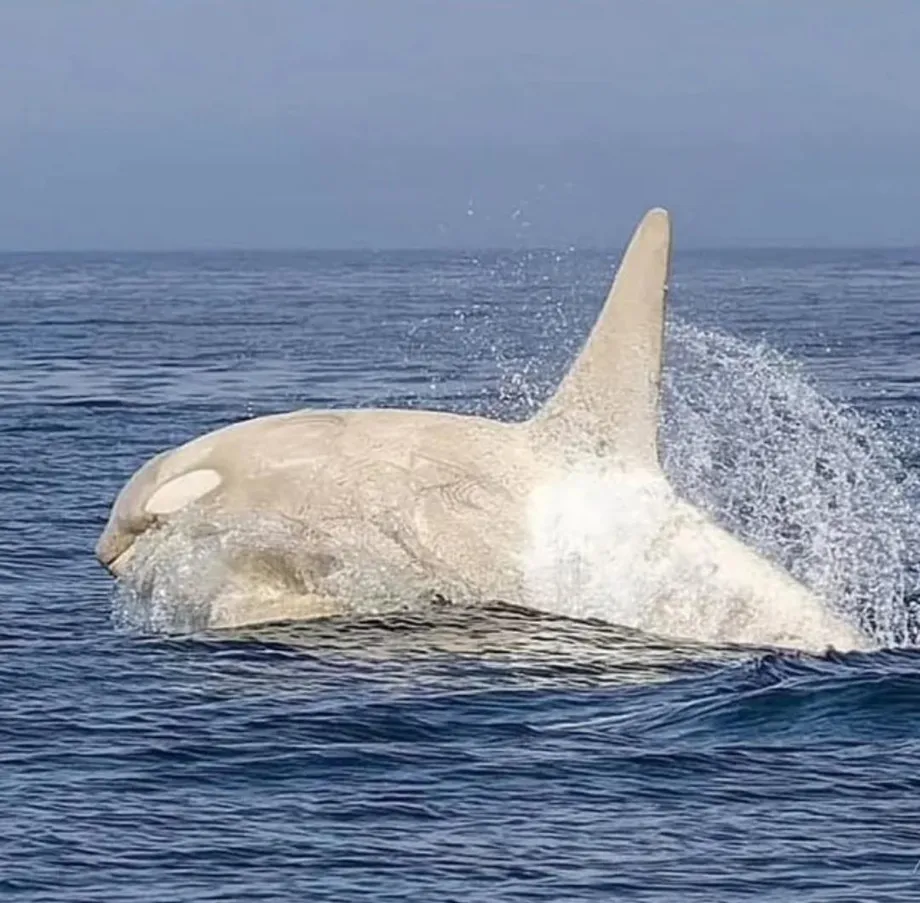
A Rare Return in the Fog Off Rausu
A white male orca photographed about 3.5 miles off Rausu, on Hokkaido's Shiretoko Peninsula, has completed a photographer's long pursuit of the three white orcas identified in these waters. The June 8 sighting was the first local appearance of a white orca in two years, and the first recorded return of this particular male in three years.
Contents
Shiretoko Nature Cruise dates the encounter to June 8, 2026, in its white orca account. The operator identifies the animal by its tall dorsal fin and says it was first observed off Rausu in 2019, with its previous sighting in June 2023. Two other white orcas were observed in June 2024. All three are different individuals.
For the photographer, who posts under the name Shiretoko Dream and the account @hayakawa0622, the encounter marked a personal milestone in his 18th year photographing orcas off Rausu. He had photographed the other two white animals in 2024. This male was the remaining individual he had hoped to see.
The June encounter involved one white orca, rather than all three swimming together. The same male was subsequently seen on June 14, 15 and 22, with the photographer encountering it again on the first two dates. An October follow-up put the number of identified white orcas off Rausu at three, with no additional individuals recorded.
A Fishing Boat Raised the Alert
A fishing boat first spotted the pale animal and passed the information to Masato Hasegawa, captain of a Shiretoko Nature Cruise vessel. At the time, the photographer was looking out over the sea from higher ground. Thick fog prevented him from seeing the orca.
After boarding Hasegawa's boat, he learned that another sightseeing vessel had already located it. Finding it again was still uncertain: fog could hide the animal, and it could move toward Kunashir Island, beyond the Japan-Russia median line described by the photographer.
The photographer said he felt relieved only after seeing the white orca himself from the boat. His attention then shifted immediately to recording photographs and video. Capturing the animal occupied him so completely that there was little time to celebrate.
Tour boat passengers and other people at sea repeatedly observed the male on June 8. Its size and appearance helped observers recognise it as the same animal during those encounters. For the photographer, completing his search brought both a sense of achievement and relief from the urgency he had previously felt.
How Three Individuals Were Identified
Shiretoko Nature Cruise's account resolves a central point about the sightings: the returning male and the two animals photographed in June 2024 are separate orcas. The local record therefore contains three known white individuals, even though sightings in different years have often involved just one or two.
The returning male has a particularly tall dorsal fin, the fin rising from its back. Photographs from May 2023 also documented a fin tip bent slightly to the left and abrasions below the fin on the left side of its body. Features such as these give observers details to compare across photographs taken years apart.
Earlier observations help explain the long gaps between encounters. Two white orcas were observed separately in the Nemuro Strait in 2019, and two were seen swimming together in 2021. A white male appeared again in 2023. The operator's later identification places the most recent returning male's previous sighting in June of that year.
The photographer's achievement depended on seeing each known animal over time. His two encounters in 2024 and the returning male's appearance in 2026 brought that personal record to three. The October count refers to individuals recognised off Rausu, rather than animals counted together on a single outing.
The Sightings Across Seven Years
The observations form a sequence of returns, with years between some encounters. They also explain why the latest sighting can be described both as a return after two years and a return after three: the first interval concerns any white orca off Rausu, while the second concerns this male.
- 2019: Two white orcas were observed separately in the Nemuro Strait. Shiretoko Nature Cruise identifies this as the first local observation year for the male with the tall dorsal fin.
- 2021: Two white orcas were seen swimming together.
- May 13, 2023: A white male was spotted at about 7 a.m., roughly 2 to 3 miles off Rausu. The operator's later account records the returning male's last sighting that year in June.
- June 17, 2024: Two white orcas were seen together off Rausu, the first simultaneous sighting since 2021.
- June 8, 2026: The male with the tall dorsal fin returned, completing the photographer's encounters with all three known individuals.
- June 14, 15 and 22: The same male was seen again after the June 8 encounter.
The repeated June observations extended the record beyond a single brief appearance. The photographer personally saw the male on three of those dates: June 8, 14 and 15.
What the Earlier Encounters Revealed
The May 13, 2023 sighting offers a more detailed picture of the white male's surroundings. A Gojiraiwa-Kanko sightseeing boat found it in the Nemuro Strait among roughly 13 to 15 normally coloured orcas. Four other sightseeing boats later left Rausu port and observed it that morning.
Mai, a spokesperson for Gojiraiwa-Kanko, described how the group moved around the vessels:
The group of orcas including the white orca passed under the boats and moved around the boats. It seemed to be playing.
Mai identified the animal as male and estimated its length at 23 to 26 feet, approximately 7 to 8 metres. The June 8 returning male was described as about 8 metres long; a visual estimate from 2023 put the animal at nearly 7 metres. These were approximate observations at sea.
A description accompanying the 2023 photographs also put the mature male's age at around 50 or older and suggested it might be the first white orca identified in Japan. Those details were presented as estimates and a possible identification. The firmer local record is Shiretoko Nature Cruise's identification of the tall-finned male as an individual first seen off Rausu in 2019.
Two White Orcas Shared the Water in 2024
The June 17, 2024 encounter was striking for a different reason: two white orcas appeared together. One white orca had been observed in the area the previous year, but no simultaneous sighting of two had been recorded since 2021.
Hasegawa, the Shiretoko Nature Cruise captain who noticed the pair, described both his reaction and that of the passengers:
I was moved to see them swimming powerfully on the waves. This was once-in-a-lifetime event for our tourists, so all of them were overjoyed.
Shiretoko Nature Cruise's subsequent account identifies the two animals observed in June 2024 as different from the male returning in 2026. That identification connects the photographer's sightings across the two years and explains how his encounters reached all three known animals.
The 2024 pair also provides a useful comparison with the latest event. Two pale animals were visible together then; the later encounter added a third individual to the photographer's experience, rather than a third animal swimming beside that pair.
Why Are the Orcas White?
Shiretoko Nature Cruise says visitors frequently ask whether the animals are albino. Its answer is that their condition has not been established. The cause of their unusual colour remains unknown.
Hiroshi Oizumi, a professor of marine ecology at Tokai University, has identified albinism and leucism as two conditions that can make animals appear pale or white. Albinism affects the production of melanin, a pigment that helps give skin and other tissues their colour. Leucism involves reduced pigmentation and often leaves eye colour unaffected.
The male photographed in 2023 appeared greyish white rather than having the familiar sharply contrasting black and white pattern. Its usual eye patch and saddle patch were difficult to distinguish unless viewed closely. The absence of visibly red eyes and its greyish colour led observers to suggest leucism as a possibility.
Oizumi said science had not yet uncovered the reason for white coloration in these orcas. For readers looking at the photographs, the useful point is simple: white describes their appearance, while albinism and leucism describe possible biological explanations. Naming the cause requires more information than the sightings have supplied.
Photographs Extend a Local Record
The latest photographs attracted attention well beyond Rausu. The photographer's social media post had accumulated about 2.95 million views by the time of the follow-up account. The images showed the pale male surfacing in thick fog, a setting that had initially made the search difficult.
Earlier photographs and video credited to Shohei Morita of Shiretoko Serai documented the May 2023 encounter, including the animal's body colour, dorsal fin and visible abrasions. Together with the cruise operator's identifications, such records preserve details that observers can revisit when an animal returns.
Rausu's observations also show how several people contribute to a sighting. A fishing crew found the male first in June, a captain received the alert, other sightseeing boats located it, and a photographer recorded it. In May 2023, one boat's encounter was followed by observations from four more vessels.
The photographer plans to continue documenting the white orcas. Having now seen all three known individuals, he described feeling less pressure and more able to approach the sea with patience. His next photographs may add to a record already stretching from 2019 through repeated June sightings in 2026.
Key Points
- A white male orca returned off Rausu on June 8, 2026, after its previous recorded sighting in June 2023.
- Shiretoko Nature Cruise identifies three distinct white orcas in local waters. The other two were observed in June 2024.
- The latest encounter completed photographer Shiretoko Dream's goal of seeing all three known individuals.
- The returning male was seen again on June 14, 15 and 22. An October follow-up recorded no newly identified white individuals.
- The cause of the animals' pale colour remains unknown. Albinism and leucism have been discussed as possible explanations.