Nepal faces smoke from nearby fires and its own streets
Meteorologist Binod Pokhrel has warned that smoke from crop residue burning in India could worsen Nepal's air pollution if winds carry it across the border, as pollution rises in the Tarai and air quality deteriorates in Kathmandu. His immediate appeal is for action inside Nepal: stop burning waste, maintain vehicles and reduce excessive exhaust smoke.
Contents
- Nepal faces smoke from nearby fires and its own streets
- Why wind matters to the warning
- Why farmers burn the remains of rice crops
- What regional pollution figures show
- Arrests and emergency measures across the region
- Machines and microbes offer alternatives to fire
- Changing crops addresses the pressure behind the fires
- Key Points
The warning connects two problems that require different responses. Nepal can reduce pollution produced by its own vehicles and open fires, while smoke arriving from Indian farmland depends on agricultural practices beyond its border and the weather carrying it. Residents can face both at the same time.
Pokhrel said haze and smoke were beginning to affect the country and warned that pollution could increase in the coming days. The Tarai, Nepal's southern plains along the Indian border, is already experiencing rising pollution, while conditions in the capital are worsening rapidly.
No numerical air quality readings, date for the warning or estimate of the share coming from India accompanied his account. The Indian and Pakistani enforcement figures discussed below also lack a calendar date, so they provide regional context rather than a measurement of Nepal's present conditions.
A separate reading from IQAir put Kathmandu's AQI at 182 on Friday morning, in a report dated 8 Falgun 2082, placing it in the unhealthy category. PM2.5, the fine particles in the air, was reported at 16.5 times the World Health Organization's safe guideline. Tripureshwor, Balkot, Koteshwor and Kumaripati were identified as the most polluted localities in the Kathmandu Valley.
For people in Nepal, the practical message is immediate. Waiting for a change in wind leaves local emissions untouched. Avoiding a rubbish fire or repairing a vehicle that releases excessive smoke reduces pollution at its source, even when communities cannot control what arrives from elsewhere.
Why wind matters to the warning
Pokhrel described the movement of smoke from India as conditional on favourable winds. Crop fires release smoke into the atmosphere, where air currents can carry it away from the fields where it began. A national border offers no physical barrier to that movement.
Weather also affects how much pollution builds up near people. In northern India, falling temperatures and cold air that traps construction dust, vehicle exhaust and smoke contribute to recurring pollution around the start of winter. The amount released and the conditions that disperse it both matter.
Kathmandu and the Tarai therefore need attention to local air quality as conditions change. Pokhrel urged individuals and communities to keep track of pollution and take precautions, alongside efforts by authorities to control emissions.
His recommendations put responsibility on several groups at once. Households can avoid burning waste, vehicle owners can arrange regular maintenance, and authorities can act against excessive smoke. These measures address sources within Nepal while the risk of incoming smoke continues.
Why farmers burn the remains of rice crops
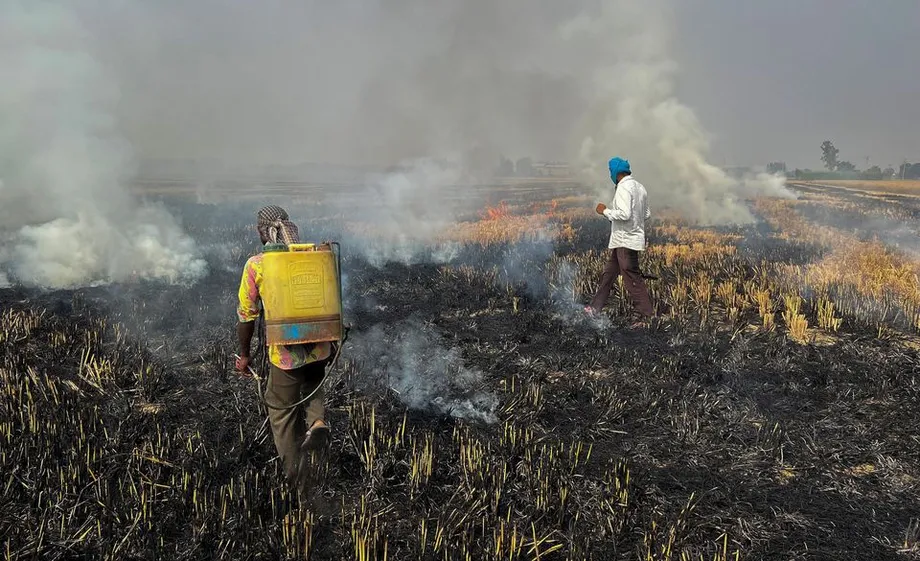
Farmers in India's Punjab and Haryana often need to clear rice fields quickly before planting wheat. Stubble is the stalk and other plant material left after harvesting. Burning removes that material rapidly, helping farmers prepare for the next crop without paying for extensive collection and transport.
A November 29, 2021 analysis by Prabhu Pingali, founding director of the Tata-Cornell Institute, economics researcher Payal Seth and associate director Bhaskar Mittra traced the practice to the region's rice and wheat cropping system. Varieties introduced during the Green Revolution made it possible to grow both crops on the same land within a year.
Rice cultivation placed heavy demands on groundwater in the western Indo-Gangetic Plain. As planting shifted toward the end of June to coincide with monsoon rainfall, farmers were left with a shorter interval between harvesting rice and sowing wheat. Clearing the residue became a race against the planting calendar.
Removing stalks takes labour and money. When farmers must pay to collect, bundle and transport material that has little immediate value to them, setting it alight remains an inexpensive option. The pollution problem is therefore tied to farm costs, water use and the timing of successive crops.
What regional pollution figures show
The 2021 analysis put crop residue burning at 15 percent of India's total air pollution. Its authors used that estimate to argue for changes in farming practices, including growing less rice in areas where the crop places pressure on water supplies.
Delhi's experience shows how farm smoke can combine with urban emissions. In the enforcement episode described by regional authorities, the Central Pollution Control Board recorded an air quality index of 320 on a Tuesday morning, within India's Very Poor category. India's environment ministry expected that category to persist in the coming days because of unfavourable weather conditions.
An air quality index, or AQI, turns pollution measurements into a number and category that people can follow more easily. On the Indian scale cited with the Delhi reading, 0 to 50 is considered good, while 300 to 400 is Very Poor. A reading of 320 signals a substantial pollution problem.
Delhi was also ranked second behind Lahore in a live city pollution ranking at the time. Both cities were dealing with a mixture of sources, including farm fires, traffic and other combustion. Their experience gives Nepal a concrete regional example of how smoke from agriculture can add to pollution generated in populated areas.
Arrests and emergency measures across the region
Police in Haryana's Kaithal area registered 22 complaints involving stubble burning and arrested at least 16 people. Deputy Superintendent of Police Birbhan, who uses one name, said those arrested had been released on bail. Across Haryana, nearly 100 farmers were under investigation and more than 300 had been fined.
In Pakistan's Punjab province, police registered 182 complaints and arrested 71 people in action covering stubble and rubbish burning, prohibited brick kilns and vehicles emitting smoke. Those figures cover several kinds of pollution offences, giving a broader picture of the enforcement campaign there.
Delhi's authorities ordered water to be sprinkled on roads to tackle dust, increased public bus and metro services, and raised parking charges to discourage car use. Pakistan's Punjab government also allocated resources for artificial rain and other measures. Senior provincial minister Marriyum Aurangzeb put the cost of each artificial rain operation at 5 million to 7 million Pakistani rupees.
Environmentalist Vimlendu Jha argued that Delhi's emergency response needed to be supported by sustained action against pollution sources. He said:
These are only emergency measures...This air pollution mitigation needs a long-term comprehensive solution rather than these ad hoc measures,
Nepal faces a related practical choice. Measures taken during a pollution episode can address immediate conditions, while regular control of waste burning and smoky vehicles can reduce emissions before the next episode develops.
Machines and microbes offer alternatives to fire
The Indian Agricultural Research Institute developed Pusa, a microbial treatment that speeds the breakdown of crop residue. The 2021 analysis described it as converting stubble into compost within 25 days, returning material to the soil rather than sending it into the air as smoke.
A different option, the Happy Seeder, is a machine attached to a tractor that sows wheat while handling the rice straw left in the field. It places straw over the newly sown land as mulch, a covering that remains on the soil surface. This allows farmers to plant without first burning the residue.
The farming calendar helps explain the limits of these options. A treatment requiring 25 days needs enough time between crops. Machinery brings operating costs, and farmers must be able to obtain and use it when fields need clearing.
Straw can also be used to make ethanol, a form of alcohol used as fuel. State governments have supported distilleries that use the material, but farmers still face the expense of collecting, baling and transporting it. Giving straw a use does not automatically make selling it cheaper or easier than burning it.
For Nepal, these details explain why appeals to stop fires need practical support on the Indian side. Farmers require an affordable way to manage residue within the time available, alongside rules against burning.
Changing crops addresses the pressure behind the fires
Pingali, Seth and Mittra proposed reducing rice cultivation in the western Indo-Gangetic Plain and expanding crops that use less water, including maize, groundnut and pulses such as moong, urad and arhar. Their argument linked cleaner air with lower pressure on groundwater and a more varied food supply.
Haryana's Mera Pani Meri Virasat scheme provided a financial example. As described in November 2021, it offered 7,000 Indian rupees per acre to qualifying farmers who diversified more than half of the land they used for rice during the kharif, or monsoon cropping, season. At that point, 98,000 farmers had registered.
Farm income is central to whether such a change lasts. Rice benefits from established purchasing arrangements, including government price support. A minimum support price is a price announced by the government to support farmers, although access to purchasing arrangements varies by crop and location.
The authors called for dependable buyers and competitive prices for alternative crops, including greater private investment in purchasing them. Farmers deciding what to plant need confidence that they can sell the harvest and protect their income.
Nepal's immediate response remains closer to home: reduce open waste burning, maintain vehicles and follow local air quality. Across the border, affordable residue management and viable alternatives to rice could reduce the smoke available for winds to carry. Addressing both sources gives communities a more complete response than treating incoming smoke or local emissions in isolation.
Key Points
- Meteorologist Binod Pokhrel warned that Indian crop smoke could reach Nepal if wind conditions allow, as pollution rises in the Tarai and Kathmandu.
- IQAir recorded Kathmandu's AQI at an unhealthy 182 on Friday morning in a report dated 8 Falgun 2082, with PM2.5 reported at 16.5 times the WHO safe guideline.
- He urged people and authorities to stop waste burning, maintain vehicles and monitor local air quality.
- A short gap between rice harvesting and wheat planting helps explain why farmers in northern India burn crop residue.
- Pusa microbial treatment and the Happy Seeder offer alternatives, but timing, machinery and transport costs affect their use.
- Haryana's crop diversification scheme offered qualifying farmers 7,000 Indian rupees per acre, with 98,000 registered by November 2021.
- Nepal can act on its own emissions while regional agricultural changes address a potential source of incoming smoke.