A February deadline meets a divided parliament
Prime Minister Sanae Takaichi wants a path toward Japan's first constitutional amendment to be in sight by February 21, 2027. Yet as the Constitution marked 80 years since its promulgation on November 3, 2026, her governing coalition remained divided over what to change and lacked even a majority in one of the two parliamentary chambers whose approval it needs.
Contents
- A February deadline meets a divided parliament
- Why a lower house landslide is not enough
- Emergency powers are the most developed proposal
- Existing emergency rules shape the debate
- Article 9 divides the governing partners
- Party talks have advanced further than parliamentary drafting
- Opposition lawmakers reject the party timetable
- What voters would decide
- The dates behind the pressure
- A deadline that may become a statement of direction
- Key Points
The Liberal Democratic Party (LDP) and Japan Innovation Party (JIP) control about three quarters of the House of Representatives following February's election. The LDP alone holds more than the two thirds needed in that chamber to initiate an amendment. In the House of Councillors, however, the coalition falls short of a simple majority, leaving it dependent on opposition support to reach the much higher constitutional threshold.
Takaichi, who also leads the LDP, set her target at the party convention on April 12. Addressing party members, she described the progress she wanted before their next annual gathering:
I want to hold the 2027 party convention in a situation in which we can say we have been able to prepare the way for the Diet to propose constitutional amendment.
The wording leaves room for disagreement about what would count as success. A parliamentary proposal ready for approval, a timetable for future negotiations and an agreement between coalition partners would represent different stages of progress. Some LDP members are already considering those less demanding measures as the deadline approaches.
The next convention was brought forward to February to avoid the unified local elections expected in April 2027. That has shortened the negotiating window for a project whose obstacles run through the governing parties themselves.
Why a lower house landslide is not enough
Japan's amendment procedure requires support from at least two thirds of all members of each Diet chamber, followed by approval in a national referendum. With the membership figures given for the two houses, that means at least 310 of 465 representatives and 166 of 248 councillors.
The lower house cannot override the upper house on a constitutional amendment. That differs from ordinary legislation, which can, under specified conditions, be passed again by a two thirds majority of representatives present after rejection by the councillors.
The coalition therefore needs opposition lawmakers to agree to actual amendment wording. General support for constitutional revision offers only a starting point: parties must settle which powers, rights or institutions they want to change.
The opposition Constitutional Democratic Party of Japan also holds the chair of the upper house Commission on the Constitution. Discussions in the two chambers have advanced at different speeds, while LDP lawmakers in the lower and upper houses are themselves not fully aligned. Takaichi faces negotiations across several groups rather than a single contest between government and opposition.
Emergency powers are the most developed proposal
The LDP wants an emergency clause to open the way to revision. In May, the lower house Legislative Bureau and secretariat presented a concept for amendment wording to the chamber's Commission on the Constitution. An outline was available for discussion during the parliamentary session that ended in July.
The proposal could allow lawmakers to remain in office beyond their normal terms when a major emergency makes elections difficult. It also includes a mechanism for the Cabinet to issue emergency decrees carrying the force of law when parliament cannot legislate quickly enough.
The situations discussed include major natural disasters, infectious disease outbreaks, internal unrest and foreign armed attacks. Under the outline described, the Cabinet would obtain prior parliamentary approval before designating a situation in which elections were difficult over a wide area for a prolonged period.
For voters, the practical issue is who exercises authority when normal democratic routines are disrupted. Extending parliamentary terms would preserve a legislature during an emergency, while postponing the public's next opportunity to replace its members. Giving Cabinet decrees legal force would shift some immediate lawmaking authority to ministers.
Existing emergency rules shape the debate
Article 54, paragraph 2, already allows the Cabinet to request an emergency session of the House of Councillors when the House of Representatives has been dissolved. The Disaster Countermeasures Basic Act also contains provisions for situations in which waiting for such a session is impossible.
Those existing arrangements are part of the argument over whether constitutional change is needed. The central policy choice is how to keep government functioning during a crisis while preserving parliamentary supervision and regular elections.
The Constitution is Japan's highest law, and Article 98 gives it priority over conflicting laws and orders. Adding emergency powers at that level would alter the basic rules governing the state, rather than simply revise a disaster response procedure.
The coalition agreement aims to submit draft emergency provisions to the Diet during fiscal 2026, which ends in March 2027. A concept outline has been discussed, but parliamentary drafting machinery and agreement on final language remain unfinished.
Article 9 divides the governing partners
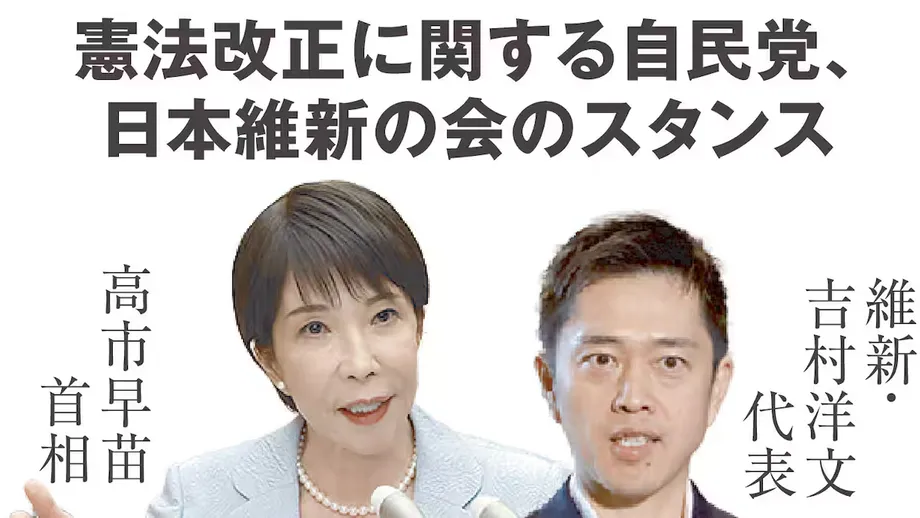
The JIP wants Article 9 revised alongside the emergency clause. The LDP favors beginning with emergency provisions, creating a disagreement about both the order of business and the substance of reform.
Article 9 renounces war. Its second paragraph says Japan will not maintain land, sea or air forces or other war potential, and does not recognize the state's right of belligerency. Japan nevertheless maintains the Self-Defense Forces under the constitutional interpretations developed by successive governments.
The LDP proposes retaining Article 9's existing wording and adding Article 9-2 to mention the Self-Defense Forces explicitly. The JIP wants to remove the second paragraph and replace it with language establishing a national defense force.
The difference concerns the constitutional rules surrounding military power. The LDP approach would preserve the present text while adding recognition of the forces that already exist. The JIP approach would replace a central restriction with a new constitutional basis for national defense forces.
Takaichi previously supported the LDP's 2012 draft, which envisaged removing the second paragraph and explicitly naming a national defense force. Her government's immediate approach gives greater priority to emergency provisions and ending merged upper house electoral districts. Coalition working talks are trying to bring the parties closer on Article 9, but no settled common wording has been announced.
Party talks have advanced further than parliamentary drafting
The governing parties have established a constitutional amendment drafting council. That provides a forum for coalition negotiations, but the parliamentary committees intended to turn agreement into amendment articles have not been established.
The coalition agreement calls for drafting arrangements involving both Diet chambers as soon as possible. The JIP has pressed for action, while opposition resistance and disagreements within the governing bloc have slowed the process.
A different piece of preparation moved forward on October 29. The lower house Commission on the Constitution received an initial outline of rules for bodies including the public information council that would explain amendment proposals during a referendum.
The referendum law already provides for that council, but detailed rules for its meetings had lagged. The planned body would bring together 10 lawmakers from each chamber to communicate the proposal and arguments for and against it through channels including newspapers and broadcasting.
Japan therefore has several tracks moving at once: coalition negotiations over policy, parliamentary consideration of possible wording and administrative preparation for a future public vote. The hardest agreement still concerns what voters would actually be asked to approve.
Opposition lawmakers reject the party timetable
Toru Kunishige, a Komeito official serving on the lower house Commission on the Constitution, has rejected the idea that parliamentary talks should follow the prime minister's schedule. Explaining his position, he said:
There is no need to hold talks based on the timing indicated by Prime Minister Takaichi.
Komeito left the governing coalition in October 2025, when the JIP became the LDP's new partner. That replaced a party cautious about the LDP's amendment plans with one pressing for faster and more extensive revision. The change made the coalition more enthusiastic about reform without resolving the need for opposition votes in the upper house.
Yuichiro Tamaki, leader of the Democratic Party for the People, supports constitutional amendment in principle but offered a bleak assessment of the present prospects:
It's almost impossible under the current circumstances.
The dispute also reaches the purpose of constitutional change. At the upper house Budget Committee on October 16, Takaichi argued:
An ideal country is defined by the Constitution.
Kiyomi Tsujimoto, a Constitutional Democratic Party lawmaker, challenged that position:
Ideals differ from person to person.
The exchange captures the political task ahead: assembling agreement on rules that would govern people with different views, including those who oppose the current administration.
What voters would decide
Japanese citizens aged 18 or older would have the final decision in a referendum held between 60 and 180 days after the Diet formally initiates an amendment. Approval requires more than half of valid votes cast.
The parliamentary process begins earlier. A draft submitted by lawmakers needs at least 100 sponsors in the House of Representatives or 50 in the House of Councillors. The constitutional commissions, comprising 50 members in the lower house and 45 in the upper house, examine proposals before decisions in plenary sessions.
Amendment proposals must be separated by related subject matter. Voters would receive a ballot for each proposal, allowing them, for example, to approve a change to Article 9 while rejecting an emergency clause.
Campaigning rules allow activities such as visits to homes that are restricted in ordinary election campaigns. Television and radio advertising calling for support or opposition is prohibited during the final 14 days before voting. Responses to online advertising and false information on social media remain under parliamentary consideration.
A postal opinion survey conducted before Constitution Day on May 3 found 69% of respondents considered amendment necessary, including those who leaned toward that view. The most common reason was that the text or its contents no longer matched the times. The question concerned amendment in general; voters would eventually face decisions on specific wording and powers.
The dates behind the pressure
Japan's Constitution was promulgated on November 3, 1946, and took effect on May 3, 1947. It has never been amended. The distinction between those dates means the country marks 80 years since publication in 2026 and 80 years since implementation in 2027.
The current campaign follows several earlier attempts to turn constitutional revision into a practical parliamentary project:
- 2007: Japan enacted the national referendum law governing constitutional amendment procedures.
- 2017: Prime Minister Shinzo Abe announced his ambition for a new Constitution to take effect in 2020. He developed proposals covering four amendment areas but left office in 2020 without achieving revision.
- October 2025: Takaichi's administration began, Komeito left the coalition and the JIP joined it.
- February 2026: The governing parties won about three quarters of lower house seats.
- April 12, 2026: Takaichi set her goal for progress by the next LDP convention.
- May 2026: Lower house officials presented the emergency clause concept.
- October 29, 2026: A first outline of referendum public information rules was presented.
- February 21, 2027: The next LDP convention is scheduled.
- March 2027: Fiscal 2026 ends, closing the coalition's target period for submitting emergency provisions.
- 2028: The next upper house election could reshape the parliamentary balance.
The budget adds immediate pressure. Debate on the government's fiscal 2027 spending plan is expected to occupy parliament until March, leaving the current extraordinary session as the main opportunity to demonstrate substantial progress before the party convention.
A deadline that may become a statement of direction
Some LDP members now suggest that publishing an amendment schedule, or reaching agreement with the JIP on the direction of Article 9 revision, could satisfy Takaichi's promise to prepare the way. Others consider a formal parliamentary proposal after the 2028 upper house election more realistic.
No date has been set for a Diet vote or national referendum. The immediate milestones are an agreement within the coalition, decisions about parliamentary drafting committees and enough opposition cooperation to move beyond the lower house.
Takaichi's electoral strength has given constitutional revision a powerful base in one chamber. Reaching voters with an amendment now depends on resolving differences within that base and building support in the chamber where her coalition remains a minority.
Key Points
- Takaichi wants a path toward a constitutional amendment proposal in sight by the LDP convention on February 21, 2027.
- The coalition controls about three quarters of lower house seats but lacks an upper house majority.
- Amendment requires two thirds of all members in each chamber, followed by approval in a national referendum.
- The LDP prioritizes emergency provisions; the JIP wants Article 9 revised at the same time.
- The parties disagree over retaining Article 9's second paragraph or replacing it with provisions for a national defense force.
- Emergency proposals include extending parliamentary terms and permitting Cabinet decrees with legal force.
- Coalition drafting talks are underway, but parliamentary drafting committees and a voting timetable remain unsettled.
- Some LDP members see the 2028 upper house election as a more realistic turning point.