A former Samsung factory site becomes an AI computing hub
Samsung SDS has begun building a 427.3 billion won artificial intelligence data center in Gumi, South Korea, giving Samsung's 60 trillion won investment plan for the southeastern Yeongnam region its first visible construction milestone. The facility will start with 60 megawatts of power capacity and is designed to expand to 120 megawatts as demand grows.
Contents
- A former Samsung factory site becomes an AI computing hub
- How the project reached construction
- Where the 60 trillion won will go
- Why robots need a data center
- Cooling equipment built for demanding GPUs
- Two ways customers can use Gumi
- A much larger infrastructure expansion
- What Gumi and local suppliers could gain
- OpenAI cooperation follows a separate track
- Key Points
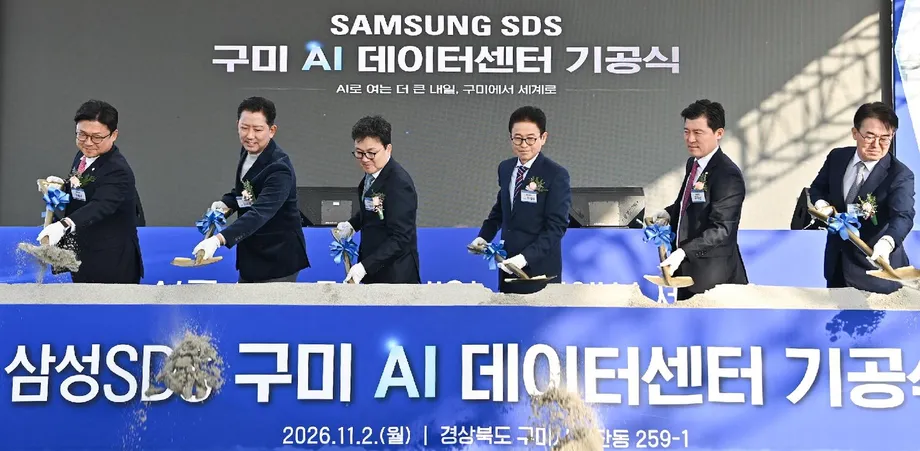
The groundbreaking ceremony took place on November 2, 2026, at the former Samsung Electronics Gumi Plant 1 site in Gongdan-dong, within the city's National Industrial Complex No. 1. Samsung SDS targets completion by December 2028, while North Gyeongsang Province and Gumi City put the planned start of operations in March 2029.
The site covers approximately 46,280 square meters. Its new role connects Gumi's established electronics manufacturing base with Samsung's ambitions in humanoid robots, automated factories and the computing systems needed to train industrial AI.
Samsung SDS intends to serve two groups of users: Samsung affiliates developing manufacturing and robotics applications, and outside companies seeking AI computing services or space for their own equipment. The project therefore combines an internal industrial purpose with a commercial expansion of the company's data center business.
How the project reached construction
Samsung SDS approved the investment in January 2026 and signed a memorandum of understanding with North Gyeongsang Province and Gumi City at CES 2026 in Las Vegas. Provincial and municipal authorities subsequently worked with relevant agencies on permits and arrangements for electricity supply.
Gumi City approved construction in late August, and work was already underway before the November ceremony. About 150 people attended the event, including Samsung SDS Chief Executive Lee June-hee, North Gyeongsang Governor Lee Cheol-woo and Gumi Mayor Kim Jang-ho.
The main milestones show how the investment moved from an agreement toward an operating facility:
- January 2026: Samsung SDS approved 427.3 billion won for the project and signed the agreement with provincial and city authorities.
- July 2026: Samsung announced its broader 60 trillion won Yeongnam investment plan at a public briefing in Jinju.
- Late August 2026: Gumi City granted construction approval.
- November 2, 2026: Officials and company executives held the groundbreaking ceremony.
- December 2028: Construction is scheduled for completion.
- March 2029: Local authorities target the start of operations.
Where the 60 trillion won will go
Samsung's regional plan spreads investment across four cities, with Gumi receiving the largest allocation. The plan was presented in July at Gyeongsang National University in Jinju, South Gyeongsang Province, as part of a vision for advanced industries in Yeongnam.
- Gumi: 19 trillion won for humanoid robot manufacturing, a robot data factory and AI data center infrastructure.
- Ulsan: 16 trillion won, including investment in batteries using solid electrolytes.
- Busan: 15 trillion won for advanced components, including semiconductor packaging substrates and multilayer ceramic capacitors for AI servers.
- Geoje: 10 trillion won for advanced shipbuilding, including vessels with greater technological content and shipyard automation.
Gumi's 19 trillion won allocation represents about 31.7 percent of the 60 trillion won total. The 427.3 billion won data center investment is about 2.2 percent of Gumi's allocation, showing how much of the city's wider program still lies in robotics and other planned facilities.
The different investments address different parts of an industrial supply chain. Packaging substrates connect chips to electronic systems, while multilayer ceramic capacitors help manage electrical power in circuits. AI servers need both computing chips and supporting components to operate reliably.
Samsung's regional program also sits alongside a government plan for 2 gigawatts of AI data center infrastructure in Yeongnam and a robotics development belt linking Gumi, Pohang, Daegu and Changwon. Two gigawatts equals 2,000 megawatts, providing a sense of the scale of the wider regional ambition.
Why robots need a data center
Gumi's planned facilities bring together physical AI, robot manufacturing and computing. Physical AI means AI used in machines that act in the real world, such as robots that handle parts or perform precise tasks on a production line.
A robot learning a delicate manufacturing task needs large amounts of data and repeated calculations. Graphics processing units, or GPUs, can perform many calculations at once, making them useful for training AI systems. Samsung SDS plans to provide that computing capacity for Samsung affiliates pursuing manufacturing automation.
Samsung also intends to establish a robot data factory in Gumi. The purpose is to connect the data needed for robot learning with the computing infrastructure that processes it, alongside a system for manufacturing humanoid robots at scale.
Samsung Electronics plans to develop its Gumi operations into a center for manufacturing innovation, building on the city's existing smartphone production base. For Gumi, the proposed change is concrete: an industrial district associated with electronics assembly would also house infrastructure supporting robot development and AI training.
Lee June-hee, the Samsung SDS chief executive, described the industrial purpose of the investment:
AI is transforming how companies operate and reshaping industrial competitiveness.
Lee said reliable computing infrastructure was necessary to turn that change into results:
Turning these changes into tangible results requires a solid foundation capable of processing vast amounts of data and ensuring the stable operation of AI systems.
Cooling equipment built for demanding GPUs
Samsung SDS is designing the Gumi facility around the electricity and heat demands of AI servers. Megawatts describe its electrical capacity; the amount of AI work it can perform will also depend on the equipment installed and how customers use it.
The initial 60 megawatts can eventually double to 120 megawatts. Inside the server rooms, racks will be able to accommodate equipment with different power requirements, including future GPU systems that draw much more electricity in a small space.
Cooling will combine air and circulating water. Networking and storage equipment, which generally produce less concentrated heat, will use air cooling. Areas containing densely packed GPU servers will use water cooling to carry heat away.
This division lets Samsung SDS match the cooling method to the equipment. GPUs grouped closely together can produce more heat than conventional air cooling can readily handle, so the facility is being prepared for both current systems and more demanding generations of hardware.
The design also includes duplicate critical equipment and emergency power supplies. Backup systems provide an alternative when a main component fails, helping support the long periods of uninterrupted computing that AI workloads can require. Samsung SDS says the project draws on 30 years of experience building and operating data centers.
Two ways customers can use Gumi
Samsung SDS plans to install and operate its own GPUs, selling access to computing resources. A customer using this service can obtain AI processing capacity without buying and managing every piece of hardware itself.
The company will also offer colocation. Under that arrangement, a customer brings its own GPU equipment into the data center and uses the building's electricity, cooling and supporting facilities.
Samsung SDS intends the center to accommodate different AI systems rather than a single GPU type or service. That flexibility supports its plan to attract outside businesses while meeting demand from Samsung affiliates.
The company has not disclosed how Gumi's capacity will be divided between affiliates and outside customers, or when expansion beyond the initial 60 megawatts would begin. Local employment totals and the investment size and timetable for the separate Pohang project have also not been announced.
A much larger infrastructure expansion
Gumi is one part of Samsung SDS's plan to increase its AI infrastructure from 110 megawatts to 230 megawatts in 2029, through projects including Dongtan, the proposed National AI Computing Center in Haenam and Gumi. The increase would add 120 megawatts, slightly more than doubling the starting figure.
By 2031, Samsung SDS aims to expand its AI infrastructure business to more than 800 megawatts through a combination of direct investment, equity stakes and contracts to design, build and operate data centers. That business target covers several forms of participation, including operating facilities for other owners.
The company wants to secure a cumulative 500 megawatts of design, construction and operation work by 2031. At its October 29 earnings conference call, Samsung SDS said reaching that scale could generate more than 1 trillion won in annual revenue from that business.
Samsung SDS also disclosed that it had been selected as preferred bidder for a separate data center project exceeding 200 megawatts being developed by Pacific Asset Management. Preferred bidder status places it in line to negotiate the work.
Demand is already supporting the company's cloud business. Third quarter cloud revenue rose 18 percent from a year earlier to 796.1 billion won, helped by demand for services that provide access to GPUs. Gumi would add capacity to serve that market alongside the group's manufacturing needs.
What Gumi and local suppliers could gain
North Gyeongsang Province and Gumi City plan to widen opportunities for local construction firms and suppliers of materials and equipment during the build. Once operating, the facility is expected to require staff in information technology operations, facility management, security and cleaning.
Local authorities also plan to work with universities to train AI and cloud specialists. Their investment recruitment efforts will target related businesses, including AI semiconductors, power equipment, cooling systems and cloud services.
Gumi Mayor Kim Jang-ho described the data center as a catalyst for Samsung's larger investment plan in the city and the designation of a robotics specialty complex. The local strategy is to use the computing facility to attract additional industrial activity around it.
Governor Lee Cheol-woo set out that ambition at the ceremony:
This is the starting point for North Gyeongsang to redraw the industrial map of the AI era.
The scale of the economic benefit will depend on subsequent robot investment and how much work local businesses win. Construction spending, permanent operating jobs and new manufacturing activity are different sources of benefit, each developing at its own pace.
OpenAI cooperation follows a separate track
Samsung SDS is also pursuing cooperation with OpenAI on data center development and operation, following a letter of intent signed in October 2025. Pohang has been identified for that initiative, while Gumi is advancing as a separate project with a defined construction budget and schedule.
The wider Korean discussions also include SK and OpenAI's proposed facility in the southwest. On November 1, Gwangju's emergence as a candidate highlighted continuing location talks for that project, alongside consideration of Haenam. Those discussions concern a different development from Samsung SDS's Gumi facility.
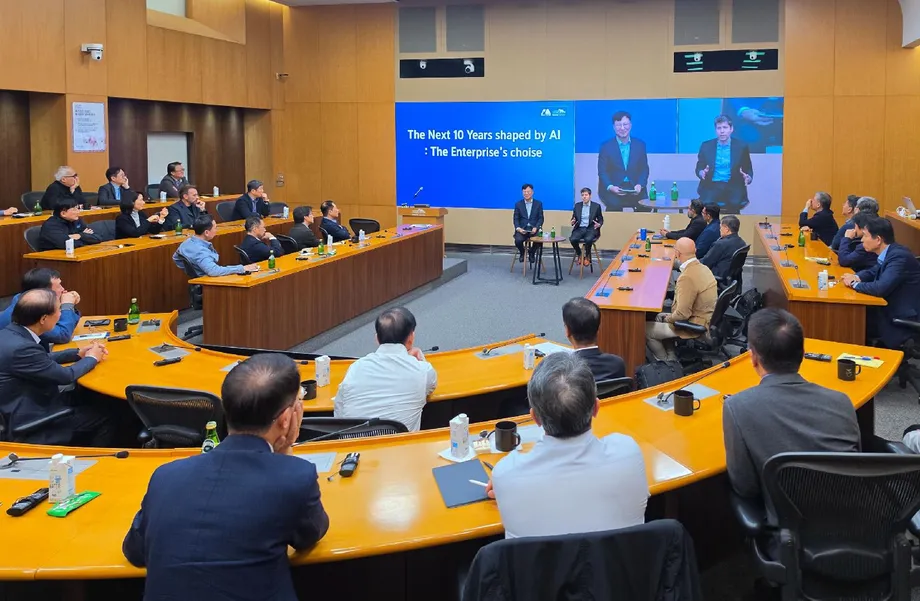
OpenAI Chief Executive Sam Altman met about 50 Samsung affiliate presidents at Samsung's human resources development institute in Yongin on October 31. They discussed the direction of AI technology and business strategy. The meeting added to the companies' continuing engagement as Samsung expands its computing infrastructure.
Gumi now has a clearer sequence: construction underway, completion targeted for December 2028 and operations planned for March 2029. The next steps are to build and equip the center, secure customers and connect its computing resources with the manufacturing and robotics investments planned around it.
Key Points
- Samsung SDS is investing 427.3 billion won in an AI data center at the former Samsung Electronics Gumi Plant 1 site.
- The facility will begin with 60 megawatts of capacity and is designed to expand to 120 megawatts.
- Construction is targeted for completion in December 2028, with operations planned for March 2029.
- Gumi receives 19 trillion won of Samsung's 60 trillion won Yeongnam investment plan.
- The center will support manufacturing and robot AI training while serving outside customers through GPU services and colocation.
- Samsung SDS aims to expand its wider AI infrastructure business to more than 800 megawatts by 2031.
- Local authorities plan supplier participation and university training programs; Samsung's OpenAI cooperation in Pohang follows a separate development track.