A smaller 3D screen built for the desk
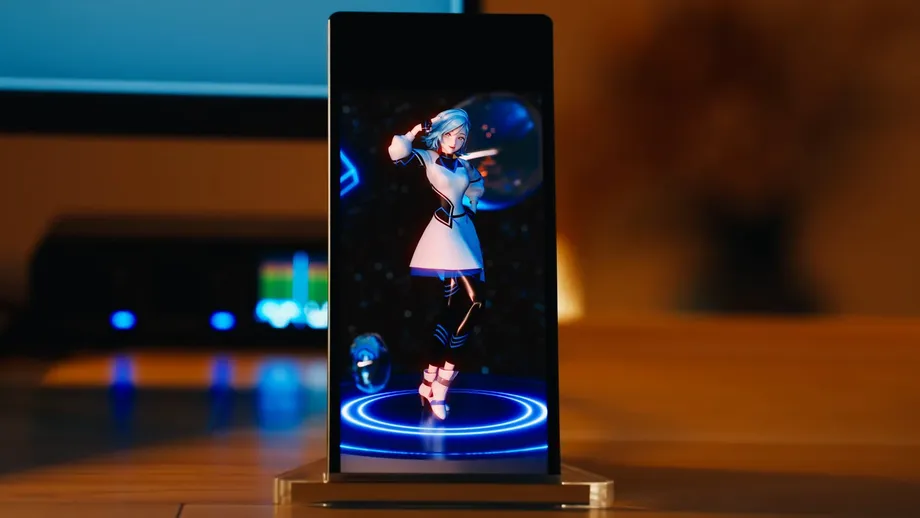
Sony will release its 6-inch ELF-MN1 Spatial Reality Display in Japan on December 11, 2026, with a Sony Store price of ¥53,900 including tax. The device connects to a compatible smartphone or Windows PC and shows characters, avatars and other digital objects in three dimensions without special glasses or a headset.
Contents
- A smaller 3D screen built for the desk
- How the image gains depth without glasses
- What buyers need to connect
- Four apps give the screen different roles
- HoloModels turns digital figures into desk displays
- The stand is part of the viewing experience
- Creators get tools for more than avatars
- A smaller direction after two larger models
- Launch dates and store demonstrations
- Key Points
Sony's October 28 announcement puts the estimated market price at about ¥54,000 including tax, with individual retailers setting their own prices. The more consequential details for buyers sit in the connection requirements: the USB-C cable must support DisplayPort Alternate Mode, while an AC adapter and charging cable are sold separately.
The ELF-MN1 brings technology previously aimed mainly at professional work into a smaller, more personal setting. Its intended uses include displaying officially licensed anime figures, keeping an AI companion visible beside a computer and viewing objects created with Sony's XYN spatial capture tools.
An added infrared sensor helps track the viewer's pupils in dim surroundings. Sony says the screen generates images to match the person's viewing position in real time, creating the impression that a digital object has depth inside the display.
For customers, the central change is practical: a character normally viewed through a phone can occupy a dedicated place on a desk. Delivering that experience requires more than the screen itself. A compatible device, the right connection and an application designed to work with the display are all part of the setup.
How the image gains depth without glasses
The ELF-MN1 uses a two-view system to create a stereoscopic image. In simple terms, each eye receives a slightly different view, giving the brain visual information it can interpret as depth. Tracking the viewer's eyes allows the display to adjust those views as the person moves.
Sony has added an infrared sensor to its existing eye recognition system to improve pupil detection in darker environments. Accurate tracking matters because the image must continue to match the position of the eyes as someone looks around a character or object.
The screen has a pixel density of 403 pixels per inch, which Sony says is the highest in its Spatial Reality Display range as of October 28, 2026. Pixel density describes how closely the picture's tiny dots are packed together. Higher density helps preserve fine details on a small screen.
Sony also uses technology to reduce blur and crosstalk, the ghosting that occurs when an image intended for one eye becomes visible to the other. Technical descriptions put the 3D image resolution at 1,080 × 2,160 pixels. The viewing system is described as serving one person, with a viewing distance of 30 to 80 centimetres and movement up to 25 degrees away from the centre.
A demonstration account described the image following sideways movements of the viewer's face without noticeable delay. That observation offers an early indication of the experience, while Sony's central technical promise is that eye tracking and image generation keep the perspective aligned as the viewer moves.
What buyers need to connect
The ELF-MN1 supports compatible Windows PCs and smartphones running iOS or Android. Sony says users can connect a supported device directly, open a compatible app and begin viewing without complicated initial setup.
DisplayPort Alternate Mode is the key connection requirement. It allows a USB-C connection to carry a display signal as well as other data. Buyers need to check the video output capability of their phone or computer, rather than relying on the presence of a USB-C socket alone.
Sony's ELF-MN1 product page lists a USB-C to USB-C cable measuring one metre among the included accessories, together with the stand, frame, documentation and warranty. The separately sold AC adapter and charging cable are additional considerations when planning where to put the display.
The screen can supply power to a connected smartphone during use. Sony cautions that the phone's battery may still lose charge depending on the device and the application running. Someone planning to leave a character on display for long periods will therefore need to consider both compatibility and power use.
Four apps give the screen different roles
Four applications were identified as compatible at the announcement: HoloModels, Deskrium, Animates and Fenestra: my focus, her future. Together, they give the hardware a broader role than simply showing a rotating digital model.
Gugenka's HoloModels supplies digital figures, particularly officially licensed anime characters. Deskrium is a viewer supporting VRM, a format used for humanoid 3D avatars. For people who already have a compatible avatar, a viewer provides a way to bring that digital character onto the desk.
Animation Inc.'s Animates is an AI companion application, placing a character based experience on the display. STAYRESIDENT's Fenestra: my focus, her future is a nurturing adventure associated with focused work and planned for distribution through Steam.
The range of applications matters because the display's usefulness depends on what can run on it. A figure collector, an avatar creator and someone interested in a companion game would use the same hardware for different activities. Sony's support for original applications also gives developers a route to add experiences beyond the initial selection.
HoloModels turns digital figures into desk displays
Gugenka confirmed the integration in its own HoloModels compatibility announcement. The company, led by chief executive Masafumi Mikami, said characters from its digital figure service would become viewable as stereoscopic images without glasses or a headset.
The service already allows users to handle and photograph digital figures through a smartphone. The ELF-MN1 adds a dedicated viewing surface, allowing a scene to remain visible on a desk without someone continuously holding up a phone.
At the product demonstration, Mikami described functions for placing several characters together, arranging scenes into playlists and adjusting how light falls on the figures to suit the room's ambient lighting. Those controls make the experience closer to arranging a small display than opening a single character file.
Mikami, Gugenka's representative director and CEO, explained the company's ambition in comments published by Sony. Translated from Japanese, he said:
By combining it with Sony's technology, I feel that the everyday life we aim for, with a favorite character nearby, will become more natural and accessible.
For fans, the change is a new place to display characters they follow. For Gugenka, compatibility connects an existing catalogue of digital goods to a new piece of hardware, giving the screen a library of recognizable content rather than requiring every experience to be created from scratch.
The stand is part of the viewing experience
Sony uses an acrylic stand to make the boundary between the screen and the desk less visually prominent. The intention is to help the digital scene appear connected to its surroundings, rather than enclosed in an obvious monitor housing.
Yo Ishimatsu, from Sony's product management department, explained at the demonstration that the stand was designed to make the physical space and the content's space appear to connect naturally. The compact format is intended for desks, sideboards and other places with limited room.
The device also includes stereo speakers rated at one watt and a microphone. Published specifications list power consumption of 14 watts and standby consumption of 0.5 watts or less. Those details matter for a product meant to remain nearby during work or leisure, rather than be brought out only for occasional demonstrations.
The design and software serve the same purpose: making spatial content something a person can keep in their everyday surroundings. The acrylic support reduces the visible separation from the desk, while scene playlists and lighting adjustments give users ways to control what stays on display.
Creators get tools for more than avatars
Sony is releasing the ELF-MN1 within XYN, its collection of hardware and software for creating spatial content. That includes objects generated through spatial capture, which turns information about physical objects or spaces into digital representations.
The company's XYN launch notice says a developer information site has opened, with software development kits and tutorials to be provided progressively. Sony's product page identifies a Unity SDK for making original applications. An SDK is a set of tools that helps developers build software for particular hardware.
Tokimitsu Ishibashi, the design project leader, described a Unity plugin and a viewer application at the demonstration. Makoto Fujise, head of business planning in Sony's XR business division, also outlined XYN's goal of making 3D computer graphics production more intuitive and efficient for a wider range of creators.
Sony names VoxelKei, Orange, YORIMIYA and Teruaki Tsubokura among the creators working on content for the display. VoxelKei demonstrated Inverse Spherium, which uses 3D Gaussian Splatting, a technique that represents a scene through many small, soft visual elements to recreate its appearance from different viewpoints.
The demonstration folded a captured space into a glass sphere like presentation. VoxelKei also showed a shooting game that used depth and changing viewpoints during a boss battle. The examples extend the display's role from presenting characters to showing captured environments and interactive scenes.
A smaller direction after two larger models
Sony's earlier Spatial Reality Displays included the 15.6-inch ELF-SR1, introduced in 2020, and the 27-inch ELF-SR2, introduced in 2023. Those products were aimed mainly at professional uses such as checking 3D models and giving presentations.
The ELF-MN1 reverses that movement toward a larger screen. Its 6-inch diagonal is about 38% of the ELF-SR1's 15.6-inch diagonal and about 22% of the ELF-SR2's 27 inches. The comparison describes screen diagonals, while the practical change is a device intended to sit beside someone's everyday work.
Smartphone support also changes the intended audience. Together with applications for figures, companions and games, it makes the new model a personal viewing device as well as a potential outlet for creators using Sony's production tools.
VoxelKei, a spatial content creator, described the difficulty of delivering work made in three dimensions to an audience in that same form. In comments published by Sony and translated from Japanese, the creator said:
Digital spatial representations using techniques such as 3D Gaussian Splatting are very appealing, but a source of frustration has been that there are very few ways to deliver three-dimensional objects to people as three-dimensional objects.
The ELF-MN1 gives creators a smaller physical destination for that work. Its initial applications and Unity tools connect two sides of the product: people who want something to display and people who want to make content for it.
Launch dates and store demonstrations
Sony plans advance demonstrations at Sony Store Ginza in Tokyo and Sony Store Nagoya. Visitors are expected to see works by spatial content creators and digital figures from HoloModels.
November 20, 2026, has been cited as the store demonstration date, while Sony's launch notices say the exhibitions will begin progressively and that current schedules will be announced through the product page. The main dates are:
- 2020: Sony introduced the 15.6-inch ELF-SR1.
- 2023: Sony introduced the larger 27-inch ELF-SR2.
- October 28, 2026: Sony announced the 6-inch ELF-MN1.
- November 20, 2026: The cited advance demonstration date, with store schedules to be checked against Sony's product information.
- December 11, 2026: Scheduled Japanese release of the ELF-MN1.
The demonstrations give prospective buyers a chance to judge the depth effect and compact screen size before purchasing. The other immediate checks are more practical: whether their device can output video through USB-C, whether their chosen application supports the display and what additional power accessories they need.
Key Points
- Sony plans to release the 6-inch ELF-MN1 in Japan on December 11, 2026.
- The Sony Store price is ¥53,900 including tax; Sony estimates a market price of about ¥54,000.
- Eye tracking and an added infrared sensor support 3D viewing without glasses or a headset.
- Compatible Windows PCs and iOS or Android phones require a supported USB-C video connection.
- A connection cable is included, while the AC adapter and charging cable are sold separately.
- Initial applications include HoloModels, Deskrium, Animates and Fenestra: my focus, her future.
- Unity development tools and XYN capture content extend its uses beyond digital figures.
- Advance demonstrations are planned at Sony Store Ginza and Nagoya.