AI tools move from answering questions to carrying out work
Japan began introducing AI agents for approximately 180,000 government employees on October 20, 2026, expanding a national trial from tools that answer questions to software that can carry out several tasks from a single instruction. The Digital Agency plans to add a more advanced development environment around December, then release both tools as open source software around February 2027.
Contents
- AI tools move from answering questions to carrying out work
- What Agent Chat and Gennai Workshop can do
- How the rollout reached this point
- How large is the expansion?
- Earlier projects show where time could be saved
- Safety rules assign responsibility to three groups
- What happens to government data?
- The software release reaches beyond central government
- Domestic models and staff adoption are being tested too
- Key Points
Digital Minister Toshiharu Furukawa announced the rollout at a press conference on October 20. The first tool, Agent Chat, is being introduced gradually across ministries and agencies through the government AI platform Gennai. The second, Gennai Workshop, called GENAI Workbench in the agency's English announcement, will let staff build and run more advanced agents.
The intended users include general administrative employees as well as technical specialists. Researching overseas policies and supporting reviews of permit applications are among the tasks envisaged. Officials will be able to give instructions in ordinary language rather than write every step as computer code.
The Digital Agency describes the deployment as the first of its kind worldwide, based on its own research. Its claim concerns the combination of advanced agent capabilities, a common government platform, everyday access for general staff and a planned scale of approximately 180,000 users.
The expansion comes within a broader Gennai pilot running from May 2026 to March 2027. Full use is planned for fiscal 2027, drawing on the pilot's results. The October announcement sets the target population for the agent rollout; it gives no completed deployment count. Alongside the new tools, the agency has published rules assigning responsibilities to users, administrators and developers.
What Agent Chat and Gennai Workshop can do
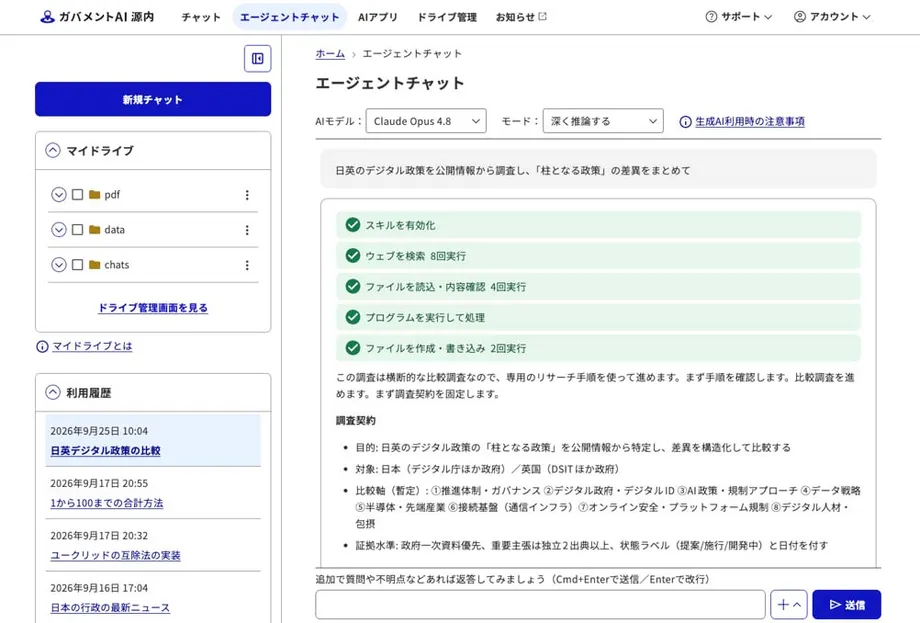
Agent Chat extends the familiar chatbot format. An employee gives an instruction, and the agent can perform multiple steps, search the web, generate materials, execute code and return results as files or documents. Staff can also create and run reusable skills, meaning sets of instructions for recurring tasks.
An ordinary chatbot usually responds within a conversation. An agent can continue beyond that response by using tools to work toward a requested result. In Gennai, that means moving between activities such as retrieving information, processing material and producing an output.
Gennai Workshop is designed for more demanding work. Its planned capabilities include direct access to websites, research across multiple sites, file operations, command execution and prototype development. The August technical preview described a coding AI environment running on a dedicated personal server, with skills that users could customize.
The agency compares Agent Chat's capabilities with Claude Cowork and Workshop's capabilities with Claude Code. In its agent rollout announcement, it describes advanced coding agents as systems that can generate and change code, operate on files, execute commands and run tests from instructions in natural language.
How the rollout reached this point
Prime Minister Sanae Takaichi instructed the government on December 19, 2025, to make Gennai available to more than 100,000 employees by May 2026. Four days later, the Cabinet approved Japan's Basic Plan on Artificial Intelligence, which calls for the government to lead through its own use of AI.
The Digital Agency's March pilot announcement set out a trial covering approximately 180,000 employees, including staff beyond central ministry offices. The main steps are:
- May 2025: Gennai began an internal trial at the Digital Agency.
- December 2025: Takaichi issued her instruction, and the Cabinet approved the Basic Plan on Artificial Intelligence.
- May 2026: The government began the wider Gennai pilot across ministries and agencies.
- August 25, 2026: The agency held a national online briefing on its planned software release.
- October 20, 2026: Agent Chat began its gradual rollout.
- Around December 2026: Gennai Workshop is targeted for introduction.
- Around February 2027: Both agent environments are planned for release in Gennai OSS Version 2.0.
- March 2027: The wider pilot is scheduled to end, ahead of full use planned for fiscal 2027.
How large is the expansion?
The current target of approximately 180,000 employees spans 39 government bodies. An earlier Digital Agency presentation from February 2026 planned a trial for approximately 130,000 officials; the March pilot announcement and October agent announcement put the target at approximately 180,000.
The February presentation also envisaged routine use by up to approximately 280,000 government employees from fiscal 2027. That longer term ambition would extend beyond the present pilot population and depend on participating ministries arranging their budgets.
Access has expanded in stages. Approximately 100,000 employees could use Gennai by May 29, 2026. The practical task now is to extend agent access across the planned population while helping employees incorporate the tools into their work.
The government links the programme to Japan's declining population and ageing workforce. Its stated aim is to maintain public services by reducing administrative burdens and improving work quality. The fiscal 2025 supplementary budget allocated 4.40 billion yen to the wider Government AI development programme, which includes infrastructure, training, applications and datasets.
Earlier projects show where time could be saved
The Digital Agency's February programme presentation gives concrete examples of AI assistance before the new agent rollout. One involved 8,095 responses to a Ministry of Agriculture, Forestry and Fisheries survey on future rice production intentions, conducted between June and August 2025.
The ministry developed more than 20 hypotheses about the responses, and the Digital Agency used AI to help test them. For analysis involving approximately 8,000 responses and 30 survey items, the agency estimated that work normally requiring about two months from one employee could be completed in about three days.
A police project addressed suspected recruitment posts for illegal work on X. The agency developed a prototype to select posts for closer inspection, reducing the number that police staff needed to check visually to approximately one third of the original volume, a reduction of about two thirds.
The agency has also helped ministries classify large numbers of public comments and plans to make a public comment support AI available through Gennai. These examples explain the focus on tasks with many documents or repeated steps: employees need help organizing material before they can assess it and act.
Safety rules assign responsibility to three groups
The new Government AI Gennai: Standards on Governance, Security, and Safety divide responsibilities among users, administrators and developers. The Digital Agency developed them with cooperation from Japan's AI Safety Institute, known as AISI, which works on methods and standards for evaluating AI safety.
The agency explains in its Gennai standards announcement that agents have more complex functions and a wider range of possible actions than conventional AI applications. Its English announcement states:
Clear rules are therefore essential to enable government employees to use these tools proactively while ensuring security and governance.
The usage rules call on staff to avoid excessive reliance on AI, check its work at appropriate stages and verify important information against primary sources. For an employee researching a foreign policy, that means checking consequential details against the original government document.
Ministries must also establish governance arrangements under the Generative AI Procurement and Utilization Guidelines, including comprehensive management by Chief AI Officers. Furukawa said the government should first create a safe, trusted environment and then extend the benefits more widely, while acknowledging that agent use brings greater risks.
What happens to government data?
The Digital Agency requires AI service providers to keep employee prompts and AI responses out of model training and to avoid storing them on the AI service side. Data storage must, in principle, remain in Japan.
Each ministry's information rules also shape what employees may enter. The Digital Agency permits information classified as confidentiality level 2 within its own arrangements, while other ministries set their conditions under their respective rules. Employees therefore need to follow the requirements of the organization handling the information.
Foreign jurisdiction is another part of the security arrangements. The United States CLOUD Act allows American authorities to seek certain data held by companies under US jurisdiction even when it is stored abroad. Government safeguards include provisions on governing law, court jurisdiction and notification procedures for foreign disclosure requests.
The distinction matters as agents gain access to more files, websites and commands. The standards place responsibility across the people using the system, those administering it and those building its functions, rather than leaving every decision to the employee typing an instruction.
The software release reaches beyond central government
The Digital Agency plans to publish Agent Chat and Gennai Workshop in Gennai OSS Version 2.0 around February 2027. Open source software gives other organizations code they can use, modify and redistribute, allowing them to build environments suited to their own needs.
The agency's August briefing summary, published September 18, describes potential use by local governments, private businesses, universities and research institutions. The planned release also includes materials for deploying a base model on SAKURA Cloud and tools for aggregating, analysing and displaying usage data.
A proposed Gennai Marketplace would allow organizations to share agent skills. The marketplace remained at the planning and concept stage in the briefing, and the agency said the release contents were under development and subject to change.
More than 20 applications using retrieval augmented generation, or RAG, were already running for administrative work. RAG retrieves relevant documents and gives them to an AI model to help it answer a question. Materials for these applications were released in OSS Version 1.0, with no major update planned for Version 2.0.
Domestic models and staff adoption are being tested too
Gennai is a shared software environment built by the Digital Agency, with language models supplied by outside companies. Alongside models from AWS and Anthropic, its Japanese and English translation application uses Preferred Networks' PLaMo translation technology.
The government selected seven proposals from 15 applications for trials of domestic language models and contracted with five companies: NTT Data, SoftBank, NEC, Fujitsu and Preferred Networks. Comparisons with existing models were scheduled for September through November 2026, with another call for models planned in November. The programme aims to support domestic AI development and Japan's ability to choose its own technology.
Employee participation presents a different challenge. During the Digital Agency's initial May to July 2025 operation, approximately 950 of roughly 1,200 employees used Gennai, while half of division chief level staff recorded no use. In a survey with 110 respondents, 79.1% said it contributed to work efficiency; respondents also identified inaccurate answers and limits in model capability.
The government is pairing deployment with training, usage measurement and accessibility work. The August briefing described continued checks by accessibility specialists, including people with visual impairments. For the pilot, success means establishing useful working practices across ministries as well as making the technology available.
Key Points
- Japan began gradually introducing Agent Chat on October 20, 2026, targeting approximately 180,000 government employees.
- Gennai Workshop, intended for more advanced agents, is targeted for introduction around December 2026.
- The tools can carry out multiple tasks, work with files, conduct research and create reusable skills.
- New standards assign responsibilities to users, administrators and developers, with staff expected to check important AI outputs.
- The government plans to release both environments as open source software around February 2027.
- The wider pilot runs through March 2027, with full use planned for fiscal 2027 based on its results.