Missile agreement advances months of industrial talks
Japan and the United States agreed on October 28, 2026, to establish a facility in Japan for the final assembly and inspection of AIM-120 Advanced Medium-Range Air-to-Air Missiles, known as AMRAAMs. The agreement moves a project examined earlier this year toward a more concrete role for Japanese industry in supplying a major American missile system.
Contents
- Missile agreement advances months of industrial talks
- What would the Japanese facility do?
- How the project developed
- Missile production extends beyond AMRAAM
- Singapore talks supplied a wider framework
- What deterrence by denial means
- Spending plans and access to ports and airports
- Exercises, information sharing and cyber protection
- Okinawa concerns remain part of alliance talks
- Key Points
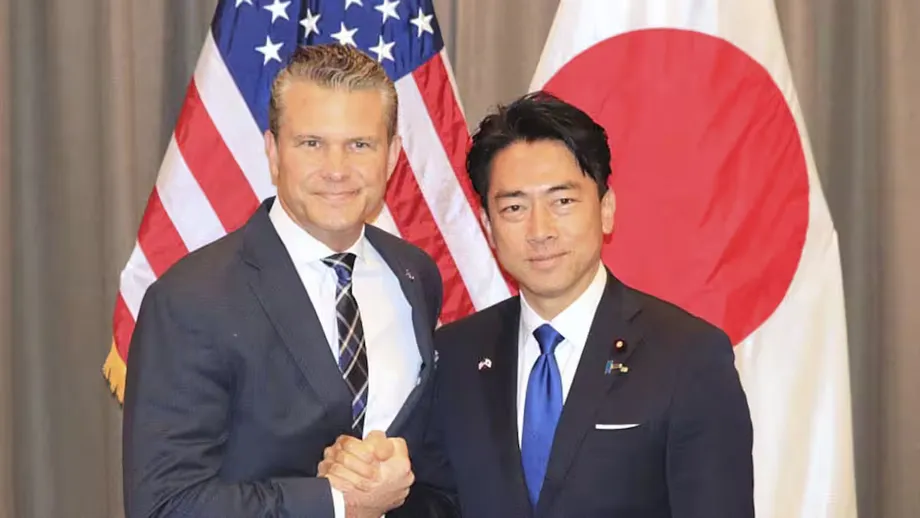
Japanese Defense Minister Shinjiro Koizumi and US Defense Secretary Pete Hegseth reached the agreement in Cebu, in the central Philippines. Their discussions also covered greater defense investment, wider use of Japanese ports and airports by US forces, practical joint exercises and stronger cooperation against cyberattacks.
Koizumi outlined Japan's plans to strengthen its ability to prevent and repel an invasion. He also explained preparations to revise three national security and defense policy documents by the end of 2026, including a plan setting out defense spending for the next five years.
The industrial groundwork is documented in Japan's Defense Ministry account of an April 14 meeting in Washington. At that stage, officials agreed to continue discussing the possibility of final assembly and inspection in Japan, drawing on a feasibility study involving Mitsubishi Electric and Raytheon. October's agreement takes that work from examining an option to agreeing to establish a facility.
The ministers placed the project within a wider effort to make the alliance better able to discourage an attack and respond if one occurs. Their discussions connected missile production with military access, training, spending and coordination along the island chain linking southwestern Japan, Taiwan and the Philippines.
What would the Japanese facility do?
AMRAAM is a guided missile designed for aircraft to engage airborne targets at medium range. Final assembly brings missile components together, while inspection, also called check-out, checks that the completed weapon meets the required standards.
The Japanese Defense Ministry's April industrial cooperation statement identifies two areas for AMRAAM cooperation: circuit card assembly and the possible establishment of final assembly and check-out operations in Japan. Circuit cards hold electronic components that help a missile's systems function.
The April statement names Mitsubishi Electric and Raytheon as participants in the feasibility study. Their work gave the governments a basis for considering which production activities could take place in Japan.
The October agreement leaves several practical details unanswered: the facility's location, construction cost, opening date, production capacity and operating arrangements have not been announced. Those details will determine when the agreement begins adding usable missiles to military inventories.
For Japanese industry, final assembly and inspection would create a role near the end of the manufacturing process, when components become a completed weapon. For the alliance, the intended benefit is a broader production base that can support readiness and supply.
How the project developed
The Cebu decision follows more than two years of policy changes and industrial discussions. Japan and the United States have been working through the Defense Industrial Cooperation, Acquisition, and Sustainment framework, known as DICAS, to turn shared production goals into specific projects.
The main steps show how the missile initiative became more detailed over time:
- December 2023: Japan changed defense export rules to allow domestically produced PAC-3 missiles to be exported to the United States.
- July 28, 2024: Japanese and US ministers meeting in Tokyo announced efforts to pursue joint production opportunities for AMRAAM and Patriot PAC-3 missiles.
- April 14, 2026: The fourth DICAS plenary in Washington agreed to include AMRAAM circuit card assembly in production discussions and continue examining final assembly and check-out in Japan.
- May 30, 2026: Koizumi and Hegseth met in Singapore and discussed accelerating missile cooperation through an initiative Koizumi called Operation Supercharge.
- October 28, 2026: The ministers agreed in Cebu to establish an AMRAAM final assembly and inspection facility in Japan.
The April meeting was chaired by Hajime Aoyagi, commissioner of Japan's Acquisition, Technology and Logistics Agency, and Michael Duffey, the senior US official responsible for acquisition and sustainment. They agreed to upgrade their cooperation framework to DICAS 2.0 as projects moved toward implementation.
Missile production extends beyond AMRAAM
Japan's Defense Ministry described the purpose of the April industrial talks as strengthening the ability of both countries to manufacture defense equipment efficiently. Its statement set out the shared production goal:
more rapidly and at a greater scale
AMRAAM is one part of that effort. The same meeting reviewed measures to increase production of the SM-3 Block IIA missile to approximately four times the existing level and agreed to assess whether production could be accelerated and expanded further. SM-3 Block IIA is an interceptor designed to engage ballistic missiles.
Officials also agreed to speed up consideration of measures to improve production efficiency for PAC-3 Missile Segment Enhancement, or PAC-3 MSE, another missile interceptor. These programs serve different military purposes, but each depends on factories, specialist components and reliable supplies.
An earlier account of Japan's PAC-3 production put output at about 30 missiles annually, with the potential to increase to 60. That would represent a doubling for that production line. Those figures describe the earlier PAC-3 situation; the planned AMRAAM facility's capacity is still unspecified.
The wider industrial agenda includes cooperation on solid rocket motors, which propel many missiles, and critical materials needed for steady manufacturing. By addressing components as well as final assembly, the governments are trying to support the full chain of work needed to deliver equipment.
Singapore talks supplied a wider framework
Koizumi and Hegseth's May 30 meeting in Singapore lasted about 60 minutes, according to the Japanese Defense Ministry's May meeting summary. It was a separate meeting from the October talks in Cebu and helps explain the policy work leading up to the facility agreement.
Koizumi proposed Operation Supercharge to accelerate cooperation that included joint development and production of SM-3 Block IIA and AMRAAM missiles. The ministers discussed practical ways to carry that initiative forward and welcomed progress at the fourth DICAS meeting.
Hegseth also welcomed Japan's changes to its defense equipment transfer system and supported its efforts to strengthen defense capabilities. The ministry said the ministers discussed regional security, including issues involving China, and agreed to coordinate closely in responding to an increasingly difficult security environment.
The Singapore meeting also connected production with military operations. The ministers supported more flexible dispersal of aircraft, a stronger joint presence in Japan's southwestern region and temporary deployments of US equipment, including missile systems.
What deterrence by denial means
Koizumi's explanation in Cebu centered on preventing an adversary from achieving its objectives through an invasion. This approach is commonly called deterrence by denial: persuading a potential attacker that an assault is unlikely to succeed because the defender can block or defeat it.
The geography discussed by the ministers makes that idea concrete. The First Island Chain runs from Japan's southwestern islands through Taiwan to the Philippines. Japan and the United States agreed to strengthen cooperation along this chain with China in mind.
According to the US Defense Department's account of the Cebu meeting, the ministers agreed that increased defense investment and continued strategic coordination were important to building an effective defense posture there. They also affirmed the alliance's essential role in maintaining peace and stability in the Pacific.
The AMRAAM facility fits into this approach by expanding the industrial capacity available to support military forces. The proposed operational changes address another part of the same task: where those forces can move, train and operate.
Japan's planned revisions to its three security documents will set out more of its approach. The documents are scheduled for revision by the end of 2026, giving the industrial agreement a place within a broader set of decisions about spending and military capabilities.
Spending plans and access to ports and airports
The United States is asking allies to spend 3.5% of gross domestic product on defense. GDP measures the value of goods and services produced in an economy, so a percentage target links military spending to the size of a country's economy.
The Cebu agreement called for increased defense investment, while Japan's coming policy revisions include a plan covering the next five years of defense spending. A specific new Japanese spending level was not announced at the meeting.
Koizumi and Hegseth also agreed to accelerate steps allowing US forces to use Japanese ports and airports more flexibly and conduct dispersed operations. Dispersal means spreading forces across more locations, giving commanders more options for moving and operating them.
For communities near those facilities, the practical effects will depend on which locations are used and how often. The agreement makes access a continuing area of alliance work alongside weapons production, rather than treating new equipment as the only requirement for stronger defense.
Exercises, information sharing and cyber protection
The ministers confirmed plans to advance more sophisticated and practical joint exercises, including further exercises using live ammunition. Japan's Defense Ministry revised its initial description, which had referred to unprecedented live fire exercises, to the more limited wording about further exercises.
Training gives Japanese and US forces opportunities to practice operating together. Alongside the exercises, the ministers agreed to strengthen cybersecurity cooperation after repeated cyberattacks caused leaks of personal information.
The May meeting had already added a regional information sharing project to the alliance's work. Japan, the United States and Australia agreed on a framework called TRISHIP, short for Trilateral Air/Surface/Missile Information Sharing in the Indo-Pacific.
The Defense Ministry described TRISHIP as supporting a network linking air and missile defenses among the three countries. Sharing information about activity in the air, at sea and involving missiles can help participating forces coordinate their responses.
The same ministry account recorded progress in joint exercises, logistics cooperation, technology cooperation and tabletop exercises under a trilateral defense consultation body. Tabletop exercises allow officials to work through a scenario and discuss decisions without deploying forces into the field.
Okinawa concerns remain part of alliance talks
Koizumi also raised the killing of a woman in Naha, Okinawa, after a US Marine was arrested on suspicion of robbery and murder. He conveyed Japan's position, and the ministers agreed to continue discussions on effective measures to prevent similar incidents.
The case brings a local public safety concern into discussions otherwise dominated by missiles, military access and regional strategy. The arrest concerns an allegation, and the ministers' stated task was to continue work on prevention.
At the May meeting, the two sides had also reaffirmed cooperation to prevent incidents and accidents involving US forces. They stressed implementation of the Okinawa consolidation plan, including construction of the replacement facility at Henoko and the return of Futenma Air Station, while maintaining deterrence and reducing effects on local communities.
The Cebu agreement therefore advances one specific industrial project within a much wider relationship. Its next practical milestones are the decisions needed to build and operate the AMRAAM facility, while Japan's next scheduled policy deadline is the revision of its three security and defense documents by the end of 2026.
Key Points
- Japan and the United States agreed on October 28 in Cebu to establish an AMRAAM final assembly and inspection facility in Japan.
- An April feasibility process involving Mitsubishi Electric and Raytheon had examined the project and identified circuit card assembly for production cooperation.
- The facility's location, cost, opening date and capacity have not been announced.
- The ministers also backed greater defense investment, more flexible military access, practical exercises and stronger cybersecurity cooperation.
- Japan plans to revise three national security and defense policy documents by the end of 2026.
- Koizumi raised the Naha killing, and both ministers agreed to continue discussions on preventing similar incidents.