More babies, a smaller population loss
South Korea recorded 23,703 births in August 2026, an increase of 2,720, or 13%, from a year earlier. Births rose across all 17 provinces and metropolitan cities, extending a run of annual increases to 26 consecutive months and bringing the August total to its highest level since 2019.
Contents
- More babies, a smaller population loss
- How far has the recovery reached?
- What does a fertility rate of 0.87 mean?
- Women in their 30s lead the increase
- First children account for a larger share
- Why did marriages fall while births rose?
- The gap between births and deaths is narrowing
- Fewer people moved within South Korea
- A birth recovery alongside a broader policy shift
- Key Points
The National Data Office's figures, published on October 28 in '2026년 8월 인구 동향' (August 2026 Population Trends), also show why the recovery has yet to stop the country's natural population decline. August deaths reached 30,308, leaving 6,605 more deaths than births. South Korea has now recorded that kind of population loss for 82 consecutive months, beginning in November 2019.
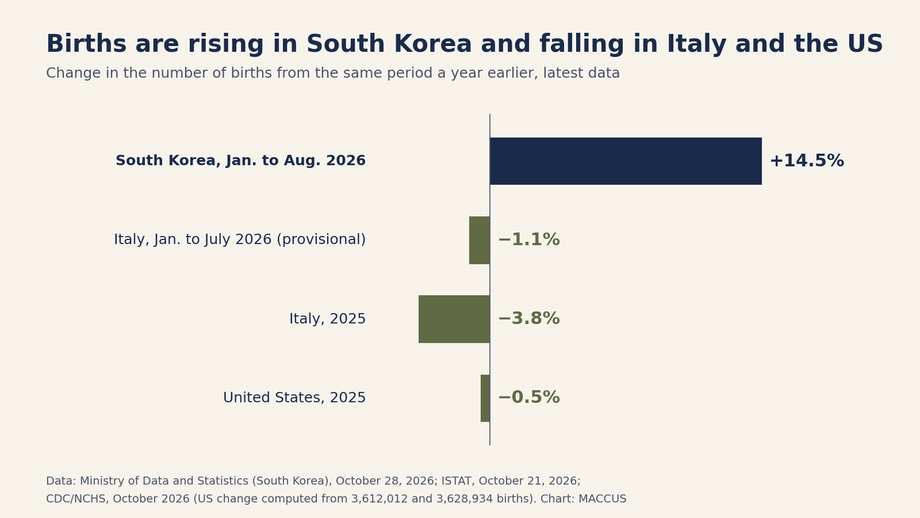
January through August brought a stronger improvement: 193,783 babies were born, up from 169,211 during the same period a year earlier. That increase of 24,572 births, or 14.5%, helped reduce the natural population loss over those eight months from 72,908 to 44,269.
South Korea is therefore experiencing two changes at once. More children are being born, and the gap between births and deaths is narrowing. Yet deaths still exceed births by enough to keep natural population change below zero. The figures offer encouragement for families and communities facing falling child numbers, while leaving substantial pressure on schools, employers and services for older people.
How far has the recovery reached?
August's 23,703 births compared with 20,983 a year earlier. The 13% increase was the strongest August growth rate since 2007, when births rose 17.6% from the previous August. The comparison concerns the pace of growth, while the highest recent August birth total remains 24,371 in 2019.
South Korea's latest August figure was just 668 births, or about 2.7%, below that 2019 level. The January through August total was also the highest for the corresponding period since 2019, giving the recovery a broader foundation than a single strong month.
Recent growth has remained substantial despite monthly changes in speed. Births rose 15.6% from a year earlier in June, 11.1% in July and 13% in August. Each comparison measures births against the same month of the previous year, helping account for recurring seasonal differences.
The recovery's main milestones are:
- August 2019: South Korea recorded 24,371 births, the benchmark still above the latest August total.
- November 2019: The current run of monthly natural population decline began.
- July 2024: Births began their continuing run of increases from a year earlier.
- January through August 2026: Births reached 193,783, an increase of 24,572 from the same period in 2025.
- August 2026: Births rose for the 26th consecutive month, while natural population decline continued for the 82nd month.
What does a fertility rate of 0.87 mean?
South Korea's total fertility rate reached 0.87 in August, up from 0.78 a year earlier. This measure estimates how many children a woman would have over her lifetime if the birth patterns measured at each age continued throughout her childbearing years.
The August figure was 0.09 higher than a year earlier, but 0.02 lower than July's 0.89. Birth totals and fertility rates answer related questions: the first counts babies, while the second measures childbearing relative to the number of women at different ages.
A fertility rate of about 2.1 births per woman is generally needed for one generation to replace itself over time without immigration. August's 0.87 was approximately 41% of that benchmark. Population change also depends on the number of people at different ages, deaths and migration.
August's improvement means childbearing was more common than a year earlier under this measure. The longer demographic challenge remains substantial because the rate is still well below replacement level, even after its recent rise.
Women in their 30s lead the increase
Women aged 30 to 34 had the highest fertility rate among the age groups detailed in the release, at 79.5 births per 1,000 women. That was an increase of 8.9 from a year earlier. For women aged 35 to 39, the rate rose by 8.2 to 59.8.
Women aged 25 to 29 recorded a smaller increase, with their rate rising by 1.2 to 21.4 per 1,000. Among women aged 24 and younger, the rate fell by 0.3 to 1.8. The gains were therefore concentrated among women in their 30s rather than spread evenly across the age groups.
A National Data Office official attributed the rise in births partly to an increase in the population of women in their early 30s, the group with the highest fertility rate. A larger number of women at ages when childbirth is more common can increase the total number of babies born.
August's figures show both a larger population in a key age group and higher fertility rates among women in their 30s. Together, those changes help explain why the birth total rose so strongly.
First children account for a larger share
First births represented 63.8% of babies born in August, an increase of 1.6 percentage points from a year earlier. Almost two in every three newborns were therefore their mother's first child.
Second births accounted for 30.5%, down 1 percentage point, while third or later births made up 5.7%, down 0.6 percentage points. The figures describe how all births were divided by birth order. Because the total number of babies increased, a smaller share can still accompany an increase in the number within a category.
South Korea's recovery is consequently drawing heavily on people becoming parents for the first time. The growing first birth share adds detail to the headline increase: more of the month's births were concentrated at the beginning of family formation.
Families having a second, third or later child accounted for the remaining 36.2%. Following both the total number of births and this distribution will help show how the recovery develops beyond the current increase in first children.
Why did marriages fall while births rose?
August marriages declined 1.2% to 19,218, a decrease of 224 from a year earlier. The comparison followed a strong August in the previous year, when marriages had risen 10.9%. A higher starting figure makes further annual growth harder to achieve.
January through August marriages remained above the previous year's pace. South Korea registered 165,874 marriages over those months, up 8,179, or 5.2%, from 157,695. Monthly declines also occurred in February and May, while June and July recorded increases of 14% and 9.3% respectively.
A National Data Office official explained that marriages feed into births after a time lag. Couples marrying in earlier months or years can therefore contribute to rising births even when the latest monthly marriage count falls.
The broader recovery has also been associated with more positive attitudes toward having children. The marriage figures provide a measurable part of that picture, with the total for the first eight months still rising despite August's decline.
Divorces moved in the opposite direction during August, increasing by 318, or 4.4%, to 7,510. January through August divorces reached 59,202, up 1,233, or 2.1%, from a year earlier.
The gap between births and deaths is narrowing
August deaths increased by 1,407, or 4.9%, from a year earlier to 30,308. Subtracting that figure from 23,703 births produces the natural population loss of 6,605.
The loss was 1,313 smaller than the 7,918 recorded in August a year earlier, a reduction of about 16.6%. It was nevertheless larger than July's loss of 4,647. The annual comparison improved while the monthly gap widened.
January through August shows a more pronounced improvement. Deaths over those eight months totaled 238,052, down 1.7% from a year earlier. More births and fewer deaths together reduced natural population decline by 28,639 people, or approximately 39.3%, from the previous year's 72,908.
Natural population change counts births minus deaths. To calculate the change in the country's total population, international migration must also be included. The August figures discussed here give the balance between births and deaths rather than a final population total after migration.
Daejeon, Ulsan, Sejong and Gyeonggi recorded more births than deaths in August. Seoul and Incheon, which had also registered natural increases in July, moved back to natural decline. Rising births across every province and metropolitan city therefore coexisted with very different local balances between newborns and deaths.
Fewer people moved within South Korea
The National Data Office's September 2026 Domestic Population Migration Statistics recorded 444,000 people moving within the country, down 50,000, or 10.1%, from a year earlier. The annualized migration rate fell by 1.2 percentage points to 10.6%.
Moves within the same province or metropolitan city accounted for 66.5% of the total, while moves between those areas made up 33.5%. The first category declined 8.9% from a year earlier; the second fell 12.4%.
Incheon recorded the largest net inflow in September, with 1,956 more people arriving than leaving. South Chungcheong gained 1,032 and North Chungcheong gained 830. Seoul recorded a net outflow of 2,359, while Busan lost 401 through domestic migration.
July through September movement totaled 1.383 million people, down 158,000, or 10.2%, from the same quarter a year earlier. Gyeonggi gained a net 10,062 residents, Incheon gained 6,773 and South Chungcheong gained 2,176. Seoul lost a net 11,368.
Domestic migration redistributes residents between communities. For an individual city, its effect can combine with births and deaths to change demand for homes, schools and local services. Across South Korea as a whole, these moves relocate people already living in the country.
A birth recovery alongside a broader policy shift
South Korea's latest figures arrive as the government broadens its population policy beyond a headline fertility target. The new national population strategy, announced on October 14, 2026, sets proposed goals for life satisfaction and workforce participation alongside measures addressing housing, care, immigration and regional decline.
The strategy seeks to raise life satisfaction from 6.6 to 7 points and labor force participation from 71.8% to 74% by 2030. It also proposes reducing career interruption among women aged 30 to 44 from 20% to 10%, connecting family circumstances with the ability to remain in employment. Final public feedback, revisions and government approval were still required when the plan was announced.
Schools and universities face a different timetable from maternity services. The Ministry of Education projected only 298,178 children entering elementary school in March 2026, according to earlier coverage of shrinking university recruitment pools. Babies born this August will reach those institutions years later, while today's schools serve generations born during earlier periods of low fertility.
August's recovery and the continuing natural population loss explain why policy is addressing both childbirth and adaptation. More newborns increase the number of young children needing care, while the existing age structure keeps pressure on institutions serving a smaller younger generation and a large older population.
Key Points
- August 2026 births rose 13% to 23,703, the highest August total since 2019 and the 26th consecutive annual monthly increase.
- January through August births reached 193,783, up 14.5% from 169,211 a year earlier.
- The total fertility rate rose from 0.78 to 0.87 compared with the previous August, while remaining below the replacement benchmark of about 2.1.
- August deaths totaled 30,308, producing a natural population loss of 6,605 and extending the monthly decline to 82 months.
- The natural population loss for January through August narrowed by about 39.3% to 44,269.
- August marriages fell 1.2%, but marriages over the first eight months remained 5.2% above the previous year's total.
- September domestic movement fell 10.1% to 444,000 people, with Incheon recording the largest net inflow.