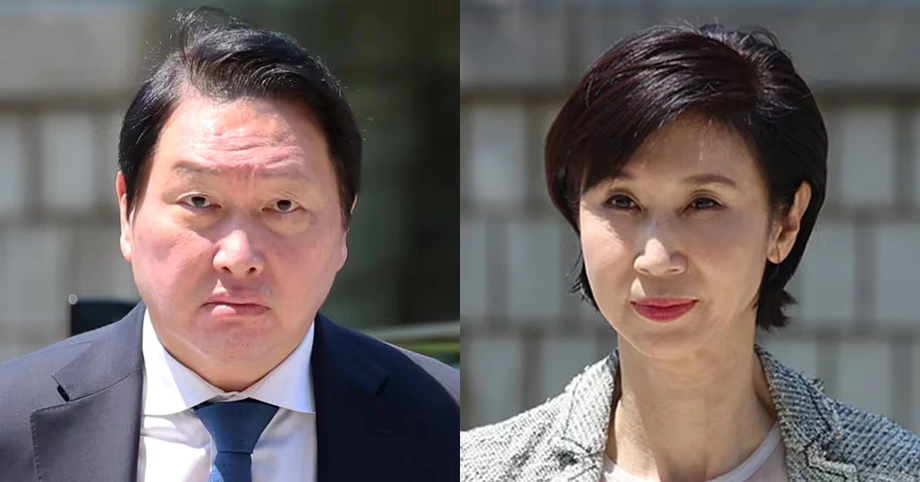
A Sudden Move to End a Decade-Long Legal Fight
SK Group Chairman Chey Tae-won asked South Korea's Supreme Court on Nov. 23 to recommend a settlement in his divorce property division case, offering to pay the full 944 billion won (about $700 million) awarded to Roh Soh-yeong, director of Art Center Nabi.
Contents
- A Sudden Move to End a Decade-Long Legal Fight
- From 66.5 Billion to 944 Billion Won
- Why the Supreme Court Rejected the Slush Fund Argument
- How the Remand Court Reached 944 Billion Won
- Chey's Appeal and the Decision to Pay in Full
- A Parallel Criminal Probe into the Slush Fund
- What the Settlement Would Mean for SK and for Roh
- Key Points
The request was filed with the Supreme Court's Division 2, presided over by Justice Kim Sung-soo. Under South Korean law, a settlement recommended by the court becomes legally binding, with the same effect as a final judgment, if neither party objects within two weeks of receiving the decision. Roh's side has not yet stated its position.
If the court issues the recommendation and neither side objects, the legal battle that began in July 2017, when Chey filed for divorce mediation, would end after nine years. The dispute has been called the "divorce of the century" in South Korean media.
Chey, 66, and Roh, 65, married in September 1988 at the Blue House when Roh's father, Roh Tae-woo, was president. They have three children. In 2015, Chey publicly admitted to fathering a child with his partner, Kim Hee-young, director of the T&C Foundation. That revelation set off the conflict. Chey filed for divorce mediation in 2017. Roh initially refused divorce, then filed a counterclaim in December 2019 seeking 300 million won in alimony and half of Chey's SK Inc. shares.
From 66.5 Billion to 944 Billion Won
The amount Chey now offers to pay has changed dramatically through the courts. Here is how the property division figure moved:
- December 2022: A lower court ordered Chey to pay 66.5 billion won in property division and 100 million won in alimony. It treated his SK shares as his separate property, not subject to division.
- May 2024: The Seoul High Court reversed that, ordering 1.3808 trillion won in property division and raising alimony to 2 billion won. It accepted that 30 billion won in slush funds from former President Roh Tae-woo had flowed into SK and helped build the couple's assets.
- October 16, 2025: The Supreme Court overturned the 1.3808 trillion won property division, ruling that illegal slush funds cannot count as a spouse's contribution. It upheld the 2 billion won alimony. Justice Suh Kyeong-hwan presided over the first petty bench.
- July 24, 2026: The Seoul High Court's remand trial, led by Family Division 1 under Chief Judge Lee Sang-ju, ordered Chey to pay 944 billion won. The court set the division ratio at one-third for Roh and two-thirds for Chey.
The 944 billion won is about 70 percent of the 1.3808 trillion won from 2024, but more than 14 times the 66.5 billion won from the first trial.
Why the Supreme Court Rejected the Slush Fund Argument
The Supreme Court's October 2025 ruling was the turning point. The high court had based its 1.3808 trillion won award on a finding that Roh Tae-woo, Roh's father, gave about 30 billion won to Chey's father, the late SK Chairman Chey Jong-hyon, around 1991. The appellate court said this money became the seed for SK Group's growth and that Roh Tae-woo "served as a shield when former SK Chairman Chey Jong-hyon was acquiring Pacific Securities and getting into the telecommunications business."
The Supreme Court disagreed. It cited Article 746 of the Civil Act, which says benefits gained from illegal causes cannot be claimed. The court said the funds likely came from bribes the former president received illegally.
Even if it is accepted that the defendant's father, Roh Tae-woo, provided approximately 30 billion won to the plaintiff's father, Chey Jong-hyon, around 1991, the funds appear to have originated from bribes which the former president received illegally.
The court added that the "anti-social, unethical, and immoral nature of this act is so pronounced that it falls outside the scope of legal protection." The 2 billion won alimony, however, was finalized. In August 2025, Kim Hee-young, Chey's partner and a foundation director, paid that amount to Roh, according to the ruling's details.
The 2024 appellate court had also raised the alimony to 2 billion won, partly because of Chey's long-running affair. It said he showed a "complete disrespect for the institution of monogamy" and had not shown genuine remorse.
How the Remand Court Reached 944 Billion Won
The Seoul High Court's remand trial had to follow the Supreme Court's instruction to exclude the slush fund. It still found that Chey's SK shares, held through the group's holding company SK Inc., were subject to division. The court said the shares increased in value during the marriage because of Chey's management activities, and Roh contributed through homemaking, childcare, and public activities related to SK Group.
The defendant's shareholdings increased substantially during the marriage through his management activities. The plaintiff contributed to that increase through homemaking, childcare and public-facing activities related to SK Group.
A critical issue was the date used to value the shares. SK's stock price had risen about five times between April 16, 2024, when arguments in the prior appeal ended, and June 26, 2026, when the remand trial's arguments ended. The court chose the earlier date, April 16, 2024, when shares traded around 160,000 won, rather than the later date, when they were around 800,000 won. It followed Supreme Court precedent that the value of assets to be divided should be based on the date the appeal trial's arguments concluded.
The court did not ignore the price surge. It raised Roh's share of the division to one-third, or 33.3 percent, considering the sharp increase. Chey received two-thirds. The court also excluded shares Chey had donated before the marriage broke down for management control purposes. The court ordered payment in cash, not stock. Usually, shares recognized as joint property in a divorce are divided in kind, meaning the asset itself is transferred. Lawyer Jung Sung-kyun of LKB Pyungsan said the "principle is division in kind," but courts can order cash when the parties agree or when circumstances call for it.
Chey's Appeal and the Decision to Pay in Full
Chey appealed the July 2026 ruling to the Supreme Court. He later narrowed his challenge, saying he would not contest 700 billion won of the 944 billion won and would dispute only the remaining 244 billion won. Roh did not file a counter-appeal against parts of the ruling that were unfavorable to her.
Then, on Nov. 23, Chey's side filed the request for a settlement recommendation, offering to pay the full amount. His lawyers said the move was meant to end the dispute. "We intend to bring an end to all disputes by paying the full amount of the property division," they said, according to Yonhap News Agency. They also explained Chey's motivation: "Amid intensifying global AI competition, it is Chairman Chey's intention to pay the full property division amount and focus on management to contribute to SK and the national economy."
To fund the payment, Chey sold 1.65 million shares of SK Inc., the group's holding company, on Nov. 2. The sale reduced his stake from 17.76 percent to 15.49 percent. SK Group said the sale does not weaken his control. "Following the sale, the largest shareholder holds 20.8 percent of shares with voting rights, or 30.5 percent when related parties are included," an SK Group official said. "The company's ability to maintain stable management remains unchanged."
A Parallel Criminal Probe into the Slush Fund
The slush fund at the center of the divorce fight is also the subject of a criminal investigation. Prosecutors at the Seoul Central District Prosecution Office's Criminal Proceeds Recovery Division, led by prosecutor So Jeong-su, asked a court to examine Roh Soh-yeong as a witness. The examination was scheduled for Nov. 24, but Roh filed a notice on Nov. 23 saying she would not attend.
Prosecutors are looking into whether some of former President Roh Tae-woo's slush fund flowed to entities including the East Asia Cultural Foundation, chaired by Roh Jae-heon, Roh's son and South Korea's ambassador to China. They are also investigating whether the money was a bribe and whether the family concealed it. The law allows prosecutors to ask a judge to examine a witness before the first court hearing if a person believed to know essential facts refuses to appear or testify. That provision is Article 221-2 of the Criminal Procedure Act.
The allegations emerged during the divorce case. In the 2023 appeal, Roh's representatives submitted a 1991 promissory note issued in the name of Sunkyong Construction, now SK ecoplant, and a memo reading "Sunkyong 30 billion won," both kept by her mother, Kim Ok-suk. In 2024, the May 18 Memorial Foundation and others filed a complaint against the former president's family, Chey, and others, alleging concealment of criminal proceeds and tax evasion. Prosecutors searched Kim's home and the East Asia Cultural Foundation on Aug. 21. The Seoul Central District Prosecution Office took over the case after regulatory changes ended prosecutors' direct investigative powers.
What the Settlement Would Mean for SK and for Roh
If the Supreme Court grants the settlement recommendation and neither side objects within two weeks, the property division case ends. The divorce itself was finalized by the Supreme Court in October 2025. The remaining fight was only about money.
The payout is one of the largest in South Korean divorce history. Chey's net worth is about US$5.6 billion, according to the Bloomberg Billionaires Index, and his net worth more than doubled in the past year. His stake in SK Group was worth roughly US$5.5 billion, according to regulatory filings and public data. The group owns SK hynix, a leading memory chip maker that supplies Nvidia and is a pillar of South Korea's technology economy.
Roh, 65, has three children with Chey and runs a digital art museum. The 33.3 percent division ratio is higher than what some lawyers expected for a chaebol divorce. In ordinary divorce cases for couples married 20 to 30 years, assets are often split evenly, but in business family cases the spouse's contribution to company management is often valued lower. The Supreme Court's rejection of the slush fund had led some to expect a much smaller award for Roh. Instead, she will receive 944 billion won if the settlement holds.
The case could also influence other chaebol divorces. The Supreme Court's ruling reaffirmed that a spouse can claim a share of shares held by a company founder or chairman if they were acquired or maintained during the marriage, and that homemaking and public activities count as contributions. At the same time, illegal outside money cannot be counted. A similar dispute involving Kwon Hyuk-bin, chief vision officer of game company Smilegate, is among the cases that may look to this ruling.
Key Points
- SK Group Chairman Chey Tae-won asked the Supreme Court on Nov. 23 to recommend a settlement, offering to pay the full 944 billion won property division to Roh Soh-yeong.
- The request was filed with the Supreme Court's Division 2, presided over by Justice Kim Sung-soo. Roh's side has not yet responded.
- If the court recommends settlement and neither party objects within two weeks, it has the same effect as a final ruling and would end the legal battle that lasted nine years.
- The 944 billion won was set by the Seoul High Court's remand trial on July 24, 2026, after the Supreme Court in October 2025 rejected the use of former President Roh Tae-woo's illegal slush funds as a contribution.
- The division ratio is one-third for Roh and two-thirds for Chey, based on SK share values on April 16, 2024.
- Chey sold 1.65 million SK Inc. shares, cutting his stake from 17.76 percent to 15.49 percent, to fund the payment.
- Prosecutors are separately investigating the slush fund and sought to question Roh as a witness; she refused to attend a Nov. 24 examination.