Six scarves for 10,000 won, and a queue to meet the seller
At Hanyangsa in Seoul's Namdaemun Market, six scarves cost 10,000 won, roughly $7. The merchant's advice is even cheaper: keep your money. His teasing warnings against unnecessary purchases have drawn hundreds of visitors, sold out an online shop and turned a narrow market alley into a crowd safety concern.
Contents
- Six scarves for 10,000 won, and a queue to meet the seller
- A sales pitch that tells people to walk away
- Why customers travel for the conversation
- Online sales brought another rush
- How the crowds became a safety issue
- More visitors, but uneven benefits for traders
- Celebrity visitors join the fans
- Fame brings pressure as well as affection
- Key Points
Known as the Namdaemun Scarf Man or Scarf Uncle, the seller has attracted more than 100,000 Instagram followers. His YouTube channel passed 110,000 subscribers within three weeks, with 23 videos collecting 22.23 million views. Customers now travel from across South Korea to hear the remarks they first encountered on their phones.
International attention has followed. One television crew visited for three consecutive days before briefly encountering him as he closed his shop. When asked for an interview, he smiled awkwardly, waved away the request and went inside.
The attention has brought a difficult mix of opportunity and disruption. His first online stock sold out within 24 hours, while police and private security have managed visitors outside the physical shop. Some neighbouring traders welcome the extra customers. Others say people taking photographs block their entrances without buying anything.
The seller has temporarily closed several times, stopped publicising his opening hours and apologised to surrounding businesses. A man whose appeal comes from relaxed conversation now faces the practical demands of managing a crowd, dispatching orders and protecting the working market around him.
A sales pitch that tells people to walk away
The Scarf Man reverses the familiar market sales pitch. Instead of praising every item, he questions whether shoppers need it, jokes about its quality and tells them a purchase will sit unused at home.
The Hanyangsa merchant, whose real name has not been publicly disclosed, addresses customers with deliberately blunt humour. One of his recurring warnings is:
Don't spend your money.
The appeal rests on how he delivers the words. Customers describe warmth beneath the mock scolding, and he often addresses older women as mothers. His jokes make the scarves, the shoppers and himself part of the entertainment.
Fans have also given him names such as Scarfrio and Scarfprio, combining scarf with Leonardo DiCaprio in a playful reference to his appearance. Yet the seller says his manner grew out of ordinary working life rather than a carefully prepared marketing plan.
In livestreams, he has said he is married, has two daughters and has worked at Hanyangsa for more than 10 years. Broadcaster Jang Seong-kyu identified him as born in 1983; the merchant described himself as 44 under the traditional Korean age system, which counts age differently from the international system.
His explanation is straightforward: he enjoyed talking and joking with customers and wanted to work in a good mood while earning a living. Over years, that became his usual way of speaking. He attributed the sudden popularity to luck.
Why customers travel for the conversation
Cho Yoon-sook travelled about 90 minutes from Incheon, west of Seoul, hoping to see him. After an unsuccessful visit, she was prepared to try again. The scarves themselves were not her main interest.
Cho, a customer drawn by his personality, explained the attraction:
There's something endearing about the way he talks.
Ahn Hyo-sun crossed Seoul after repeatedly watching his videos. She also missed her chance to meet him, but described his banter as something that gives viewers a happiness boost.
Lee Mi-hwa came from Yongin, about 35 kilometres south of Seoul, after discovering him on YouTube. Other visitors travelled from Daegu and Daejeon. Some international tourists have joined the queue despite being unable to understand his Korean jokes.
For these shoppers, the modest price makes the scarf an affordable souvenir of an encounter. Dividing 10,000 won by six puts each scarf at about 1,667 won. Friends can share the purchase, and the experience can matter more to them than choosing a particular design.
Online sales brought another rush
The seller moved online after repeated customer requests and growing difficulty handling visitors at the stall. His Naver Smart Store offers six scarves for 10,000 won, with a delivery charge of 3,000 won. He selects the colours and designs rather than letting buyers choose.
The launch was dated November 12 in accounts of the store opening, while his livestream and other accounts placed the start on November 11. By November 12, the rush was unmistakable: the store had recorded 132,000 visits that day and 200,000 cumulative visits by 1:15 p.m. Access was disrupted, and every listed item sold out.
The product page carried the same message as the physical shop. The merchant's listing warned:
Absolutely no overspending.
Customers responded with orders and messages. More than 796 posts appeared in the store's question and answer section by the afternoon, including purchase enquiries, encouragement and jokes written in his own distinctive style. Cumulative visits reportedly reached 400,000 by November 13.
The merchant later warned that dispatching orders could take more than two weeks. He expressed discomfort about individuals spending 300,000 to 500,000 won and told buyers they could cancel if they could not wait.
The online shop created a way to buy without travelling to Seoul, but also gave a small business a much larger packing and delivery workload. Stock had sold out faster than he could comfortably process it.
How the crowds became a safety issue
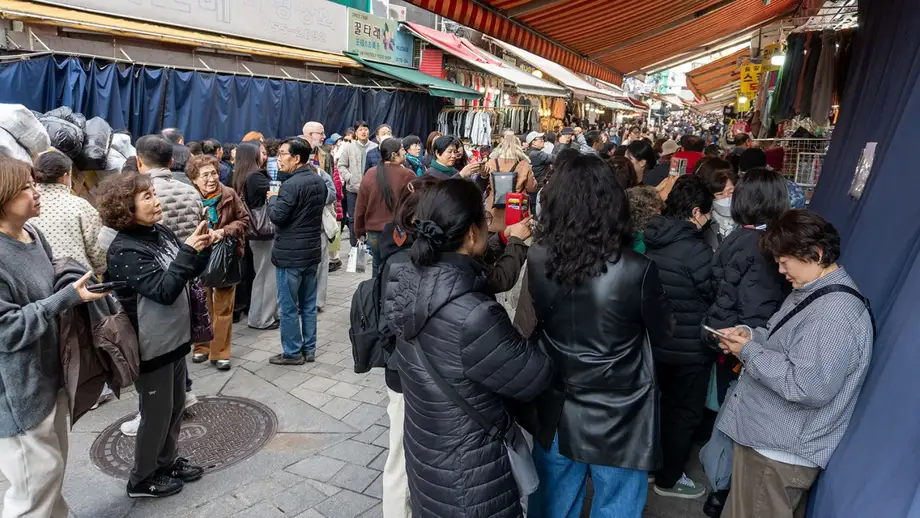
Namdaemun's narrow passages serve shoppers, traders and delivery workers at the same time. A queue that stops to watch one person can quickly restrict movement around several businesses.
At 1 p.m. on a Wednesday during the surge, Seoul's population indicator put the wider Namdaemun Market area at approximately 25,000 people and classified it as severely crowded. More than 30 police officers were dispatched on a Tuesday as concern grew about the density of visitors.
Private guards have kept passages open, managed numbered tickets and controlled admission. At one observed session, three guards organised access, and the seller called for groups of 10 or 15 customers to enter. He repeatedly asked people not to push.
The response developed over several dates:
- November 4: Police were called as crowds gathered around the stall.
- November 5: The shop closed temporarily for a safety inspection.
- Early November: Private security was hired at the merchant's expense.
- November 9: Jung District increased monitoring and patrols and deployed safety personnel during busy periods.
- November 11 to 12: Online sales began and the prepared stock sold out.
- November 15: The seller announced another temporary closure on social media and asked followers to spread the message to prevent wasted journeys.
Jung District plans to seek the market's inclusion in the Ministry of the Interior and Safety's crowd management system from 2027, following a demand survey at the end of 2026. Admission has already closed before some visitors arrive, and the seller no longer advertises fixed opening hours.
More visitors, but uneven benefits for traders
Seoul's floating population data, which measures people present in an area, recorded 7,715 people around Hanyangsa at 2 p.m. on November 6, compared with 6,606 a year earlier. That is an increase of 1,109 people, or about 16.8 percent.
Some neighbours see an opportunity in the extra traffic. Scarf seller Bae Jong-min welcomed the visitors and pointed to possible benefits for restaurants, coffee shops and food stalls, while also expressing concern about crowding.
Others face a more immediate loss of access. Moon, a neighbouring shoe seller who has worked at the market for more than 30 years, described the effect on his shop:
Business is bad. The passage next to me gets blocked and it's really hard on me.
Delivery worker Choi Hyo-yeol, 82, said weekday visitor numbers had doubled or tripled, making deliveries and movement difficult. A neighbouring clothing merchant said the attention was concentrated on the scarf shop rather than increasing sales at surrounding stores.
The wider market was already attracting more spending. Shinhan Card figures put foreign card spending at tourism related businesses near Jayu Shopping Center at 15.758 billion won in January through September, up 65.6 percent from 9.514 billion won a year earlier. Total card sales in a wider tourism related tally reached 109.181 billion won, up 7.5 percent.
Those figures cover different spending groups and periods extending well before the scarf videos spread widely in late October. The immediate challenge for nearby traders is concrete: turning additional visitors into customers while keeping shop entrances and delivery routes open.
Celebrity visitors join the fans
Broadcaster Jang Seong-kyu visited on November 16 after publicly expressing admiration for the merchant. He said admission had already ended and police security prevented him from approaching, leaving him to take a photograph from a distance.
Jang had initially assumed the seller was older because of his confidence and skill at joking with customers. Learning that they were both born in 1983 prompted him to address the merchant as a friend in his social media posts.
The couple Lee Eun-young and Kang Jae-jun also released a video showing them greeting the seller and posing for photographs.
Ordinary shoppers describe a similar excitement. Lee Ji-hyun queued from 10 a.m. until 11:20 a.m. before buying scarves. She said she had not visited Namdaemun for 30 years despite living in Seoul, and now planned to return monthly. Her visit offers a specific example of how interest in one trader can reconnect someone with the market.
Fame brings pressure as well as affection
The merchant has accepted some parts of his new visibility, opening social media accounts, posing for photographs and selling online. He has resisted others, declining many interviews and temporarily suspending YouTube's Super Thanks feature, which lets viewers send paid contributions.
The seller explained his discomfort with accepting that support:
I still feel a little uncomfortable and cautious about receiving support.
In another social media message, he said the attention had brought "enormous pressure and anxiety" and apologised to neighbouring traders. His closures reflect a business trying to keep operating while coping with demand beyond its usual capacity.
Kwak Keum-joo, professor emerita of psychology at Seoul National University, connects his appeal to warmth, candour and memories of vendors who entertained customers through conversation. She also describes the speed at which online attention can move.
Kwak explained how quickly an audience can gather and disperse:
Excitement can build in a very short time. With new content constantly coming out, it can fade just as quickly when the next thing comes along.
Lee Taek-gwang, a cultural studies professor at Kyung Hee University, points to the expanding opportunities for ordinary people to gain recognition through media. Visitors can now record an encounter, publish it immediately and sometimes earn money from the resulting content.
At Hanyangsa, that creates a repeating cycle: videos bring visitors, visitors film more videos, and the next audience wants its own encounter. The merchant's task is now larger than selling inexpensive scarves. It includes managing access, fulfilling orders and keeping a crowded alley usable for everyone who works there.
Key Points
- Hanyangsa sells six scarves for 10,000 won, while its merchant jokes that customers should save their money.
- His Instagram following exceeds 100,000, and his online shop's first stock sold out within 24 hours.
- Online buyers receive randomly selected designs and were warned that delivery could take more than two weeks.
- Crowds have prompted police deployments, private security and repeated temporary closures.
- Neighbouring traders report mixed results, from extra visitors to blocked entrances and disrupted deliveries.
- Jung District plans to seek inclusion in the government crowd management system from 2027.