Three worker deaths could trigger a penalty tied to company profits
South Korea will allow financial penalties of up to 5% of an employer's average annual operating profit when violations of workplace safety duties cause at least three worker deaths within a year. The new powers begin on April 28, 2027, alongside broader rights for workers to stop dangerous work and leave the area before an accident occurs.
Contents
- Three worker deaths could trigger a penalty tied to company profits
- How the financial penalty will work
- Workers will be able to act earlier
- Government orders can come before another casualty
- Reporting rewards and a new safety committee
- Construction schedules and safety budgets will change
- Why construction companies are watching a separate bill
- Employers and unions disagree about the reach of the law
- Deaths have fallen, while the rollout extends into 2027
- Key Points
The amendments to the Occupational Safety and Health Act were promulgated on October 27, 2026. They combine financial sanctions for multiple or repeated deaths with earlier intervention at dangerous workplaces, rewards for reporting violations and wider requirements to set aside money for safety.
The penalty will use average annual operating profit over the preceding three years. When that figure is unavailable or difficult to calculate, or 5% of it falls below 3 billion won, authorities may instead impose a penalty of up to 3 billion won. Operating profit is the money a business earns from its operations after operating costs are deducted.
Workers employed by subcontractors will also gain the right to ask the primary contractor directly to stop work. For someone facing a dangerous task at a site controlled by another company, that creates a route to the business managing the wider workplace.
The government is introducing the changes in stages. Reporting rewards and a new national safety committee begin on January 28, 2027. The main penalty and work stoppage provisions follow three months later, while some safety spending requirements begin in October 2027.
How the financial penalty will work
The financial sanction applies when an employer breaches safety or health obligations and at least three workers die from workplace accidents within a year. The relevant duties are set out in Articles 38, 39 and 63 of the Occupational Safety and Health Act, covering safety and health measures and responsibilities involving contracted work.
A penalty review committee will examine each case. Authorities will consider the number of violations, the company's size, the number of workers killed, the seriousness of the breaches and the proportion of the workforce that died. Efforts to prevent accidents and stop them happening again will also affect the amount.
The 5% figure is a maximum, with the actual assessment depending on those factors. The alternative ceiling of 3 billion won also allows a substantial penalty when an employer has little operating profit or its profit cannot readily be calculated.
For scale, 5% of average annual operating profit of 100 billion won would be 5 billion won. At average profit of 20 billion won, the same calculation produces 1 billion won, bringing the employer within the provision allowing a penalty of up to 3 billion won.
Collected money will enter the industrial accident compensation insurance fund and be used for accident prevention. The Ministry of Employment and Labor says the measure is intended to encourage employers to invest in protecting workers before accidents happen.
Workers will be able to act earlier
Workers currently have the right to stop work and evacuate when an industrial accident presents an imminent danger. From April 28, 2027, that right will extend to situations where there is reasonable concern that such danger may arise.
The change moves the point at which a worker may act. Instead of waiting until a dangerous situation has fully developed, a worker can respond to a credible concern that an accident is approaching.
Workers, employee representatives and designated honorary occupational safety inspectors will be able to request a work stoppage from an employer. Honorary inspectors are people appointed to help monitor workplace safety, with worker participation forming part of their role.
Subcontracted workers will be allowed to make the request directly to the primary contractor, as well as to their own employer. This matters at workplaces where one company controls the site while another supplies the people doing the work.
Labor organisations want practical guidance on how workers' wages will be protected during a stoppage and how imminent danger will be judged. Employers also want a clear decision process, arguing that uncertainty over the threshold could lead to disputes about stopping and restarting work.
Government orders can come before another casualty
The labor minister's authority to stop work will expand beyond cases where a serious accident has already occurred. An order may also be issued when an injured worker is unconscious or their survival is uncertain.
Collapses, fires, explosions and leaks of hazardous substances will provide grounds for intervention when they create an imminent risk of a serious accident. The aim is to interrupt dangerous operations before further workers are harmed.
Employers will also face a specific duty to suspend work when they have failed to comply with a corrective safety order and that failure creates an imminent accident risk. Work must remain suspended until the required correction is completed.
An order to install safety railings illustrates the practical effect. If an employer leaves the required protection unfinished and workers face an imminent risk, the employer must stop the affected work until the problem is fixed.
Repeated fatal accidents may also threaten an employer's business registration. The labor minister will be able to ask the relevant administrative authority to cancel or revoke a registration after at least two business suspension penalties within three years, followed by another incident qualifying for a suspension request. Qualifying incidents include safety or health violations that kill at least two workers at the same time.
This power, also effective April 28, 2027, gives the ministry a route to seek removal of a repeat offender's permission to operate. The cancellation decision belongs to the relevant administrative authority.
Reporting rewards and a new safety committee
From January 28, 2027, authorities may pay rewards to people who report violations of occupational safety law or orders issued under it. The ministry plans to open a workplace safety reporting centre as part of the scheme.
Reward eligibility, payment amounts and procedures will be specified in subordinate regulations. The same rulemaking process will settle detailed penalty calculations, collection procedures, work stoppage criteria and the expanded safety expense requirements. These are the practical rules that turn the law's broad duties into procedures workplaces can follow.
A Safe Workplace Committee will begin operating within the labor ministry on January 28. Chaired by the labor minister, it will have no more than 20 members, including labor and management representatives, senior government officials and occupational safety experts.
The committee will review and coordinate accident prevention policy and plans. Its work will include monitoring implementation, assessing institutions and considering research into workplace risks.
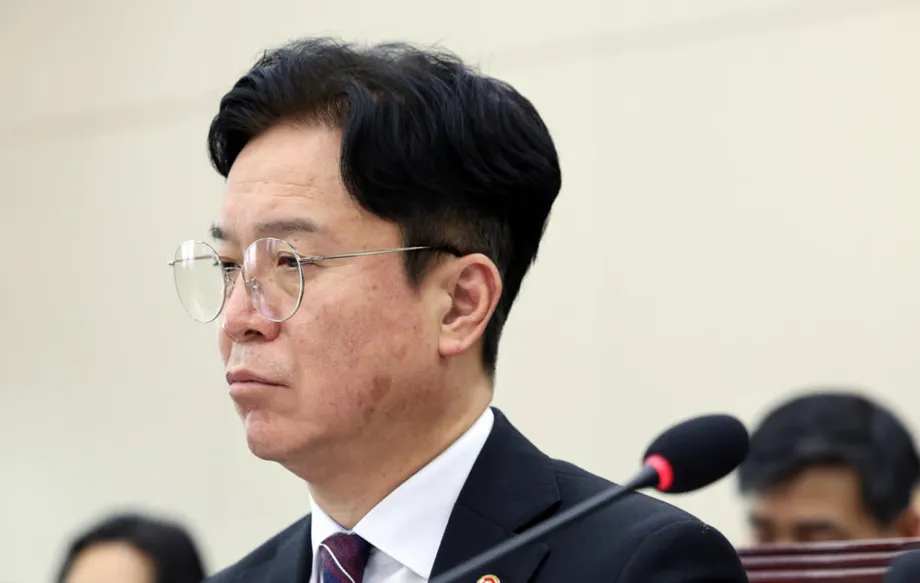
Labor Minister Kim Young-hoon has called for employers and workers to identify hazards together and correct them before accidents happen. He has also pledged to prepare the regulations and enforcement arrangements needed to put the measures into practice.
Construction schedules and safety budgets will change
Requirements to account for occupational safety and health management costs will extend beyond construction project owners to contractors and other industries. These are funds set aside for measures that protect people while work is being carried out.
The construction provisions take effect on April 28, 2027. Requirements covering other industries begin on October 28, 2027. Subcontractors will have to prepare and retain spending records and will be barred from using the designated safety money for other purposes.
Extreme heat and cold have been explicitly recognised as grounds for requesting an extension to a construction schedule. That provision took effect immediately, allowing weather hazards to be considered when deciding whether a project needs more time.
The link between time and safety is concrete: stopping dangerous work can delay a project, while a fixed deadline can put pressure on contractors to keep moving. Recognising severe weather in extension requests gives contractors a formal basis to seek additional time.
Another provision taking immediate effect allows certain imported machinery intended for export, including equipment otherwise subject to safety certification, to qualify for an exemption.
Why construction companies are watching a separate bill
Construction businesses are also following a proposed Construction Safety Special Act introduced by Democratic Party lawmaker Moon Jin-seok. That proposal would allow business suspension or penalties of up to 3% of sales for specified safety failures causing casualties, with a proposed ceiling of 100 billion won. It remains a bill under consideration.
The difference between sales and profit makes the financial stakes easier to understand. Sales are the total money received from customers. Operating profit is what remains after operating costs, so a percentage of sales can be much larger than the same percentage of profit.
The Construction Association of Korea puts the industry's operating profit margin at 3.15%. At that margin, a company with sales of 1 trillion won would earn operating profit of about 31.5 billion won. A penalty equal to 3% of those sales would be 30 billion won, about 95% of that operating profit.
By comparison, 5% of 31.5 billion won is 1.575 billion won. Under the enacted Occupational Safety and Health Act amendments, that calculation falls within the provision allowing a penalty of up to 3 billion won. Actual penalties would depend on the applicable legal criteria and the facts of the case.
Association chairman Han Seung-gu has said construction's recovery is concentrated in the capital region and public projects, while regional and private construction remain weak. The association argues that the proposed sales based sanction could damage companies' finances and wants adequate construction budgets and schedules.
Employers and unions disagree about the reach of the law
The Korea Enterprises Federation argues that the new penalties are excessive and unrealistic, particularly when added to criminal liability under the Serious Accidents Punishment Act. It says large workplaces could face very large assessments, while smaller companies could face threats to their survival.
The Federation of Korean Trade Unions welcomes the ability to impose financial penalties after fatal safety failures, but worries that requiring at least three deaths within one year will leave the measure with a limited reach. It wants detailed assessment standards that make the law effective in practice.
Lim Hyun, a partner at Dongin Law Firm, has argued that the amendments make safety a matter for senior management and boards, alongside financial performance and investment. His assessment focuses on whether workers can raise danger concerns, managers respond promptly and primary contractors share risk information with subcontractors.
An earlier Kim & Chang briefing described a proposal that passed a parliamentary committee on February 23, 2026, using a threshold of three or more fatal accident cases in a year. The provisions promulgated in October use three or more worker deaths, allowing multiple deaths in a single accident to count toward the threshold.
The firm's briefing also describes related amendments promulgated on February 19, 2026, covering safety disclosures, risk assessment and worker participation. For employers, those measures connect the new sanctions to existing duties to identify risks, document safety activity and involve workers in prevention.
Deaths have fallen, while the rollout extends into 2027
The labor ministry's 2025 closing figures put workplace deaths at 828 in 2021, 644 in 2022, 598 in 2023, 571 in 2024 and 559 in 2025. The decline from 2021 to 2025 was 269 deaths, or about 32.5%.
The 2025 accident death rate was 0.38 per 10,000 workers, compared with a policy target of 0.29 associated with the OECD average. Figures reported through September 2026 showed 366 deaths, down 91, or 19.9%, from the corresponding period a year earlier.
The legislative timetable sets out when workers, contractors and employers will see the next changes:
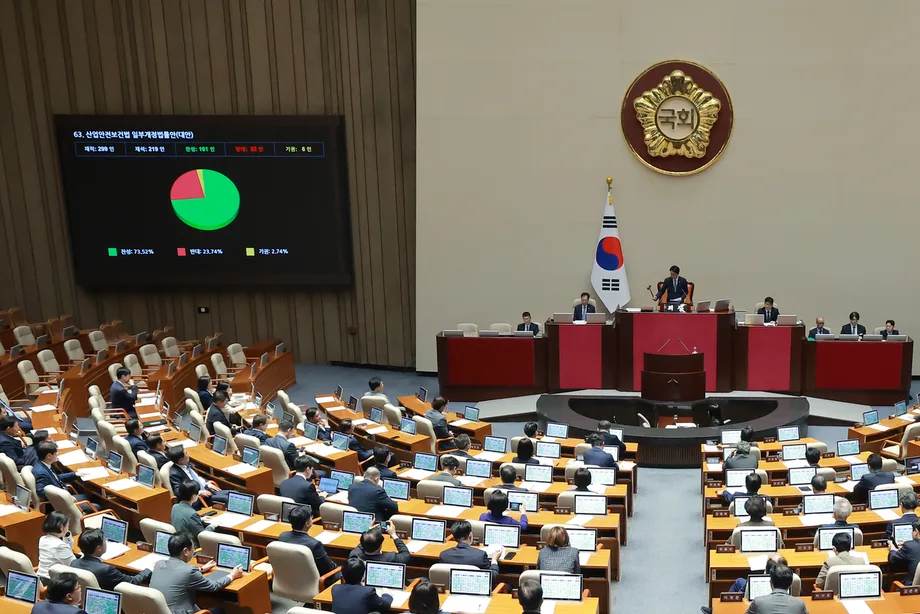
- October 1, 2026: The National Assembly passed the amendments by 161 votes to 52, with six abstentions among 219 members present.
- October 20, 2026: A cabinet meeting chaired by President Lee Jae-myung approved the promulgation measure.
- October 27, 2026: The amendments were promulgated, with the construction weather provisions and certain machinery exemptions taking immediate effect.
- January 28, 2027: The reporting reward provisions and Safe Workplace Committee begin.
- April 28, 2027: The financial penalties, expanded work stoppage rights, business registration measures and construction safety expense provisions begin.
- October 28, 2027: Safety expense requirements extend to other industries.
The next practical step is the government's preparation of detailed regulations. Those rules will determine how a worker's danger concern is assessed, how employers document prevention efforts and how authorities calculate penalties after fatal violations.
Key Points
- Safety violations causing at least three worker deaths within a year can trigger penalties from April 28, 2027.
- The main ceiling is 5% of average annual operating profit over the previous three years, with an alternative ceiling of 3 billion won in specified circumstances.
- Workers will gain broader rights to stop and evacuate, and subcontracted workers may ask primary contractors directly to suspend work.
- Repeated fatal violations can lead the labor minister to request cancellation or revocation of a business registration.
- Reporting rewards and a national safety committee begin on January 28, 2027.
- A separate proposal for penalties based on construction sales remains under consideration.