Large crowds return under tighter controls
Seoul's Hongdae district drew an estimated 115,000 to 120,000 people by 7 p.m. on Saturday, October 31, while 18,000 to 20,000 gathered in Itaewon, according to the Seoul metropolitan government's real time urban data. By 9 p.m., the estimates had risen to 125,000 to 130,000 in Hongdae and 26,000 to 28,000 in Itaewon.
Contents
- Large crowds return under tighter controls
- What the crowd figures show
- Roads become walking space
- Police prepare for the busiest hours
- City staff and national teams widen the operation
- Cameras track pressure at street level
- Subway access could change as crowds grow
- Celebration shares the streets with remembrance
- What visitors were advised to do
- Key Points
Police deployed about 7,800 personnel across 28 priority locations nationwide, including 14 in Seoul, as Halloween fell on a weekend for the first time since the 2022 Itaewon disaster. Barriers separated pedestrians moving in opposite directions, roads were opened for walking, and authorities prepared to restrict access to crowded alleys and subway stations.
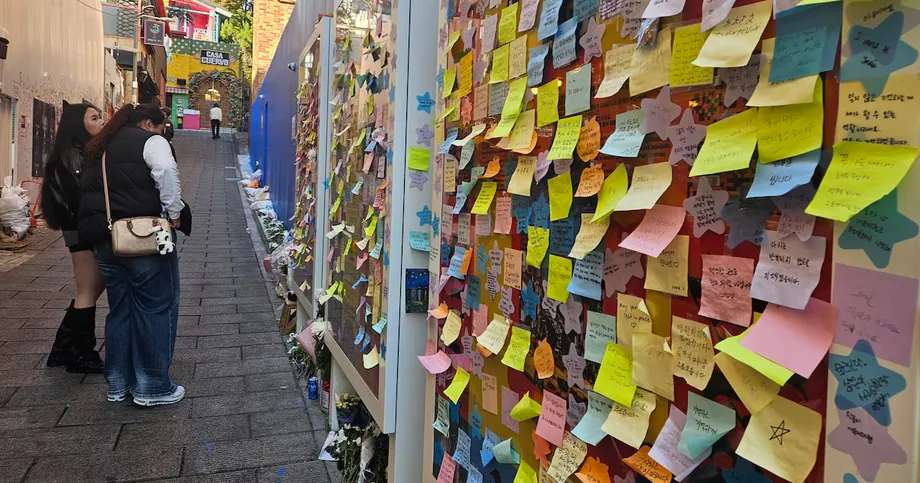
Itaewon carried two moods at once. Visitors dressed as film and game characters gathered outside restaurants and posed for photographs. Others stopped at the alley beside the Hamilton Hotel to leave chrysanthemums and read messages remembering the 159 people killed in the crowd crush on October 29, 2022.
Hongdae's much larger district population made it another major focus of the safety operation. Its Red Road area displayed a warning that it was very crowded at 7 p.m., while Itaewon was rated crowded. Pedestrians generally followed the barriers and directions from officers, although movement slowed as more people arrived.
What the crowd figures show
Hongdae's population increased from about 60,000 around lunchtime to about 120,000 by 7 p.m., roughly doubling during the afternoon and early evening. Itaewon's numbers continued climbing toward the period police expected to be busiest, from 9 p.m. until 1 a.m.
People in their 20s made up 38.3 percent of Itaewon's estimated population at 7 p.m. Families with children, foreign visitors and older adults also joined the celebrations. The district figures describe the estimated population across an area; the pressure on pedestrians depends on how many people gather in each particular street or alley.
Seoul uses information from mobile telephone base stations to estimate how many people are in busy districts. Cameras and staff on the ground provide a closer view of individual bottlenecks, where a large district's visitors may converge on a much smaller space.
Friday evening had already brought an increase in activity. At 9 p.m. on October 30, the population near Itaewon Station was estimated at 9,500 to 10,000, with people in their 20s accounting for 50.4 percent. The total was 79.7 percent above the average for the same weekday and hour during the preceding 28 days.
Roads become walking space
Authorities restricted vehicle traffic on Itaewon's main road from about 6 p.m. on Saturday. The planned closure stretched from the Itaewon 119 Safety Center to Noksapyeong Square, allowing pedestrians to use space normally occupied by vehicles.
The timing marked a practical change from the previous year. Police had then decided to restrict traffic at about 10:40 p.m., after checking congestion. This time, the closure was arranged before the anticipated evening peak, giving people more room earlier.
Hongdae's plan reserved one lane of Club Street for pedestrians. Safety fences guided people in one direction, while city authorities also planned to manage queues outside popular clubs and other businesses so waiting customers would leave a clear route for people passing through.
Itaewon's narrow, sloping streets received particular attention. Police identified World Food Culture Street and six connecting slopes as priority risk areas. The alley beside the Hamilton Hotel where the disaster occurred was restricted to movement uphill from the direction of Itaewon Station.
Separating opposing streams of pedestrians reduces the places where people meet head on and stop. Opening road space also gives visitors somewhere to spread out instead of concentrating entirely in adjoining alleys.
Police prepare for the busiest hours
Itaewon's operation included 370 police officers, about 80 more than the previous year. Police, firefighters and Yongsan district staff coordinated through a joint situation room, sharing information about crowd movement and conditions on the streets.
Police expected crowds to peak between 9 p.m. and 1 a.m. and begin declining around 3 a.m. to 4 a.m. They had prepared for as many as 30,000 people in Itaewon, about twice the usual number. Ahn Dae-seon, head of the security division at Yongsan Police Station, said the previous year's maximum around Itaewon Station had also been about 30,000.
Officers could stop people entering World Food Culture Street from either end, introduce movement in one direction through sloping alleys, or restrict entry from the surrounding streets if congestion became dangerous. Police also planned to give crowd related calls to the emergency number 112 a response designation of Code 1 or higher.
Crime prevention teams operated alongside the crowd management staff. Plans included seven detective teams, 20 officers from Seoul's metropolitan crime prevention patrol unit, eight patrol cars and 10 police tactical officers. A tactical armored vehicle was deployed as a precaution against terrorism or knife attacks.
Police warned visitors about imitation firearms and knives used as costume accessories, particularly careless use in crowded places. They also planned strict enforcement against legally prohibited imitation police uniforms.
City staff and national teams widen the operation
Seoul's municipal plan called for 3,271 safety personnel, comprising 2,011 public sector staff and 1,200 private sector workers. Their responsibilities covered 14 locations in 10 districts, with eight designated for priority management.
Those eight areas were Itaewon, Hongdae, Ikseon-dong, Myeongdong, Seongsu-dong Cafe Street, Konkuk University Food Street, Gangnam Station and Apgujeong Rodeo Street. Seoul also provided 244 million won from its disaster management fund to seven districts to strengthen their local response.
The Ministry of the Interior and Safety designated October 23 through November 1 as a special measures period and issued a Caution level crisis alert. It sent advance inspection teams to 12 areas to check safety plans, staffing, facilities and potential bottlenecks such as entrances, stairs and narrow alleys.
Ministry coordinators were scheduled to work in those 12 areas from October 30 through November 1, supporting local governments, police and fire services until crowds dispersed. Seoul's own intensive management period covered the same three days.
Cameras track pressure at street level
Seoul planned to use 361 cameras capable of detecting crowd concentrations across its designated management areas. Drones were also planned for Hongdae, Seongsu-dong and Gangnam Station to observe bottlenecks that are difficult to see from the ground.
The city's system sends automatic alerts when crowd density reaches around five to six people per square meter. Density means the number of people occupying a given amount of space. At that level, a small patch of pavement can hold several people with little room between them, making local conditions a crucial part of deciding when to redirect visitors.
Yongsan district described a wider local network of 218 cameras using artificial intelligence at 59 locations in and around Itaewon. That network covered World Food Culture Street and other commercial areas, including Gyeongnidan-gil, Yongni-dan-gil and Sinheung Market. Its software classified congestion into four levels and sent warnings to district safety officials, police and firefighters.
The more focused monitoring arrangements around World Food Culture Street included six intelligent cameras and three ordinary cameras added to the Hamilton Hotel rooftop on October 23. Baek In-gwan, a safety planning team leader at Yongsan district, said actual conditions seen through cameras were the main indicator used by staff, with other information supporting their judgment.
Yongsan also combined station exit counts, Seoul's urban population estimates and its own Real-Time Smart Map, which collects pedestrian flow information every five minutes. Three electronic boards displayed crowd information and evacuation directions in Korean and English.
Kim Kyung-dae, the Yongsan district mayor, described why the district wanted warnings to lead quickly to action.
A single moment of delayed judgment in a crowd incident can lead to irreversible consequences,
Kim said the district would use its surveillance system to identify danger early and move rapidly from detection to controlling and dispersing crowds. The district planned to keep the system operating beyond Halloween, including for gatherings at the end of the year and New Year events.
Subway access could change as crowds grow
Authorities prepared to control subway entrances or have trains pass through stations without stopping if arrivals added too much pressure to the surrounding streets. Locations identified for possible action included Itaewon, Hongik University, Seongsu and Konkuk University stations.
Keeping a train from stopping temporarily reduces the number of new passengers entering a congested area. Separating station entrances and exits can also prevent people arriving and leaving from meeting in the same confined passage.
Seoul was considering extending subway operating hours to help people leave later at night. An extension had not been confirmed. The city also planned to send emergency text messages if danger signs appeared and activate its disaster and safety headquarters if concern about an accident increased or people were harmed.
The main stages of the operation were:
- October 23: The special Halloween safety period began, with additional monitoring and preparations.
- October 30: National coordinators began their scheduled deployment, and Friday evening patrols checked Itaewon's streets.
- October 31, about 6 p.m.: Vehicle restrictions began on Itaewon's main road.
- October 31, 9 p.m. to November 1, 1 a.m.: Police expected the heaviest crowds.
- November 1: The special measures period was scheduled to end.
Celebration shares the streets with remembrance
Hongdae attracted some visitors who were uneasy about Itaewon's narrow alleys. A 29-year-old office worker dressed in a skull mask said he chose Hongdae because it seemed more spacious. Baek Du-san, 41, visiting with his wife and two children, also chose Hongdae while trying to avoid the densest crowds and cigarette smoke.
Itaewon drew others for its open atmosphere and mixture of visitors. Restaurants had waiting lines, shops displayed pumpkin lanterns and skeleton decorations, and people stopped to photograph elaborate costumes. Officers in fluorescent clothing patrolled and directed pedestrians as the streets filled.
The alley now known as the October 29 Memory and Safety Road offered a quieter place. Visitors laid chrysanthemums, paused before memorial messages and remembered those killed in 2022. Hwang A-young, a 25-year-old university student visiting with her younger sibling, said Halloween and discussion of the disaster had prompted her to stop there.
Local businesses were balancing the return of visitors with the need for caution. Itaewon merchant Kwon Dae-hyun said police were providing extra management and acknowledged the commercial difficulties following the disaster. His priority was preventing another accident.
What visitors were advised to do
The Ministry of the Interior and Safety urged people to avoid the busiest areas at peak times and follow directions from safety staff. It advised leaving a crowded area when walking slows or pressure from surrounding people begins to build, and taking particular care on stairs and in narrow alleys.
For someone already being pushed along by a crowd, the ministry advised keeping both arms folded in front of the chest to preserve breathing space instead of forcefully trying to move against the flow. If a person falls and cannot get up, it advised curling the body and protecting the head with the arms.
Visitors could report danger to police on 112 or to fire and rescue services on 119. Across both districts, the immediate task for authorities was to keep routes moving and respond to pressure at individual bottlenecks as the evening population rose.
Key Points
- Hongdae had an estimated 115,000 to 120,000 people at 7 p.m.; Itaewon had 18,000 to 20,000.
- By 9 p.m., estimates had risen to 125,000 to 130,000 in Hongdae and 26,000 to 28,000 in Itaewon.
- Police deployed about 7,800 personnel across 28 priority locations nationwide, including 14 in Seoul.
- Itaewon's main road was closed to vehicles from about 6 p.m., while barriers separated pedestrian flows.
- Authorities prepared subway access restrictions, camera alerts and crowd dispersal measures for dangerous congestion.
- Mourners left chrysanthemums and messages for the 159 people killed in the October 29, 2022, Itaewon crowd crush.