A smaller generation faces a growing replacement gap
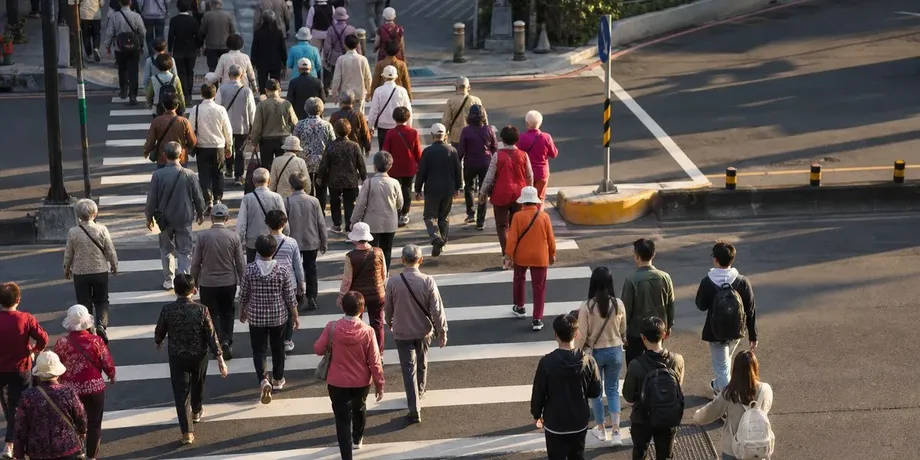
Taiwan's population aged 15 to 64 is projected to shrink by 4.509 million between 2026 and 2046, according to the National Development Council. That is an average net decline of about 618 people a day, as large generations reach 65 and much smaller generations reach 15.
Contents
- A smaller generation faces a growing replacement gap
- What has changed in the population forecast?
- Two large generations are moving toward retirement
- Older people are already filling more jobs
- Many older workers want to stay employed
- Care needs are growing alongside labor shortages
- Why pensions and health insurance face pressure
- How the government is trying to widen recruitment
- Key Points
The demographic imbalance is stark. Taiwan has 7.292 million people aged 45 to 64, representing 46.3 percent of its working age population. Over the next two decades, that group will pass the upper boundary of the working age category, while only 3.095 million young people are projected to reach its lower boundary.
Those figures amount to roughly 2.4 people reaching 65 for every person reaching 15. For employers, the prospect is a smaller pool of potential recruits. For households and the government, it means supporting more older people with fewer people in the age groups that usually provide most workers and insurance contributions.
The forecast measures movement between age groups. People reaching 15 often remain in education, while some people reaching 65 continue working. The figure of 618 a day describes the projected net reduction in the working age population, rather than a daily count of employees retiring.
Taiwan is already responding through recruitment services, support for older employees and women returning to work, and changes to migrant worker quotas. Employment among people aged 65 or older has also passed 500,000, showing that the boundary used in population statistics is becoming less closely tied to the end of working life.
What has changed in the population forecast?
The latest projection puts the decline at about 4.51 million for 2026 to 2046, compared with an earlier forecast of 4.06 million for 2024 to 2044. Lower fertility assumptions, meaning fewer expected births, contribute to the weaker outlook.
The two totals differ by about 449,000 people, although they cover different periods. The updated estimate has also been described as only 3,000 above a previous model, alongside an estimate of roughly 60 additional people lost each day. Those descriptions leave the precise size of the forecast revision unclear: 3,000 spread over 20 years would average less than one person a day.
The direction of change is consistent across the projections. An earlier National Development Council medium scenario put the population aged 15 to 64 at 16.17 million in 2024 and 11.84 million in 2045, a reduction of 4.33 million. Each calculation points to a substantial contraction over about two decades.
Lower births affect labor supply with a long delay. A child born today reaches 15 in 15 years and may begin full employment several years later. Measures that keep existing workers employed can therefore affect recruitment sooner than changes in birthrates.
Two large generations are moving toward retirement
Taiwan's current squeeze follows two periods of high births. Ministry of the Interior figures described in earlier coverage identify 3.78 million births during 1958 to 1966 and another 2.89 million during 1976 to 1982. Together, those generations total 6.67 million people.
The first group began reaching typical retirement ages in 2023. The later group will follow in the early 2040s. Earlier coverage of the two retirement waves described how these large generations are being followed by much smaller groups entering employment.
- 1958 to 1966: The first large birth generation totaled 3.78 million people.
- 1976 to 1982: A second large birth generation totaled 2.89 million.
- 2023: People born in the late 1950s and early 1960s began reaching retirement ages.
- 2037: People aged 45 to 64 are projected to exceed half of the working age population.
- Early 2040s: The later large birth generation reaches typical retirement ages.
- 2046: The latest projection period ends, with the working age population about 4.51 million smaller than in 2026.
The earlier retirement wave calculation paired 6.67 million people with about 1.6 million incoming young people. The latest projection pairs 7.292 million people aged 45 to 64 with 3.095 million reaching 15 over its forecast period. Readers need the age groups and dates alongside these totals because they describe different populations.
Older people are already filling more jobs
Employment statistics show a substantial change already underway. The Directorate-General of Budget, Accounting and Statistics recorded more than 500,000 employed people aged 65 or older in March, when labor force participation for that age group stood at 10.8 percent.
The agency's annual comparison showed employment among people aged 65 or older rising from 250,000 in 2015 to 460,000 in the later annual figure, an increase of 84 percent. Over the same comparison, employment among people aged 25 to 44 fell from 5.99 million to 5.67 million, a decrease of 320,000, or about 5.3 percent.
Tan Wen-ling, deputy director of the agency's Census Department, attributed the increase in older workers partly to longer healthy life expectancy and persistent staff shortages. She explained why businesses have an incentive to retain experienced employees:
"Employers are also reporting labor shortages. If they can get older people to keep working, it would be helpful to businesses," she said.
Ministry of the Interior figures put the population aged 65 or older at 4.67 million, or 20.06 percent of residents, in the annual figures accompanying the employment comparison. Taiwan has therefore crossed the threshold commonly used for a super aged society, where at least one person in five is 65 or older.
Ageing is changing the composition of the potential workforce as well as its size. People aged 45 to 64 currently account for 46.3 percent of the working age population. Council projections place their share above half from 2037, while the earlier 2045 scenario put it at 53.3 percent.
Many older workers want to stay employed
Demand for work among older people is rising too. A white paper by 104 Job Bank found that applications from middle aged and older job seekers increased 34.4 percent over three years, reaching an average of 82,000 a month in the latest year covered.
More than 80 percent of the workers surveyed hoped to continue working after 60, citing concerns about retirement savings and rising living costs. For these workers, staying employed means both continued earnings and a way to stretch savings across a longer retirement.
Chan Wan-jung, a manager at 104 Job Bank, said some companies still worry that older employees will cost more or discourage younger applicants. The platform's survey found that 93.7 percent of workers under 40 held neutral or positive views of workplaces that accommodate older employees.
The Ministry of Labor has introduced subsidies for retaining older workers, incentives for adjusting working hours, and programs to redesign jobs and improve working environments. These measures address a practical problem: a person may be willing to work while needing different hours or duties from those offered in an existing vacancy.
Care needs are growing alongside labor shortages
Taiwan's oldest residents are expected to become a much larger group. The National Development Council's 2024 medium projection put the population aged 85 or older on course to rise from about 470,000 to 1.39 million by 2045, nearly tripling.
Health ministry data and related studies place the disability rate among people aged 65 or older at about 15 percent. After 85, the average rises to roughly 50 percent, with differences between men and women. Applying that older age estimate to the projected population suggests that about 700,000 people over 85 could need help with daily activities or medical care.
The existing care workforce is much smaller. Ministry of Health and Welfare statistics for Long-Term Care 2.0 show about 97,000 to 100,000 licensed local caregivers. Around 70,000 provide home visits, helping with bathing, meals and medical appointments, while roughly 30,000 work in care centers, nursing homes or hospitals.
Migrant workers provide much of the care that requires someone to live in a household. Ministry of Labor figures count about 225,000 migrant workers in social welfare, with more than 92 percent working as home caregivers. Detailed figures put about 209,000 in home care and 16,354 in institutions.
Care demand and staffing are measured in different ways: a person receiving a few hours of help each week needs a different service from someone requiring constant assistance. Expanding care services matters to employment as well, because relatives providing care at home may have less time available for paid work.
Why pensions and health insurance face pressure
A National Development Council spokesperson warned that the widening replacement gap would put pressure on labor pensions, civil servant retirement funds and National Health Insurance. More older residents can mean higher spending on retirement benefits and healthcare, while a smaller employed population can limit contributions and tax revenue.
Social insurance pools money collected through contributions and public funding to pay benefits or cover services. When the number of people needing support grows faster than the number contributing, maintaining that support becomes more difficult.
Employment is therefore central to the financial challenge. A person who remains in paid work can continue earning and contributing, even after crossing the statistical age boundary of 65. Conversely, someone aged 15 to 64 who is studying, caring for relatives or unable to find work may contribute little through employment.
The council spokesperson called for a higher retirement age, greater participation and retention among women and older people, and more immigration. The proposals describe several ways to expand the number of contributors. No implementation date for a retirement age increase was given.
How the government is trying to widen recruitment
The Ministry of Labor says public employment service centers are matching job seekers with employers, organizing recruitment events and contacting potential candidates to arrange interviews. Support for unemployed women and older people includes changes to working hours and job duties, alongside retention incentives.
Manufacturing policy also links access to additional migrant workers with higher pay for local employees. Under the ministry's scheme, an employer can obtain one additional migrant worker quota for each NT$2,000 raise given to a local employee.
The additional quota is capped at 10 percent of the employer's workforce covered by labor insurance. When combined with other migrant worker schemes, the permitted quota can reach as much as 45 percent of insured workers.
The ministry says the policy is intended to help industries fill vacancies while improving wages and working conditions for local staff. Its stated principle is to avoid harm to local employment as access to migrant workers expands.
International recruitment can supplement Taiwan's shrinking domestic labor pool, while job redesign and flexible schedules can help people already living in Taiwan remain employed. The care figures show why both approaches matter: businesses need workers at the same time that ageing households need more assistance.
The immediate task is broader than replacing every departing employee with a young recruit. Taiwan needs more of its existing population to be able to work, employers to make suitable jobs available, and care services that allow families to balance employment with support for older relatives. The demographic forecast puts a scale and a timetable on those decisions.
Key Points
- Taiwan's population aged 15 to 64 is projected to fall by 4.509 million between 2026 and 2046, averaging about 618 people a day.
- The age groups involved suggest roughly 2.4 people reaching 65 for every person reaching 15.
- Employment among people aged 65 or older passed 500,000 in March, with labor force participation at 10.8 percent.
- People aged 45 to 64 are projected to exceed half of the working age population from 2037.
- The population aged 85 or older could reach 1.39 million by 2045, increasing demand for care.
- Government measures include older worker retention support, flexible hours, job redesign and migrant worker quotas linked to local wage increases.