

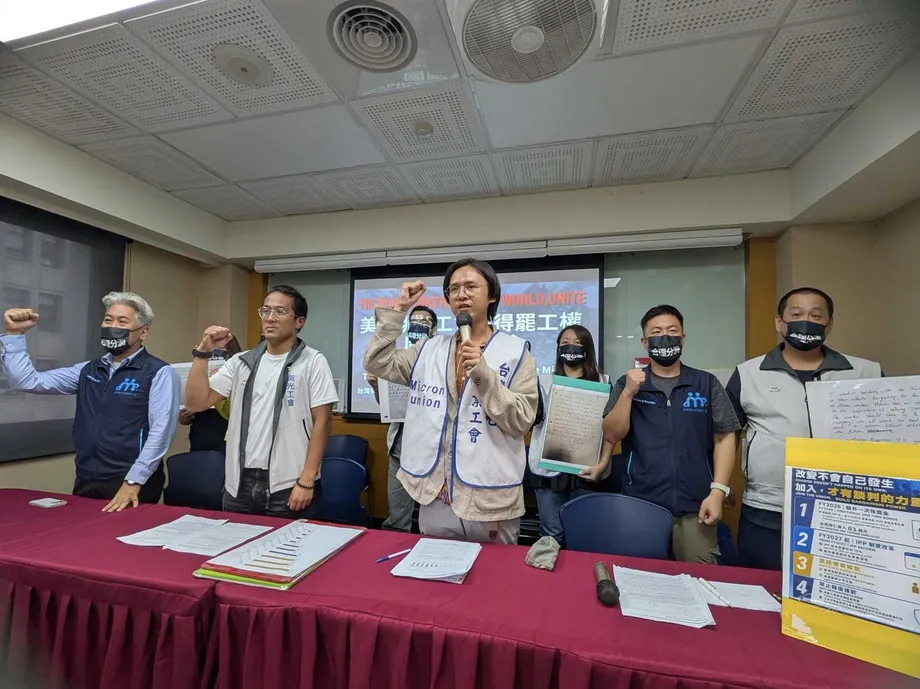
Strike mandate puts pressure on Micron board
Workers at Micron Technology's Taoyuan operations in Taiwan have authorized a strike by an overwhelming margin, putting pressure on the American memory chipmaker to negotiate a permanent system for sharing profits. Of 2,258 eligible union members, 2,012 voted between October 1 and 6, 2026. There were 1,994 votes in favor, 14 against and four invalid ballots.
Contents
- Strike mandate puts pressure on Micron board
- What the ballot authorizes
- A profit formula rather than discretionary rewards
- Why the September package did not settle the dispute
- Cash and stock comparisons drive worker complaints
- How the proposed pool compares with competitors
- Exceptional earnings raise the stakes
- Production risk depends on the strike's scope
- Separate negotiations, coordinated demands
- The dates that matter next
- Key Points
The union announced the result on October 7 but did not set a strike date. Chairman Jerry Lin said members could receive a text message calling a surprise walkout if the company failed to present concrete proposals after board meetings scheduled for October 8 and 9, U.S. time. The union said giving little notice would limit the company's opportunity to prepare.
The demand reaches beyond a larger bonus this year. The Taoyuan and Taichung unions want 15% of Micron's operating profit allocated to employee rewards, including a permanent quarterly distribution system starting in fiscal 2027. They also seek an additional fiscal 2026 payment that they estimate could equal about 83 months of salary per Taiwan employee.
Micron says it respects employees' legal rights, takes their concerns seriously and will continue dialogue and mediation. Taiwan's Ministry of Labor has urged the company to offer concrete, feasible proposals. The immediate issue is whether negotiations can bridge the gap between Micron's exceptional compensation package and the unions' demand for a predictable formula that applies beyond a single profitable year.
What the ballot authorizes
The vote gives the Taoyuan union authority to pursue a strike and establish picket lines, according to union officials. It does not mean a walkout has begun. Timing, participation and the precise form of any action remain undecided.
The ballot totals also explain the slightly different percentages appearing in reports. The 1,994 supporting votes represent 88.3% of all eligible members and approximately 99.1% of the 2,012 ballots cast, including invalid ballots. Reports describing support as 99% are using a rounded figure. Turnout was approximately 89.1%, sometimes rounded to 89%.
Union secretary Chen Yan-kai connected the result directly to dissatisfaction with Micron's Incentive Pay Plan, known as IPP, its annual performance bonus system.
The vote "shows the employees' distrust in the IPP system."
Taoyuan mediation ended without agreement in September. The union is now combining its strike mandate with a demand for further negotiations, rather than announcing an immediate stoppage.
A profit formula rather than discretionary rewards
The unions' central proposal is to replace what they describe as an opaque bonus arrangement with payments tied to a published measure of company performance. Operating profit is the amount a business earns after operating expenses, before items such as interest and income taxes. Linking a bonus pool to that figure would make its size move with the company's operating results.
The joint demands include an additional fiscal 2026 bonus based on 15% of global operating profit, followed by quarterly distributions using the same percentage from fiscal 2027. The unions also want provisions addressing employees who benefit from an agreement without participating in the union, and protection against retaliation for union activity. The precise contractual wording has not been disclosed.
Lin, the Taoyuan union chairman, described the purpose of the proposed reform in these terms:
What we want is to establish an open and transparent profit-sharing system.
The unions say they are not demanding large payments during periods of losses. Their argument is that employees bear business risks during downturns and should receive a defined share when demand and profits rise. They also say Micron previously distributed 10% of quarterly net profit to employees. That historical arrangement, as described by the unions, used a different accounting measure from the operating profit proposed now.
Why the September package did not settle the dispute
Micron announced fiscal 2026 rewards in September for more than 60,000 employees worldwide following what the company called an "extraordinary year." For eligible Taiwan employees, the package included an NT$1 million cash bonus, annual performance awards reported as reaching up to 500% of the basic target, and additional stock compensation.
Descriptions of the package differ. One account gives a minimum of NT$1.7 million in cash compensation for Taiwan employees, while others identify the NT$1 million payment as one component. Another describes the package as worth up to 68 months of pay. These figures use different descriptions of compensation and should not be treated as interchangeable amounts guaranteed to every worker.
The unions rejected the package because it did not establish the permanent mechanism they wanted. They also criticized Micron for announcing rewards while mediation was underway without first reaching agreement with them. Micron has not linked its fiscal 2026 rewards announcement to the Taiwan labor dispute.
The distinction is between the size of a particular payment and the rules governing future payments. A large exceptional award can still leave employees uncertain about eligibility, calculation methods and what happens in the next financial year. The unions are asking management to negotiate those rules, as well as this year's amount.
Cash and stock comparisons drive worker complaints
The unions cite fiscal 2025 compensation as evidence of unequal access to company gains. They say the global employee IPP performance factor was 93.9%, producing Taiwan performance bonuses initially worth about 2.3 months of salary, later adjusted to 2.6 months. They compare that with the chief executive's annual cash performance compensation, which they calculate as equivalent to 32.4 months of salary.
That comparison needs a qualification: the employee and executive awards came under different programs. Expressing each award in months of the recipient's salary does not establish that the programs had identical targets, conditions or calculation methods. The union acknowledges the difference but argues that Micron should explain why rewards tied to company performance diverge so widely.
Stock awards are another point of contention. The union says about 40% of Taiwan employees received restricted stock awards in 2025. Taichung union representative Qiao Yanxiang contrasted that with nearly universal coverage in the United States. Restricted stock awards are company shares granted subject to conditions, commonly including continued employment before full ownership.
The union also cites approximately 207 shares awarded on average to global employees in 2025, compared with 83,015 shares for the chief executive, roughly 400 times as many. It says that in 2023, when Micron recorded losses and cut nearly 15% of its workforce, the chief executive received about 225,000 shares, approximately 570 times the global employee average.
These are union comparisons, not an agreed assessment of equivalent compensation. The union says Micron has since announced stock awards covering all employees, but it continues to seek clearer eligibility and allocation rules.
How the proposed pool compares with competitors
The unions point to Samsung Electronics and SK Hynix as examples of memory manufacturers whose rewards are linked to profits or operating performance. They also cite Taiwan Semiconductor Manufacturing Co., Nanya Technology, Winbond Electronics and Powerchip Semiconductor Manufacturing as companies with employee rewards connected to business results.
A reported Samsung agreement allocated the equivalent of 10.5% of operating profit to semiconductor employee bonuses, with around 78,000 employees eligible. Micron's unions are seeking 15%, a difference of 4.5 percentage points. The proposed percentage is about 43% higher than Samsung's reported percentage, but that alone cannot establish which company's employees would receive more. Profit levels, workforce size, allocation rules and salary structures all affect individual payments.
The unions estimate that their fiscal 2026 proposal could produce awards worth about 83 months of salary per Taiwan employee. That is their calculation, not a company commitment. They also argue that even a 15% allocation would not necessarily put Micron employees ahead of their Korean counterparts.
The dispute includes competing descriptions of bonus limits. Reports describe the existing IPP achievement ceiling as 200%, corresponding to approximately five months of bonus pay, while the exceptional fiscal 2026 package includes awards of up to 500% of the basic target. Those descriptions should not be collapsed into a single rule. The negotiations concern both the exceptional rewards and the framework for future years.
Exceptional earnings raise the stakes
The compensation demands come amid strong demand for memory used in artificial intelligence infrastructure. Reported fiscal 2026 figures put Micron's revenue at US$133.19 billion and operating income at US$99.34 billion for the year ending September 3. Those figures imply an operating margin of approximately 74.6%, calculated by dividing operating income by revenue.
Applying the unions' proposed 15% allocation to that reported operating income would produce a global employee pool of approximately US$14.9 billion. That calculation illustrates the scale of the demand, but it does not establish any individual's entitlement. Distribution rules and the employees covered would determine actual awards.
Another report describes fiscal 2026 revenue as approximately US$133 billion, up 256% from about US$37 billion the previous year. The rounded revenue figures do not reproduce that growth rate exactly, so they cannot support a precise comparison without more detailed figures.
Micron shares were reported down more than 2% in U.S. trading before the market opened on October 7. The price movement occurred as the strike authorization became public, but it does not by itself establish how much of the decline was caused by the labor dispute.
Production risk depends on the strike's scope
Taiwan is a major manufacturing center for Micron's DRAM and high bandwidth memory, or HBM. DRAM provides working memory for computers and servers. HBM places memory chips in stacked arrangements to move large amounts of data quickly, making it valuable for demanding AI workloads.
The Taoyuan factory primarily produces DRAM. A strike that interrupts equipment maintenance or process monitoring could reduce production stability and the proportion of chips that meet quality requirements. A longer disruption could gradually affect output and supply. The actual impact would depend on participation, duration and Micron's contingency arrangements.
Reports differ on Taiwan's share of Micron production. One puts it at roughly 50% to 60% of the company's chips; another, citing the union, says the Taoyuan and Taichung sites account for more than 60% of global output. Neither figure means that a Taoyuan strike alone would stop that entire share of production.
Micron has described Taiwan as a critical manufacturing hub and said it has invested more than NT$1.6 trillion there. A disruption could add pressure to an already tight memory market, but no confirmed production loss, delivery delay or customer impact has been announced.
Separate negotiations, coordinated demands
Micron employs approximately 15,000 people in Taiwan. Local estimates put Taoyuan employment at around 3,000, with about 2,400 union members, and Taichung employment at 12,300, including roughly 11,000 union members. Those approximate site figures do not exactly match the national total. Reports also vary between nearly 12,000 union members across Taiwan and more than 80% of the workforce.
The important procedural distinction is that the two locations have separate unions. Taoyuan has secured strike authorization, while Taichung remains in negotiations. Its next mediation session is scheduled for October 22. Most accounts describe that as the second session, while one calls it the third; the date is consistent.
The unions say their demands were submitted jointly and that they will remain coordinated. The Taichung union plans to invite Taoyuan representatives to the October 22 mediation to discuss the company's proposals together. Taichung has not announced a strike decision.
Micron said it would continue communicating with both unions. In its statement on the dispute, the company described how it intended to proceed:
We will continue to work through the established dialogue and mediation processes.
The Ministry of Labor said the vote reflected employee expectations for a reasonable profit sharing system. It described a strike as a last resort aimed at securing equal negotiations and said it would work with the Taoyuan City Government and Central Taiwan Science Park Bureau to support further talks.
The dates that matter next
The immediate negotiating sequence centers on a board response, a public rally and further mediation. The union has expressly distinguished the October 19 rally from a strike, encouraging employees to take leave to attend.
- September: Taoyuan mediation ended without agreement, and Micron announced its fiscal 2026 rewards package.
- October 1 to 6: Taoyuan union members voted on strike authorization, with counting completed on October 6.
- October 7: The union announced the result and said a surprise strike remained under consideration.
- October 8 and 9, U.S. time: Scheduled board meetings after which the unions sought concrete proposals.
- October 19: Planned rally on Taipei's Ketagalan Boulevard, with participation through employee leave rather than a formal strike.
- October 22: Scheduled Taichung mediation, with Taoyuan representatives invited to participate.
No strike date or negotiated settlement has been announced. The allocation formula, treatment of different employee groups and protections surrounding union participation remain unresolved. Strike authorization has increased the pressure on Micron, but it has not ended negotiations or established that production will stop.
Key Points
- Taoyuan workers approved strike action with 1,994 supporting votes, representing 88.3% of eligible members.
- No strike date has been set; the union may notify members by text message.
- The unions seek a fiscal 2026 bonus and permanent quarterly distributions based on 15% of operating profit.
- Micron's exceptional rewards package did not resolve demands for transparent, lasting compensation rules.
- The October 19 Taipei rally is not a formal strike; Taichung mediation is scheduled for October 22.
- Any production impact would depend on the scale and duration of a walkout and the company's response.