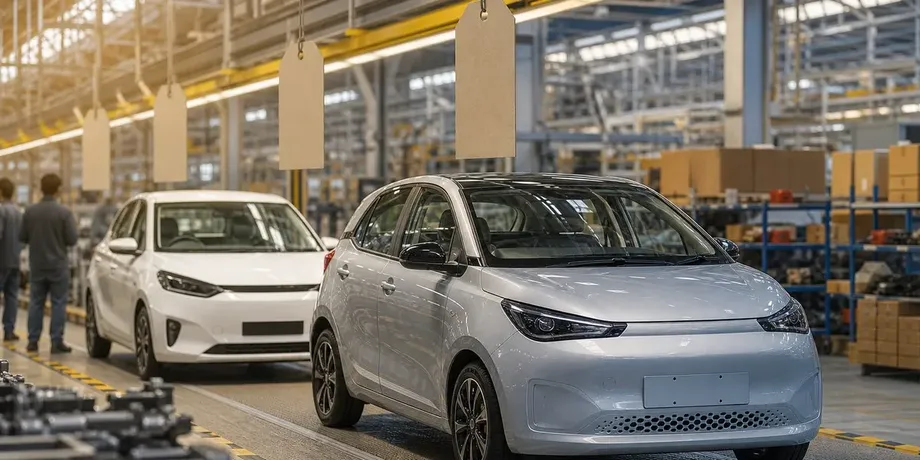
Cheaper cars proposed, with tougher demands on manufacturers
Pakistan's proposed Automotive and Auto Parts Manufacturing Policy 2026–31 could cut prices for some vehicles by more than 20%, while requiring manufacturers to export more, use more domestic components and compete against cheaper imports.
Contents
- Cheaper cars proposed, with tougher demands on manufacturers
- How much could buyers save?
- Why a tax cut is not the same as a price cut
- Three electric technologies, three proposed rates
- Financing and charging could shape demand
- A new levy would help pay for incentives
- Exports would become a condition of manufacturing
- Local suppliers fear losing their market
- What still needs approval?
- Key Points
The draft proposes sales tax of 1% for battery electric vehicles, 6% for range extended electric vehicles and 9% for plug-in hybrids. Preliminary industry estimates suggest petrol cars could become about 8–10% cheaper and conventional hybrids about 9% cheaper. Electric vehicles with an import value up to $15,000 could fall by roughly 22%, compared with about 8% for more expensive models.
Prime Minister Shehbaz Sharif approved the draft on October 20 for further consultation and review, according to Pakistan Association of Automotive Parts and Accessories Manufacturers chairman Abdul Rehman Aizaz. The proposals still require government approvals and legal implementation. Manufacturers have not announced the projected price reductions.
Pakistan's parts makers see a serious threat alongside the potential savings for buyers. Lower duties would make imported components and finished cars more competitive, putting pressure on businesses that supply domestic assembly plants. The government is pairing those cuts with export obligations, financial support and penalties that could extend to cancelling manufacturing certificates.
The central bargain is straightforward: consumers would gain access to cheaper vehicles, while manufacturers would receive incentives tied more closely to exports and domestic production. Whether both sides benefit depends on the final tax rules, the pace of tariff cuts and how much of the savings reaches showroom prices.
How much could buyers save?
Industry estimates put the potential price of the GAC Aion UT at about Rs5 million to Rs5.2 million, down from roughly Rs6.4 million. That would mean savings of Rs1.2 million to Rs1.4 million, or approximately 19–22% of the current price.
Certain versions of the Honda HR-V e:HEV, Haval Jolion and Toyota Corolla Altis could become Rs600,000 to Rs800,000 cheaper. The estimates cover different vehicle technologies and tax arrangements, so the expected reduction varies by model.
Plug-in hybrids could receive some of the largest reductions under preliminary assessments of the wider package. Extended range electric vehicles, however, could become about 3% more expensive under the proposed structure, even though their proposed sales tax rate is lower than the rate for plug-in hybrids.
Vehicle prices reflect several charges, including sales tax, customs duties and, where applicable, federal excise duty. A lower rate for one tax can be offset by changes elsewhere. Exchange rates, imported component costs and manufacturers' pricing decisions would also affect the amount buyers pay.
Why a tax cut is not the same as a price cut
The proposed reduction in plug-in hybrid sales tax from 18% to 9% illustrates how the calculations work. The tax rate falls by nine percentage points, but a price already including 18% tax would fall by about 7.63% if everything else stayed unchanged.
A vehicle worth Rs10 million before sales tax costs Rs11.8 million with 18% tax. At 9%, it would cost Rs10.9 million. The saving is Rs900,000, which is about 7.63% of the original Rs11.8 million price.
Some model estimates assume broader changes. A published calculation places the MG HS Super Hybrid at Rs8.843 million rather than Rs10.199 million, a saving of Rs1.356 million. Its estimated Jetour T2 price falls from Rs12.795 million to Rs11.094 million, saving Rs1.701 million. Those reductions are larger than the effect of the sales tax change alone.
The model calculations contain inconsistent assumptions about other taxes and some differences between their stated savings range and individual entries. Buyers therefore have a more reliable guide in the underlying tax arithmetic than in those projected showroom prices. Final prices will depend on the approved package and manufacturers' announcements.
Three electric technologies, three proposed rates
Battery electric vehicles run entirely on electricity stored in a battery. They need an external electricity supply to recharge and would retain the draft's lowest sales tax rate, 1%, throughout 2026–31.
A genuine range extended electric vehicle uses an electric motor to drive its wheels. A combustion engine acts as a generator when needed, producing electricity rather than mechanically driving the wheels. The draft proposes a 6% sales tax for this category.
Plug-in hybrids combine an externally rechargeable battery with a combustion engine that can also help drive the vehicle. Their proposed sales tax is 9%. Conventional hybrids, which are not charged from an external supply, form a separate category.
An earlier draft proposed a uniform 1% sales tax for all three new energy technologies, alongside exemptions from federal excise duty, capital value tax and withholding tax. The later structure separates them. That change matters because their use of petrol can vary considerably, particularly when owners do not regularly charge vehicles capable of running on electricity.
The policy debate also includes proposals to tie plug-in hybrid incentives to measurable electric driving range, battery capacity, fuel consumption and emissions. Clear technical definitions would help customs and tax authorities apply the intended rate to each vehicle.
Financing and charging could shape demand
The draft would raise the financing limit for eligible electric or new energy vehicles from Rs3 million to Rs10 million and extend the maximum repayment period from three years to five. The proposed borrowing ceiling would be more than three times its current level.
A longer repayment period spreads the principal across more instalments, although interest rates and bank lending conditions still determine the monthly bill and total financing cost. The higher limit would give buyers more scope to finance vehicles whose prices exceed the existing ceiling.
Charging equipment would receive support through a proposed 1% import duty on charging stations. An earlier draft also considered financial assistance for battery swapping infrastructure where commercial revenue would initially be insufficient to cover costs.
Electric vehicles with import values below $15,000 would receive lower tariffs during the policy's first two years. At the other end of the market, the draft proposes a 10% federal excise duty on electric vehicles valued above $75,000. The structure directs stronger support toward less expensive models while adding a charge for the most costly imports.
A new levy would help pay for incentives
The proposed Automotive Development Levy would apply to locally produced and imported conventional vehicles, including affected petrol, diesel and hybrid models. Its engine capacity schedule would create a much larger charge above 2,000cc:
- Up to 1,000cc: 0%.
- 1,001cc to 1,300cc: 2%.
- 1,301cc to 2,000cc: 2%.
- 2,001cc to 3,000cc: 10%.
- Above 3,000cc: 10%.
The government expects the levy to raise more than Rs232 billion over five years. Proposed uses include export incentives, technology upgrades for parts makers, research, testing and certification. Legislation governing the charge is targeted for completion by December 2026.
The levy would sit within a wider package of duty reductions and tax adjustments. Small cars would remain subject to other applicable taxes even with a zero levy rate. For larger vehicles, the eventual price would reflect both the new charge and any reductions elsewhere.
Earlier Budget 2025–26 proposals described a Climate Support Levy with rates of 1%, 2% and 3% for conventional and hybrid vehicles. The final legislation needs to specify how the Automotive Development Levy interacts with existing vehicle charges.
An earlier draft's fiscal projections used a broader framework: approximately Rs349.9 billion in additional federal excise collections and a cumulative surplus of Rs21.1 billion after export support and new energy tax concessions. Its annual balance moved from a Rs46.8 billion surplus in 2026–27 to a Rs44.1 billion deficit in 2030–31, showing why the cost of incentives is central to negotiations.
Exports would become a condition of manufacturing
The latest ministry presentation sets a target of roughly $6 billion in combined vehicle and parts exports over five years. A detailed account puts the total at $6.01 billion. PAAPAM estimates current annual exports at about $190 million to $200 million, making the proposed expansion substantial.
A five year total of $6 billion would average $1.2 billion annually, around six times the current annual level. An earlier draft used a cumulative target of about $4.59 billion. Another description assigns $6 billion to vehicles and a separate $1.2 billion parts target by 2030–31, rather than using the combined five year measure.
The annual figures published alongside the $6.01 billion target also require clarification. They are $256.6 million for 2026–27, $671.8 million for 2027–28, $1.11 billion for 2028–29, $1.17 billion for 2029–30 and $2.19 billion for 2030–31. Together, they total about $5.40 billion.
The proposed enforcement measures are severe. Manufacturers missing minimum export targets could face penalties of 1–3% of annual production value. Missing targets for two consecutive years could lead to cancellation of manufacturing certificates.
Exporters would receive compensation equal to 5% of net free on board export value, with an additional 10% on incremental exports when annual growth exceeds 5%, under the later description. Free on board value generally covers goods through loading for export, before international freight and insurance. An earlier version reversed the incentive structure, proposing 10% support plus 5% when exports grew by at least 5%.
Aizaz, the PAAPAM chairman, argued that targets need practical support to become achievable:
Exports will not go up just by setting up a target.
He cited security concerns, limited trade agreements, high energy and financing costs, taxation and difficulties bringing foreign buyers to Pakistan for factory inspections. Parts makers put their structural cost disadvantage at 34%.
Local suppliers fear losing their market
The draft envisages reducing tariffs on localized components imported in completely knocked down kits from 25% to 15% by fiscal year 2030–31. These kits contain parts brought into Pakistan for assembly. Lower duties would reduce the protection domestic suppliers receive against competing imports.
Topline Securities analysts expect competition could push assemblers to pass tariff savings to consumers. Parts manufacturers warn that the same change could weaken their businesses before they can build export markets or upgrade production.
Aizaz pointed to September imports as evidence of mounting pressure. New completely built vehicles rose to 2,407 units from 391 in August, while used vehicle imports increased to 2,454 from 1,185. Combined imports reached 4,861 vehicles, compared with 1,576 a month earlier, more than tripling.
He estimated the associated loss of potential revenue for domestic parts makers at about Rs7.3 billion. Imported finished cars bypass much of the local component supply chain that supports domestic assembly.
The draft also seeks more domestic production through minimum value addition requirements. An earlier version proposed 40% for conventional cars by 2030–31, with new energy vehicles starting at 10% and rising to 15%. Manufacturers missing local content targets could lose export incentives and concessions on imported components.
The Pakistan Institute of Development Economics has recommended tying incentives to technological development, exports and measurable performance. That approach would reward engineering and more sophisticated components alongside assembly. Proposed testing facilities and technology funding could support that shift, while suppliers face stronger import competition.
What still needs approval?
The Ministry of Industries and Production has shared the draft with the International Monetary Fund, according to ministry sources, with virtual discussions expected. The IMF had sought an 18% sales tax on electric vehicles, while the government proposed alternative revenue to offset preferential rates.
Officials were also expected to discuss a levy on vehicles valued above Rs20 million. Its detailed relationship with the engine capacity levy has not been specified. The main steps described during the policy's development are:
- September 9, 2026: Sharif reportedly gave an earlier draft approval in principle.
- October 20: the ministry presented the revised draft, and Aizaz said Sharif approved it for consultation and IMF review.
- October 21: the draft was described as shared with the IMF, with further approval steps pending.
- December 2026: the stated target for completing Automotive Development Levy legislation.
- Fiscal year 2030–31: the endpoint for major tariff, export and domestic production targets.
Aizaz said the policy would proceed through the Economic Coordination Committee, federal cabinet and National Assembly after IMF approval. Ministry spokesperson Shahzad Ali said private industry had been consulted, but declined to confirm the IMF submission when asked.
The draft would establish a Pakistan Automotive Testing Institute, support independent certification and introduce international safety standards for domestic and imported vehicles. It also proposes mandatory compliance certificates for imports, two sector audits each year and consumer protection provisions in manufacturers' contracts with buyers.
For consumers, the next decisive developments are the approved tax schedules and manufacturers' price announcements. For factories and suppliers, the final export obligations, tariff timetable and rules for receiving incentives will determine how quickly they must adapt.
Key Points
- Some vehicle prices could fall by more than 20%, according to preliminary estimates, if the draft is implemented and savings reach buyers.
- Proposed sales tax rates are 1% for battery electric vehicles, 6% for range extended vehicles and 9% for plug-in hybrids.
- Eligible vehicle financing could rise from Rs3 million to Rs10 million, with repayment extended to five years.
- A proposed Automotive Development Levy reaches 10% for conventional vehicles with engines above 2,000cc.
- The latest export goal is roughly $6 billion over five years, with penalties and possible certificate cancellation for missed targets.
- Parts makers warn that lower import tariffs could weaken domestic suppliers.
- The policy remains a draft requiring further approvals and legal implementation.