A force based in Korea, ready for orders elsewhere
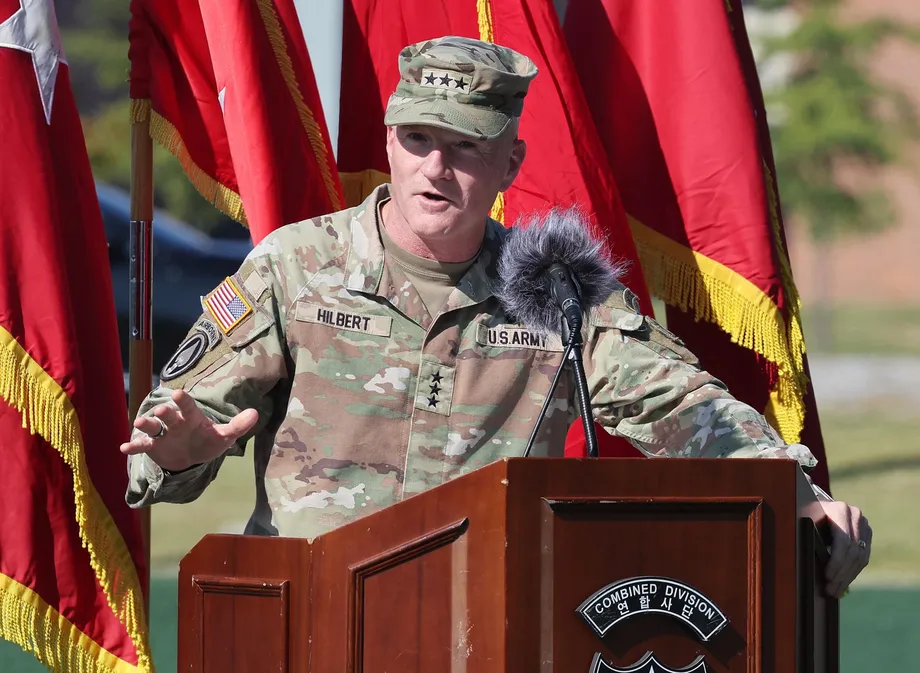
Lt. Gen. Joe Hilbert, commander of the U.S. Eighth Army in South Korea, says his troops must be ready to deploy beyond the Korean Peninsula if ordered, as Washington seeks greater freedom to use its forces across the region. His comments bring a concrete military dimension to a policy already set out in the Pentagon's January 2026 defense strategy: South Korea should take primary responsibility for deterring North Korea, with critical but more limited American support.
Contents
- A force based in Korea, ready for orders elsewhere
- What Washington's strategy asks of Seoul
- Defense of South Korea remains the stated commitment
- Why a Taiwan contingency enters the discussion
- How the policy and industrial plans developed
- South Korea's factories become part of military planning
- A $260 million contract shows closer industrial ties
- A more reciprocal alliance
- Support could matter as much as troop deployments
- Key Points
The Eighth Army commands American ground forces from Camp Humphreys in Pyeongtaek, south of Seoul. It forms part of U.S. Forces Korea, known as USFK, which has roughly 28,500 personnel across its services. That figure covers the wider American presence, rather than the Eighth Army alone.
In an email interview on October 21, Hilbert said his command remained focused on fulfilling American commitments under the mutual defense treaty with Seoul. He also argued that being stationed in South Korea should not restrict the missions his troops prepare to undertake.
Hilbert described how the force approaches readiness:
We view readiness as largely threat-agnostic. If we have a trained, ready force capable of executing the Army's assigned missions, we can apply that force against whatever threat is required.
In plain language, he wants soldiers prepared for the missions assigned to them, rather than trained around only one opponent. A deployment beyond Korea would still depend on orders. No specific deployment, destination, timetable or number of troops was announced.
What Washington's strategy asks of Seoul
The Pentagon's 2026 National Defense Strategy, published in January, supplies the policy behind this broader role. It calls for a strong denial defense along the first island chain and greater contributions from regional allies and partners to collective defense and to deterring and balancing China.
A denial defense aims to make an attack too difficult or costly to succeed. The first island chain runs from Japan through Taiwan to the Philippines and the South China Sea. South Korea sits near its northern end, making the peninsula relevant both to defense against North Korea and to American operations farther across the western Pacific.
The strategy identifies South Korea's powerful military, high defense spending, substantial arms industry and mandatory military service as reasons it can assume greater responsibility. Its assessment also rests on Seoul's direct interest in confronting the threat from North Korea.
The Pentagon states its intended division of responsibilities in these terms:
South Korea is capable of taking primary responsibility for deterring North Korea with critical but more limited U.S. support.
The document then connects that shift to updating the American force posture on the peninsula. Force posture means how troops and equipment are positioned, organised and made available for missions. For Seoul, the practical issue is how to carry more of the immediate defense burden while American forces remain available for wider regional tasks.
Defense of South Korea remains the stated commitment
The Pentagon has reaffirmed that Washington remains committed to the bilateral mutual defense treaty. Asked about the possible contribution of forces in Korea to wider Indo-Pacific deterrence, an unnamed Pentagon official described their continuing mission.
Our forces in Korea remain focused on maintaining readiness, deterring aggression, and defending the Republic of Korea alongside our ROK allies.
Republic of Korea, or ROK, is South Korea's official name. The statement places defense of South Korea at the center of the current mission, while Hilbert's remarks explain why the command also prepares for other assignments.
Hilbert said the Eighth Army trains daily with South Korean allies against its principal threat while staying ready for other national requirements. He pointed to participation in multinational exercises across the Asia-Pacific as an existing example of activity beyond the peninsula.
Why a Taiwan contingency enters the discussion
A conflict in the Taiwan Strait is among the regional contingencies discussed in connection with a more flexible USFK. Washington's focus on deterring China gives particular weight to questions about whether forces based in Korea could support operations elsewhere.
Strategic flexibility means giving American leaders more options to use those forces outside their usual area of responsibility. In this case, the debate concerns ground forces as well as the air and naval capabilities more commonly associated with movement across the Pacific.
Gen. Xavier Brunson, commander of USFK, has connected strategic flexibility to modernising the alliance. At a briefing in August of the previous year, he described the need to respond to threats from China, Russia and North Korea within a wider Indo-Pacific security framework.
The Eighth Army has a distinctive place in that discussion. It is the only permanently forward deployed American field army and commands U.S. ground forces already positioned on the Asian continent. Its location provides an established base from which Washington can prepare for several demands, while Seoul continues to face the immediate threat from the North.
How the policy and industrial plans developed
Hilbert's comments follow a series of policy statements and proposals linking South Korea's defense capacity with American regional operations. The sequence shows that troop readiness and industrial support are developing as connected parts of the same approach.
- August 2025: Brunson described strategic flexibility as central to alliance modernisation.
- January 2026: The National Defense Strategy called for South Korea to take primary responsibility for deterring North Korea, with critical but more limited U.S. support.
- May 2026: At the Land Forces Pacific symposium in Hawaii, Hilbert proposed using South Korean manufacturing to reduce the need to transport equipment across the Pacific.
- August 2026: The U.S. Army awarded Hanwha a contract worth up to $260 million for K9 Mobile Howitzer prototypes.
- October 2026: Brunson discussed sustaining Pacific operations through South Korean industry at the Association of the United States Army's annual meeting.
- October 21, 2026: Hilbert explained why his troops must remain ready for missions beyond the peninsula.
The developments move from broad policy toward practical preparations: deciding what forces should be ready to do, where equipment could be supported and which manufacturers could supply it.
South Korea's factories become part of military planning
Brunson's remarks at the Association of the United States Army meeting focused on a basic wartime problem: keeping forces supplied and their equipment working over long distances. He said the Army wants to change a depot mindset that relies on moving weapons and equipment between the continental United States and the Asia-Pacific, a process that can take days or weeks.
Military sustainment covers the supplies, maintenance and other support that allow troops to continue operating. For a force in the Pacific, access to ammunition and repairs closer to its operating area can reduce dependence on lengthy journeys across the ocean.
Brunson described South Korea as having an advanced industrial base capable of supporting American endurance within the first island chain. He explained the operational goal:
What's going to be important in the future, in particular in a fight in the Pacific, is our ability to endure, whether that be able to protect the things that we've placed forward, or whether that be the ability to stay there because we can sustain ourselves inside the first island chain from Korea.
Hilbert had made a similar proposal in Hawaii in May. His argument was that working with South Korean manufacturing could reduce the need to cross the Pacific and give American joint forces greater flexibility. For South Korea, this would mean a larger supporting role through production and maintenance, alongside its existing military mission.
A $260 million contract shows closer industrial ties
The U.S. Army's August award to Hanwha provides a specific example of the industrial relationship. The contract, worth up to $260 million, covers prototypes of the K9 Mobile Howitzer for the Army's Mobile Tactical Cannon program. The acquisition was described as the first South Korean weapons system acquired by the American military.
A howitzer is an artillery weapon that fires shells at targets from a distance. A prototype is a version supplied for development and evaluation. The contract ceiling describes the maximum potential value of the award, while the stated work concerns prototypes for the program.
General Atomics also displayed a scale model of its Mojave drone at the Army association's annual meeting. The aircraft was developed and produced with Hanwha Aerospace under a partnership signed the previous year.
Mojave is designed for short takeoff and landing, meaning it can operate with less runway space than aircraft requiring longer runways. Alongside the artillery contract, the partnership shows how cooperation is extending into weapons and aircraft development, beyond the traditional relationship between American forces and the country hosting them.
A more reciprocal alliance
Lami Kim, Korea chair in advanced technologies, national security and defense at the International Institute for Strategic Studies in London, sees the alliance becoming a more reciprocal partnership. Her assessment connects Washington's requests with the growth of South Korea's military capabilities since the alliance was established in the 1950s.
Kim described the change in responsibilities:
Both countries are expected to contribute to each other's security and South Korea assumes greater responsibility for its own defense.
That would place two demands on Seoul at the same time: maintaining strong deterrence against North Korea and contributing to the support American forces need during a regional emergency. Kim said South Korea would likely provide logistical support in such a contingency.
She also identified a role for its arms industry if fighting continued for a prolonged period:
If the conflict became prolonged, South Korea's defense industrial base could also play an important role in replenishing American weapons stockpiles and sustaining U.S. military operations.
For South Korean manufacturers, that points toward demand for replacement weapons and supplies during extended operations. For military planners, it makes production capacity part of the discussion about how long forces can keep operating.
Support could matter as much as troop deployments
Troy Stangarone, a visiting senior fellow at the Korea Economic Institute of America, also places South Korea's supporting role at the center of the regional debate. He said Seoul has been taking on a larger defense role and expanding its domestic arms industry while Washington seeks greater flexibility in using American forces.
Stangarone noted that the United States has previously moved forces and equipment from the peninsula for operations elsewhere, including the Iraq war in 2003 and the recent Iran war. His assessment puts Hilbert's readiness argument within an existing practice of moving resources when required.
Stangarone described South Korea's likely contribution during a regional contingency:
Despite periodic calls for South Korea to commit forces to any contingency in the region, it has long been clear that its primary role is a supporting role providing needed munitions and armaments.
That assessment helps explain why factories, repair capacity and supply arrangements feature so prominently alongside discussion of troop movements. South Korea could contribute to operations elsewhere through the equipment and ammunition it provides, while keeping its own military focused on deterrence against North Korea.
The emerging division of labor connects three concrete aims: stronger South Korean responsibility on the peninsula, more deployment options for American commanders and a regional supply base capable of sustaining forces in a prolonged conflict. Hilbert's remarks describe the readiness required of his troops; the Pentagon strategy and industrial partnerships show the broader changes around them.
Key Points
- Lt. Gen. Joe Hilbert says the Eighth Army must be ready for missions beyond the Korean Peninsula if ordered.
- The Pentagon's January 2026 strategy calls for South Korea to take primary responsibility for deterring North Korea, with critical but more limited American support.
- The Pentagon continues to affirm its treaty commitment to defending South Korea.
- USFK has roughly 28,500 personnel across its services. No specific new deployment was announced.
- American commanders want South Korean industry to help supply, maintain and sustain forces operating in the Pacific.
- A Hanwha contract worth up to $260 million for artillery prototypes illustrates closer defense industrial cooperation.