Three districts account for nearly half the bill
Seoul apartment owners have been assessed a record 3.2723 trillion won in property tax in 2026, with Gangnam, Seocho and Songpa accounting for nearly half the total despite representing less than a quarter of the city's apartment taxpayers.
Contents
- Three districts account for nearly half the bill
- Tax assessments have outpaced taxpayer growth
- Gangnam accounts for most of the annual increase
- The Han River districts move further ahead
- Dongdaemun records the fastest growth
- Official housing values explain the geographic pressure
- More homes cross the additional tax threshold
- Selected homes face much larger combined bills
- Valuation reviews and calls for local action
- Key Points
The figures come from Seoul Metropolitan Government's records of residential property tax assessments on individuals, analysed by Choi Eun-seok, a lawmaker from the People Power Party. The total rose by 478.1 billion won, or 17.1%, from 2.7942 trillion won the previous year. It is the first time the annual amount has exceeded 3 trillion won.
The number of people assessed grew much more slowly, increasing 3.0% to 1,985,669. The average assessment consequently reached about 1.65 million won per taxpayer, almost 200,000 won more than the previous year.
The sharpest divide runs between the expensive southeastern districts and three northern districts: Nowon, Dobong and Gangbuk. Average apartment property tax in Gangnam, Seocho and Songpa reached 3.337 million won, compared with 499,000 won in the northern group. The gap widened from roughly six times to 6.7 times in one year.
Property tax is a recurring cost of owning a home. These figures describe amounts assessed on individual apartment owners, so they provide a direct measure of how ownership costs are changing across the capital. The financial pressure is growing fastest in areas where apartment values have climbed most strongly, while increases in several outer districts remain much smaller.
Tax assessments have outpaced taxpayer growth
Seoul's apartment property tax total has grown to about 2.7 times its 2016 level of 1.2172 trillion won. Over the same period, the number of taxpayers increased from 1,533,239 to 1,985,669, a rise of about 30%, against roughly 169% growth in the amount assessed.
The average bill more than doubled from 793,000 won in 2016. It first exceeded 1 million won in 2019, when it reached 1.113 million won, and stood at about 1.449 million won in 2025.
The annual totals show a substantial interruption before the latest record:
- 2016: Apartment property tax assessments totalled 1.2172 trillion won.
- 2017 to 2019: The total rose to 1.361 trillion won, then 1.5558 trillion won and 1.8312 trillion won.
- 2020 to 2022: Assessments reached 2.2614 trillion won, 2.7087 trillion won and 2.8734 trillion won.
- 2023: The total fell to 2.3344 trillion won.
- 2024 and 2025: Assessments recovered to 2.489 trillion won and then 2.7942 trillion won.
- 2026: The total reached a new record of 3.2723 trillion won.
The 2023 decline amounted to about 18.8% from the previous year. By 2026, the total was approximately 40.2% above that lower point. The longer history therefore shows both a steep rise in ownership costs and a period when the direction reversed.
Gangnam accounts for most of the annual increase
Gangnam, Seocho and Songpa, commonly grouped as the Gangnam trio, were assessed 1.5552 trillion won in apartment property tax, up from 1.2786 trillion won. Their increase of 276.6 billion won represented about 58% of the entire city's annual increase of 478.1 billion won.
The three districts' share of Seoul's total rose from 45.8% to 47.5%. Their share of taxpayers was 23.5%, meaning that fewer than one in four people assessed accounted for almost half the bill.
Subtracting their assessments from the city total leaves 1.7171 trillion won for Seoul's other 22 districts combined. The Gangnam trio's bill was therefore close to the amount assessed across the rest of the capital.
Average property tax in the three districts increased from 2.867 million won to 3.337 million won, adding 470,000 won per taxpayer. In Nowon, Dobong and Gangbuk, the average increased by 21,000 won, from 478,000 won to 499,000 won.
The cash gap between those averages widened from 2.389 million won to 2.838 million won. For an owner facing a bill near the regional average, the annual increase in the Gangnam trio was almost as large as the entire average bill in the northern group.
The Han River districts move further ahead
Mapo, Yongsan and Seongdong, a group often called Mayongseong in South Korea, also crossed a new threshold. Their combined apartment property tax assessments reached 414.3 billion won, exceeding 400 billion won for the first time.
The total increased 16.7% from 355 billion won. Yongsan accounted for 146.4 billion won, Seongdong for 146 billion won and Mapo for 121.9 billion won. Together, they were assessed about 3.2 times the 128.8 billion won recorded in Nowon, Dobong and Gangbuk.
The northern districts' total increased from 122.2 billion won, or about 5.3%. Nowon accounted for approximately 79.4 billion won, Dobong for 32.3 billion won and Gangbuk for 17.1 billion won.
Average assessments also pulled further apart. Mapo, Yongsan and Seongdong rose from 1.789 million won per taxpayer to 2.04 million won, an increase of 14.0%. The average in the northern group increased about 4.3%. Their ratio widened from 3.7 times to 4.1 times.
Combining the Gangnam trio with Mapo, Yongsan and Seongdong produces a total of 1.9695 trillion won. That is about 60.2% of Seoul's apartment property tax assessments concentrated in six of its 25 districts.
Dongdaemun records the fastest growth
Dongdaemun had the largest percentage increase in total apartment property tax assessments, at 27.4%. Seocho followed at 25.7%, Songpa at 24.6%, Seongdong at 22.4% and Gangnam at 17.2%.
Dongdaemun and Seongdong's positions bring newer apartment developments into the picture alongside the established expensive districts. Both have experienced new apartment occupancy and rising market prices, which help explain why rapid growth extends beyond the Gangnam trio.
Geumcheon recorded the smallest increase, at 3.8%. Dobong followed at 4.5%, Gangbuk at 5.5%, Nowon at 5.6% and Guro at 7.0%. The difference between Dongdaemun and Geumcheon was 23.6 percentage points, with Dongdaemun's growth rate about seven times as large.
A district's total assessment reflects both the people and properties entering the tax records and the amounts charged. Average assessments show another part of the change: how much tax is being charged per taxpayer. Across Seoul, the rise in that average explains why bills grew much faster than the taxpayer count.
Official housing values explain the geographic pressure
The Ministry of Land, Infrastructure and Transport's March 17 release of proposed official apartment prices for 2026 showed a similar geographic pattern. Seoul's assessed prices rose 18.67%, the fastest increase since the 19.91% recorded in 2021 and the third largest since the disclosure system began in 2005.
Official assessed prices are government valuations used in calculating property taxes. A market price is what a buyer might pay for a home; an official assessed price is the value entered into the tax calculation. The ministry kept the assessment to market value ratio at 69% for 2026, so the increase reflected changes in market values rather than a rise in that ratio.
Assessed prices rose an average of 24.7% across the Gangnam trio: 26.05% in Gangnam, 25.49% in Songpa and 22.07% in Seocho. Eight districts along the Han River, including Mapo, Yongsan and Seongdong, recorded an average increase of 23.13%.
Nationwide, official apartment prices increased 9.16% across approximately 15.85 million homes. Outside Seoul, the average increase was 3.37%. Seoul's 18.67% increase was therefore about twice the national rate and more than five times the rate outside the capital.
The March valuations help explain why expensive districts faced particular pressure in 2026. They also feed into a second ownership tax that becomes relevant when an owner's taxable housing value exceeds the applicable deduction.
More homes cross the additional tax threshold
A total of 487,362 apartments nationwide had proposed official values above 1.2 billion won in 2026, up 53.3% from 317,998 the previous year. They represented 3.07% of the approximately 15.85 million apartments covered by the figures.
For an eligible owner of a single home, 1.2 billion won is the basic deduction used for the comprehensive real estate holding tax. This is an additional levy on taxable housing value above the deduction. The annual holding tax bill combines this levy with ordinary property tax, with the calculation depending on ownership circumstances and applicable relief.
Seoul accounted for 414,896 apartments above that value, or 14.9% of its 2,782,147 apartments. That placed about 85% of the national total in the capital. Gangnam had 99,372 such apartments, followed by Songpa with 75,902 and Seocho with 69,773.
Yangcheon had 28,919 and Seongdong had 25,839. The number increased especially quickly in several Han River districts, rising 516% in Gangdong, 296% in Dongjak, 164% in Gwangjin, 147% in Seongdong and 140% in Mapo.
Gangbuk, Dobong, Nowon, Geumcheon and Gwanak had no apartments above the threshold in the March figures. Outside Seoul, the number nearly doubled from 37,633 to 72,466, showing that the expansion extended beyond the capital even though Seoul remained the main concentration.
Selected homes face much larger combined bills
Calculations published alongside the March valuation coverage illustrated how the two taxes can rise at different speeds. For an apartment measuring 84 square meters at Raemian One Bailey in Seocho's Banpo neighbourhood, the projected combined holding tax increased from 18.29 million won to 28.55 million won, a rise of 10.26 million won, or 56.1%.
Within that calculation, ordinary property tax rose from 7.46 million won to 9.47 million won. The comprehensive levy rose from 10.83 million won to 19.08 million won, accounting for most of the projected increase. The home's official value increased from 3.436 billion won to 4.569 billion won.
A home measuring 111 square meters at Shin Hyundai 9th in Gangnam's Apgujeong neighbourhood had a projected combined bill of 29.19 million won, up 10.61 million won, or 57.1%. Its official value increased from 3.476 billion won to 4.726 billion won.
At Jamsil Els in Songpa, the projected holding tax on an apartment measuring 84 square meters increased from 5.82 million won to 8.59 million won. That was an increase of 2.77 million won, or 47.6%, as its official value rose from 1.865 billion won to 2.335 billion won.
Those estimates concern combined holding taxes for selected properties. The citywide total of 3.2723 trillion won concerns ordinary apartment property tax assessments on individuals. Keeping the two amounts separate helps owners identify which part of their bill is increasing.
Valuation reviews and calls for local action
The March announcement set April 6 as the deadline for comments on proposed values, April 30 for final publication, May 29 for appeals and June 26 for announced adjustments. The final results of that review process are not specified here.
At the March briefing, the land ministry said it had received no guidance from the responsible ministries or tax authorities about increasing the ratios used to turn official values into taxable amounts. The calculations cited ratios of 60% for the comprehensive levy and 45% for ordinary property tax for single home owners. These ratios serve a different purpose from the 69% measure linking assessed prices to market values.
Choi Eun-seok, the People Power Party lawmaker who analysed Seoul's assessment records, linked the rising bills to housing prices. He said, in translation:
Rising apartment prices in Seoul are leading to increased property tax burdens, and regional gaps are also deepening.
Choi called for effective government measures reflecting supply and demand in individual areas, rather than stopping at announcements of housing supply plans.
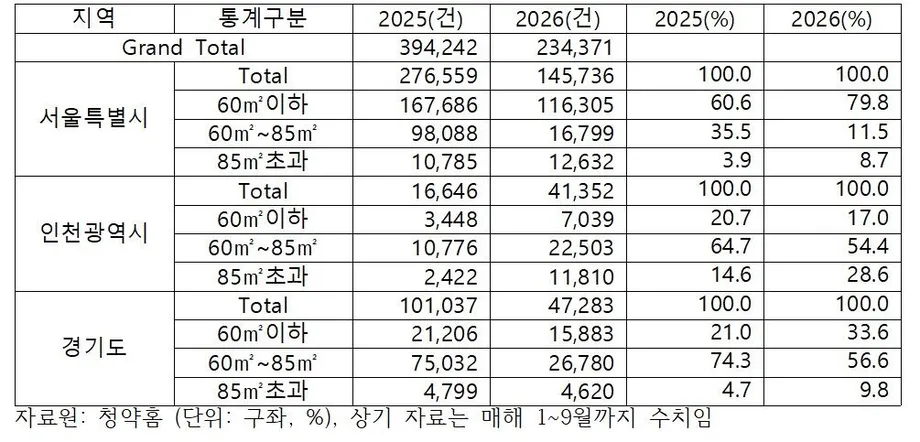
The ownership cost figures sit alongside a change in buying preferences. During the first nine months of 2026, apartments measuring 60 square meters or less attracted 79.8% of Seoul's housing subscription applications, a shift toward smaller apartment applications as standard sized homes became harder to afford. Purchase prices and annual taxes now form two distinct financial pressures for households deciding where and what to buy.
Key Points
- Seoul's apartment property tax assessments reached a record 3.2723 trillion won in 2026, up 17.1%.
- The taxpayer count increased 3.0%, while the average assessment reached about 1.65 million won.
- Gangnam, Seocho and Songpa accounted for 47.5% of assessments and about 58% of the annual increase.
- Their average bill was 6.7 times the average in Nowon, Dobong and Gangbuk.
- Mapo, Yongsan and Seongdong crossed 400 billion won in combined assessments for the first time.
- Seoul's proposed official apartment values rose 18.67%, adding pressure to ordinary property tax and the additional comprehensive levy.
- About 14.9% of Seoul apartments exceeded the 1.2 billion won official value threshold used for the single home owner deduction.