Higher funding costs reach household repayments
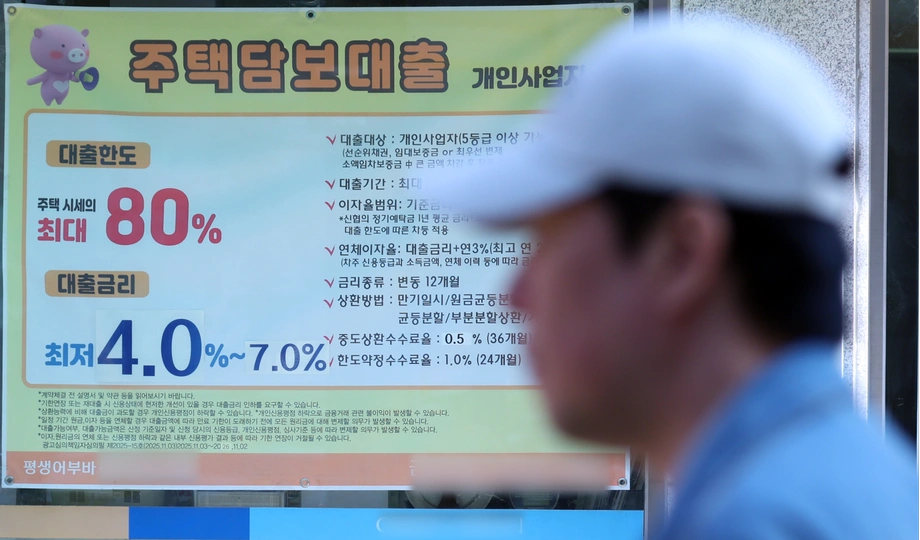
South Korean homeowners face rising mortgage bills after the September 2026 Cost of Funds Index, known as COFIX, climbed to 3.43%, prompting major banks to raise variable lending rates from October 16. NH NongHyup Bank's ceiling reached 6.48%, while KB Kookmin Bank and Woori Bank also moved above 6%.
Contents
- Higher funding costs reach household repayments
- Which banks have crossed 6%?
- What changed in COFIX?
- Why deposits are pushing loan rates upward
- How much more will households pay?
- Why 165 trillion won is approaching a reset
- Variable borrowing remains widespread
- Can longer fixed rates offer protection?
- What could happen at the next policy meetings?
- Key Points
The increase comes as 165 trillion won in bank mortgages are scheduled for interest rate adjustments in the fourth quarter, according to Financial Supervisory Service figures submitted to Social Democratic Party lawmaker Han Chang-min. That is 21.1 trillion won more than the 143.9 trillion won scheduled for adjustment in the preceding quarter, an increase of about 14.7%.
For families, the immediate issue is the amount leaving their bank accounts each month. A borrower taking a mortgage of 400 million won over 30 years, with equal monthly payments covering principal and interest, would pay about 1.93 million won at January's lower quoted rate of 4.10%. At 4.82%, the monthly payment rises above 2.10 million won.
Borrowers reaching the end of an initial period with a fixed rate face another pressure point. One borrower in their 40s who took a mortgage of 500 million won in October 2021 saw the rate change from 3.6% to 5.6% this month. The monthly repayment rose from 2.27 million won to 2.79 million won, adding 520,000 won to the household's monthly commitments.
Which banks have crossed 6%?
Detailed bank schedules for October 16 put the combined range for major mortgages with rates that adjust every six months at 4.36% to 6.48%. Another banking tally placed the range at 4.82% to 6.25% and counted four banks above 6%; the individual schedules identify three: KB Kookmin, Woori and NH NongHyup.
Woori raised its range from 4.75% to 5.95% to 5.00% to 6.20%. KB Kookmin increased its range from 4.39% to 5.79% to 4.64% to 6.04%. Both banks passed through an increase of 0.25 percentage points at each end of their quoted ranges.
NH NongHyup increased its range from 4.49% to 6.29% to 4.68% to 6.48%, a rise of 0.19 percentage points. Shinhan's quoted range was 4.36% to 5.77%, while Hana's was approximately 4.64% to 5.84%.
Borrowers receive different rates because mortgage prices combine a benchmark with the bank's additional charge and any discounts. Hana's relevant variable mortgage uses the yield on bank bonds maturing in six months, rather than COFIX, so its pricing follows a different reference.
What changed in COFIX?
The Korea Federation of Banks announced the September COFIX figures on October 15. The index based on newly raised funds increased from 3.18% in August to 3.43%, its largest monthly rise since November 2022, when it increased by 0.36 percentage points.
COFIX measures the weighted average cost of money raised by eight domestic banks. Those banks obtain money through deposits, savings products and bank bonds, then use that funding to support lending. When they must pay more to attract money, the index rises.
The index based on new funding responds relatively quickly because it measures money raised during the latest month. Measures that include funding already on bank balance sheets move more gradually. In September, the balance based index rose from 3.05% to 3.15%, while the newer balance measure increased from 2.71% to 2.79%.
The recent sequence shows how the pressure developed:
- September 2025: COFIX based on newly raised funds stood at 2.52%.
- June 2026: The index reached 3.05%.
- July and August 2026: It stood at 3.18%.
- September 2026: It rose to 3.43%, an increase of 0.91 percentage points over a year.
- October 15: The Korea Federation of Banks released the September figures.
- October 16: KB Kookmin, Woori and NH NongHyup applied higher rates to relevant new mortgages.
The short term COFIX measure also increased, from 3.16% on September 30 to 3.32% on October 8 and 3.43% on October 14. Together, the measures show higher funding costs across several parts of the banking system.
Why deposits are pushing loan rates upward
Banks competed more aggressively for deposits in September as corporate tax payments drew company money out of the banking system. Offering higher deposit rates helped attract household savings, but increased the cost of the money available for lending.
Promotional deposits continued into October. Shinhan introduced a product on October 6 offering up to 4.0%, and NH NongHyup introduced another on October 13 offering up to 3.9%. Savers qualifying for those rates can earn more interest, while borrowers whose mortgages follow bank funding costs face upward pressure on their bills.
Bank bond yields have risen too. The yield on AAA rated bank bonds maturing in one year increased from 3.755% on August 27 to 4.033% on September 18. It eased to 4.002% on October 15, still 0.247 percentage points above the August figure.
The average rate on new mortgages repaid through regular principal and interest payments at the five major banks rose from 4.66% in July to 4.94% in August. That increase of 0.28 percentage points brought borrowing costs higher even before the latest COFIX adjustment.
How much more will households pay?
A small change in the interest rate can become a substantial cash expense when applied to a large mortgage. On a balance of 249 million won, an increase of 0.23 percentage points adds about 572,700 won in annual interest if the balance stays unchanged.
Loans repaid monthly work differently because each payment covers interest and reduces the amount owed. For a mortgage of 400 million won over 30 years, raising the rate from 4.5% to 6.0% increases the monthly payment from about 2.02 million won to 2.39 million won. The extra cash required is roughly 370,000 won a month, or 4.44 million won a year, covering both principal and interest.
The borrower whose monthly bill increased from 2.27 million won to 2.79 million won faces an annual increase of 6.24 million won, about 23% more than before. A household must find that money alongside its existing spending on food, transport, education and other commitments.
The Korea Federation of Banks' household lending disclosure explains that its published minimum and maximum rates use standard assumptions: credit grade 3, a term of 30 years or the product's maximum term, and a loan of 200 million won where the amount affects pricing.
The federation also says its monthly repayment and total borrowing cost examples assume that the previous month's average lending rate continues throughout the loan. An individual borrower's payments depend on the actual contract, outstanding balance, remaining term and future rate changes.
Why 165 trillion won is approaching a reset
The Financial Supervisory Service figures cover mortgages at 19 domestic banks, excluding policy mortgage products. They identify 165 trillion won scheduled for rate adjustment in the fourth quarter, including loans whose earlier fixed periods are ending.
A mortgage described as fixed for five years can change price after those five years. For someone who borrowed during the low interest rates of 2021, an adjustment in 2026 can replace an affordable initial rate with a much higher one.
Bank of Korea weighted average figures put mortgage rates at deposit taking banks at 2.70% in the second quarter of 2021 and 4.26% in the second quarter of 2026, a difference of 1.56 percentage points.
A calculation accompanying the reset figures assumes that all 165 trillion won consists of loans with rates resetting after five years, using a repayment structure of equal monthly principal and interest payments over 30 years. Under those assumptions, the additional annual repayment burden reaches about 1.7212 trillion won. The estimate is a scenario based on those loan terms; actual payments will vary across contracts.
The schedule extends well beyond December. Mortgages due for adjustment total 137.3 trillion won in the first quarter of 2027, 154.4 trillion won in the second, 127.7 trillion won in the third and 143.5 trillion won in the fourth. Quarterly amounts remain above 120 trillion won through the later years covered by the figures, reaching between 162.7 trillion won and 169.9 trillion won during 2030.
Variable borrowing remains widespread
Financial Supervisory Service figures show that variable mortgages accounted for 36.3 trillion won of the 41.5 trillion won in new bank mortgage lending during the second quarter, excluding policy mortgages. Their share was 87.5%.
Across outstanding mortgages at the end of that quarter, variable loans represented 497.1 trillion won of a total 767 trillion won, or 64.8%. Nearly two thirds of the outstanding balance therefore carried exposure to changing rates.
An August lending measure put the variable share of new mortgages at 64.7%. The figures cover different periods and lending populations, but both show that changing interest rates affect a large part of mortgage borrowing.
Existing borrowers generally face a new rate on the adjustment date specified in their contracts. Someone with a rate that changes every six months will encounter a different timetable from a borrower reaching the end of five years at a fixed rate. October 16 changes the price of relevant new loans immediately, while existing household bills change according to those contractual schedules.
Can longer fixed rates offer protection?
Mortgages fixed for five years have also become more expensive. A banking tally put the range at 5.23% to 6.61%, compared with 4.48% to 4.86% at the end of January. These products are priced against bank bond yields, exposing new borrowers to market movements before they lock in their rate.
The policy challenge is to expand mortgages with rates fixed for much longer. Banks often raise money for relatively short periods. Lending that money at an unchanged rate for 20 or 30 years creates a risk that their own funding costs will rise while the income from the mortgage stays the same.
The Financial Services Commission told Han Chang-min's office that its task force on mortgages with long fixed rates was not operating and that internal consideration was continuing. The task force held its first meeting on May 30 of the previous year.
A Korea Institute of Finance study commissioned by the commission estimated that stable core deposits could support replacing at least 31.6 trillion won in existing mortgages with loans carrying long fixed rates. Core deposits are funds that tend to remain with a bank, providing a more dependable funding base.
The institute also proposed expanding mortgage backed securities and covered bonds. Mortgage backed securities raise money against mortgage payment streams. Covered bonds allow banks to borrow against a pool of assets, including mortgages, while remaining responsible for repayment. Both can help banks obtain funding for longer periods.
The Korea Housing Finance Corporation provides payment guarantees for bank covered bonds to support mortgages with long fixed rates. By April, it had signed related agreements with nine banks. Expanding that funding would give banks more capacity to offer borrowers a longer period of predictable payments.
What could happen at the next policy meetings?
The Bank of Korea raised its policy rate by 0.25 percentage points in both July and August, bringing it to 3.00%. September consumer prices rose 2.9% from a year earlier, above the bank's 2% inflation target. In the United States, September inflation was 3.7%, compared with an expected 3.6%.
Kim Jung-sik, an emeritus economics professor at Yonsei University, expects another Bank of Korea increase before the end of the year. He also warned that excessive increases could worsen financial distress and unsettle stock and property markets.
Lee Min-hwan, a professor in Inha University's department of finance and management, said inflation pressure associated with war and higher oil prices could require further tightening. He considered a variable mortgage ceiling of 7% by the end of the year a likely possibility.
At 7%, annual interest on an unchanged balance of 300 million won would be 21 million won, compared with 19.44 million won at 6.48%. That difference is 1.56 million won a year, or an average of 130,000 won a month, before principal repayments.
The next policy decisions are scheduled for October and November; exact meeting dates were not specified. Further increases have not been decided. Mortgage prices will also depend on deposit competition, bond yields, bank charges and discounts, making each borrower's contract and next adjustment date central to the size and timing of any increase.
Key Points
- September 2026 COFIX rose 0.25 percentage points to 3.43%, its largest monthly increase since November 2022.
- Detailed bank schedules put variable mortgage ceilings at 6.48% for NH NongHyup, 6.20% for Woori and 6.04% for KB Kookmin.
- Bank mortgages worth 165 trillion won are scheduled for rate adjustments in the fourth quarter, excluding policy mortgages.
- A scenario assuming all those loans reset after five years puts the additional annual repayment burden at about 1.72 trillion won.
- Variable mortgages represented 64.8% of outstanding bank mortgage balances at the end of the second quarter.
- October and November policy decisions, bank funding costs and individual contract dates will shape the next changes in household payments.