23 of 31 approved projects fall below the economic benchmark
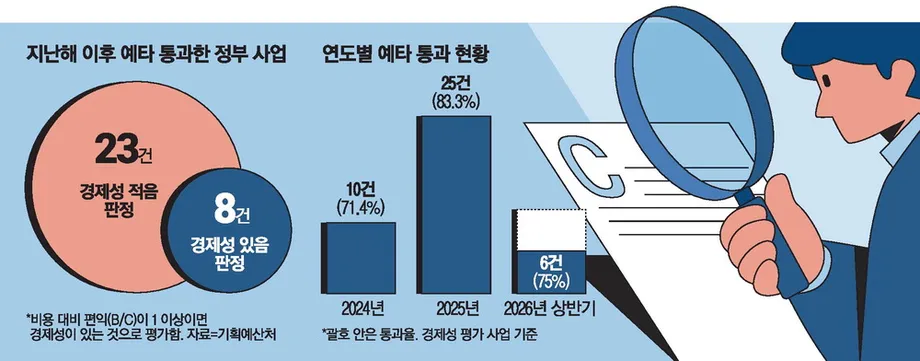
South Korea approved 23 major public projects with combined estimated costs of 28.576 trillion won despite assessments showing that their expected economic benefits were smaller than their costs. They represented 74.2% of the 31 projects that passed preliminary feasibility studies between January 2025 and June 2026, according to figures attributed to the Ministry of Planning and Budget.
Contents
- 23 of 31 approved projects fall below the economic benchmark
- What a benefit–cost ratio tells readers
- Two transport projects illustrate the scale
- How the screening decision is made
- Regional development gains more weight
- Approval rates rose, then eased
- Earlier research shows what screening has saved
- Forecast uncertainty adds another budget risk
- Who bears the cost of broader policy goals?
- Key Points
Five of six projects with expected benefits worth less than half their costs also passed. Those five projects carry a combined price of 12.4915 trillion won, including the Yeongwol–Samcheok Expressway and an upgrade of the Samcheok–Gangneung railway.
The approvals come as South Korea gives greater weight to development outside the capital region. A change to assessment guidelines in May 2026 further reduced the importance of economic returns for construction projects in areas with declining populations, while increasing the weight given to regional growth.
The central choice is how much public money to commit to projects whose measured economic benefits are weak but which may serve broader regional goals. Roads and railways can improve access and support local development. Their construction also ties up money that could finance other public needs.
What a benefit–cost ratio tells readers
A benefit–cost ratio, usually shortened to B/C, compares the estimated economic benefits of a project with its estimated costs. A ratio of 1 means the two are equal. A ratio below 1 means the benefits counted in the assessment are smaller than the costs.
A ratio of 0.5 means that every 100 won of estimated economic cost is matched by 50 won of estimated benefit. These benefits can include gains such as time saved by travellers, rather than money collected through tolls or ticket sales. The ratio measures economic value; an operator's income and expenses are assessed separately.
South Korea's screening system also considers policy goals and regional development. A project can therefore pass with a B/C ratio below 1 if it receives enough support in the other parts of the assessment. The recent approvals show how much spending can proceed through that route.
Two transport projects illustrate the scale
The Yeongwol–Samcheok Expressway has an estimated project cost of 5.6167 trillion won and a B/C ratio of 0.27. Expressed simply, its assessment puts measured economic benefits at 27 won for every 100 won of economic cost.
The Samcheok–Gangneung railway upgrade has an estimated cost of 1.1507 trillion won and a B/C ratio of 0.4, equivalent to 40 won in measured benefits for every 100 won of economic cost.
Together, the two projects account for 6.7674 trillion won, or about 54.2% of the 12.4915 trillion won assigned to the five approved projects with ratios below 0.5. Those five, in turn, account for approximately 43.7% of the spending attached to all 23 approved projects with benefits below costs.
Approval was also common in the other categories below the economic benchmark. Projects with B/C ratios from 0.5 to below 0.8 had a pass rate of 66.7%. Those from 0.8 to below 1 had a pass rate of 83.3%, matching the rate for projects below 0.5.
How the screening decision is made
The Korea Institute of Public Finance, or KIPF, explains in its feasibility study guide that preliminary studies examine proposals before major budget commitments. Their stated purpose is to prevent waste and help the government rank new investments fairly and transparently.
KIPF and the Korea Development Institute, or KDI, conduct studies at the request of the Minister of Economy and Finance under the framework described in the guide. Researchers assess economic returns, policy considerations and balanced regional development. A committee combines those findings through the Analytical Hierarchy Process, known as AHP, a method for assigning weights to different decision criteria.
The official eligibility threshold is a total project cost of at least 50 billion won and central government support of at least 30 billion won. The Korean amounts are 500 eok won and 300 eok won respectively, which convert to those figures.
Studies also consider alternatives, appropriate project size and timing. After deliberation by the fiscal project evaluation committee, the finance minister communicates the results to the responsible ministry for use in budget and fund planning.
Regional development gains more weight
South Korea changed the balance of assessment in 2019 under President Moon Jae-in. For construction projects outside the capital region, the economic evaluation weight fell from 35–50% to 30–45%. The regional development weight rose from 25–35% to 30–40%.
The government's 2019 reform explanation says revised guidelines took effect on May 1 that year. They differentiated assessments between the capital region and other regions, while changing the treatment of regional underdevelopment from a system of bonuses and deductions to bonuses alone.
The reform also expanded policy assessment to cover employment, living conditions, environmental effects and safety. Public service access, improvements in health and daily life, and the ability to respond to disasters became explicit considerations. Financing risks and difficulty covering operating expenses also featured in the framework.
A further revision in May 2026 lowered the economic evaluation weight for construction projects in areas with declining populations from 30–45% to 25–40%. The regional growth weight increased from 30–40% to 35–45%. Both ends of each range moved by five percentage points.
The revised approach considers local historical, cultural and tourism resources and their potential to support growth over time, alongside regional disadvantage and economic effects. It gives assessors more room to value a place's future development potential when current demand is limited.
Approval rates rose, then eased
The ministry's figures show that 10 of 14 projects assessed for B/C passed in 2024, an approval rate of 71.4%. In 2025, 25 of 30 passed, lifting the rate to 83.3%, an increase of 11.9 percentage points.
Six of eight projects passed in the first half of 2026. That rate of 75% was below the 2025 figure but remained above the 2024 level. Across January 2025 to June 2026, the annual figures add up to 31 approvals from 38 assessments.
The main changes and results follow this sequence:
- May 1, 2019: Revised guidelines took effect, giving regional development greater influence outside the capital region.
- 2024: Ten of 14 projects assessed for B/C passed.
- 2025: Twenty five of 30 projects passed.
- May 2026: The government revised the weights for construction projects in areas with declining populations.
- January to June 2026: Six of eight projects passed, bringing approvals since January 2025 to 31.
Earlier research shows what screening has saved
Chang Gyun Park of Chung-Ang University examined 576 projects assessed between 1999 and 2013 in a quantitative performance assessment hosted by KDI. Of those projects, 204 were judged infeasible.
The study reported that 45.6% passed the economic B/C test, while 64.6% passed the broader feasibility assessment. Under the framework described in the study, a project passed the combined assessment when its AHP score reached at least 0.5. Policy and regional considerations therefore played a substantial role long before the latest guideline changes.
Park estimated that screening saved between 38.8% and 39.2% of proposed project costs, depending on the calculation used. The historical findings show why changes to the system matter for taxpayers: rejecting or resizing proposals can avoid large commitments before construction begins.
The research also examined cases in which a project failed the economic test but passed the combined assessment. Project and research team characteristics generally explained little of that outcome, although a research leader affiliated with KDI was associated with a lower probability of such a reversal. The study's period and project mix differ from the recent approval figures.
Forecast uncertainty adds another budget risk
A 2024 uncertainty study examined a different weakness: economic forecasts can look more precise than the underlying estimates warrant. It recorded 767 preliminary feasibility studies conducted in South Korea from the system's introduction in 1999 through 2021.
The researchers used a road project case study and historical forecast accuracy to estimate a range of possible outcomes for traffic, benefits and costs. In that case, the probability that benefits would exceed the forecast was 19.5%. The probability that costs would fall below 90% of the forecast was 25.6%.
The project's original forecast B/C ratio was 1.0. After allowing for uncertainty, the estimated probability of the ratio exceeding 1.0 was 4.8%. Those percentages describe the case project's modelled outcomes.
The researchers recommended using evidence about past forecasting accuracy rather than relying on a single forecast value. For a budget decision, a range of possible outcomes helps show whether a proposal needs a different design, a smaller scale or another option to make its economic case stronger.
Who bears the cost of broader policy goals?
Kim Woo-cheol, chairman of the Korea Public Finance Association, warned that increasing the weight of policy judgments could weaken the discipline imposed by preliminary feasibility studies. He described the system's screening role:
Preliminary feasibility studies are a key system for filtering out infrastructure investments with low economic returns.
Kim also warned about the effect of repeatedly increasing the role of regional and political considerations:
If the weight of political judgments such as balanced regional development continues to increase, the efficiency of fiscal investment could fall and the preliminary feasibility study system itself could become ineffective.
Residents of areas with declining populations may gain better transport access and new opportunities from projects that receive strong regional scores. The national budget must carry the construction commitments, while project planners must also address financing and future operating needs. Making regional goals more influential changes which benefits can justify those commitments.
KIPF's framework provides for feasibility reassessments when projects meet specified conditions during implementation, with the aim of stopping unjustified work or unnecessary cost increases. Even projects exempted from the preliminary study undergo a review of their plans, including financing, future fiscal needs, costs, benefits and efficient alternatives.
The recent figures give project costs and economic ratios, but no construction or completion dates for the two named transport schemes. The immediate budget issue is the scale of approved commitments: nearly three quarters of the projects approved during the 18 months had measured benefits below costs, while the assessment rules now give regional growth more influence in areas losing population.
Key Points
- Twenty three of 31 projects approved from January 2025 through June 2026 had expected economic benefits below costs.
- Those 23 projects carry combined estimated costs of 28.576 trillion won.
- Five of six projects with B/C ratios below 0.5 passed, involving 12.4915 trillion won.
- The Yeongwol–Samcheok Expressway has a B/C ratio of 0.27; the Samcheok–Gangneung railway upgrade has a ratio of 0.4.
- Guideline changes in May 2026 reduced the economic evaluation weight and increased the regional growth weight for construction in areas with declining populations.
- Historical research found substantial savings from screening, while a 2024 study recommended accounting for forecast uncertainty.