Record exports drive a second growth upgrade
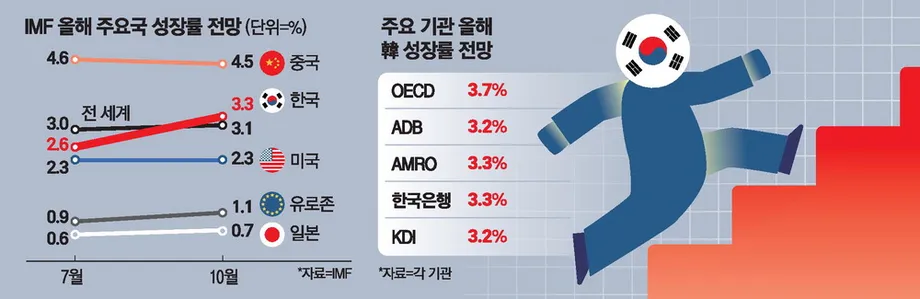
The International Monetary Fund has raised its forecast for South Korea's economic growth in 2026 to 3.3%, up from 2.6% in July, as semiconductor demand helps offset the economic damage from the Middle East war. The upgrade follows a September export record of $120.9 billion, an increase of 83.5% from a year earlier, with semiconductor shipments exceeding $60 billion for the first time.
Contents
- Record exports drive a second growth upgrade
- How the forecast changed during 2026
- What the semiconductor boom looks like in the data
- Where the IMF stands among other forecasters
- A rare lead over global growth, with Taiwan further ahead
- Dollar GDP forecasts point to new milestones
- A stronger global forecast masks uneven war damage
- Why stronger output may not relieve household pressure
- AI investment creates financial risks as well as growth
- Key Points
The October World Economic Outlook also raised South Korea's 2027 growth forecast from 2.5% to 2.8%. The new projections put this year's expansion above the IMF's 3.1% global forecast and its 2.1% forecast for the group of 41 advanced economies. South Korea's estimated growth in 2025 was 1.1%, making the projected acceleration this year 2.2 percentage points.
The IMF attributed the stronger outlook to demand for chips used in artificial intelligence infrastructure. Its assessment identifies South Korea and Taiwan as central participants in that trade, together accounting for 62% of net trade in AI computing hardware. That figure describes a trade balance measure, not their share of all hardware sales or production.
South Korea's Ministry of Finance and Economy welcomed the stronger outlook while warning that rising prices, interest rates and the prolonged war continue to burden households. The contrast runs through the IMF's assessments: technology investment is lifting output, but dependence on that investment creates exposure if expected returns disappoint.
How the forecast changed during 2026
The October revision is the IMF's second consecutive upgrade for South Korea. Its forecast has risen by 1.4 percentage points since April, from 1.9% to 3.3%. That is a much larger change than the latest 0.1 percentage point increase in the global forecast.
The sequence shows how expectations strengthened as the export boom developed:
- January and April 2026: The IMF projected South Korean growth of 1.9%.
- July 2026: It raised the forecast to 2.6%, while projecting 2.5% growth for 2027.
- September 2026: Exports reached $120.9 billion, and the OECD raised its growth forecast to 3.7%.
- October 2026: The IMF lifted its forecasts to 3.3% for 2026 and 2.8% for 2027.
Reports differ on the release date. Most place the October outlook's publication on October 13, while one gives October 12 local time. The assessment coincided with the IMF and World Bank Group Annual Meetings in Bangkok, described as running from Monday through Sunday.
South Korea's latest upgrade of 0.7 percentage points exceeded the advanced economy group's 0.4 percentage point increase. It was also reported as the largest revision among advanced economies, ahead of Germany's 0.6 percentage point upgrade.
What the semiconductor boom looks like in the data
September's semiconductor exports of more than $60 billion represented more than 49.6% of the month's $120.9 billion in total exports. The figures show how heavily the export record depended on chips, rather than an evenly distributed expansion across all industries.
The surge was already visible in August, when exports of information technology products rose 162% from a year earlier. Total exports exceeded $100 billion for three consecutive months. AI investment creates demand for computing equipment and memory chips, giving South Korean producers a direct route into spending on new digital infrastructure.
Bank of Korea balance of payments figures put the cumulative current account surplus through August at a provisional $279.2 billion, compared with $69.67 billion in the same period of 2025. That is roughly four times the earlier figure. The current account measures trade in goods and services together with income and transfers between an economy and the rest of the world, so it is broader than the merchandise export total.
The IMF projects South Korea's current account surplus at 18.8% of GDP in 2026, up from 6.5% in 2025, before easing to 16.1% in 2027. Those forecasts suggest that strong external earnings will persist, even as economic growth slows next year.
Where the IMF stands among other forecasters
The IMF's 3.3% projection matches the Bank of Korea and the ASEAN+3 Macroeconomic Research Office (AMRO). It sits above the government's published 3.0% forecast and the 3.2% forecasts from both the Korea Development Institute (KDI) and the Asian Development Bank.
Other institutions are more optimistic. The OECD expects 3.7% growth, after raising its forecast from 2.6%. Moody's projects 3.5%, matching the September average from eight foreign investment banks. That average rose from 2.4% in April and included JPMorgan's 4.0% projection.
AMRO also revised its assessment repeatedly, moving from 1.9% in April to 3.1% in July and then 3.3%. The Asian Development Bank raised its forecast from 2.6% in July to 3.2% in September. These changes show a broad shift toward stronger growth expectations, although the published projections still span 3.0% to 4.0%.
For 2027, the IMF's 2.8% forecast exceeds the government's and KDI's 2.2%, the Asian Development Bank's 2.3% and the OECD's 2.6%. It is just below the Bank of Korea's 2.9%. The IMF expects growth to slow by 0.5 percentage points next year, rather than treating the current export surge as a permanently accelerating expansion.
A rare lead over global growth, with Taiwan further ahead
At 3.3%, South Korea would grow 0.2 percentage points faster than the world economy and 1 percentage point faster than the United States, whose forecast remains 2.3%. If realized, this would be South Korea's first growth outperformance against the United States since 2022.
Deputy Prime Minister and Finance and Economy Minister Lee Hyoung-il said that exceeding global growth would be the first such result since 2010, excluding 2020. That exception matters: South Korea's economy contracted by 0.7% in 2020, but still performed better than the world's 2.7% contraction. The current forecast would therefore be its first outperformance since 2020, and its first outside that pandemic year in 16 years.
Taiwan, the other economy singled out for its AI hardware trade, has a much higher 2026 growth forecast of 10.7%. The gap with South Korea is 7.4 percentage points. In 2027, Taiwan's forecast falls to 4.3%, narrowing the gap to 1.5 percentage points.
The two economies also differ in prices and external balances. The IMF projects Taiwanese inflation at 2.0% this year and 1.8% next year, below South Korea's 2.7% and 2.3%. Taiwan's current account surplus is projected to rise from 22.0% of GDP in 2026 to 23.1% in 2027, while South Korea's is expected to decline. Participation in the same technology trade does not produce identical economic outcomes.
Dollar GDP forecasts point to new milestones
The IMF's accompanying projections put South Korea's nominal GDP at $2.2458 trillion in 2026, which would mark its first move above $2 trillion. Nominal GDP per person is forecast at $43,512, also a first crossing of the $40,000 threshold.
The per person figure compares with an estimated $36,408 in 2025, an increase of $7,104, or 19.5%. That is far larger than the projected 3.3% real economic growth rate because the measures answer different questions. Real growth adjusts output for price changes; nominal GDP in dollars also reflects prices, currency conversion and, for the per person measure, population.
GDP per person is not average take home pay and does not show how income is distributed. A rise in that measure can coexist with household financial pressure, particularly when growth is concentrated in export industries.
The IMF projects GDP per person at $49,277 in 2027 and $59,919 in 2031. Nominal GDP is forecast to reach $2.5395 trillion next year and $3.0693 trillion in 2031. These are projections rather than achieved milestones.
For 2026, South Korea's projected GDP per person is $439 below Taiwan's $43,951. The IMF expects South Korea to move ahead in 2027, before Taiwan catches up again in 2030. South Korea is also projected to exceed Japan by $8,112 per person this year and remain ahead through 2031.
A stronger global forecast masks uneven war damage
The IMF raised its 2026 global growth forecast from 3.0% to 3.1%, while keeping 2027 at 3.4%. Technology investment helped sustain activity, but the fund warned that national growth paths depend on exposure to the Middle East war and participation in AI production and trade.
In its World Economic Outlook, the IMF described a resilient but uneven global economy:
The global economy is once again showing resilience, but it remains unbalanced and the room for short-term adjustment is narrowing rapidly.
The eurozone forecast rose from 0.9% to 1.1%, with strong activity in Ireland and continuing growth in Spain contributing to the revision. Japan's forecast increased from 0.6% to 0.7%. China's was lowered by 0.1 percentage points to 4.5%.
The Middle East and Central Asia face a projected contraction of 0.3% in 2026, followed by 6.3% growth in 2027. The IMF links that pattern to disrupted energy production and transport, and an expected recovery as those activities normalize. Reports describe the current year's regional downgrade as 1.0 percentage point relative to July and 2.2 percentage points relative to April, comparisons with different forecast rounds.
Global trade volume growth is projected at 4.6% this year, down from 5.0% in 2025, and 4.7% in 2027. The IMF expects global inflation of 4.7% in 2026 and 4.1% next year. A longer AI investment cycle and changes to energy supply chains could support activity, while further energy disruptions could undermine it.
Why stronger output may not relieve household pressure
South Korea's projected inflation decline from 2.7% in 2026 to 2.3% in 2027 would mean prices rising more slowly, not returning to earlier levels. The finance ministry warned that the war, higher prices and interest rates continue to weigh on living conditions despite the improved growth outlook.
KDI's October Economic Trends assessment also pointed to price pressure beneath the headline figures. Inflation excluding the effect of telecommunications fees rose to 3.1%, from 2.7% the previous month. KDI attributed the acceleration in underlying inflation to intensifying pressure from the supply side.
The ministry said it would pursue three main social policy areas: housing, jobs and financial services for ordinary people. It also identified economic disparities and slowing potential growth, meaning the economy's sustainable pace of expansion, as continuing problems. Strong chip exports do not by themselves establish that those problems have eased.
The IMF recommended that support for energy and food costs be temporary and directed at those who need it, while avoiding measures that distort market prices. Its wider monetary policy assessment warned that economies benefiting from technology demand can still face inflation pressure, especially when they also import energy. That was a general assessment, not an announced interest rate decision for South Korea.
AI investment creates financial risks as well as growth
The IMF's Global Financial Stability Report identified three major threats: falling asset prices if returns on AI investment weaken, rising government bond yields, and expanding cyberattacks as finance becomes more digital. The technology spending supporting South Korea's export outlook is also a potential channel for financial shocks.
If investors lower their expectations for AI profits and productivity, investment could retreat. The IMF described possible effects including weaker demand for technology goods and services, reduced capital flows into economies connected to AI production, and losses on investments across borders.
The fund also examined a combined shock involving falling AI asset prices, higher bond yields and an energy disruption. In that scenario, the core capital ratio of global banks could decline by 1.5 percentage points to 11.5%. This ratio measures a bank's main capital cushion against assets adjusted for risk. The share of bank assets held by vulnerable institutions with capital ratios below 7% could rise from 18% to 22%. These are stress scenario results, not predictions that the losses will occur.
Fiscal conditions add another source of vulnerability. The IMF projects a combined deficit of 5.2% of GDP for 41 advanced economies, the highest since 2021. The United States, including state and local governments, is projected at 8.5%, and China above 8%. The US Treasury yield for 10 year debt reached 5.24% on October 9, compared with around 4.2% early in the year.
Asked about using roughly 5 trillion won in additional South Korean tax revenue to repay government bonds, Athanasios Vamvakidis, deputy director of the IMF's Monetary and Capital Markets Department, advised saving during good times to allow spending during bad times. That advice connects the stronger growth forecast with the fund's call to rebuild the capacity to respond to future shocks.
The main unresolved issues are how long AI spending and semiconductor demand will remain strong, how the Middle East war will affect energy costs, and whether export gains will translate into better household conditions. The outlook sets no firm date for resolving those uncertainties. Its 2027 forecasts assume continued growth, but at a slower pace for South Korea.
Key Points
- The IMF raised South Korea's 2026 growth forecast from 2.6% to 3.3%, and its 2027 forecast from 2.5% to 2.8%.
- September exports reached a record $120.9 billion, with semiconductor shipments exceeding $60 billion.
- South Korea and Taiwan account for 62% of net trade in AI computing hardware.
- South Korea's forecast exceeds global growth of 3.1% and matches the Bank of Korea's projection.
- GDP per person is projected to reach $43,512, but that measure is not household income.
- Inflation, war disruption and a possible reversal in AI investment remain risks despite the stronger outlook.