Seoul stocks slide toward 6,400 as chip leaders retreat
South Korea's KOSPI fell more than 3% on Monday, October 12, 2026, as foreign investors continued selling and a dispute over OpenAI's revenue figures unsettled the semiconductor stocks that dominate the market. The decline came as investors also confronted higher oil prices and elevated U.S. government bond yields.
Contents
- Seoul stocks slide toward 6,400 as chip leaders retreat
- How the morning decline developed
- What the OpenAI revenue numbers actually measure
- Why an accounting dispute still hurt semiconductor shares
- Foreign selling meets a market concentrated in two stocks
- U.S. technology losses crossed into Seoul
- Oil and bond yields added a second source of pressure
- Earnings helped some companies resist the decline
- What investors still need to establish
- Key Points
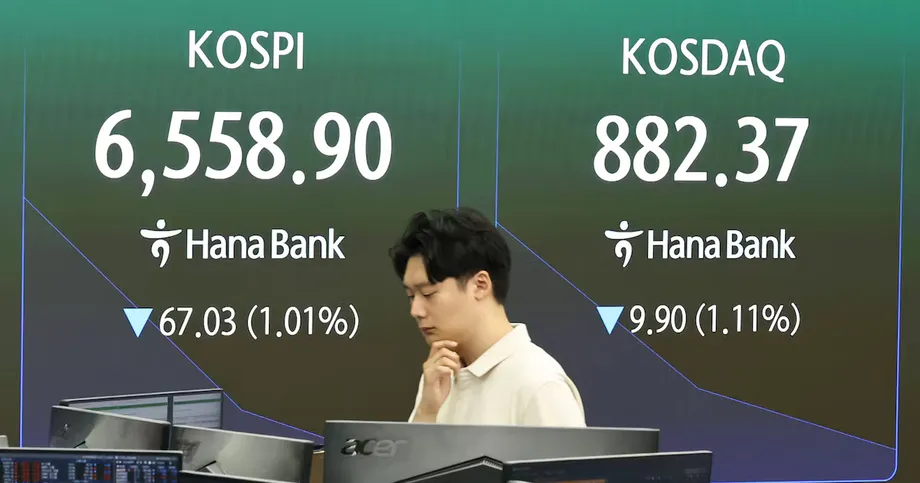
At 10:24 a.m., the benchmark stood at 6,419.74, down 3.11%, according to figures attributed to the Korea Exchange. It had opened at 6,578.17, down 0.72%. Samsung Electronics traded at 255,250 won, a decline of 2.67%, while SK hynix fell 4.28% to 1,609,000 won.
A subsequent morning update put the KOSPI at 6,429.07, down 2.97%, after an intraday low of 6,417.13, or a 3.15% decline. The low left the index just 17.13 points above 6,400. The market was heading toward a fourth consecutive losing session, although the morning figures do not establish its closing performance.
The immediate concern was a roughly $20 billion gap between OpenAI's reported annualized revenue of almost $50 billion and the $70 billion figure previously circulating among investors. The smaller number was about 28.6% below the larger one. That comparison, however, does not demonstrate that sales fell: explanations centered on different accounting scopes and the treatment of revenue earned through cloud partners.
Seoul was also reopening after the October 9 Hangeul Day holiday. Investors therefore had to absorb both a sharp Thursday decline in U.S. technology stocks and a partial Friday recovery. That timing helps explain why Korean chip shares weakened even though Wall Street ended Friday higher.
How the morning decline developed
The index lost 158.43 points between its opening level and the 10:24 a.m. reading. Several morning snapshots show the broad direction of trading, although they should not be treated as a complete record of every market move.
- October 8: Reports described OpenAI's annualized revenue as approaching $50 billion at the end of September, below the $70 billion figure previously circulating.
- October 9: Korean markets were closed for Hangeul Day while U.S. technology shares recovered some of Thursday's losses.
- October 12, market opening: The KOSPI began at 6,578.17, down 0.72%.
- 9:15 a.m.: The index was reported at 6,474.95, down 2.28%.
- 9:58 a.m.: It stood at 6,471.57, down 2.33%.
- 10:24 a.m.: The KOSPI reached 6,419.74, down 3.11%.
- Later morning update, published at 11:40 a.m.: The index was quoted at 6,429.07, with an intraday low of 6,417.13.
The technology focused KOSDAQ also weakened. An earlier snapshot put it at 879.5, down 1.4%; the later update recorded 859.62, down 3.66%, after a low of 858.55. Its opening level had been 885.53, down 0.76%.
Those figures show that selling extended beyond the largest chip companies. On the KOSDAQ, foreigners and institutions were reported to have sold a net 64.4 billion won and 31 billion won respectively, while individuals bought 97.6 billion won.
What the OpenAI revenue numbers actually measure
Annualized revenue estimates how much a company would generate over a year if a recent pace of sales continued. It is not necessarily revenue already earned during a full financial year, and it is not the same as profit or cash available to spend.
Reports differ in how they describe OpenAI's figures. Some call the $50 billion number an annualized revenue measure based on sales through September; another describes it as projected revenue for the year. They also differ over the origin of the $70 billion figure. Some say it had been signaled to investors, while another says OpenAI did not directly provide that number and that it emerged from comparisons with rival Anthropic.
A further report says OpenAI told investors in a financial presentation that its annualized revenue was roughly $50 billion at the end of September. A person familiar with the matter said the widely reported $68 billion figure included gross revenue from OpenAI's partners, allowing a more direct comparison with Anthropic. The presentation reportedly also cited total run rate growth of 77% during the third quarter and enterprise run rate growth of 107% over the same period. This account specifies the timing of the $50 billion measure and the broader scope of the $68 billion figure, but does not establish who originally produced the $70 billion estimate.
The dates differ slightly too. Several accounts place the disclosure or reporting on October 8, while another dates the revenue controversy to October 9. A subsequent account says OpenAI maintained that its annualized revenue would reach $70 billion during the year. Without a common reporting basis, those statements cannot be combined into a single confirmed revenue forecast.
The central accounting distinction concerns cloud partner sales. Anthropic was described as counting customer sales through services such as Amazon Web Services and Google Cloud, then recording partner fees as costs. OpenAI was described as using a narrower measure, counting its own share of partner sales rather than the full customer payment.
Other accounts simplify that distinction by saying Anthropic includes cloud partner sales while OpenAI excludes them. Both descriptions point to the same comparability problem: two revenue totals may cover different amounts of the same commercial activity. A larger reported total does not automatically mean stronger demand or better profitability.
The $70 billion estimate was also linked to an earlier $40 billion figure and OpenAI's statement that revenue had increased more than 70% since July. Reports disagree over whether the $40 billion figure referred to July performance or an August report. Applying 70% growth to $40 billion produces $68 billion, close to the $68 billion to $70 billion expectations described in another account, but only if both figures use the same scope.
Why an accounting dispute still hurt semiconductor shares
Investors use the revenue growth of major AI developers as one signal of demand for computing infrastructure. If expectations for that growth weaken, markets can reassess the spending likely to reach chipmakers and other suppliers, even before any company announces a reduction in orders.
That distinction matters here. The revenue controversy was presented as a measurement issue, not evidence of an actual sales contraction. Nevertheless, the gap between the headline numbers gave investors another reason to examine whether share prices had assumed too much growth.
Han Ji-young, an analyst at Kiwoom Securities, described the dispute as a difference in the scope of revenue aggregation rather than falling sales. He also warned that investors were becoming less forgiving about AI company results:
It is necessary to prepare for heightened sensitivity to the quality of earnings during the third-quarter earnings season.
In this context, earnings quality means looking beyond a large revenue or profit headline to how the result was produced, whether it can recur and how accounting choices affect comparisons. Kim Ju-yeon, an analyst at Mirae Asset Securities, likewise attributed weakness in Samsung Electronics and SK hynix to investors absorbing renewed concerns about an AI bubble.
Share prices varied through the morning. At 9:16 a.m., Samsung was quoted at 259,250 won, down 1.05% against the previous Korea Exchange aftermarket close, and SK hynix at 1,631,000 won, down 2.97%. Those percentage changes use a stated reference price that may differ from other reports. Later, Samsung touched 254,000 won and SK hynix reached 1,605,000 won.
Foreign selling meets a market concentrated in two stocks
At 10:30 a.m., foreigners had sold a net 566 billion won of KOSPI shares, while individuals bought 313.7 billion won and institutions bought 69.3 billion won, according to figures attributed to the Korea Exchange. Net selling means sales exceeded purchases over the measured period.
Other morning reports give different snapshots: foreign net selling of 699.27 billion won in one account, 161.4 billion won shortly after the opening in another, and 356.5 billion won in a separate update. The later report published at 11:40 a.m. put foreign net sales at 535.2 billion won. Different observation times and possible differences in coverage mean these figures should not be added together.
That later update also recorded foreign net selling of 322.3 billion won in KOSPI 200 futures. Futures are contracts tied to a future index value and can be used to reduce exposure, hedge other holdings or take a market position. Their net selling is a separate measure from cash share transactions.
Foreign investors had reportedly been net sellers on every trading day that month, with the later update describing five consecutive sessions of net selling. On the preceding Thursday, foreign net sales were reported at 2 trillion won as the KOSPI fell 2.6%.
The pressure is especially consequential because Samsung Electronics and SK hynix together reportedly account for more than half the KOSPI's weight. Weakness in those two companies can therefore outweigh gains elsewhere. A broader market assessment put South Korea's equity market at $4.3 trillion, with trading volume down 70% from its late May peak and the KOSPI down 22% after leading major global indexes during the first half.
Phillip Wool, head of portfolio management at Rayliant Global Advisors, said much of the readily available profit from the memory chip theme had already been captured. Rayliant had taken profits in Korean AI shares and held both chip companies below their benchmark weights. The same assessment described foreign withdrawals as the fastest in Asia and pointed to selling linked to heavy borrowing during the summer. Those broader measures cover a longer period than Monday's trading.
U.S. technology losses crossed into Seoul
Thursday's U.S. session provided a direct warning for Korean chip investors. The Nasdaq Composite closed at 27,193.34, down 1.25%, while the S&P 500 fell 0.47% to 7,765.36. The Dow Jones Industrial Average moved in the opposite direction, gaining 0.1% to 51,231.64.
Another account gives the Nasdaq decline as 1.4%, while a separate summary rounds it to 1.3%. Those figures differ from the detailed 1.25% closing account. Across the reports, however, the direction is consistent: technology shares underperformed.
Nvidia fell about 2.94%, AMD about 3.9%, Broadcom 4.4% and Micron roughly 4.8%. Oracle lost more than 5%. SK hynix's American depositary receipts, securities representing its shares in the U.S. market, declined about 4.35% to 4.4%.
Friday brought a rebound, with the Dow rising 0.83% and the Nasdaq 0.64%. Across October 8 and 9 combined, another account put the Nasdaq down 0.6% and the Philadelphia Semiconductor Index down 3.8%, despite gains of 0.9% for the Dow and 0.1% for the S&P 500.
The losses were not universal. Palantir rose 2% on Thursday following a Goldman Sachs upgrade. That exception, alongside the Dow's gain, suggests investors were reassessing particular exposures rather than selling every company equally.
Oil and bond yields added a second source of pressure
Reports also linked Seoul's weakness to Middle East tensions, including renewed Houthi attacks in Saudi Arabia, concerns about shipping through the Strait of Hormuz and possible disruption to energy supplies. One account described an attack on Saudi Arabia's main airport; another referred to a missile attack causing casualties. Hurricane effects were also cited as a factor affecting oil prices.
Oil quotations vary across the accounts. One put West Texas Intermediate at $91 a barrel on October 9, up 0.39%. Another described a Thursday settlement at $91.49, up 3.64%, with Brent at $104.28, up 4.07%. Those are separate reported observations, not a single price movement.
Higher energy prices can keep inflation elevated, making interest rate reductions less likely and potentially increasing pressure for higher rates. Rising bond yields also increase the return available from government debt, which can make expensive growth stocks less attractive by comparison.
U.S. 10 year and 30 year Treasury yields were reported to have reached fresh 24 year highs during the week. One snapshot placed them at 5.227% and 5.601%, respectively, while another put the 10 year yield at 5.24% on Friday.
Ross Mayfield, an investment strategist at Baird, linked the rate pressure to energy costs:
At the end of the day, I think it's inflation pressures, primarily driven by energy, that have shifted the Fed's disposition and have in a lot of ways shifted the long end of the curve as well,
The Korean won's reported direction is less consistent. One update quoted 1,335.35 won per dollar at 11:20 a.m., saying the dollar quotation had risen 6.65 won. Another quoted 1,337.8 won and described a 6.2 won strengthening of the Korean currency. Reports therefore differ on the movement against the previous close.
Earnings helped some companies resist the decline
LG Energy Solution rose in several morning snapshots, with reported gains ranging from 0.37% to 1.3%. Its preliminary third-quarter revenue was reported at a quarterly record of 9.6434 trillion won, up 59% from a year earlier, while operating profit increased 25.7% to 756 billion won.
A separate breakdown put operating profit at 339.1 billion won after excluding 416.9 billion won in U.S. production tax credits. Those two components add to the reported 756 billion won total. The distinction gives investors a more useful picture of profit than the headline alone, particularly when assessing earnings without government support.
Samsung Electronics, by contrast, declined despite a reported preliminary third-quarter operating profit of 107.4 trillion won. That unusually large figure was not accompanied here by a company filing that could establish its reporting basis, so it warrants caution. The reported market reaction nevertheless illustrates how concerns about rates, oil and AI expectations can outweigh a favorable earnings headline.
Other shares showed a mixed pattern. Kia gained 0.94%, HMM rose 5.29% and Hyundai Motor advanced 0.31% in separate snapshots. Hanwha Aerospace fell 2.58%, HD Hyundai Heavy Industries lost 3.91%, Samsung Biologics declined 2.63% and SK Square fell roughly 4.4% to 4.7%.
What investors still need to establish
The main unresolved issue is a comparable account of OpenAI's revenue: whether the figures describe an annualized pace or a full year projection, which partner transactions they include, and who originally produced the $70 billion estimate. The reported explanation supports caution about treating the numerical gap as a decline in customer demand.
The scale of financing plans makes that distinction consequential. OpenAI was reportedly in early discussions for a $30 billion funding round at a valuation of about $1.4 trillion, after a reported $122 billion March round valuing it at $852 billion. Anthropic was reported to have raised $65 billion two months later at a $965 billion valuation, with a possible public listing as soon as November. These are reported plans and transactions, not confirmation of future funding or listing dates.
SoftBank was also reportedly seeking up to $100 billion from Gulf investors after a $65 billion OpenAI investment. A reported $11.1 billion bond sale, carrying yields as high as 9.75%, illustrates the financing costs attached to some AI expansion plans.
For Korean equities, the next immediate tests were whether foreign selling eased and whether the KOSPI held above 6,400 through the afternoon. Han identified the September U.S. consumer price index as the main event to watch because of its potential effect on rates; no exact release date was specified. Third-quarter earnings would provide another test of revenue growth, margins and the composition of profits. No closing KOSPI result was established by the morning updates.
Key Points
- The KOSPI fell 3.11% to 6,419.74 at 10:24 a.m. on October 12 and later recorded an intraday low of 6,417.13.
- Samsung Electronics and SK hynix fell together as the OpenAI revenue dispute weakened semiconductor sentiment.
- The gap between roughly $50 billion and $70 billion was linked to different revenue accounting scopes, not an established sales decline.
- Foreign investors sold a net 566 billion won of KOSPI shares by 10:30 a.m.; other snapshots reported different totals.
- Higher oil prices and elevated U.S. Treasury yields added pressure, while LG Energy Solution gained after improved preliminary earnings.
- The KOSDAQ fell 3.66% in a later morning update. The closing results and a fully comparable OpenAI revenue calculation were not yet established.