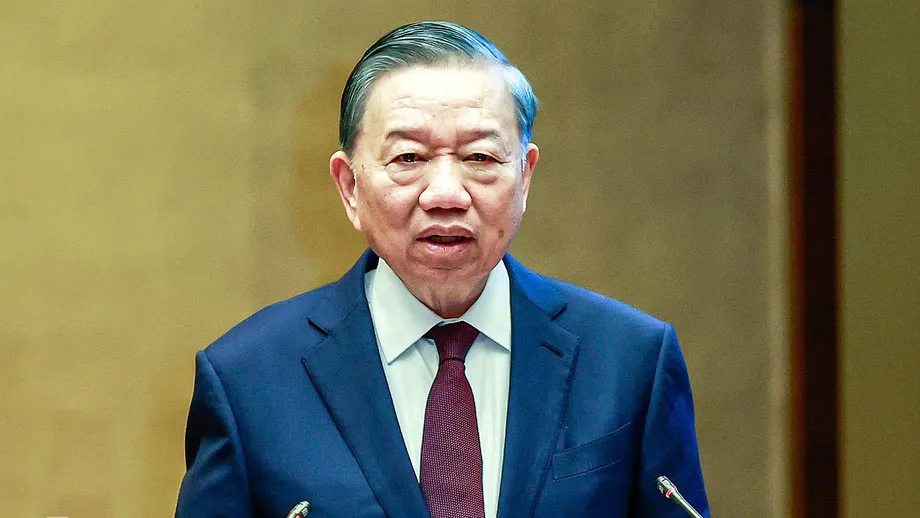
Personnel resolution puts unfinished work under scrutiny
Vietnamese Communist Party General Secretary and President To Lam called on October 16, 2026, for officials who cannot meet their duties to be considered for replacement before misconduct reaches the point of disciplinary action. His directive followed a new Central Committee resolution allowing personnel changes before an official's term or appointment expires.
Contents
- Personnel resolution puts unfinished work under scrutiny
- Replacement and discipline serve different purposes
- Job requirements must come before appointments
- Performance reviews must account for difficult assignments
- Commune offices need authority, staff and support
- Fewer approval rounds and clearer responsibility
- Business participation faces controls on actual benefits
- Talent policy looks beyond recruitment totals
- The growth target needs projects, resources and decisions
- Da Nang shows the pressure on local delivery
- Deadlines turn the directives into a test of delivery
- Key Points
Signed by Lam on October 15 on behalf of the Party Central Committee, Resolution No. 30-NQ/TW requires authorities to promptly reassign officials who fall short, allow their resignation, remove them from office or replace them. Officials whose weaknesses can be corrected should receive clear requirements, a deadline and another assessment.
Lam brought that personnel agenda together with economic demands at a national conference in Hanoi, where he called for preparation to achieve GDP growth of at least 10% in 2027. Ministries and localities must identify the resources, additional production capacity and decisions needed to deliver that target.
The Politburo and Secretariat convened the conference to implement decisions from the fourth plenum of the 14th Party Central Committee. It connected 2,725,229 delegates across more than 40,000 locations and heard six thematic presentations, bringing personnel management, leadership methods, business rules and economic planning into the same discussion.
For residents and businesses, Lam's instructions focus on familiar problems: unanswered petitions, officials seeking unnecessary approvals, delayed investment and public services held up by staffing shortages. He said the quality of leadership should be judged through the daily performance of institutions and the results people experience.
Replacement and discipline serve different purposes
Lam instructed Party committees to review their personnel regularly against the requirements of each job. Assessments should consider political qualities, ethics, credibility and actual contributions, alongside the difficulty of assignments and the conditions in which officials work.
Authorities should use those findings promptly to assign duties, provide training or change personnel. Reassignment must have evidence behind it, follow regulations and avoid arbitrary disruption. Lam also said moving someone to another post must not replace action over misconduct.
Resolution 30 gives this approach a wider institutional basis. The document identifies personnel evaluation as a continuing weakness, saying results have been insufficiently measured and verified, and assessment findings have not consistently guided decisions. It also describes officials avoiding responsibility, passing work elsewhere or fearing mistakes.
The resolution requires responsibility to extend to people who assess, recommend and appoint officials. Their decisions must be judged by their quality and consequences, while biased evaluations, improper interference, position buying and manipulation of appointments must face action. Lam's speech did not identify individual officials for replacement.
Job requirements must come before appointments
Nguyen Duy Ngoc, head of the Central Organization Commission, explained that agencies must first define their tasks, job positions and required skills, then select and develop suitable personnel. Jobs should not be designed around the people already available.
Ngoc said the Politburo had directed the political system to complete the definition of job positions in the fourth quarter of 2026. Those descriptions will provide a basis for staffing levels, salary reform and personnel policies. In practical terms, each position should specify what work must be done, what authority the official has and which results are expected.
Resolution 30 sets three central priorities: reforming evaluation and selection, developing a broader pool of future officials and talent, and creating connected personnel management based on verified information. It seeks to replace fragmented decisions made by different agencies or for individual terms with a continuous process linking recruitment, training, appointment and review.
Performance reviews must account for difficult assignments
Resolution 30 makes practical results a main measure of performance, while requiring assessors to consider authority, resources, circumstances and task difficulty. A leader's evaluation should also reflect the performance of the institution, the quality of its staff and preparation of successors.
Ngoc illustrated the approach by comparing a leader assigned to a prosperous area with ample resources and one sent to a difficult locality with longstanding unresolved problems. Assessors should examine who resolves hard tasks, makes effective use of resources and earns public confidence.
Lam cited recent reviews of centrally managed officials in which some units missed the highest performance rating because numerous assigned tasks remained unfinished. He said leaders must accept criticism and correct shortcomings rather than repeat the same weaknesses in annual reviews.
Lam, speaking as Party general secretary and state president, called for stricter examination of organizational capacity:
"We must be that rigorous and examine whether those Party organizations are truly strong, united and capable of carrying out their responsibilities," he said.
Commune offices need authority, staff and support
Vietnam's model of local government operating at provincial and commune levels makes commune officials central to implementing policy and serving residents. Ngoc said their workloads and required skills had changed substantially, making older assessments based mainly on titles, seniority or previous experience inadequate.
Lam instructed provincial authorities to understand the work and staffing capacity of each locality. They should provide suitable personnel, training and professional support, giving priority to offices with too few staff or excessive workloads.
Commune authorities must handle matters within their remit rather than pass them upward. At the same time, assigned duties must match their legal authority and practical capacity. When local services perform poorly, reviews should examine both the officials doing the work and the higher authorities responsible for staffing and support.
Central agencies also have responsibilities under decentralization, meaning the transfer of decisions to lower levels. Lam called on them to answer local concerns promptly, adjust guidance when needed and provide shared infrastructure and data that reduce delays and repeated requests for information from residents and businesses.
Fewer approval rounds and clearer responsibility
Lam told agencies to distinguish decisions requiring consultation with Party committees from decisions that competent state bodies can make themselves. Seeking opinions merely to shift responsibility upward should be corrected, he said.
The conference linked that instruction to Resolution 29-NQ/TW on leadership methods, adopted alongside Resolution 30 and Resolution 31-NQ/TW on Party building and rectification on October 15. Ngoc presented the three measures as a connected programme addressing organizational standards, decision making and the personnel responsible for delivery.
Lam warned that adding conditions and approval stages at every administrative level reduces opportunities for development. Agencies should resolve matters within their powers. When an issue exceeds those powers, they should report it together with a proposed solution.
Lieutenant Colonel Tran Huu Huy, a researcher at the Vietnam Institute for Defence Strategy and History, attributed delays partly to unclear responsibilities, overlapping rules and officials fearing mistakes. He proposed defining the timetable, expected results and individual responsibility for each task, then assessing the quality of work and the handling of practical problems.
Business participation faces controls on actual benefits
Party members' investment and business activities formed another part of the conference agenda. Nguyen Thanh Nghi, head of the Central Policy and Strategy Commission, presented Regulation 224-QD/TW, dated October 14, 2026, which differentiates rights and limits according to the member's role and exposure to conflicts of interest.
The approach examines who owns, controls and benefits from a business, rather than focusing only on the name appearing in its records. A conflict of interest arises when someone's public duties and private financial interests pull them toward different decisions.
Officials managed by the Politburo and Secretariat, together with officials in roles carrying a high risk of conflicts of interest, are barred from founding economic organizations, holding controlling shares or managing and operating them. Participation by other groups is subject to the relevant conditions and controls.
Lam called for legitimate wealth creation, jobs and social contributions while preventing the use of official positions, privileged information or public resources for personal gain. Party members engaged in business must comply with the law and protect workers' legitimate rights. Changes requiring amendments to state law must proceed through the relevant legislation.
Talent policy looks beyond recruitment totals
Lam said talent policy should start with the problems that industries and priority sectors need to solve. Agencies should judge talented recruits by their contributions, their ability to build skilled teams and their role in mastering technology, rather than the number of people hired.
Leaders must assign suitable work, provide the conditions needed to perform it and base rewards on actual contributions. Lam also called for developing talent within Vietnam while expanding cooperation with Vietnamese specialists overseas and international experts.
Resolution 30 sets a goal for 2030 of developing comparable career routes for managers and specialists with deep expertise. This would give skilled professionals opportunities for recognition and advancement without requiring them to become administrators. The resolution also seeks broader movement of qualified personnel between the public and private sectors.
Succession planning should test potential leaders through challenging assignments. Lam called for attention to women, young officials, ethnic minority officials and professionals in science and engineering, while maintaining qualification standards. Resolution 30 places these changes within goals for 2030 and a longer vision extending to 2045.
The growth target needs projects, resources and decisions
Lam's target of at least 10% GDP growth in 2027 requires each sector and locality to explain where its expansion will come from. GDP measures the value of goods and services produced in an economy. Plans should identify added production capacity, obstacles needing removal and the agency responsible for each task.
He urged authorities to complete 2026 objectives as fully as possible and begin preparations for 2027 during the closing months of 2026. Growth should increasingly depend on productivity, science, technology, innovation and more competitive businesses.
Public investment funds should move into projects faster, alongside attention to construction quality and useful results. Lam called for action on stalled projects that waste resources, support for private businesses expanding production and employment, and stronger connections between foreign investment, domestic companies and technology transfer.
The 2027 budget should reflect development goals and sustainable public finances. Lam identified essential services, salary reform, social security, nationally important tasks and disadvantaged areas as priorities. Each investment should account for its operating costs and management responsibilities, while fiscal and monetary policies should work together to control inflation and maintain economic stability.
Da Nang shows the pressure on local delivery
Da Nang Party Secretary Le Ngoc Quang issued a similar personnel instruction at the city's Party Committee conference on October 15. He called for transferring or replacing officials who fail to meet requirements, act irresponsibly or allow work to drag on, while sending qualified specialists to understaffed communes, especially remote and mountainous areas.
The city estimated regional GDP growth of 10.31% in the first nine months of 2026, including 11.83% in the third quarter. Its target for the fourth quarter was 12.8% to 13.6%, supporting an annual goal of at least 11%. Third quarter growth was 1.52 percentage points above the rate for the first nine months.
Da Nang also reported unresolved investment projects and continuing avoidance of responsibility. Quang called for tackling difficulties affecting 357 projects being handled under National Assembly Resolution 29 and accelerating land clearance involving 404 projects and nearly 47,000 files. That National Assembly measure is separate from the Party's Resolution 29 on leadership methods.
The city had transferred, rotated or appointed 17 senior officials during the first nine months. Quang instructed authorities to connect year end personnel ratings to specific results, particularly in areas drawing complaints such as land, investment, construction and business registration.
Deadlines turn the directives into a test of delivery
Ngoc called for visible improvements in organizational and personnel quality during 2027. The immediate implementation schedule combines study of the new measures with action plans and the redesign of job positions:
- October 14, 2026: Regulation 224-QD/TW on Party members' investment and business activities was dated.
- October 15, 2026: The Central Committee issued Resolutions 29, 30 and 31.
- October 16, 2026: The national conference presented the measures and Lam's implementation requirements.
- October 2026: Provincial Party organizations are to complete study and action programmes, under instructions outlined by Trinh Van Quyet.
- November 2026: Party cells are to complete their study and action programmes.
- Fourth quarter of 2026: The political system is to complete the definition of job positions.
Lam instructed inspectors to identify responsibility, corrective measures and deadlines, then follow the work until results are achieved. Reviews should compare institutional reports with residents' and businesses' feedback and conditions on the ground. Repeated complaints should receive a resolution or a clear explanation.
Colonel Do Phu Tho, editor in chief of Vietnam Veterans Newspaper, proposed regular dialogue, protection for people offering candid criticism and public tracking of responses. Lam also called for protecting officials who innovate for the common good, with responsibility reviews examining their motives, methods and the information and conditions present when they decided.
Key Points
- Resolution 30-NQ/TW allows reassignment, resignation, removal or replacement before an official's term or appointment ends.
- Lam called for replacing officials who cannot meet their duties without waiting for disciplinary violations.
- Personnel reviews must consider verified results, job difficulty, available resources and public confidence.
- Provincial authorities must support commune offices with suitable staff, training and workable assignments.
- Vietnam's 2027 GDP growth target is at least 10%, supported by plans identifying resources and production capacity.
- Action programmes and job definitions face deadlines in the final months of 2026, with visible improvements sought in 2027.