₩39,000 to import a tray, ₩4,980 at the supermarket
South Korea imported 1.12 million Brazilian eggs at ₩1,300 each, equivalent to ₩39,000 for a tray of 30, while subsidizing supermarket sales of imported eggs at about ₩4,980 per tray in July and August. The resulting controversy centers on why Brazil was chosen despite much cheaper alternatives, and whether public money would have achieved more by helping domestic farms recover.
Contents
- ₩39,000 to import a tray, ₩4,980 at the supermarket
- How Brazil became the most expensive supplier
- What the subsidy actually covered
- An official report documents the supply shortage
- Plans, deliveries and the sequence of events
- Why the government defended diversification
- Political allegations and the minister's denial
- Lower prices, but an uncertain contribution from imports
- Domestic investment and another approaching production change
- Key Points
Agriculture Ministry figures submitted to Representative Kim Yong-tae show that South Korea imported 133.24 million eggs through September. Brazilian eggs represented just 0.84% of that volume. The United States supplied 125.78 million, Thailand 5.62 million and Denmark 720,000.
The approximately ₩120 billion cited in the debate concerns support for fresh egg imports across suppliers, not spending on Brazilian eggs alone. Reports variously describe that amount as money budgeted, allocated or spent, without providing a reconciled account of final expenditure. That distinction matters when judging the scale of the intervention.
The government says emergency imports were needed after avian influenza forced the destruction of more than 11.3 million laying hens. Critics question the high Brazilian price, the use of the Livestock Development Fund and the balance between immediate consumer discounts and investment in domestic production.
How Brazil became the most expensive supplier
Brazilian eggs cost about 2.8 times the ₩464 import price for a U.S. egg, 4.3 times the ₩305 price for a Thai egg and 1.7 times the ₩761 price for a Danish egg. For a tray of 30, those figures translate into ₩39,000 from Brazil, ₩13,920 from the United States, ₩9,150 from Thailand and ₩22,830 from Denmark.
The gap did not begin at the farm. According to figures attributed to the University of Sao Paulo's Center for Advanced Studies on Applied Economics, Brazilian eggs cost roughly ₩100 each at the farm gate. Air freight, refrigerated handling, quarantine and repackaging added costs before they reached Korean distributors.
Tariffs also differed sharply. Brazilian eggs faced a 27% import duty, compared with no duty for U.S. eggs, 5% for Thai eggs and 1.6% for Danish eggs. Brazil was not included in the tariff reductions applied to selected imports to restrain inflation.
The reported Brazilian import price was therefore about 13 times its farm price. This does not establish that exporters received an excessive profit: the difference includes transport, taxes and other expenses. It does make the breakdown of those expenses central to assessing whether the purchases offered reasonable value.
What the subsidy actually covered
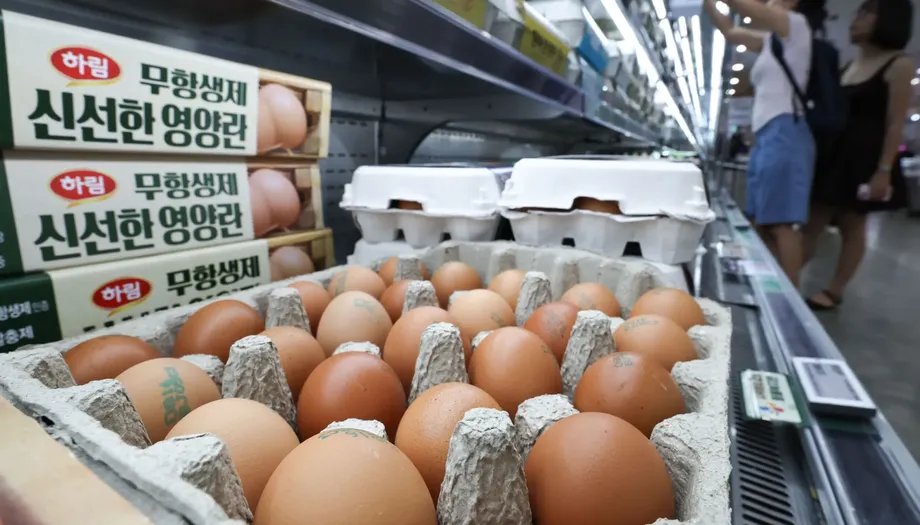
The Agriculture Ministry says imported eggs were supplied to distributors at a uniform price regardless of origin, averaging about ₩131 per egg. That is ₩3,930 for 30 eggs, a different stage of the transaction from the approximately ₩4,980 supermarket price supported in July and August.
Using the ministry's average distributor price as an illustration, the gap against the Brazilian import cost was ₩1,169 per egg, or ₩35,070 per tray. Applied to 1.12 million Brazilian eggs, that would amount to approximately ₩1.31 billion. This is a calculation using an average, not an audited subsidy total for the Brazilian shipments.
At the stated import price and volume, the Brazilian purchases themselves were worth approximately ₩1.456 billion. These figures show why the controversy has two separate dimensions: Brazil was unusually expensive per egg, while the much larger public budget supported an import program dominated by other suppliers.
People Power Party leader Jang Dong-hyeok claimed distributors received the eggs for ₩100 each. That differs from the ministry's stated average of ₩131. The accounts do not establish whether his figure described a particular transaction or was a rounded characterization of the program.
An official report documents the supply shortage
The U.S. Department of Agriculture's Foreign Agricultural Service sets out the production problem in its July 17 report, numbered KS2026-0028 and dated July 17, 2026. It says an outbreak beginning in November 2025, followed by the culling of 11.3 million laying hens and slow flock recovery, left daily production at 46 million to 47 million eggs against demand of 50 million.
That represents a daily shortage of 3 million to 4 million eggs, or 6% to 8% of demand. The ministry figures cited in the parliamentary debate give a slightly more precise culling total of 11.34 million hens, consistent with the official report's rounded figure.
The USDA report says South Korea planned to import approximately 210 million eggs from the United States and Thailand in July and August, supported by ₩99.7 billion, or $67 million, ahead of Chuseok. At the reported daily shortage, that volume would cover about 53 to 70 days of the production gap, assuming all planned eggs arrived and the gap stayed unchanged.
Separate reporting citing USDA figures describes ₩21.5 billion in earlier transport and repackaging support, followed by the additional ₩99.7 billion. Together, those allocations total ₩121.2 billion, close to the rounded ₩120 billion under scrutiny. The figures do not establish that every authorized won was spent.
Plans, deliveries and the sequence of events
The import totals describe different stages of the response. Eggs authorized for purchase are not necessarily eggs delivered, and an announced spending allocation is not the same as a final expenditure statement.
- November 2025: The outbreak identified in the USDA report began, eventually leading to the culling of about 11.3 million laying hens.
- First half of 2026: About 16.5 million eggs were imported from the United States and Thailand. The average retail price for 30 extra large eggs was ₩7,079, up 5.3% from a year earlier.
- By early July 2026: Approximately 31.4 million eggs from the United States, Thailand and Brazil had been authorized, with ₩21.5 billion in transport and repackaging support.
- July 17, 2026: The USDA report documented plans for approximately 210 million additional eggs from the United States and Thailand during July and August.
- Through September: Ministry figures cited in the spending controversy recorded 133.24 million imported eggs across four countries.
- Early October: Ministry figures put the tray price at ₩6,937, down from ₩7,418 in mid-July.
The reports describing the September totals and October parliamentary scrutiny do not consistently state a calendar year. Their figures should therefore not be treated as a fully reconciled completion report for the explicitly dated USDA plan. The reason actual deliveries differed from announced volumes is not established.
Why the government defended diversification
The ministry argues that buying from Brazil tested an alternative source when familiar suppliers were also under pressure. Avian influenza in the United States restricted imports from some producing regions, while heat waves reduced output in Spain and the Netherlands.
Brazil's Southern Hemisphere location gives it seasons opposite to South Korea's. The ministry says that could provide another source during the Korean winter, when avian influenza outbreaks are more common. Diversification in this context means reducing dependence on a supplier that might become unavailable, rather than necessarily securing the lowest immediate price.
The Agriculture Ministry described its immediate objective in an explanatory statement:
The measure was a short-term response to egg shortages, aimed at easing costs for consumers and encouraging retailers to cut prices,
Even after purchases from three other countries, the United States supplied about 94.4% of the September import total. Brazil's 0.84% share suggests a limited test rather than a substantial shift in sourcing. Whether that test justified its cost depends on what purchasing options were available at the time, information not established by the disclosed totals.
Retail acceptance was another constraint. Large supermarket chains were described as more comfortable with U.S. systems for recording when eggs were laid and tracking their movement. Verification of distribution arrangements in Brazil and Thailand required greater scrutiny. A new supplier therefore needed both export capacity and records acceptable to Korean buyers.
Political allegations and the minister's denial
Jang linked the Brazilian purchases to a February summit between President Lee Jae-myung and Brazilian President Luiz Inacio Lula da Silva. He alleged political favoritism and questioned why imports proceeded at several times the cost of eggs from other suppliers.
People Power Party Supreme Council member Kim Min-soo also called for scrutiny of whether a commission was involved. Those are political allegations, not established findings of improper payments or favoritism. The disclosed prices show a large cost difference, but do not prove the reason for the supplier choice.
Agriculture Minister Song Mi-ryung rejected the alleged connection between the summit and the imports during a parliamentary audit:
There is no connection,
Representative Kim Yong-tae raised a separate question about the use of agricultural funds during the audit:
Shouldn't the government have invested in Korea's domestic egg industry instead of using the Livestock Development fund and supplementary budget funds to import foreign eggs?
A fuller assessment would require the purchasing criteria, comparisons with available bids, detailed freight and handling charges, tariff decisions and final subsidy payments. No completed inquiry or scheduled decision resolving those issues is identified in the reports.
Lower prices, but an uncertain contribution from imports
The ministry's reported tray price fell from ₩7,418 in mid-July to ₩6,937 in early October, a decline of ₩481, or about 6.5%. That is evidence of easing prices during the intervention, but not a measure of how much the imports alone achieved. Domestic production was also recovering.
A separate October 7 observation put the consumer price for a tray of extra large eggs at ₩7,168, compared with a farm price of ₩5,828. The ₩1,340 difference was about 23% of the farm price. The consumer figure had risen from ₩6,882 during the Chuseok holiday period.
The ₩7,168 observation and the ministry's ₩6,937 early October figure differ. The reports do not establish that they use the same sampling method, egg specification or observation date, so they cannot be treated as interchangeable measures.
The Korea Rural Economic Institute projected that daily production could reach 50.31 million eggs as the number of laying hens aged at least six months increased. Against the USDA report's demand estimate of 50 million, that would represent a small daily surplus of 310,000 eggs. It is a forecast, not confirmation that the shortage had ended.
Distribution may affect how quickly lower farm prices reach shoppers. Eggs pass through roughly four or five stages involving collection, sorting, packing and logistics, without a wholesale market establishing a common reference price. Parliamentary discussion included strengthening price formation at egg grading and packing centers and using actual transaction prices more effectively. The retail gap alone does not show excessive profit, because those stages also incur costs.
Domestic investment and another approaching production change
Representative Shin Chang-sik said direct facility subsidies for domestic laying hen farms totaled ₩9.7 billion over nine years, approximately ₩1.08 billion annually. The ₩120 billion import support figure is about 12.4 times that nine year total.
The comparison captures the scale of the disputed spending choice, but it is not a comparison with all domestic poultry support. Direct facility grants are a specific category. The figures do not account for every loan, compensation payment, disease control measure or other form of assistance available to farms.
A numerical inconsistency also requires care. One English description gives import spending as ₩1,200 billion, while its accompanying Korean text states 1,200 eok won. That Korean amount equals ₩120 billion, not ₩1.2 trillion, and matches the other reported budget figures.
Production faces another change when minimum space per laying hen rises from 0.05 to 0.075 square meters, a 50% increase. Reports place full implementation in September of the following year without consistently identifying the calendar year. Farms keeping the same floor area may need fewer hens unless they expand or adjust facilities.
The spending dispute also echoes earlier interventions. In 2017, support for U.S. egg imports included partial air freight subsidies and tariff waivers, amounting to approximately ₩4,600 per tray. Imports fell short of targets and faced criticism for providing temporary relief.
During the 2021 avian influenza crisis, South Korea imported about 380 million eggs, mostly from the United States, with import support exceeding ₩100 billion. Agricultural and livestock discount support spending also rose from ₩106.8 billion in 2022 to ₩225 billion in the year described as the previous year, more than doubling.
These figures show repeated reliance on imports and discounts when supplies tighten. They do not establish that emergency imports were unnecessary. The unresolved policy choice is how much to spend on immediate relief while also restoring production and making distribution prices easier to track.
Key Points
- Brazilian eggs cost ₩1,300 each to import, compared with ₩464 from the United States and ₩305 from Thailand.
- Brazil supplied 1.12 million eggs, just 0.84% of the 133.24 million imported through September.
- The roughly ₩120 billion figure concerns the wider fresh egg import program, not Brazilian purchases alone.
- The USDA's July 17, 2026 report documented a daily shortage of 3 million to 4 million eggs and plans for 210 million imports.
- The ministry reported a tray price decline of about 6.5% from mid-July to early October, while domestic output was also recovering.
- Political allegations about the Brazilian purchases remain unproven; Agriculture Minister Song Mi-ryung denied a connection to the bilateral summit.
- Final spending, procurement details and the balance between emergency imports and domestic farm investment remain unresolved.