Smaller homes take nearly 80% of Seoul applications
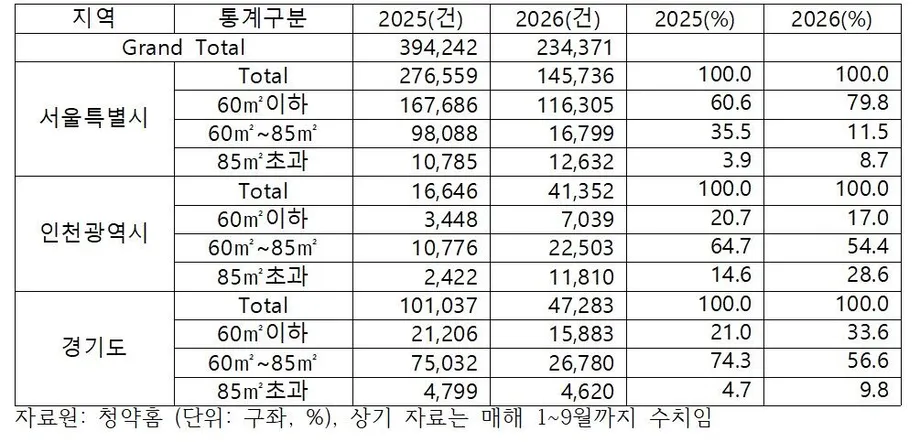
Seoul apartments measuring 60 square meters or less attracted 116,305 of the city's 145,736 housing subscription applications in January through September 2026, accounting for 79.8% of the total. The traditional 84 square meter apartment, often called South Korea's national standard home, belongs to a size category whose share fell to just 11.5%.
Contents
- Smaller homes take nearly 80% of Seoul applications
- What the subscription figures measure
- Why the total bill matters more than the area price
- The standard apartment loses applications fastest
- Gyeonggi shows the same budget pressure
- Large Seoul apartments move in the opposite direction
- Incheon records growth across all sizes
- Financing and household size shape choices
- Smaller existing homes are becoming more expensive too
- Key Points
The shift came as average apartment presale prices across Seoul, Gyeonggi Province and Incheon rose 22.2% compared with the same period in 2025, from 21.71 million won to 26.54 million won per 3.3 square meters. In Seoul, prices for apartments larger than 60 square meters and no larger than 85 square meters climbed 23.9%, while prices for smaller units were almost unchanged.
Yet the headline concentration in small homes does not mean more applications were submitted for them. Seoul's small apartment applications fell from 167,686 to 116,305. Their share increased because applications for the middle size category fell much faster, from 98,088 to 16,799.
At the other end of the market, apartments larger than 85 square meters attracted more applications despite a 74.2% increase in their average price per unit of area. The result is a market splitting between households seeking a manageable total purchase price and buyers willing to pay for space, location and scarcity.
Ham Young-jin, head of Woori Bank's real estate research lab, presented the analysis on October 14, using Korea Real Estate Board housing subscription data to compare the first nine months of 2025 and 2026. The figures describe applications for newly offered apartments, rather than completed purchases or the number of individual households buying homes.
What the subscription figures measure
Housing subscription is the application process through which prospective buyers seek an allocation of a newly offered apartment. An application records interest in a particular housing offer; it does not establish that the applicant secured a unit, signed a contract or completed the purchase.
The Korea Real Estate Board's subscription data service provides application counts, competition rates and special supply application information from the Cheongyak Home platform. Its coverage extends beyond ordinary apartments to categories including private advance subscriptions, New Hope Town housing, officetels, urban housing and private rental housing. Ham's analysis concerns the apartment market.
The official service also warns that application counts can change because of banks' computer processing and may differ from the final figures displayed on Cheongyak Home. That makes the figures useful for tracking the direction of applications, but provisional counts should not be confused with final allocation results.
The comparison covers several distinct dates:
- January through September 2025: the baseline period for prices and subscription applications.
- January through September 2026: the comparison period showing the shift toward smaller apartments in Seoul and Gyeonggi.
- October 14, 2026: the release of Ham's analysis of the two periods.
Why the total bill matters more than the area price
Seoul's smaller apartments were not cheaper per unit of area. Their average presale price was 58.18 million won per 3.3 square meters in 2026, compared with 57.61 million won for units larger than 60 square meters and no larger than 85 square meters. The smaller category therefore carried an area price about 1% higher.
The difference lies in how much space buyers must purchase. A smaller apartment can require less total funding even when each unit of area costs more. For a household constrained by savings or borrowing limits, the full contract price and the funds needed before moving in can matter more than the price per 3.3 square meters.
The price gap between the two categories also narrowed sharply. In 2025, smaller Seoul units averaged 58.39 million won per 3.3 square meters, against 46.48 million won for the middle category. By 2026, the latter had risen to 57.61 million won, while the small apartment average slipped 0.4% to 58.18 million won.
A separate Realhouse analysis put the average presale price of a Seoul apartment with 84 square meters of exclusive use area at approximately 2 billion won in the month preceding that report. This is a different measure from Ham's average price per unit of area and should not be treated as a direct conversion of his figures.
The Korean price figures also resolve a discrepancy in some accounts, which give amounts ten times lower. For example, 2,654 units of 10,000 won equals 26.54 million won, not 2.654 million won. The prices used here follow those Korean amounts and the matching English accounts.
The standard apartment loses applications fastest
The category containing the familiar 84 square meter apartment suffered the sharpest retreat in Seoul. Applications for homes larger than 60 square meters and no larger than 85 square meters fell by 81,289, or approximately 82.9%, between the two comparison periods.
Small apartment applications fell by about 30.6%. That decline was substantial, but much less severe than the contraction in the middle category. Small homes consequently increased their share from 60.6% to 79.8%, a gain of 19.2 percentage points.
The middle category's share fell from 35.5% to 11.5%. Reports describe that decline as either 23.9 or 24.0 percentage points; subtraction of the displayed, rounded shares gives 24.0 points. Some accounts similarly round its price increase to 24.0%, while most give 23.9%.
Seoul's total applications fell from 276,559 to 145,736, a decline of about 47.3%. Across the metropolitan region, applications dropped from 394,242 to 234,371, or approximately 40.6%. These totals make the distinction between a rising share and rising application volume essential: small apartments gained prominence within a shrinking subscription market.
The figures do not show how many apartments were offered in each size category. Without those supply totals, application shares alone cannot establish whether buyers became more willing to choose small homes, developers offered a different mix of units, or both occurred.
Gyeonggi shows the same budget pressure
Gyeonggi Province followed Seoul's movement toward smaller apartments, although its average presale prices were much lower. The province's average across apartment sizes rose 14.1%, from 20.14 million won to 22.98 million won per 3.3 square meters.
For units of 60 square meters or less, prices increased 20.6%, from 21.21 million won to 25.59 million won per 3.3 square meters. Despite that increase, the category's application share rose from 21.0% to 33.6%, a gain of 12.6 percentage points.
Here too, the growing share concealed falling application numbers. Small apartment applications declined from 21,206 to 15,883, or about 25.1%. Applications for the middle category dropped from 75,032 to 26,780, approximately 64.3%, while its share fell from 74.3% to 56.6%.
Reports give the middle category's share decline as 17.6 percentage points, although the rounded endpoints imply 17.7 points. Its average presale price rose 11.1%, from 19.84 million won to 22.05 million won per 3.3 square meters.
Total applications in Gyeonggi fell from 101,037 to 47,283. The smaller category's growing share, even as its own prices increased, supports the argument that buyers were focusing on the full funding requirement rather than simply choosing whichever category had the slowest price growth.
Large Seoul apartments move in the opposite direction
Seoul apartments larger than 85 square meters recorded a much steeper price increase than either smaller category. Their average presale price rose from 39.87 million won to 69.46 million won per 3.3 square meters, an increase of 74.2%.
Applications nevertheless increased from 10,785 to 12,632, a gain of approximately 17.1%. Their share of Seoul applications more than doubled, from 3.9% to 8.7%. Unlike the small apartment category, this segment gained both applications and market share.
Ham linked the strength of large apartments to scarce supply in sought after Seoul locations, particularly areas where reconstruction and redevelopment account for much of the housing offered. He said expectations of future price gains and location scarcity could sustain competition despite high entry prices.
Ham, speaking as head of Woori Bank's real estate research lab, described why these buyers continued to apply:
Even with high presale prices, large dwellings in core locations with strong expectations for price gains or with pronounced scarcity have maintained high competition rates by overcoming price resistance,
The distinction is between different financial constraints. Households seeking a home within a fixed budget may reduce the size they apply for, while buyers with greater assets may prioritize a scarce apartment in a preferred location. The application data do not establish that those expectations of future gains will be fulfilled.
Incheon records growth across all sizes
Incheon differed from Seoul and Gyeonggi because its total applications increased, from 16,646 to 41,352, or approximately 148.4%. Its average apartment presale price rose 22.8%, from 19.14 million won to 23.50 million won per 3.3 square meters.
The largest increase in applications came from homes above 85 square meters. Their count rose from 2,422 to 11,810, nearly 4.9 times the earlier figure, while their share increased from 14.6% to 28.6%. Prices in this category climbed 88.3%, from 17.74 million won to 33.40 million won per 3.3 square meters.
Small apartment applications also increased, from 3,448 to 7,039, but their share fell from 20.7% to 17.0%. Applications for homes larger than 60 square meters and no larger than 85 square meters rose from 10,776 to 22,503, while their share declined from 64.7% to 54.4%.
Ham attributed interest in Incheon's large apartments to the premium associated with landmark complexes and expanded allocation by lottery, which drew waiting applicants into the market. A lottery provides a route to allocation through a draw, rather than relying entirely on other applicant ranking criteria.
Gyeonggi's large apartment category offers another contrast. Its applications slipped from 4,799 to 4,620, yet its share rose from 4.7% to 9.8% because the province's total market contracted. Across the three regions, similar share movements can therefore describe very different changes in actual application numbers.
Financing and household size shape choices
Ham identified higher construction and building material costs, benchmark interest rate increases and lending restrictions as pressures on apartment applicants. His explanation was that rising total prices and tighter access to funds were pushing households away from the standard apartment size.
He also pointed to restrictions on jeonse loans tied to ownership transfers. Jeonse is a Korean rental arrangement based on a large deposit rather than conventional monthly rent. Constraints on this form of financing can affect the funding options surrounding a housing purchase, although the analysis does not quantify their contribution to the shift in apartment size.
Price is not the only factor Ham identified. Improved floor plans and better use of space, including balcony extensions, can make a small apartment more workable. Growth in households with one or two people can also increase the appeal of a compact home.
Those explanations help connect the price and application figures, but they are not separate measurements of cause. The analysis does not calculate how much of the change resulted from lending rules, household composition, layouts or the mix of apartments offered.
Smaller existing homes are becoming more expensive too
A separate KB Real Estate series shows that smaller apartments can still become more expensive in the broader sale market, even when their presale prices are stable. These sale price averages measure a different market from the newly offered apartments in Ham's subscription analysis.
In the KB January to September comparison, Seoul apartments of 60 square meters or less rose 12.9%, from an average of 956.13 million won to 1.07942 billion won. Homes larger than 60 square meters and no larger than 85 square meters rose 7.3%, from 1.4765 billion won to 1.58455 billion won.
Larger categories posted smaller increases: 3.1% for apartments above 85 and up to 102 square meters, 4.6% for those above 102 and up to 135 square meters, and 1.3% for homes above 135 square meters. The account of this series does not explicitly identify its calendar year, so it should not be assumed to cover exactly the same period as Ham's 2026 analysis.
Kim Deok-rye, a director at the Housing Industry Research Institute, attributed pressure on smaller homes to lending and tax regulations and instability in the rental market. She described the rental connection directly:
In particular, instability in the rental market is driving up prices for smaller, cheaper apartments.
Together, the two measures describe a difficult affordability tradeoff. Smaller apartments may offer a lower total entry price, but they are not necessarily cheap, and their prices in the wider sale market can rise faster than those of larger homes.
Ham expects the divide between budget conscious applicants seeking small homes and wealthy buyers seeking scarce large apartments to continue for the time being. No date for a further release or revision is specified, and the official data warning leaves room for application totals to change. Supply by size, final contracts and completed purchases would be needed to assess how far the application pattern carries through to actual ownership.
Key Points
- Small apartments accounted for 79.8% of Seoul subscription applications in January through September 2026, up from 60.6% a year earlier.
- Applications for Seoul's middle size category fell from 98,088 to 16,799, reducing its share from 35.5% to 11.5%.
- Small apartment applications also fell in Seoul and Gyeonggi, despite their rising shares.
- Metropolitan apartment presale prices increased 22.2%, to 26.54 million won per 3.3 square meters.
- Large apartment applications increased in Seoul and Incheon despite price rises of 74.2% and 88.3%, respectively.
- Application figures measure interest in housing offers, not completed purchases, and may be revised.