A living tailor, a missing vote and a mounting backlog
Kamta Prasad, a 53-year-old Delhi tailor who earns 250 rupees a day to support four people, is spending working hours visiting government offices to prove he is alive. His electoral record lists him as dead. His name is also recorded incorrectly as Kanta Prasad.
Contents
- A living tailor, a missing vote and a mounting backlog
- How many voters have been removed?
- Public checks find residents behind missing names
- When a home lacks the documents officials seek
- Demolitions and relocation complicate address checks
- Why Form 6 has become a legal dispute
- Election officials propose changing the remedy
- A return drive meets a large processing queue
- West Bengal shows the burden of appeals
- Protests move between streets and courts
- The dates voters and campaigners face next
- Key Points
Prasad is among millions excluded during India's Special Intensive Revision (SIR), an exercise intended to remove deceased people, duplicate registrations and voters who have moved or are otherwise ineligible. He says he voted in the last assembly and general elections and has been voting for 35 years.
Prasad described the moment he learned about his removal and the effort to reverse it:
I panicked when I heard about it. Since then I've been going everywhere to prove that I'm alive.
Election Commission data put nationwide deletions at approximately 133 million names. In Delhi, an October 20, 2026 account of application processing showed that only 1,238 of roughly 450,000 Form 6 applications seeking inclusion had been disposed of over 42 days, about 0.27%. Disposal means an application has received a decision; applicants are seeking entry into the electoral roll that determines who can vote.
The Election Commission says eligible people excluded by mistake can submit claims, supporting documents and appeals. It has ordered officials to revisit excluded voters. For Prasad and others, however, the correction process means lost wages, repeated hearings and uncertainty about when their names will return.
How many voters have been removed?
Election Commission figures published on September 30 divided approximately 133 million nationwide deletions into three broad groups: 95 million marked absent, shifted or others; 27 million recorded as dead; and 10.1 million identified as multiple registrations. The absent, shifted or others group accounts for more than 71% of deletions.
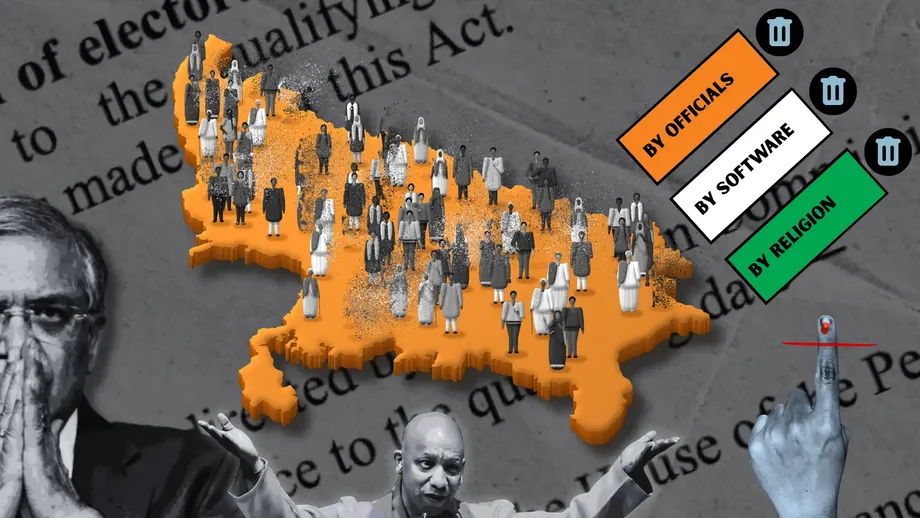
Delhi's draft roll presents a particularly large administrative challenge. A Supreme Court application gives the number excluded as 4,756,722, or 32.78% of the electorate before revision. Another account of the August 31 draft puts the number at 4.2 million. The higher figure means roughly one in three previously listed Delhi voters was excluded.
Within the larger Delhi total, about 3.159 million people were classified as permanently shifted. That category makes the handling of address changes central to the dispute: officials must determine where people now live, while residents need a workable route to registration at their current homes.
The New Delhi district administration's SIR 2026 page records publication of the revision programme on July 15 and dates Delhi's absent, shifted, dead and duplicate list to August 31. The programme uses October 1, 2026 as its qualifying date, the reference date for assessing eligibility.
Civil society presenters have also identified an earlier round of removals: around 1.1 million names were deleted through monthly updates before the SIR freeze, mostly between January and June 2026. Delhi's January 2025 roll had contained more than 15 million voters. Those earlier deletions and the later draft exclusions occurred at different stages of the revision process.
Public checks find residents behind missing names
Rajendra Kumar, a volunteer with Jan Sarokar, says approximately 2,000 of the roughly 9,000 voters in Prasad's block were removed, about 22%. They were classified as absent, shifted, deceased or registered elsewhere. Prasad was the only person Kumar identified as wrongly recorded dead in that block.
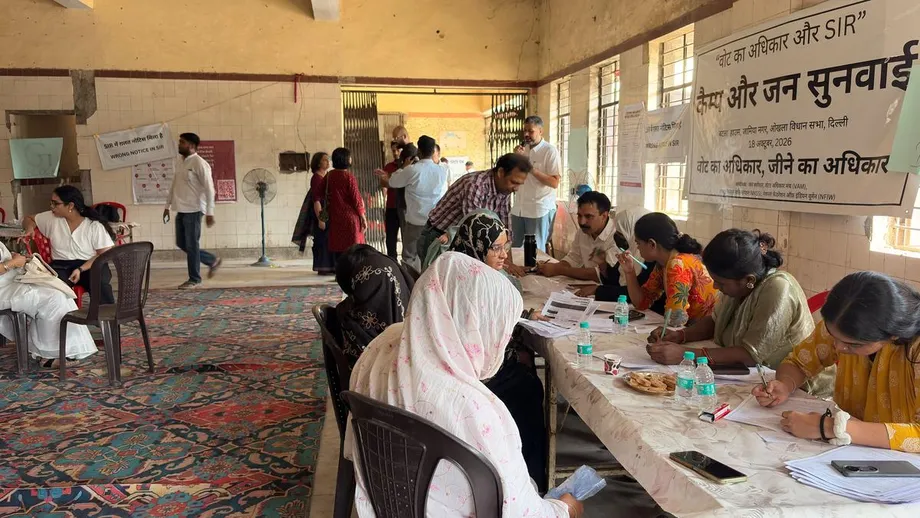
A public audit in two polling booths in Delhi's Okhla constituency found at least 100 voters wrongly classified as absent, shifted, dead or duplicate. Volunteers visited 258 households over seven days. Residents subsequently attended an October 18 public hearing in Batla House organised by Jan Sarokar, Mazdoor Kisan Shakti Sangathan, Voter Adhikar Manch and the National Federation of Indian Women.
At another hearing, an independent commission chaired by former judges A K Patnaik, Rekha Sharma and Anjana Prakash heard complaints from Delhi, West Bengal, Telangana and Bihar. Former Lok Sabha member Tarun Mondal said his name had been removed despite his family completing the enrolment process.
The commission proposed reading draft electoral rolls aloud at public meetings. That would allow neighbours to identify missing residents, incorrect classifications and duplicate entries together, alongside the individual claims process.
When a home lacks the documents officials seek
Kamal Lal, a 38-year-old private school teacher, says officials classified him as having moved even though he still lives beneath a Delhi flyover with dozens of families. After discovering his exclusion in September, he approached election officials, attended hearings and submitted repeated applications.
Lal explained how the demand for property or utility records affects residents of informal settlements:
It is very disappointing that we have been voting in this country and now our names have been cut because we do not have land papers or a water bill.
At a civil society hearing, Lal said 728 of Bela Estate's 729 voters had been removed. He said his grandfather arrived there in 1913 and that residents had submitted more than 500 enrolment forms.
Maya Devi, a 58-year-old domestic worker from Mayur Vihar, described a household split by the lists: her name and those of her two daughters were missing, while her husband and son remained registered. After demolition of their home, the five family members were living in a small room near the metro station. She said a local election officer she contacted for help never visited.
Mamta, 39, fears that losing her electoral record could also affect access to subsidised food and other welfare schemes. Her concern reflects the wider role that electoral records can play in documenting a family's identity and residential history, especially when other paperwork is scarce.
Demolitions and relocation complicate address checks
An analysis of Delhi's deletion lists identified nine polling booths in areas affected by demolitions where 8,800 of 10,015 voters were removed, about 88%. Across the capital, it counted 639 booths where more than half the voters had been deleted.
The same analysis said only 51 of Delhi's 14,947 booths stayed within a 2% deletion benchmark cited in Election Commission guidance. Deletions above that level require personal cross checking by the Electoral Registration Officer, the official responsible for preparing and revising the local roll.
In Wazirpur, 991 residents were removed, mostly as absent or untraceable, after relocation to government housing. Prime Minister Narendra Modi had handed families keys to flats on January 3, 2025; their former Jailorwala Bagh settlement was demolished that June.
In Patparganj, 1,057 of 1,199 registered voters were deleted after a July 2024 demolition, although many families returned and rebuilt. Booth officer Sovindra Kumar Gautam said officials could not link many residents to the 2002 electoral rolls. At Jangpura's former Madrasi camp, demolished in June 2025, 934 of 1,093 voters were removed.
Some displaced Madrasi camp families received Narela flats under the Delhi Slum and Jhuggi Jhopri Rehabilitation and Relocation Policy, 2015; others rented rooms elsewhere. Their cases connect two practical tasks: recording a new address and preserving the electoral history associated with the old one.
Why Form 6 has become a legal dispute
Form 6 is the application used to seek inclusion in an electoral roll, primarily for new voters. Its declaration says the applicant is applying for inclusion for the first time. Previously registered voters directed to use it say that wording conflicts with their voting history.
Section 31 of the Representation of the People Act, 1950 provides for imprisonment of up to one year, a fine, or both for a written declaration that a person knows or believes is false, or does not believe to be true. Petitioners have cited that provision in challenging the requirement. Form 8, by comparison, is used to change an existing voter's address or correct an entry.
On October 14, Delhi High Court Justices Dinesh Mehta and Aditi Choudhary closed a petition brought by Nilotpal Datta and another voter who had moved and missed enumeration. The court accepted the Election Commission counsel's submission that they could apply through Form 6 with assistance from the Electoral Registration Officer, and rejected their concern about being accused of a false declaration.
The Bombay High Court at Goa has also questioned the use of Form 6 rather than Form 8 in a case involving five family members who moved within Santa Cruz constituency. A Supreme Court application challenges both the Form 6 requirement and an additional SIR declaration about earlier registration of applicants or their relatives.
Election officials propose changing the remedy
Maharashtra's Chief Electoral Officer has proposed removing the words new voters from Form 6's title and adding an alternative declaration for previously enrolled applicants. The proposal would also let people supply their old Elector Photo Identity Card number so officials could trace their earlier entry.
Changing the statutory form requires the Central government to amend the Registration of Electors Rules, 1960. Former Chief Election Commissioner S Y Quraishi has challenged the use of Form 6 for deleted voters, while Congress leader P Chidambaram has criticised the expense of removing people and then organising their return.
Goa illustrates a further obstacle inside election software. Ninety seven deleted voters produced documents and were found eligible by local registration officers, but ECINet had no option to reverse their deletions. They remained outside the final roll and were told to apply again through Form 6.
Election Commissioners Vivek Joshi and Sukhbir Singh Sandhu have also objected to changes made to the online form without amendments to the rules. The Supreme Court discussed the modified form on October 5, 12 and 14. The Delhi SIR hearing was brought forward from October 30 to October 28.
A return drive meets a large processing queue
The Election Commission ordered a special enrolment drive on September 29 across 20 states and Union Territories where revision had been completed. Its wider instructions ask officials in places where SIR is complete or underway to compare old and current rolls, identify excluded residents and visit their homes.
Booth officers were advised to cover at least 20 to 25 electors each week and complete the exercise in about one month. They must record residents' current status, help eligible people submit Form 6 and share their findings with registration officers and recognised political parties. Camps are proposed for night shelters, labour colonies, homeless people and other marginalised residents.
Delhi's processing figures show the scale of the queue. About 239,000 applications came from people seeking inclusion again or registering for the first time after publication of the draft. Those applications formed part of the roughly 450,000 Form 6 requests, of which 1,238 had received decisions over 42 days.
A later update said more than 60% of approximately 3.3 million Delhi voters issued notices had been verified after procedures were eased. Booth officers could collect documents at homes and correct minor spelling errors. More than 1.9 million notices involved logical discrepancies, such as inconsistent names or ages, while nearly 1.4 million concerned records that could not be linked to the 2002 revision.
West Bengal shows the burden of appeals
West Bengal's appellate system offers another measure of the work involved after exclusion. Around six million voters faced judicial examination over logical discrepancies, and judicial officers deleted 2.716 million. Nineteen appellate tribunals established under Supreme Court directions in Writ Petition (Civil) 1089/2025 were all sitting in Kolkata, requiring some residents to travel hundreds of kilometres.
A detailed appeals dataset recorded 3.81 million filings and 82,782 decisions, about 2.2% of the total. Of those decided, 75,443 resulted in restoration and 7,339 in rejection. Malda had decided 1,027 of 685,000 appeals, about 0.15%. Another aggregate account put decisions above 100,000.
An examination of 6,444 rejected inclusion appeals recorded between April 13 and September 10 estimated that 80.2% involved voters with Muslim names. The records contained names rather than official religious identities, and the religious composition of all appellants was unavailable. Women accounted for 52.7% of those rejected.
Tribunals also hear Election Commission appeals against voters whom judicial officers had cleared. Justice Indrajit Chatterjee said all 254,000 appeals against inclusion before his tribunal, covering 10 Murshidabad seats, came from the Additional Chief Electoral Officer. West Bengal's Chief Electoral Officer said successful appellants would be enrolled for future elections.
Protests move between streets and courts
Opposition parties and youth organisations accuse Chief Election Commissioner Gyanesh Kumar of shaping revision to benefit the Bharatiya Janata Party. The commission and the BJP deny the allegation. Demonstrators have demanded Kumar's resignation, while police have used force and detained protesters in Delhi and elsewhere.
The Cockroach Janata Party, which began organising around examination irregularities, has shifted its attention to voter rights. Founder Abhijit Dipke announced a pause in fresh demonstrations until Diwali and asked supporters to spend time with their families. The organisation continued seeking the release of Saurabh Das and Ashutosh Ranka from Tihar jail.
Das and Ranka were among 14 people detained after crossing barriers at Jantar Mantar on October 13. A special executive magistrate cited a continuing risk to public peace when extending their detention. Their organisation challenged the October 19 extension in Delhi High Court under Article 21 of the Constitution, which protects personal liberty, and sought urgent release.
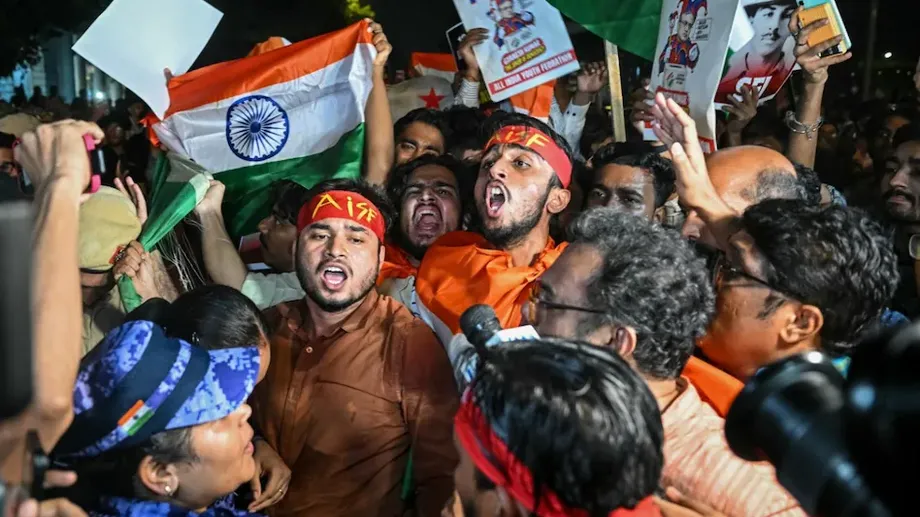
At an October 16 demonstration in Connaught Place, more than 100 people were detained. Dipke and student leader Neha Bora were detained beforehand and released the following day. Police cited restrictions, lack of permission and public safety; protesters said they were demonstrating peacefully with national flags.
The Supreme Court has sought responses from election officials on opposition petitions, agreed to examine Jantar Mantar's removal from the list of permitted protest locations and ordered preservation of CCTV footage after allegations of excessive police force. US Representative Pramila Jayapal also expressed concern on October 14 and supported peaceful protests.
The dates voters and campaigners face next
Officials have assured Prasad that his name will be restored, but no completion date has been given. The approaching hearings and enrolment deadlines make the speed of correction concrete for residents still waiting.
- October 21: Das and Ranka were due to appear again before the magistrate.
- October 26: Maharashtra's claims and objections window closes.
- October 28: The Supreme Court is scheduled to hear the Delhi SIR matter.
- October 29: A deadline was set for Delhi voters served notices to establish eligibility.
- November 16: Maharashtra's final electoral roll is due.
- December 4: Delhi's final SIR roll is scheduled for publication.
Prasad's immediate task remains securing a corrected entry while supporting his family. For election offices, the task combines revisiting excluded residents, processing applications and resolving address and identity questions before final rolls are published.
Key Points
- Approximately 133 million names have been deleted nationwide during SIR, with more than 71% classified as absent, shifted or others.
- A Supreme Court application puts Delhi's draft exclusions at 4,756,722 voters, about one third of its previous electorate.
- Public audits and residents' testimony identify living, eligible people classified as dead or moved.
- Only 1,238 of approximately 450,000 Delhi Form 6 applications had received decisions over 42 days.
- Delhi High Court accepted Form 6 as a route back for two petitioners; broader challenges continue in the Supreme Court.
- Maharashtra election officials have proposed changing the form to recognise previously registered voters.
- Fresh verification, enrolment camps and approaching court hearings will shape the correction process.