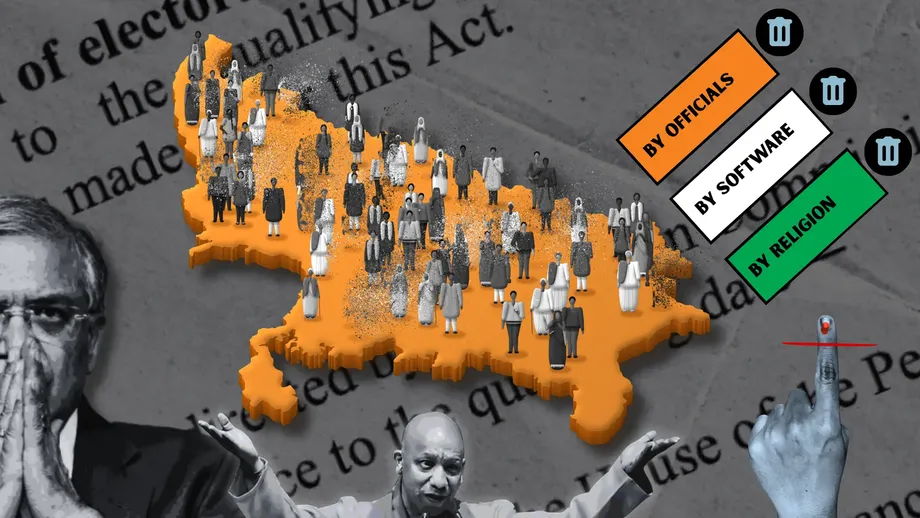
97 eligible Goa voters expose a gap between decisions and software
In Goa, election officers examined documents and found 97 voters eligible for inclusion in the electoral roll. Eight communications over seven days sought the software access needed to reverse their earlier exclusion. The final Special Intensive Revision (SIR) roll was published on February 21, 2026, without them. Checks through September 20 found all 97 still missing.
Contents
- 97 eligible Goa voters expose a gap between decisions and software
- What TCS built, and what came before it
- Goa's correction requests reached Delhi and the vendor
- Uttar Pradesh's deletion forms lacked reasons
- Why family matching can produce misleading flags
- The scale is large, but the totals measure different things
- Form 6 changes and objections inside the Commission
- Karnataka and court challenges reveal other safeguards at risk
- Political funding adds scrutiny, not proof of a connection
- What remains unresolved
- Key Points
That sequence puts a concrete problem at the centre of the controversy over India's election software: an officer can reach a lawful decision, yet lack the digital permission needed to implement it. In Uttar Pradesh, a separate investigation found 85,854 deletion requests bearing election officers' signatures without reasons for removal. Four officers described a system that automatically generated deletion forms when they did not approve voters during hearings.
Tata Consultancy Services (TCS), the technology partner behind ERONet 2.0, is now facing questions about how the platform implements Election Commission of India (ECI) instructions. The dispute concerns software permissions, automated family matching, changes to registration forms and the public visibility of deletion requests. It also brings scrutiny to political donations by the Tata Group's Progressive Electoral Trust.
These issues require distinctions that the political debate sometimes blurs. A software flag is not proof that a voter is ineligible. A deletion application is not necessarily a completed deletion. A company's government contract and political donations do not, by themselves, establish misconduct. The central issue is whether software preserves the authority of electoral registration officers and the safeguards available to citizens.
What TCS built, and what came before it
TCS's 2024-25 annual report describes ERONet 2.0 as a platform with a centralised database, a daily executive dashboard and applications supporting more than 1.05 million election officials. The company says it completed the nationwide rollout, including data migration, within seven months.
The history is more complicated than a claim that TCS built the entire voter registration system from scratch. ERONet was originally developed by the Centre for Development of Advanced Computing (C-DAC), under the Ministry of Electronics and Information Technology. Reporting based on shareholder disclosures places TCS's operation of ERONet 2.0 from 2023.
ECINet, launched on January 22, 2026, brought together about 40 existing applications. ERONet became its electoral registration component. The booth level officer application collects information in the field, while the registration system supports decisions on additions, corrections and removals.
A central database can help officials work from consistent records. It does not automatically transfer their legal powers to the people administering that database. Electoral registration officers (EROs) remain responsible for constituency rolls under electoral law. They exercise quasi judicial functions, meaning they must assess evidence and decide individual cases rather than merely process instructions.
The distinction matters when access settings prevent an officer from correcting an entry. Responsibility must then be traced separately: who specified the restriction, who approved it, who implemented it and who could remove it. TCS's role as technology partner does not establish that its engineers devised every disputed rule or independently controlled every permission.
Goa's correction requests reached Delhi and the vendor
The Goa dispute followed a January 29 Supreme Court order requiring publication of names flagged for logical discrepancies, with brief reasons. Affected electors were to receive ten days to submit documents or objections and be heard. Although the case concerned Tamil Nadu, the court expected compliance wherever SIR was underway. The ECI issued an implementation letter on January 31.
In Goa, 649 electors responded after the lists were displayed. EROs and assistant EROs found 97 eligible for inclusion. Of those, 65 were from Taleigao; the others were from St Cruz, Cumbarjua, Priol, Margao, Benaulim and Velim.
The missing functions included reversal of an earlier decision and the ability to upload documents again. Goa Electronics Limited, the state agency supporting the election office, wrote on February 11 that these functions remained unavailable despite repeated requests communicated to ECI and TCS officials. Further communications followed through February 17.
Goa Chief Electoral Officer Sanjay Goel attributed the decision not to include the voters to the ECI and identified the missing local correction mechanism:
The call (to not include) was theirs. But there has to be some mechanism (in ECINET) to re-include voters at the ERO level.
On February 18, Deputy Election Commissioner Sanjay Kumar instructed Director General of IT Seema Khanna that the system could not obstruct action required by the Supreme Court:
IT system cannot block necessary action as per the directions of SC.
The published account records no effective correction before the final roll. It does not establish whether the failure arose from technical limitations, withheld permission or an instruction not to act. Its consequences extend beyond voting: eligibility for the Goa Mediclaim Scheme is limited to state voters, with covered treatments including dialysis, transplants and chemotherapy.
Uttar Pradesh's deletion forms lacked reasons
Uttar Pradesh's chief electoral officer published more than 430,000 Form 7 applications, the prescribed requests for objections or deletion of electoral entries. Analysis identified 87,127 applications filed under the names of EROs and assistant EROs between March 15 and April 2, 2026.
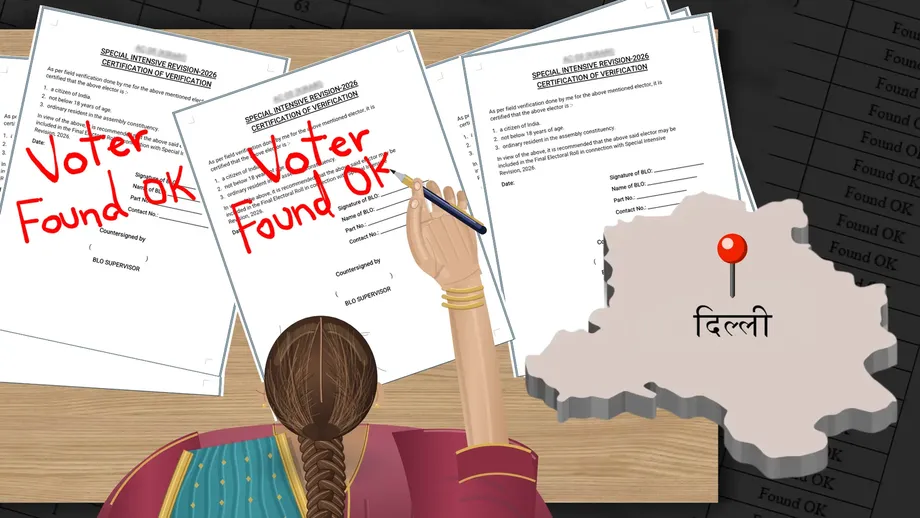
Of those, 85,854, or about 98.5%, contained no reason. Another 62 carried only letters, while 1,211 specified absence or a change of residence. Four EROs described automatic generation of Form 7 after a voter was not approved at a hearing, with digital signatures already attached.
The issue is more than an incomplete field. A reason tells a citizen what allegation to answer, whether death, duplication, age, citizenship or residence. Without it, challenging an objection becomes harder. The reported workflow also places an adjudicating officer in the position of generating the objection that election authorities must assess.
The investigation separately identified 110,476 applications from individual objectors submitted and accepted after the stated deadline. It reported that roughly 343,000 individual objectors specified reasons. Detailed questions to the ECI and Uttar Pradesh Chief Electoral Officer Navdeep Rinwa had not received replies by publication.
Other patterns warrant examination without being treated as proof of their cause. In Tarabganj and Pilibhit, about 90% of deletion requests targeted Muslim voters. In Tarabganj, 188 objections under the name Reshma concerned one booth and one date. Public disclosures did not identify objectors beyond their names, preventing independent checks of who submitted them.
Why family matching can produce misleading flags
SIR software links current electors to older electoral rolls, sometimes through parents or grandparents. Those it cannot link are described as unmapped. Others receive logical discrepancy flags when their recorded relationships or details fall outside programmed rules.
Reported rules include parent and child age gaps below 15 years or above 50 years, a grandparent gap below 40 years, siblings recorded less than nine months apart and more than six children linked to one father. Differences in names can also trigger scrutiny. Accounts describe changing thresholds: early West Bengal rules used a parent and child band of 15 to 45 years, while the version recorded in January 2026 used an upper boundary of 50.
The reference rolls are not uniformly from 2002. Instructions used 2003 for several states, including Uttar Pradesh and Madhya Pradesh, and later years elsewhere. Tamil Nadu used 2002 for 197 constituencies and 2005 for 37. Accuracy therefore depends on the correct reference record as well as the matching rules.
On December 27, 2025, West Bengal's election office suspended hearings for unmapped voters after incomplete conversion of old PDF records into structured CSV data caused linkage failures. On December 29, it acknowledged that the base data had not been digitised accurately. Bengali records also passed through a machine transliteration process before comparison in English.
These are different potential sources of error: a paper record may be entered incorrectly, a name may be converted inconsistently between scripts, or a matching rule may reject a genuine relationship. A flag alone cannot distinguish among them. The reported notice involving Nobel laureate Amartya Sen, after an implausible recorded age gap with his mother, illustrates why the underlying record must be checked before eligibility is decided.
The scale is large, but the totals measure different things
Uttar Pradesh began with 154.4 million registered voters. During enumeration, 28.9 million names entered the absent, shifted, dead or duplicate list. Separately, 32.6 million electors were flagged for logical discrepancies or lack of mapping. Its final roll, published April 10, contained 134 million electors.
The difference between the starting and final totals is 20.4 million, approximately 13.2% of the starting electorate. That is a net change, not a count of completed deletions: additions and restorations can occur during revision. The absent list and discrepancy population also cannot simply be added without knowing their overlap.
West Bengal reportedly flagged 13.1 million electors, or 17.11%, compared with 23.5 million, or 41.22%, in Madhya Pradesh. The Madhya Pradesh share was about 2.4 times West Bengal's. That contrast supports a need to examine state data and procedures, but does not by itself explain the difference.
National estimates require equal caution. The original commentary alleges more than 130 million deletions, while former Chief Election Commissioner O.P. Rawat described nearly 140 million voters as disenfranchised. A May 1, 2026 communication by United Nations Special Rapporteurs cited about 52 million removals in Phase II alone. These figures refer to different scopes and claims; they do not provide a reconciled national total of eligible citizens wrongly excluded.
Form 6 changes and objections inside the Commission
Form 6 is used to apply for fresh registration. The controversy concerns whether the online version introduced additional requirements during SIR without the necessary amendment to the Registration of Electors Rules, 1960. The original account says two Election Commissioners recorded that an amendment by the Union government was required and had not occurred.
On October 1, 2026, Lok Sabha opposition leader Rahul Gandhi alleged that the online form was changed illegally. He asked who at the ECI instructed TCS to change it and whether the company had been pressured. Congress communications general secretary Jairam Ramesh alleged the change targeted younger voters and attributed it to Prime Minister Narendra Modi and Home Minister Amit Shah. Those are political allegations, not established findings.
Separate reporting describes at least 14 written objections by Election Commissioners Sukhbir Singh Sandhu and Vivek Joshi concerning decisions and access to election systems. Accounts differ on the period covered, placing the earliest objections in October or November 2025 and continuing through August 2026.
Sandhu's reported August objection addressed restrictions on EROs, district election officers and chief electoral officers. Joshi had raised the gradual centralisation of the database in May. Together with the Goa correspondence, these objections make the allocation of digital permissions a question of institutional authority, rather than merely an opposition complaint.
Karnataka and court challenges reveal other safeguards at risk
Karnataka's chief electoral officer reported 110,654 Form 7 applications received between June 16 and October 8, 2026. The public portal displayed 81,822. The difference, 28,832 applications, represented about 26.1% of the reported total, despite assurances that all applications would be available for scrutiny.
Missing disclosures do not establish that the underlying applications were improper. They prevent citizens from checking them. In Vijayapura, eight living voters complained that objectors had sought their removal as deceased. An initial investigation found genuine death certificates had been used against voters with similar names. The objectors included followers of expelled BJP legislator Basanagouda Patil Yatnal.
That case illustrates a problem distinct from automated matching: a genuine document can still refer to the wrong person. Verifying a death certificate's authenticity is therefore insufficient without confirming that it belongs to the elector concerned.
Courts are also examining individual notices and procedural authority. In Telangana, social worker S Q Masood and businessman Syed Waheed Uddin challenged automated notices and the transparency of ECINet and ERONet. The ECI said Masood's notice followed a mismatch in his father's name. The bench asked what action followed his September 15 hearing.
In Goa, Bombay High Court Justices Valmiki Menezes and Amit Jamsandekar questioned deletions involving the Salgaonkar family, who had submitted Form 8 to change address. The bench said the existing electoral roll remains valid until the revised roll is finalised and questioned requiring an enumeration form from a voter changing residence. These proceedings do not establish that every automated notice or deletion is unlawful.
Political funding adds scrutiny, not proof of a connection
The Tata Group's Progressive Electoral Trust distributed Rs 915 crore in 2024-25, including Rs 757.6 crore to the BJP and Rs 77.3 crore to Congress. Tata Sons contributed Rs 308 crore to the trust, and TCS contributed Rs 217 crore.
The BJP's share of the trust's distributions was about 82.8%. A separate reported total puts BJP receipts from all electoral trusts at Rs 959 crore. Against that denominator, Rs 757.6 crore represents about 79%, not 83%. The figures describe different comparisons and should not be interchanged.
For 2018-19, the original account gives trust distributions of Rs 454 crore and BJP receipts of Rs 356 crore. Those figures produce a share of about 78.4%, rather than its stated approximation of 75%. Across the two periods, the BJP received the largest share of the trust's distributions.
The original commentary also places an April 2024 donation shortly after approval of roughly Rs 44,000 crore in subsidies for two Tata semiconductor units. Timing alone does not establish a connection to those subsidies or election software contracts. No evidence presented establishes that donations purchased software decisions or favourable treatment.
Tata Sons' leadership dispute is another separate issue. The original account describes N. Chandrasekaran withdrawing a planned departure and securing a September 2026 reappointment through a disputed casting vote. It also describes an October 2025 meeting involving Chandrasekaran, Noel Tata, Amit Shah and Finance Minister Nirmala Sitharaman. Neither account establishes government direction of the later board decision or a connection to electoral software.
What remains unresolved
The documented sequence places changing software, disputed permissions and legal safeguards alongside one another:
- June 24, 2025: The ECI ordered the Bihar SIR.
- October 27, 2025: Phase II was ordered across 12 states and Union Territories, covering about 510 million electors.
- December 2025: West Bengal officials recorded problems with digitised legacy rolls.
- January 22-31, 2026: ECINet launched, the Supreme Court issued discrepancy hearing directions, and the ECI circulated implementation instructions.
- February-April 2026: Goa published its final roll without the 97 eligible voters; Uttar Pradesh's disputed officer deletion forms were generated before its April 10 final roll.
- May-October 2026: The exercise expanded, while challenges over forms, notices and disclosures continued.
Several questions remain unanswered: who approved the family matching thresholds; who authorised online Form 6 changes; why Goa's correction functions were unavailable; and whether automatically generated deletion forms preserved an officer's reasoned decision.
Contracts, change requests, access records, testing results and system logs could separate the ECI's policy choices from TCS's implementation responsibilities. They could also show whether faults were detected, escalated and corrected. The accounts identify no scheduled public release of those records or common deadline for an independent software audit.
The test is specific: every voter facing exclusion should receive a comprehensible reason and an effective opportunity to respond, and every authorised officer should be able to record and implement a lawful decision. Goa demonstrates why a hearing without a functioning correction mechanism is insufficient.
Key Points
- Goa officers found 97 voters eligible, but checks through September 20, 2026 found them absent from the final SIR roll.
- Analysis of Uttar Pradesh disclosures found 85,854 officer deletion requests without reasons.
- TCS operates ERONet 2.0; the earlier ERONet system originated with C-DAC.
- Legacy data errors, changing matching rules and restricted correction access require separate examination.
- Karnataka's public portal showed 28,832 fewer Form 7 applications than the reported total.
- Tata electoral trust donations warrant scrutiny, but do not establish a connection to disputed software decisions.
- National deletion estimates differ and do not establish a verified total of eligible voters wrongly excluded.