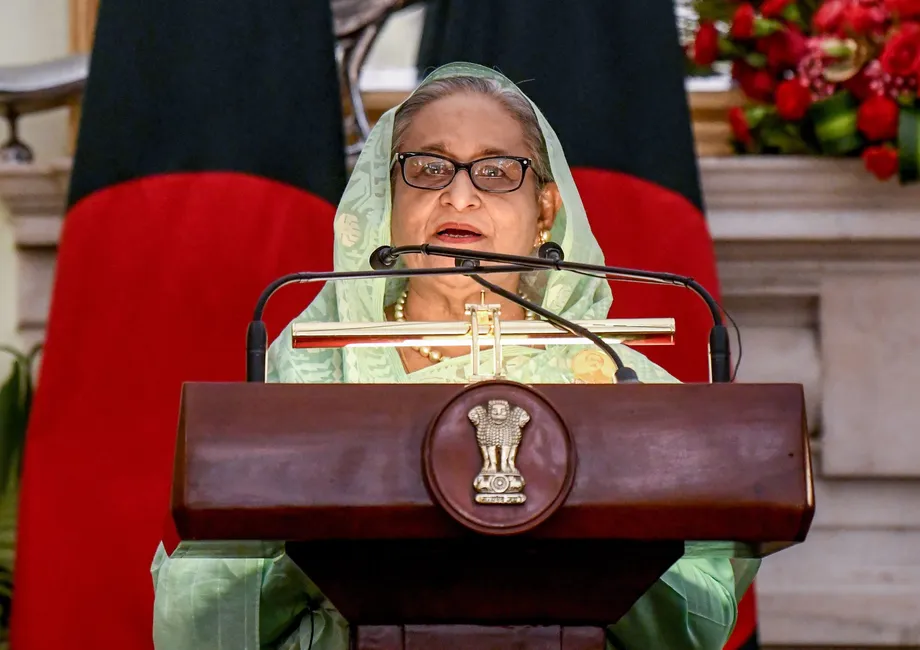
A return pledge under the shadow of a death sentence
Former Bangladesh Prime Minister Sheikh Hasina has appealed to the United States to support inclusive elections and independent courts as she renews her pledge to return from India, where she has lived since her government collapsed in August 2024. Her proposed homecoming carries immediate legal stakes: she was sentenced to death in her absence in 2025 over crimes against humanity linked to the crackdown on the 2024 uprising.
Contents
- A return pledge under the shadow of a death sentence
- What she is asking Washington to support
- The election exclusion behind her appeal
- A conviction tied to the 2024 uprising
- How earlier returns shape her message
- Reconciliation alongside sharp criticism
- India, BRICS and relations with major powers
- The economic part of her US appeal
- Key Points
Bangladesh's government, led by Prime Minister Tarique Rahman, is seeking her extradition from India. Hasina disputes the conviction and accuses the current leadership of using criminal proceedings to silence her and members of her Awami League.
Speaking virtually at an event hosted by the Center for US-Bangladesh Relations in Washington, Hasina said responsibility toward her supporters and ordinary citizens outweighed fears for her safety. The former prime minister described herself as determined to return despite the possibility of imprisonment or violence.
How risky it is, I don't care. I have to go back.
Hasina has identified December as her intended month of return, following an earlier announcement in New Delhi pointing to December 2026. Her son, Sajeeb Wazed Joy, subsequently said no date had been fixed and that an announcement would come closer to the time. December therefore remains her stated intention, with the precise timing unsettled.
What she is asking Washington to support
Hasina's central appeal was for Washington to support democratic institutions rather than choose between competing political leaders. She said Bangladesh's citizens should determine their government through a free and inclusive political process.
Addressing the United States directly, the former prime minister set out her request in terms of political rights.
I ask the U.S. to choose democracy.
Her demands included independent courts, freedom of expression, political association, protection of minorities and respect for due process. Political association means the ability to organise and take part in political groups. Due process means that authorities must follow fair legal procedures when investigating, prosecuting or punishing someone.
For Bangladeshis, those demands concern practical freedoms: whether they can join a party, criticise a government, seek protection from a court and vote among competing candidates. Hasina also said that people who opposed her administration were entitled to have their rights respected.
The election exclusion behind her appeal
The Awami League was barred from the February 2026 parliamentary election, which brought the Bangladesh Nationalist Party, or BNP, to power under Tarique Rahman. Restrictions on the Awami League's political activities remain in place.
Hasina's call for an inclusive political process therefore has a direct bearing on her own party. Its exclusion prevented it from fielding candidates in that election and left its supporters unable to vote for an Awami League candidate.
Hasina argued that excluding political parties would deepen divisions and obstruct national reconciliation. Her position links a personal demand, the opportunity to return and contest allegations, with a wider demand for her party to regain space in public life.
Rahman's government faces two connected disputes with the former prime minister: the criminal proceedings against her and the question of political participation for the party she leads. Hasina addressed both in Washington, calling for fair proceedings and political rights while challenging the legitimacy of the cases against her.
A conviction tied to the 2024 uprising
The death sentence gives Hasina's return pledge a consequence beyond the ordinary risks of political opposition. She was convicted in absentia, meaning the proceedings took place without her being physically present, over crimes against humanity connected to the crackdown on the uprising that preceded her fall.
Crimes against humanity concern grave abuses committed as part of a widespread or systematic attack on civilians. Hasina disputes her conviction and maintains that allegations against political leaders should be examined through transparent and impartial proceedings.
Extradition is the process through which one country formally transfers a person to another country for prosecution or punishment. Bangladesh's request to India places Hasina's legal position within the relationship between the two neighbours, while she continues to receive refuge in India.
Hasina also acknowledged questions about her own time in office. Speaking about her administration and the upheaval that ended it, she said:
I acknowledge the difficult questions surrounding my government, the events of 2024 and their aftermath.
She maintained that allegations against anyone, including herself, should be resolved through fair legal proceedings. Her acknowledgement and her challenge to the conviction form the two central parts of her legal argument: scrutiny of her government, accompanied by a demand for an impartial process.
How earlier returns shape her message
India has sheltered Hasina since August 2024. In her Washington remarks, she thanked the Indian government and people, recalling the refuge she received after the assassination of her father, Bangladesh's founding leader Sheikh Mujibur Rahman, and several other family members in 1975.
Hasina invoked her return to Bangladesh in 1981 after years abroad, as well as her decision to return during the political emergency in 2007 despite facing criminal allegations. She presented those episodes as evidence of her willingness to confront danger.
Her references bring several decades of family history, political exile and legal conflict into the current pledge. The key events run from the killings in 1975 to the election held without her party in 2026.
- 1975: Sheikh Mujibur Rahman and several members of Hasina's family were assassinated. Hasina subsequently spent years abroad.
- 1981: Hasina returned to Bangladesh after that period away.
- 2007: She returned during a political emergency while facing criminal allegations.
- August 2024: Her government collapsed following the uprising, and she left for India.
- 2025: She was sentenced to death in absentia over crimes against humanity linked to the 2024 crackdown.
- February 2026: The Awami League was barred from the parliamentary election that brought the BNP to power.
- December 2026: The month Hasina previously identified for a return, although her son says no date is fixed.
Reconciliation alongside sharp criticism
Hasina has described her return as part of an effort to restore democracy, the rule of law and voting rights. In a separate interview, she accused Rahman's government of closing democratic space and said extremist forces had regained room to operate. Those were her assessments of the current government.
She also said she wanted to stand alongside Bangladeshis and help restore security and development. Her explanation for returning centres on a claimed responsibility to people she says are suffering while she remains abroad.
At the Washington event, Hasina paired that criticism with an appeal for reconciliation. The former prime minister explicitly included opponents of her administration in her statement about citizens' rights.
Equally, those who oppose my government are citizens whose rights must be respected. The future of Bangladesh must be built on reconciliation, not revenge.
Her remarks place political participation and accountability beside each other. She is asking for space for her party and protection for its supporters while acknowledging that her own administration faces serious questions over the events of 2024.
India, BRICS and relations with major powers
Hasina called for constructive relations with India, the United States, China and Japan. She argued that Bangladesh should avoid becoming a battleground for competition among major powers.
Her comments put relations with India at the centre of both her personal circumstances and her foreign policy argument. India is sheltering her while Bangladesh seeks her extradition, and she is urging Dhaka to maintain constructive engagement with its neighbour.
In the separate interview, Hasina criticised Rahman's decision to skip a BRICS summit in India, calling it immature and damaging to Bangladesh's national interest. BRICS is a grouping of major emerging economies that provides a forum for discussion of economic and international issues.
Hasina said participation could have opened opportunities for Bangladesh's economic and social development. She argued that foreign policy should serve national interests rather than personal reactions or short political calculations, calling for a mature and balanced approach.
The economic part of her US appeal
Washington also featured in Hasina's economic proposals. She supported greater American investment and closer cooperation in education, technology and security, alongside her request for US support for democratic institutions.
Those areas concern different parts of Bangladesh's relationship with the United States: investment in businesses, educational opportunities, access to technology and cooperation between public institutions. Her remarks outlined priorities rather than specific projects, funding commitments or agreements.
Hasina's message combines a request for international engagement with a claim that Bangladeshis themselves must choose their government. She wants Washington involved as a supporter of political rights and economic cooperation while urging Bangladesh to maintain working relationships with several major partners.
Her proposed return brings those diplomatic goals back to a concrete legal and political confrontation. Bangladesh is seeking her transfer from India, her death sentence remains central to the risks she describes, and the Awami League remains excluded from political activity. Her pledge commits her publicly to coming back while leaving the practical arrangements unresolved.
Key Points
- Sheikh Hasina urged the United States to support inclusive elections, independent courts, minority protection and freedom of expression in Bangladesh.
- She has pledged to return from India despite a death sentence imposed in absentia in 2025, which she disputes.
- Hasina has named December as her intended return month, previously specifying December 2026. Her son says no date has been fixed.
- Prime Minister Tarique Rahman's government is seeking her extradition from India.
- The Awami League was barred from the February 2026 election that brought the BNP to power, and its political activities remain prohibited.
- Hasina acknowledged difficult questions about her government's record and the 2024 protests while calling for impartial legal proceedings.
- She advocated reconciliation, constructive ties with major partners and greater US investment and cooperation.