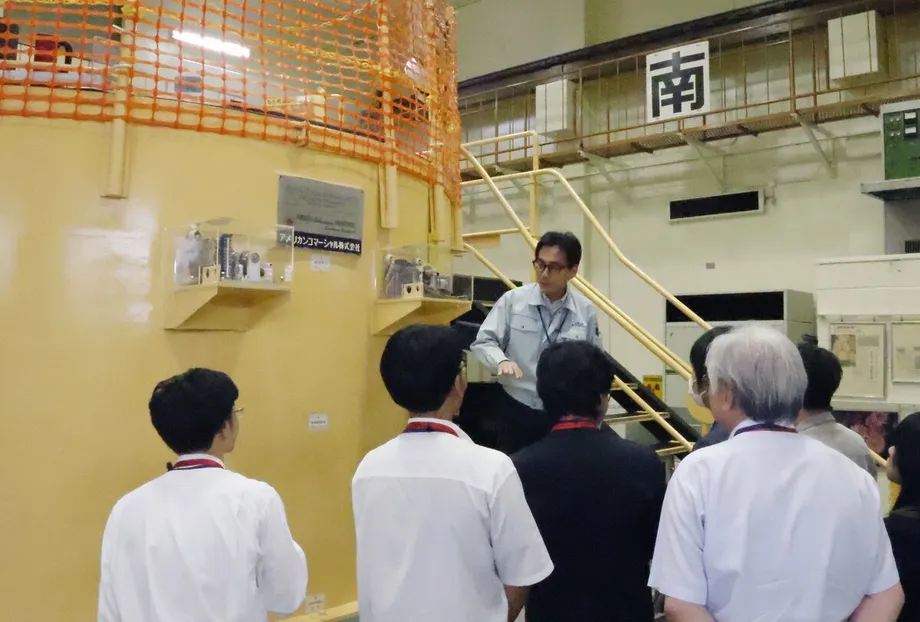
A tiny reactor carries a growing training burden
Kindai University's teaching reactor in Higashiosaka, Osaka Prefecture, produces at most 1 watt of heat, less than a candle flame. Keeping it available costs about 200 million yen a year, according to the university, while corporate usage fees and government training subsidies bring in only about 6 million yen. A required change of uranium fuel now threatens to add a much larger bill.
Contents
- A tiny reactor carries a growing training burden
- What students learn at 0.01 watts
- How the teaching reactor works
- More than six decades of shared use
- A busy facility with little direct income
- Why the uranium must change
- A security commitment with a large bill
- Fewer students, fewer places to train
- The workforce need extends to dismantling reactors
- Key Points
The reactor is Japan's only university reactor currently operating, with the other remaining facility, at Kyoto University, temporarily suspended. More than 250 students trained at Kindai in fiscal 2024. Companies also use it for cancer treatment research and experiments related to dismantling nuclear facilities.
Japan and the United States committed in September 2022 to replace its highly enriched uranium with low-enriched uranium and return the existing fuel to the United States. The conversion is expected to cost tens of billions of yen, with Kindai expected to shoulder part of that expense.
The pressure comes as Japan turns toward greater use of nuclear power after years of seeking to reduce dependence following the Fukushima Daiichi disaster. The country also needs people who can safely dismantle older reactors. Yet education ministry figures show that entry into nuclear related university departments and programs fell from 579 students in fiscal 1994 to 177 in fiscal 2024.
What students learn at 0.01 watts
About 20 students from Fukui University of Technology took part in an August training session at Kindai's Atomic Energy Research Institute. Watching a control panel, they worked toward bringing a nuclear chain reaction into a stable state.
When the reading reached 0.01 watts, a student participating in the exercise announced the result:
0.01 watts. We've reached criticality.
Criticality means that each generation of nuclear fissions supplies enough neutrons to sustain the next generation. In a controlled reactor, operators can maintain that reaction at a steady level. Here, the students reached it at just one hundredth of the reactor's maximum thermal output.
The exercise lets students connect calculations with instruments, control movements and an actual chain reaction. A reactor with such a small heat output can teach the principles of reactor operation without generating electricity.
Genichiro Wakabayashi, a professor at Kindai's institute, described the purpose of that training:
I want students to learn what nuclear energy is and how it can be used safely.
Kindai's reactor facility guide says the control console, in a room beside the reactor room, was designed to make startup, shutdown and power adjustments suitable for student training.
How the teaching reactor works
The UTR-KINKI reactor stands about 2 meters high and measures about 4 meters in diameter. Often called a zero-power reactor because its output is extremely low, it uses water to slow neutrons and graphite around the core to reflect some of them back toward the fuel.
Slower neutrons help sustain fission in the uranium fuel. The graphite helps keep neutrons available for the reaction, while control rods allow operators to adjust it. Kindai lists five neutron detectors and four control rods among the instruments used to control reactor power.
The core contains 12 flat fuel elements made from a uranium and aluminum alloy, divided into two groups of six. That compact arrangement supports experiments and training rather than the large heat production needed at a commercial nuclear power station.
Kindai says the reactor has very low residual gamma activity. Its shielding allows access to the reactor room during operation, and radiation monitoring takes place there. Students therefore learn radiation protection alongside reactor physics: shielding, monitoring and controlled access remain part of the work even at very low power.
More than six decades of shared use
Kindai's institute history identifies UTR-KINKI as Japan's first private and university reactor. Its development stretched from the creation of the institute in 1960 to later additions that widened its research uses.
- April 1960: Kindai established the Atomic Energy Research Institute for research and education.
- August 1960: Installation of the reactor was approved.
- November 11, 1961: The reactor first reached criticality, at a thermal output of 0.1 watt.
- October 1974: Maximum thermal output increased to 1 watt.
- January 1984: Facilities were added for small animal irradiation, neutron radiography and expanded vertical irradiation.
- September 27, 2022: Japan and the United States announced their commitment to convert the reactor's fuel.
Neutron radiography uses neutrons to examine the inside of objects, much as an X-ray image reveals internal structures using a different form of radiation. Irradiation facilities let researchers expose samples to radiation under controlled conditions.
Students from Osaka, Kobe, Nagoya and Kyushu universities are among those who use Kindai's reactor for education and training. The institute also provides workshops and seminars for teachers and members of the public. Its role therefore extends beyond the students enrolled at its own university.
A busy facility with little direct income
Kindai operates the reactor for about 130 days a year, excluding inspections and other maintenance. Alongside university classes, corporate users bring projects ranging from research connected to cancer treatment to simulations of nuclear decommissioning work.
Wakabayashi described the pressure on the schedule:
(It's so busy) there are hardly any days off.
The university puts annual maintenance and security costs at about 200 million yen. Corporate usage fees and government subsidies for practical training together provide around 6 million yen. Those receipts cover roughly 3 percent of the stated annual costs, leaving about 194 million yen for Kindai to meet from other income.
The comparison explains why a full training calendar can coexist with financial strain. The reactor serves students from several universities and supports outside research, while Kindai carries most of the recurring expense. The much larger conversion project would come on top of that continuing obligation.
Why the uranium must change
The United States originally supplied the highly enriched uranium used at Kindai and sought its return because of concerns about potential use in nuclear weapons. Enrichment refers to increasing the proportion of uranium-235, the form of uranium that readily sustains a fission chain reaction. Low-enriched fuel contains a smaller proportion than highly enriched fuel.
The U.S. National Nuclear Security Administration and Japan's Ministry of Education, Culture, Sports, Science and Technology set out the commitment in their September 2022 announcement. They agreed to convert UTR-KINKI to low-enriched fuel and return all its highly enriched uranium to the United States.
The NNSA said Kindai had become Japan's last research reactor using highly enriched uranium after removal of that material from the Kyoto University Critical Assembly. The agreement places Kindai within a wider effort to reduce the amount of nuclear material that could be used in weapons.
After conversion, the existing fuel is to be securely transported to the United States for downblending to low-enriched uranium, other disposition, or both. Downblending means mixing highly enriched material with uranium containing less uranium-235 to lower its concentration.
Jill Hruby, then NNSA administrator, described the bilateral cooperation at the signing ceremony:
We appreciate our close bilateral relationship with Japan and look forward to announcing the completion of this latest commitment in the coming years.
A security commitment with a large bill
The estimated conversion cost runs into tens of billions of yen. Kindai is expected to pay part of it, creating a second financial challenge alongside the annual operating deficit. Changing fuel requires the reactor to remain suitable for its teaching and research tasks with the replacement material.
No firm conversion completion date or final division of costs has been given. Hruby's 2022 statement referred to completion in the coming years, leaving the university without a publicly specified deadline in that announcement.
The NNSA described a much broader program when it announced the Kindai agreement. Earlier in 2022, U.S. President Joe Biden and Japanese Prime Minister Fumio Kishida had announced the removal of more than 30 kilograms of highly enriched uranium from three Japanese research reactors.
At the time, the NNSA's Office of Material Management and Minimization said it had converted or verified the shutdown of 108 research reactors and medical isotope production facilities worldwide. It also reported removing or confirming the disposition of nearly 7,275 kilograms of nuclear material usable in weapons.
Kindai's challenge sits where those security goals meet education funding. The two governments have committed to removing the existing fuel, while continued practical training depends on making the replacement arrangement affordable for the university.
Fewer students, fewer places to train
Japan once had six educational reactors installed at universities. Only two remain, and Kyoto University's temporary suspension leaves Kindai as the sole operating university facility. Practical training at Kyoto is expected to resume no earlier than the following fiscal year, although a calendar date was not specified.
Education ministry figures put entrants to nuclear related departments and programs at 177 in fiscal 2024, compared with 579 in fiscal 1994. That is a fall of 402 students, or about 69 percent. The more recent intake is roughly 31 percent of the earlier figure.
The ministry's 2015 student statistics, drawn from its School Basic Statistics, show that the decline predates the Fukushima disaster. That document places the peak in new entrants in fiscal 1992, followed by a decline, a recovery beginning in fiscal 2007 and another fall after the 2011 earthquake and disaster.
The same document puts the peak in total student enrollment in fiscal 1994. New entrants count the students arriving in a given year; total enrollment includes students already partway through their studies. The two measures help explain different parts of the shrinking education pipeline.
Wakabayashi warned that access to an actual reactor could influence where future specialists study:
If educational reactors disappear, young people could end up going overseas.
The workforce need extends to dismantling reactors
Japan's shift toward greater use of nuclear energy creates a need for people who understand reactor operation and radiation safety. Older facilities also require specialists who can plan and carry out decommissioning, the process of safely retiring a plant and dealing with its structures and radioactive materials.
Shunji Matsuoka, a Waseda University professor specializing in environmental economics and policy, said practical experience with educational reactors matters for both operating commercial plants and decommissioning them.
Matsuoka also called for universities to connect technical training with public accountability. He said they need to:
show transparency in how the reactors are operated, broaden understanding of their value to society and train nuclear specialists who are open and engaged with society.
Kindai already brings together several parts of that task: students learning reactor controls, companies testing ideas related to dismantling facilities, and public education programs. Its funding problem concerns the continued availability of those activities, alongside the international commitment to replace its fuel.
The central decision is how to pay for a facility whose users extend beyond the institution maintaining it. Wakabayashi is seeking greater government support. With annual receipts covering only about 3 percent of maintenance and security costs, and a major conversion expense approaching, that request concerns both everyday operation and the reactor's ability to continue teaching with a different fuel.
Key Points
- Kindai's reactor in Higashiosaka is Japan's only university reactor currently operating and trained more than 250 students in fiscal 2024.
- Annual maintenance and security cost about 200 million yen, against roughly 6 million yen in corporate fees and government training subsidies.
- Japan and the United States committed in September 2022 to replacing its highly enriched uranium and returning the existing fuel to the United States.
- Conversion is estimated to cost tens of billions of yen, with Kindai expected to meet part of the expense.
- Entrants to nuclear related university departments and programs fell from 579 in fiscal 1994 to 177 in fiscal 2024.
- The facility supports training for reactor operation, research and work connected to decommissioning.