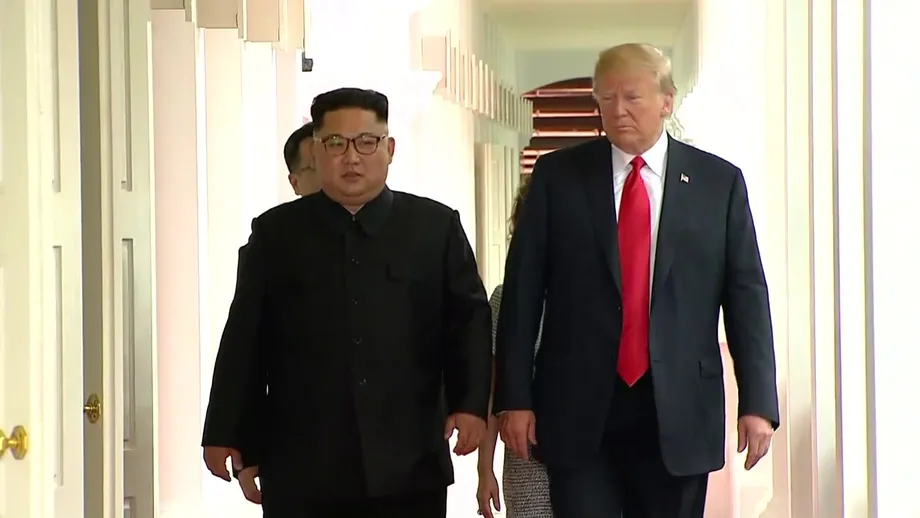
A month before Shenzhen, no clear signal of a meeting
U.S. President Donald Trump has tempered expectations of a meeting with North Korean leader Kim Jong Un during his November trip to China, saying on October 19 that he did not know whether anyone was requesting talks. His comments came a month before the Asia-Pacific Economic Cooperation (APEC) summit, scheduled for November 18–19 in Shenzhen.
Contents
- A month before Shenzhen, no clear signal of a meeting
- How Trump's confidence changed
- Seoul's optimism meets Washington's caution
- What Pyongyang wants from another summit
- The lesson left by Hanoi
- The preparation window is narrowing
- Kim's quieter public profile draws attention
- Russia and China change the setting
- Key Points
Speaking to reporters at the White House, Trump sounded less certain than he had in August, when he said he expected to meet Kim before the end of the year, or on October 12, when he described a possible encounter during his Asia trip as exciting.
Trump, asked whether he expected to meet the North Korean leader next month, replied:
Oh, I don't know. I don't know. I'm not sure that anybody's asking for a meeting.
The president immediately returned to a familiar theme, his personal relationship with Kim:
I get along with him very well. But my relationship with Kim Jong-un is very good.
No meeting date or confirmed concrete contact between Washington and Pyongyang has been announced. North Korea has given no confirmed substantive response to Trump's recent overtures, while South Korean officials have offered different assessments of whether another summit is within reach.
The central difficulty is now becoming more visible: Trump has publicly expressed willingness to meet, but arranging talks requires agreement from Pyongyang on both the encounter and what it could achieve. With November approaching, personal warmth is sharing the stage with unresolved demands over nuclear weapons and sanctions.
How Trump's confidence changed
Trump spent the summer reviving images and language associated with his diplomacy with Kim during his first presidential term. In August, he posted photographs on Truth Social apparently showing their June 2018 Singapore summit and their June 2019 meeting at Panmunjom, the village on the border between the two Koreas.
The posts omitted their February 2019 Hanoi summit, which ended without an agreement. The selection brought attention back to the moments when the two leaders visibly demonstrated their willingness to meet.
His public statements then became progressively more cautious:
- August 19: Trump said he expected to meet Kim before the end of the year.
- September 1: South Korea's intelligence service described signs of dialogue, while saying concrete contact had not been confirmed, according to a lawmaker briefed after a closed parliamentary session.
- October 12: Trump said a meeting during his Asia trip could happen. South Korea's ambassador in Washington said she knew of no concrete progress.
- October 14: South Korean Unification Minister Chung Dong-young expressed confidence that a summit was coming within reach.
- October 19: Trump said he did not know whether a meeting would take place or whether anyone was requesting one.
- November 18–19: APEC leaders are scheduled to gather in Shenzhen.
The shift concerns Trump's confidence about getting a meeting arranged. His description of Kim remained friendly, and the administration continued to express willingness to engage North Korea.
Seoul's optimism meets Washington's caution
Chung Dong-young, South Korea's unification minister, offered one of the most optimistic public assessments on October 14. He said his ministry considered a summit within the "visible range," while describing the National Intelligence Service's assessment as a 50–50 chance.
Chung also acknowledged that he saw no signs of movement between South Korea's Foreign Ministry and the U.S. State Department. His optimism rested partly on Trump's personal interest and his capacity to make sudden diplomatic decisions.
Kang Kyung-wha, South Korea's ambassador to the United States, gave a more cautious assessment during a parliamentary audit in Washington on October 12. She said the embassy routinely checked developments with the State Department and the White House National Security Council.
Kang told lawmakers:
I am aware that there has been no concrete progress regarding the U.S.-North Korea summit.
She also said there were "no specific signs" supporting an approaching meeting. Her assessment placed the focus on preparations in Washington, rather than the possibility of a surprise decision by Trump.
The intelligence service's earlier position was similarly qualified. After a closed National Assembly Intelligence Committee session on September 1, committee member Youn Kun-young said the agency had detected signs of dialogue but had not confirmed concrete contact between the United States and North Korea.
What Pyongyang wants from another summit
Nam Sung-wook, a chair professor at Sookmyung Women's University, identified North Korea's lack of response as the main reason for the uncertainty. In his assessment, the two sides remain divided over what must happen before their leaders meet.
Nam described Pyongyang's principal demands as official recognition of North Korea as a state possessing nuclear weapons and relief from sanctions. Sanctions are restrictions on trade, finance and other dealings intended to put pressure on a government to change its conduct.
Recognition matters because it would give North Korea something beyond acknowledgment that its weapons exist. Pyongyang wants its nuclear status accepted as part of the starting point for negotiations. Sanctions relief would provide a more immediate economic benefit by easing restrictions affecting the country.
Trump has used language describing North Korea as a nuclear power. On August 19, he cited a figure of 57 North Korean nuclear weapons while discussing Kim. That number was Trump's stated figure; the proposed summit discussion has produced no new agreed inventory of the arsenal.
Nam's analysis is that Kim wants confidence in the benefits of another meeting before committing to it. Washington, meanwhile, has presented talks without preconditions as a way to begin negotiations. The practical disagreement is about sequence: whether leaders meet first to bargain, or settle important terms before appearing together.
The lesson left by Hanoi
Trump and Kim have met three times: in Singapore in June 2018, in Hanoi in February 2019, and at Panmunjom in June 2019. Those encounters created direct contact at the highest level, but their diplomacy did not produce an agreement exchanging sanctions relief for dismantlement of North Korea's nuclear program.
Hanoi remains particularly relevant because it showed how a summit could end when the benefits sought by each side were too far apart. Nam linked today's disagreement over nuclear status and sanctions to the unresolved bargaining that surrounded that meeting.
Kim has already gained the visibility of standing alongside a U.S. president. A fourth encounter would therefore face a more demanding test: what concrete result could each leader take home?
Tommy Pigott, spokesperson for the U.S. State Department, has said Trump does not view talks with North Korea as a concession and is willing to engage when doing so serves U.S. national interests. That position leaves an opening for diplomacy even as the arrangements remain uncertain.
The preparation window is narrowing
Shenzhen offers a potential opportunity because Trump is already expected to be in China for APEC. Diplomats have viewed the gathering as the likeliest occasion for a meeting with Kim before the end of the year.
Nam said a U.S. presidential movement requires at least three to four weeks of security and advance preparation. From October 19 to the November 18 opening of APEC is 30 days, placing the discussion close to that preparation window.
A meeting would require decisions about location, access, security and the officials who would negotiate its agenda. Trump's readiness to make sudden moves leaves room for a late announcement, but officials would still need to organize the encounter.
Chung has proposed going further, expanding the diplomacy into talks involving South Korea, North Korea, the United States and China. He has also called for a summit between the two Koreas during President Lee Jae Myung's term. Those remain proposals, with the immediate attention still on whether Trump and Kim will meet at all.
Kim's quieter public profile draws attention
Kim's visibility at recent domestic events has offered another possible angle on Pyongyang's calculations. He appeared at celebrations for the Workers' Party anniversary on October 10, but did not deliver a speech and was less prominent in related activities.
North Korean television subsequently aired an edited broadcast of the celebration performance lasting about 16 minutes, without showing Kim. He was also absent from events marking the October 17 centenary of the Anti-Imperialist Union, an organization that North Korea traces to 1926.
The centenary events carried themes of resistance to imperialism, language that North Korea has long directed against the United States. Keeping Kim personally distant from those celebrations could give him more room to pursue diplomacy with an American president.
That diplomatic interpretation sits alongside the more immediate indicators identified by Kang and Nam: the absence of visible preparations and a confirmed response from Pyongyang. Kim's intentions remain uncertain, and his public schedule is only one part of the picture.
Russia and China change the setting
North Korea approaches the possibility of renewed talks with stronger ties to Russia than it had during Trump's first term. A treaty signed in June 2024 committed the two countries to provide military assistance if either came under armed attack.
Pyongyang has supplied Russia with artillery ammunition and ballistic missiles and sent troops to Russia's Kursk region during the war in Ukraine. Those contributions have increased North Korea's value to Moscow, giving Kim another major diplomatic relationship to consider alongside any opening from Washington.
Relations with Beijing have also warmed, including a Kim-Xi summit in Pyongyang in June and exchanges of senior delegations in July. Kim's choices about a U.S. meeting now sit within a wider network of contacts with both neighboring powers.
Trump, meanwhile, sounded more receptive on October 19 to a proposed meeting with Chinese President Xi Jinping and Russian President Vladimir Putin. Putin had proposed discussing a settlement to the Ukraine war, while Trump said he preferred an agenda centered on nuclear weapons and denuclearization.
Denuclearization means removing nuclear weapons, although negotiations must determine whose weapons are covered and what steps each country would take. The wider arms control setting has become more difficult following the expiration of New START in February, which removed the last legally binding limits on U.S. and Russian strategic nuclear arsenals.
A proposed Trump-Xi-Putin discussion and a possible Trump-Kim encounter would be separate meetings. For North Korea, the immediate issue remains whether Washington and Pyongyang can turn public expressions of interest into an agreed purpose and a workable schedule.
Key Points
- Trump said on October 19 that he did not know whether he would meet Kim during his November Asia trip.
- The APEC summit is scheduled for November 18–19 in Shenzhen, China.
- Trump continued to describe his relationship with Kim as very good.
- South Korean officials have expressed different levels of optimism, while concrete contact and preparations remain unconfirmed.
- Nam Sung-wook identified nuclear recognition and sanctions relief as central North Korean demands.
- Trump and Kim's three previous meetings produced no agreement exchanging sanctions relief for nuclear dismantlement.
- North Korea's closer relationships with Russia and China form part of the changed setting for any renewed talks.