A family appearance amid claims of a medical crisis
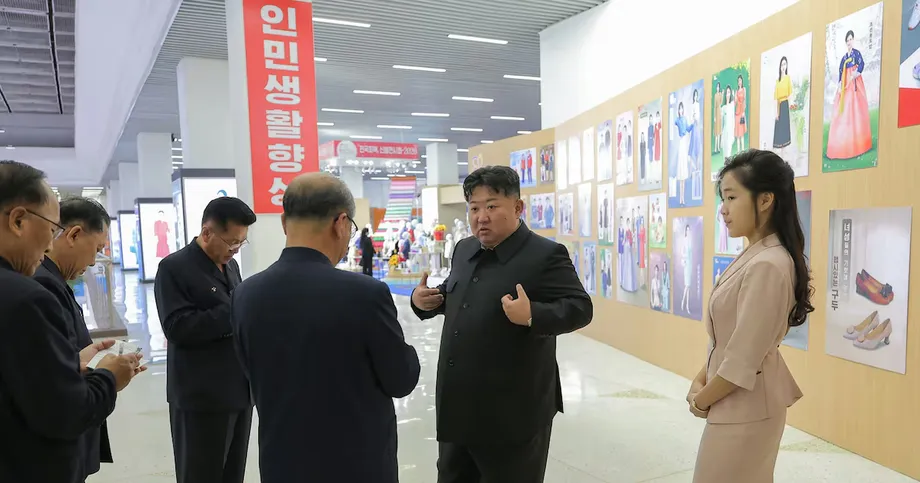
North Korean leader Kim Jong Un inspected a Pyongyang exhibition featuring more than 70,700 garments and 170,000 pairs of shoes with his daughter, Kim Ju Ae, and wife, Ri Sol Ju, according to the Korean Central News Agency (KCNA). The agency published photographs on October 20, 2026, and dated the visit to October 19, as unsupported claims of his death spread online.
Contents
- A family appearance amid claims of a medical crisis
- What was on display in Pyongyang?
- Why Kim connected clothing to regional development
- How the death claims spread
- The dates behind the latest speculation
- What South Korean intelligence had assessed
- What named observers and past events add
- Family visibility and succession speculation
- Key Points
The National Garment and Footwear Exhibition-2026 brought together products from more than 270 clothing, footwear and bag production units. Its stated theme was enthusiasm for developing new products and improving their quality. Kim called for better designs and manufacturing standards and discussed efforts to reduce economic differences between cities and rural areas.
Photographs showed him bending toward a small pink shoe, examining the sleeve of a women's coat on a mannequin and gesturing while addressing officials. His wife and daughter accompanied him through the displays, placing a family appearance at the center of a visit focused on everyday consumer goods.
The publication followed social media allegations that Kim had suffered a brain hemorrhage, received emergency treatment in China and died. Those claims originated with Xie Wanjun, a Chinese dissident based in the United States who describes himself as a leader of the China Democracy Party.
No medical records, identifiable witnesses or other independently verifiable evidence accompanied the allegations. North Korean state media presented the exhibition visit as a routine official engagement rather than explicitly answering the rumors. The photographs' authenticity and exact shooting date had not been independently verified.
What was on display in Pyongyang?
KCNA's detailed exhibition tally listed more than 70,700 garments in over 30 categories and more than 170,000 pairs of shoes in over 60 categories. A higher published count put the clothing total at more than 77,000 items. Both descriptions placed the footwear display above 170,000 pairs.
More than 270 production units supplied the exhibition, giving Kim and accompanying officials a broad display of products from the clothing, footwear and bag industries. Children's shoes and women's outerwear were among the goods singled out in the released photographs.
Light industry, the sector covered by the visit, makes everyday goods such as clothes and shoes rather than large machinery or military equipment. For households, improvements in this sector can mean more practical designs, better materials and products that last longer.
Kim instructed producers to improve design and quality. The visit therefore carried a domestic economic message alongside its international attention: factories were being asked to show progress through goods people wear and use. The exhibition figures describe the scale of the display; no figures were given for retail prices, household purchases or distribution to shops.
Why Kim connected clothing to regional development
Kim praised production improvements associated with his regional development program and discussed narrowing the gap between urban and rural areas. That places the exhibition within a wider government effort to strengthen manufacturing outside the capital.
For residents away from major cities, the practical issue is access to useful goods of consistent quality. Better footwear and clothing production would matter through the availability, durability and cost of products. Kim's instructions focused on the design and quality part of that process.
Pyongyang's presentation linked factory output to the government's development policies. The display allowed officials to present many producers together, while Kim's inspection put personal attention on individual products. His examination of a child's shoe and a coat made that message more concrete than a general statement about industrial growth.
How the death claims spread
Xie began circulating allegations on X on October 18. He claimed that specialists from Beijing's Peking Union Medical College Hospital had traveled to North Korea on October 17 to treat Kim after a severe brain hemorrhage. A brain hemorrhage is bleeding in or around the brain and can be a medical emergency.
Xie then alleged that Kim had been transferred to Beijing, died despite treatment and had his body secretly returned to North Korea. His posts expanded into claims about a transfer of political power and the deployment of 9,000 Chinese troops to Pyongyang.
The allegations traveled through social media and international news coverage on October 19. Their central details continued to trace back to Xie's posts. Neither North Korea nor China announced the alleged hospitalization, death or troop deployment.
After North Korea published the exhibition images, Xie claimed that officials had reused older photographs. He supplied no earlier publication of the same pictures or other evidence for that allegation. His competing account continued to rest on assertions about hidden events.
The dates behind the latest speculation
KCNA placed the exhibition visit on October 19 and released its account on October 20. Some descriptions instead placed the visit on the day the photographs were published. The agency's stated sequence separates the appearance from its announcement by one day.
The main events surrounding the rumors unfolded over several days:
- October 17: Xie alleged that Chinese medical specialists traveled to North Korea to treat Kim.
- October 18: Xie's claims about a medical emergency and death circulated on X.
- October 19: The allegations spread internationally. KCNA later identified this as the date of Kim's exhibition visit.
- October 20: KCNA and the Workers' Party newspaper Rodong Sinmun published accounts and photographs of the visit with Kim's wife and daughter.
Before the exhibition, KCNA had reported Kim's attendance at the National Defense Revolution Museum inauguration on October 11, with an account published two days later. Another published account dated that appearance to October 12. The exhibition photographs became the latest state presentation of his public activity.
What South Korean intelligence had assessed
South Korea's National Intelligence Service (NIS) told lawmakers on September 30 that Kim weighed about 140 kilograms and faced an elevated risk of cardiovascular disease. Cardiovascular disease affects the heart and blood vessels. The agency also assessed that he had shown no clear recent signs of serious physical difficulty, citing footage of him running up stairs during a naval destroyer inspection.
The NIS has tracked changes in his apparent weight for years. Its estimates placed him at about 90 kilograms in 2012 and 140 kilograms in 2019. His weight was assessed to have fallen to around 120 kilograms during 2020 and 2021 before rising again to between 130 and 140 kilograms in 2022.
In May 2023, the agency told the National Assembly's Intelligence Committee that analysis using artificial intelligence put his weight in the middle of the 140 kilogram range. Compared with the estimate of 90 kilograms in 2012, the September 30 figure of about 140 kilograms represents an increase of roughly 50 kilograms.
The NIS also previously raised the possibility of substantial sleep problems, citing efforts to obtain information abroad about insomnia treatments. Its assessments came from intelligence gathering and analysis of public appearances. North Korea keeps detailed information about its leader's health private.
What named observers and past events add
Benedict Rogers, a North Korea expert, urged caution during the latest rumors. He pointed to the highly organized mourning that followed the deaths of previous North Korean leaders and said comparable public activity had not appeared.
When a supreme leader died in the past, there was an organized outpouring of public mourning. People were wailing and weeping in the streets, and news anchors reported in very emotional tones. We have not seen any of that yet.
Xie's record also includes circulating a manipulated image presented as showing Chinese President Xi Jinping being escorted out of a political meeting. A verification published in July 2024 traced the picture to a satire creator who had adapted images of former president Hu Jintao leaving the 2022 Communist Party congress.
Kim faced another widely circulated death rumor in April 2020 after an absence from public view. Ji Seong Ho, a North Korean defector who had been elected to South Korea's parliament, claimed he was 99 percent certain Kim had died. Kim attended the Sunchon fertilizer factory opening on May 1, and Ji later apologized.
That old prediction resurfaced during the latest wave of speculation, with some social media accounts presenting it as new information. Its reuse added an earlier false claim to the current circulation of allegations.
Family visibility and succession speculation
Kim Ju Ae and Ri Sol Ju were visible beside Kim at the exhibition. Xie's posts, meanwhile, offered competing succession claims: that Kim's sister, Kim Yo Jong, had assumed control, and that Chinese troops had arrived to help stabilize a future government under his daughter.
Kim Yo Jong, a Workers' Party vice department director, issued warnings about South Korea around the same time. On October 19, she accused Seoul of repeated military provocations and discussed possible responses involving loudspeaker broadcasts and tactical weapons near the border. Her public statements concerned relations with South Korea.
The exhibition announcement kept the official focus on Kim's direction of economic policy, with his wife and daughter accompanying him. For manufacturers and officials, its concrete instructions concerned better goods and regional production. For readers following the health rumors, the latest dated public account was KCNA's description of the October 19 visit.
Key Points
- KCNA said Kim Jong Un visited the National Garment and Footwear Exhibition-2026 in Pyongyang on October 19 with his wife and daughter.
- The detailed exhibition tally listed more than 70,700 garments and more than 170,000 pairs of shoes from over 270 production units.
- Kim called for better designs and quality and linked production improvements to regional development.
- Claims of his death, a Chinese troop deployment and a transfer of power originated with Xie Wanjun and lacked independently verifiable evidence.
- South Korean intelligence assessed elevated cardiovascular risk but reported no clear recent signs of serious physical difficulty.
- The photographs were published on October 20; their authenticity and exact shooting date had not been independently verified.