Armed drones move beyond their development base
North Korea is reportedly moving its missile carrying Saetbyol-9 drones from Panghyon Airfield in North Pyongan Province to other airfields for weapons tests, widening a program whose physical expansion includes seven new hangars and a factory redevelopment with a planned building of approximately 9,300 square meters.
Contents
- Armed drones move beyond their development base
- What the tests at other airfields indicate
- How the program reached this stage
- What is known about the Saetbyol-9
- Glide bombs show ambition, not confirmed readiness
- The Saetbyol-4 follows a separate reconnaissance track
- Smaller Kumsong drones expand the production effort
- Panghyon's expansion provides physical evidence
- Russian assistance remains an unresolved factor
- Key Points
The movements, described by South Korean government sources, suggest preparations for deployment beyond the country's main drone development center. Small drones, including aircraft designed to destroy themselves when striking a target, are also reportedly being mass produced, tested and used in training in several areas. The reports do not identify the additional airfields, the number of aircraft moved or a date for operational deployment.
The strongest documented evidence points to an expanding program, rather than a fully measured combat capability. In its September 25, 2025 drone program assessment, the research organization 38 North estimated that North Korea had manufactured at least six Saetbyol-9 aircraft. It also documented construction at Panghyon and several smaller drone designs, while warning that public demonstrations do not establish their range, payload, guidance performance or accuracy.
That distinction matters. Moving aircraft between bases and expanding production facilities are concrete steps toward a broader military role. They do not, by themselves, show whether North Korea can reliably locate targets, guide weapons onto them or keep drones operating under attack.
What the tests at other airfields indicate
Panghyon has served as North Korea's central site for developing and demonstrating its large drones. Testing elsewhere could help establish whether the aircraft and their supporting crews can operate from additional bases, rather than only from a development facility.
The reported activity involves armed Saetbyol-9 aircraft conducting test launches after moving to other airfields. It is described as preparation for deployment, not confirmation that regular combat units have already received the drones. No public breakdown of the tests or their results accompanies the account.
The distinction between testing and service is especially relevant because North Korea has already demonstrated that its large drones can fly. The unresolved issue is how well the complete system works: aircraft, weapons, sensors, communications and personnel operating together. A successful flight or a brief missile launch video establishes only part of that chain.
The small drone effort is developing alongside the larger aircraft. Government sources describe production, performance testing and training across several locations. That would give North Korea two different routes to building unmanned forces: reusable aircraft carrying weapons and smaller expendable drones produced in larger numbers.
How the program reached this stage
Kim Jong Un designated drone development a strategic weapons task at the Workers' Party Congress in 2021. Subsequent inspections have linked that objective to reconnaissance, attack missions and production capacity.
The main public milestones show a progression from unveiling aircraft to testing weapons and expanding manufacturing:
- 2021: Kim identified drone development as a strategic weapons task at the Workers' Party Congress.
- July 26, 2023: The Saetbyol-4 and Saetbyol-9 were formally displayed at a weapons exhibition attended by Kim and Russian Defense Minister Sergei Shoigu.
- August 2024: Kim visited the Academy of Defence Science's drone research institute and called for more reconnaissance, multipurpose attack and tactical suicide drones.
- November 2024: Kim urged the establishment of production systems and the start of mass production of suicide drones.
- March 2025: An upgraded Saetbyol-4 appeared during an inspection at Panghyon.
- May 15, 2025: Air drills included a Saetbyol-9 carrying guided glide bombs during what state media described as an application test.
- September 2025: Further flight testing and another inspection highlighted drone technology, artificial intelligence and increased production capacity.
The sequence shows sustained leadership attention across several years. The September production instructions reinforce the assessment that at least some designs have progressed beyond initial development, although they do not establish how many are ready for military service.
What is known about the Saetbyol-9
The Saetbyol-9 is a propeller powered aircraft with an estimated wingspan of approximately 20 meters. Its appearance resembles the American MQ-9 Reaper, and North Korean state media has described it as a multipurpose combat drone.
An earlier satellite imagery estimate put its wingspan at about 65 feet, compared with 66 feet for the MQ-9. Since 65 feet is approximately 19.8 meters, that estimate broadly agrees with the later 20 meter assessment. Similar dimensions and appearance, however, do not establish equivalent performance.
The aircraft has three weapons pylons beneath each wing, giving it six external mounting points. North Korean television has shown brief footage of it firing missiles. Images also show what appears to be a large optical sensor assembly beneath the nose, along with other features whose functions remain uncertain.
The estimate of at least six aircraft draws on exhibition displays, parade appearances and flight footage. Identified serial numbers include 2102009, 2101005, 2101007 and 2101003. Some aircraft could not be identified by number, so the total involves an assessment that several appearances represented different airframes.
The number ending in 009 could suggest that nine aircraft existed at some point, but it is not a verified fleet count. Serial numbers need not provide a complete or consecutive production record. The defensible conclusion is the published estimate of at least six, not a confirmed inventory of nine operational drones.
Glide bombs show ambition, not confirmed readiness
The May 15, 2025 air drills added evidence of North Korea's plans to arm the Saetbyol-9 with guided glide bombs. These weapons use aerodynamic lift to travel after release, while guidance equipment helps steer them toward a target. Their reach depends on factors including release altitude, speed and design.
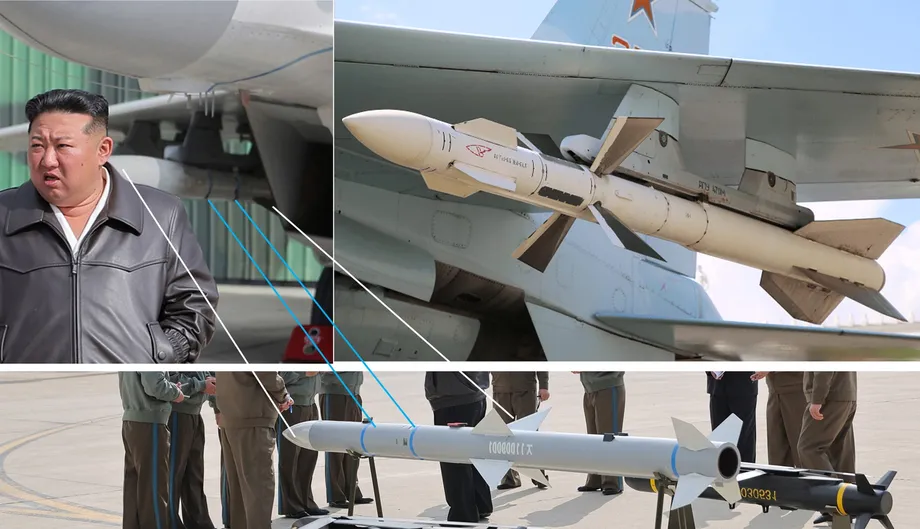
In his May 22 air drills assessment, 38 North researcher Tianran Xu examined two bombs inspected by Kim: one apparently fitted with satellite navigation equipment and another with an optical seeker for the final approach to a target.
Satellite navigation would likely support attacks on fixed locations. An optical seeker could potentially improve accuracy or help engage a moving target, but that would depend on the weapon's actual capabilities and, potentially, correction commands during flight. Neither possibility is a verified result of the demonstration.
Xu assessed that serial numbers on the bombs indicated they were probably the same samples shown to Kim in May 2024. He concluded that the weapons were not yet operational, although they may have been carried by a Saetbyol-9 during the May 2025 application test.
This places a limit on descriptions of the drone carrying a new precision weapon. Carriage demonstrates an integration step. It does not prove that a bomb has been released successfully, guided accurately or accepted for service. No independently established range figure is given for these weapons.
The Saetbyol-4 follows a separate reconnaissance track
North Korea's other large drone, the Saetbyol-4, is intended for strategic reconnaissance rather than the attack role associated with the Saetbyol-9. It resembles the American RQ-4 Global Hawk and has an estimated wingspan of approximately 35 meters, about 15 meters wider than the Saetbyol-9.
The September assessment identified at least two earlier Saetbyol-4 aircraft through serial numbers 2102001 and 2102002. An upgraded aircraft carrying the number 21070601 appeared in March 2025, at Sunchon Airfield in May and during further testing at Panghyon in September.
Visible changes included a new optical window beneath the nose, additional panels on both sides and alterations to the wings. Some panels may be intended for gathering electronic intelligence, but their purpose has not been confirmed. External windows and panels do not prove that functioning sensors are installed behind them.
The reconnaissance and attack programs could eventually complement each other, with one aircraft gathering information and another delivering weapons. No public demonstration establishes that North Korea has achieved such coordination. The existence of both designs should therefore be distinguished from a proven ability to connect them into an effective targeting system.
Smaller Kumsong drones expand the production effort
The smaller drones may be more consequential for production volume. Unlike a large reusable aircraft, a suicide drone is intended to be expended in an attack, so its military value depends partly on whether it can be manufactured and deployed in sufficient numbers.
Reports of North Korean announcements refer to two suicide drone types carrying the Kumsong name and claims that they use artificial intelligence. The September 38 North assessment describes a broader Kumsong series containing at least six smaller models. These accounts cover different levels of detail and should not be treated as interchangeable counts of operational weapons.
The designs include a small propeller driven aircraft, two aircraft with wings arranged in an X shape and another with small forewings ahead of its main wings. Some are launched from tubes and others from rails, using gas ejection or a small rocket to begin flight. Photographs have shown demonstrations involving vehicles and armored targets.
The research assessment cautioned that Kumsong tests had not been shown on video. Still photographs can show a launch, an approaching aircraft or an explosion, but cannot establish the full sequence, the accuracy of guidance or the damage caused. At least one photographed vehicle target was partly wooden.
North Korea has also displayed three quadcopters of different sizes and images of a drone dropping a munition onto a tank. Their manufacturer is uncertain. These displays suggest interest in several battlefield roles, but the claim of artificial intelligence remains unverified. No detailed public explanation establishes what the claimed technology does or how much human control remains necessary.
Panghyon's expansion provides physical evidence
Panghyon lies approximately 110 kilometers northwest of Pyongyang and 60 kilometers from the Chinese border. Its surrounding aviation industry gives the drone program an established manufacturing and maintenance base.
An adjacent aircraft parts factory has produced components for MiG-15 and MiG-17 aircraft and assembled MiG-29 fighters from kits. Other fabrication and aircraft facilities are located nearby, including a plant with an underground component.
The 2024 airfield expansion added seven hangars, each approximately 45 meters wide with a 40 meter opening. Those openings are wider than the estimated 35 meter wingspan of the Saetbyol-4. That is a useful indication of the scale of aircraft the buildings could accommodate, though it does not establish their assigned occupants.
Seven additions alongside the original three hangars bring the described total to ten. An administrative building was demolished in early 2025, and three apparently administrative buildings were erected during the summer.
Redevelopment at the nearby aircraft factory began in July 2024. The largest planned building appears to be a fabrication hall approximately 225 meters long and covering about 9,300 square meters. Satellite imagery examined for the September assessment showed construction continuing, with roofing still required. These changes support the production expansion account, but floor space cannot be converted into an annual drone output without further information.
Russian assistance remains an unresolved factor
North Korea's deployment of troops to Russia for the war in Ukraine has created a possible route for battlefield experience and technical knowledge to enter its drone program. South Korean officials assess that North Korean troops gained experience in drone piloting and tactics, alongside possible technical support for development.
Ukrainian President Volodymyr Zelensky said at a Kyiv press conference, in remarks reported on October 4, that Russia appeared to have shared technology for jet propelled drones with North Korea. The statement is an allegation, not public confirmation of a specific transfer. The account identifies neither a recipient drone model nor the equipment transferred.
If such assistance occurred, it could potentially support North Korea's smaller expendable attack drones. It would not establish that the Saetbyol-9, which is propeller powered, had received a jet engine. Battlefield training and assistance with manufacturing or design are also different forms of support and should not be merged into a single confirmed arrangement.
The Ukraine experience offers a practical reason for North Korea's interest in inexpensive drones that can be produced in large numbers. Yet its program predates the troop deployment: the strategic development task dates to 2021, and the large aircraft were publicly unveiled in 2023.
The May 2025 drills also addressed defense against drones. They included a scenario involving incoming cruise missiles and suicide drones approaching from different directions. North Korea is therefore pursuing unmanned attack capabilities while training against similar threats.
The next decisive evidence would concern verified weapons performance, deployment to regular units and sustained production. No operational deployment deadline or next test date has been announced in these accounts. For now, the documented picture is one of wider testing and expanding infrastructure, with major questions about combat effectiveness still unanswered.
Key Points
- Government sources report Saetbyol-9 weapons tests at airfields beyond Panghyon, but the locations and deployment timetable are undisclosed.
- 38 North estimates that at least six Saetbyol-9 aircraft have been manufactured.
- Guided glide bombs carried during the May 2025 drills were assessed as not yet operational.
- The Kumsong series includes several smaller designs, but their range, accuracy and claimed artificial intelligence capabilities are unverified.
- Panghyon added seven hangars in 2024, while a nearby factory redevelopment includes a planned building of approximately 9,300 square meters.
- Claims of Russian drone technology assistance remain unconfirmed publicly, and no specific transfer has been identified.