New construction and heat signals point to a larger nuclear complex
Satellite imagery assessments of North Korea's Yongbyon nuclear complex describe an expanding production network, with a probable uranium enrichment building measuring approximately 120 by 47 meters, additional waste storage and continued activity at the country's only known plutonium production site. Yet the assessments differ on whether its experimental reactor is producing nuclear material or still undergoing tests.
Contents
- New construction and heat signals point to a larger nuclear complex
- What the thermal images actually show
- The experimental reactor is the main point of disagreement
- The older reactor kept working through extensive repairs
- A probable enrichment building gains cooling equipment
- Plutonium separation appears to have followed a campaign
- Demolition and flood repairs reshape the site
- The dates separate observations from conclusions
- Expansion is visible, production totals are not
- Key Points
An analysis dated September 19, 2026, describes surface temperatures of 18 to 30°C across the complex, averaging 23°C. It interprets cooling water discharges into the Kuryong River and warmer areas around processing facilities as evidence that both reactors, uranium enrichment and plutonium separation are active.
A separate assessment published on November 21, 2025, presents a more qualified picture. It finds that the older 5MWe reactor had operated since October 2024, but interprets intermittent cooling water discharges at the experimental light water reactor as signs of testing before operation with a nuclear fuel load. It also concludes that a probable plutonium reprocessing campaign had ended sometime after June 2025.
These findings concern different observation periods, so some differences could reflect changes over time. Nevertheless, the stronger claims about continuous operation and nuclear material output require caution. Satellite images can reveal construction, water flows and surface heat, but they cannot directly establish how much plutonium or highly enriched uranium a facility produces.
Yongbyon, approximately 100 kilometers north of Pyongyang, is therefore showing two developments at once: visible investment in more production infrastructure and continuing uncertainty about the operating status of individual facilities.
What the thermal images actually show
The September 2026 assessment uses thermal infrared imagery from Landsat 9, an Earth observation satellite operated jointly by NASA and the U.S. Geological Survey. Thermal infrared measurements register heat emitted from surfaces. They do not measure the temperature inside a reactor core or identify the nuclear material inside a building.
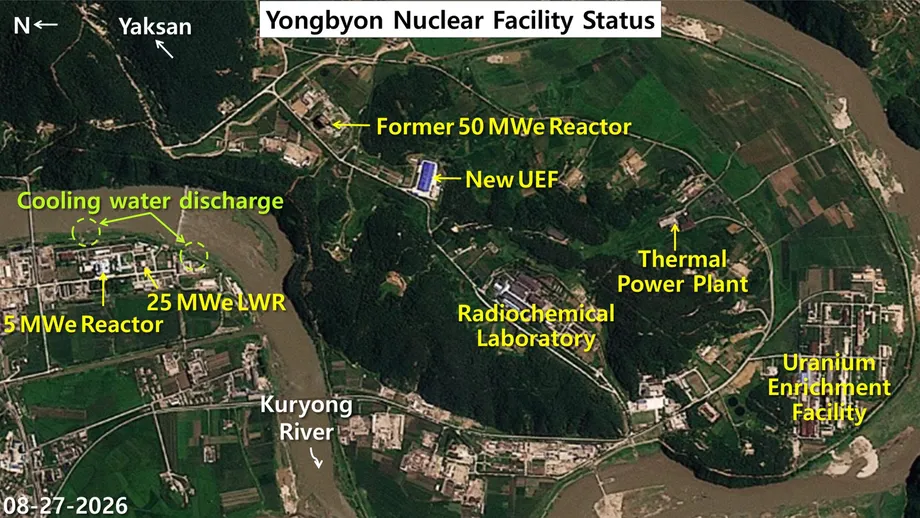
The assessment places the Radiochemical Laboratory and the nearby thermal power plant among the hottest areas, at 29 to 30°C. The existing uranium enrichment area registers 27 to 30°C, compared with 21 to 26°C around the probable new enrichment building. Reactor areas are described as showing readings around 26 to 28°C, although the older reactor building itself appears relatively cool.
Against the reported complex average of 23°C, the laboratory and power plant readings are 6 to 7°C higher. The existing enrichment area's readings are 4 to 7°C higher. These differences help identify areas worth examining, but the average is not a controlled baseline that proves a particular industrial process is occurring.
The warmer laboratory area is interpreted as consistent with steam generation and heat treatment associated with reprocessing. Heat around the existing enrichment plant is interpreted as consistent with centrifuge operation. Those are assessments of possible activity, rather than direct measurements of plutonium separation or uranium enrichment levels.
The cooler new building is especially important. Even the assessment describing strong activity elsewhere allows that this facility may be at a different stage of preparation or may not yet be operating normally. A completed exterior does not establish that equipment inside is installed, commissioned or producing material.
The experimental reactor is the main point of disagreement
The two reactor assessments diverge most sharply over the 25MWe experimental light water reactor. The September 2026 analysis treats repeated water discharge into the Kuryong River as evidence of continued reactor operation. The November 2025 assessment interprets a longer sequence of discharge and stoppages as evidence of testing before startup with nuclear fuel.
The earlier assessment records discharge in June and July 2025, no visible discharge in imagery from September and October, and renewed discharge on November 13. It also describes interruptions during September and October 2024 and from November 2024 through April 2025. That intermittent pattern underlies its testing assessment.
The later observations could indicate a subsequent change in status, but they do not resolve precisely when testing ended or whether sustained operation with fuel began. Cooling water discharge shows that a cooling system is moving water. Interpreting it as proof of nuclear operation requires supporting evidence and a sufficiently detailed observation sequence.
The September 2026 analysis estimates that the experimental reactor could produce more than five times as much plutonium as the 5MWe reactor. That estimate should not be confused with a verified production total. The labels 25MWe and 5MWe describe electrical generating capacity, not measured plutonium output.
Plutonium yield depends on factors that satellite images cannot fully establish, including fuel composition, power levels and how long fuel remains in the reactor. Nor does cooling water alone establish that any plutonium produced has the composition intended for weapons. The reactor's potential matters, but its actual contribution remains uncertain.
The older reactor kept working through extensive repairs
The assessments are more consistent about the 5MWe reactor. The November 2025 analysis dates its operating period to October 2024 and describes activity continuing while workers refurbished its roof, exterior walls and associated buildings.
Reports differ on the repair timetable. One places extensive work around June and July 2025; the other describes roof resealing or replacement and exterior painting between April and August. The narrower period may capture the most visible work, but the dates should not be presented as identical.
The September 2026 assessment suggests that the repairs strengthened an aging structure and may also have reduced the heat visible to foreign satellite sensors. The November 2025 assessment documents refurbishment without establishing that concealing heat was its purpose. A relatively weak thermal signal is therefore not proof of deliberate surveillance avoidance.
Additional construction appeared near the reactor in late 2025. Imagery from October 22 showed an excavation approximately 20 by 20 meters across a road, while November images showed docking bays taking shape near a shipping and receiving area. Their functions were not established.
The combination of water discharge, maintenance and nearby construction supports a picture of an active facility receiving continued investment. It does not establish uninterrupted operation every day or provide a reliable figure for nuclear material output.
A probable enrichment building gains cooling equipment
The most detailed construction evidence concerns a probable uranium enrichment facility about 500 meters northeast of the Radiochemical Laboratory. The November 2025 assessment describes a building of at least two stories, with a central hall and an approximate footprint of 120 by 47 meters.
Those dimensions give it a footprint of about 5,640 square meters. They do not reveal the usable area inside or the number of centrifuges it could accommodate. The assessment identifies similarities in footprint, construction and security arrangements with the suspected enrichment facility at Kangson, supporting the proposed function without confirming it.
The main building was enclosed and roofed by June 2025. By October 22, the exteriors of two support buildings were complete, an enclosed passageway connected one building to the main structure, and paving and terracing had progressed.
Six possible heat exchangers appeared along the main building's southeast side from September 2025. Such equipment can remove heat and help maintain controlled temperatures for centrifuges, which separate uranium isotopes by spinning gas at high speed. Equipment outside the building suggested that interior work was still underway.
This construction sequence makes an important distinction: the building shell was complete before the whole facility was necessarily ready. Reports that call the new facility complete appear to describe its exterior, while the cooler readings in the September 2026 analysis leave its operating status unresolved.
The existing enrichment area showed relatively little visible change during the preceding six months, following refurbishment and expansion over earlier years. However, October 22 imagery showed additional roof openings in a possible hydrogen fluoride handling building approximately 150 meters long. Whether that work represented refurbishment or dismantlement was uncertain.
Plutonium separation appears to have followed a campaign
The Radiochemical Laboratory separates plutonium from spent reactor fuel. Reactor operation and reprocessing are distinct steps: a reactor can produce plutonium within its fuel, but recovering that material requires subsequent chemical processing.
In spring 2025, smoke from the thermal plant supplying steam to the laboratory was interpreted as evidence of a probable reprocessing campaign. Vehicles also appeared regularly at the spent fuel reception building. The November assessment found that smoke had ceased sometime after June and that the reception building no longer showed comparable activity.
The exact end date was uncertain because imagery coverage was inconsistent. The conclusion was that the campaign had ended for the time being, rather than that the laboratory had been permanently shut down.
The September 2026 thermal assessment later identifies readings of 29 to 30°C around the laboratory and interprets them as evidence of renewed or continuing reprocessing. A later campaign would be compatible with the earlier pause, but neither account establishes a complete operating schedule or the quantity of plutonium separated.
Nearby waste construction adds another part of the picture. June 11, 2025, imagery showed a concrete structure approximately 20 by 12 meters with nine top hatches near the Old Waste Site. By October, earth covered its sides, leaving the top exposed. Excavation immediately west of it suggested another possible underground storage vault.
The structure's approximately 240 square meter footprint describes its size, not its storage volume or contents. Its appearance is consistent with additional waste storage capacity, but it cannot by itself demonstrate how much nuclear material has been processed.
Demolition and flood repairs reshape the site
Expansion is occurring alongside the removal of the unfinished 50MWe reactor. Construction stopped under the 1994 Agreed Framework between North Korea and the United States, and the reactor was never completed. Its demolition therefore should not be mistaken for the retirement of an operating source of plutonium.
The November 2025 assessment describes gradual dismantling over several years, with some materials reused elsewhere at Yongbyon. More extensive demolition began in June. By autumn, the main reactor hall was the principal remaining structure, and a mobile crane appeared beside it on October 22 and November 13.
Water infrastructure also required attention. Heavy rain and flooding in July and August 2025 breached the Kuryong River overflow dam near the reactors. The dam helps maintain sufficient water depth for cooling water intake while allowing excess water to pass during higher river levels.
A temporary earthen levee was extended into the river during September. By November 13, imagery showed work toward a stronger overflow dam. The assessment found no apparent interruption to reactor activity from the flooding, though satellite observations cannot establish every operating detail.
These changes show why assessing Yongbyon requires more than counting reactor buildings. Cooling water control, waste storage, processing facilities and support equipment all affect the site's ability to sustain production. Removing an unfinished reactor while strengthening those systems is not, by itself, evidence that production capacity is shrinking.
The dates separate observations from conclusions
A short chronology helps distinguish the observed construction sequence from later claims about operation:
- 1994: Construction of the 50MWe reactor stopped under the Agreed Framework. It was never completed.
- 2009: North Korea expelled IAEA inspectors, ending the agency's access for inspections inside the country.
- October 2024: The November 2025 assessment dates the start of the 5MWe reactor's operating period to this month.
- April to August 2025: Refurbishment of the 5MWe reactor's roof and exterior was observed, with another account highlighting June and July.
- June 2025: The probable enrichment building was enclosed and roofed. Smoke from the laboratory's steam plant ceased sometime after this month.
- September to November 2025: Possible heat exchangers, further support construction, waste storage work and river defenses were observed.
- September 19, 2026: The later thermal assessment reports warmer areas around the laboratory and existing enrichment plant, alongside a cooler probable new facility.
The official reporting chronology is separate. The International Atomic Energy Agency's DPRK safeguards report listing identifies GC(69)/13, dated August 18, 2025, as its latest listed report. Its title is Application of Safeguards in the Democratic People's Republic of Korea.
That listing establishes the report's identity and date. It does not itself validate the September 2026 temperature readings or show that the IAEA endorsed every interpretation in the later analysis. Accounts citing the agency describe signs of operation at the older reactor, brief maintenance pauses and enrichment expansion, but those descriptions should not be treated as direct quotations from the listed report.
Expansion is visible, production totals are not
The strongest combined finding is that Yongbyon is receiving sustained investment across several parts of its nuclear material production network. Probable enrichment construction, additional waste storage, older reactor refurbishment and water infrastructure repairs are visible developments. The status of the experimental reactor and the timing of reprocessing are less firmly established.
These activities fit North Korean leader Kim Jong Un's stated objective of increasing nuclear material production. Accounts of his January 2025 visits to nuclear institutions quote him describing the year as a crucial period for strengthening nuclear forces.
Kim, North Korea's leader, used the following phrase to describe that objective:
bolstering up the nuclear forces
The construction record is consistent with that goal, but it does not establish whether a production target was achieved. Highly enriched uranium and separated plutonium provide different routes to nuclear weapons material; the imagery does not quantify either stockpile or translate the observed activity into a verified number of warheads.
Since 2009, the IAEA has relied chiefly on satellite imagery and public information rather than inspections inside North Korea. That limits its ability to verify operating rates, fuel composition, enrichment levels and material inventories. No confirmed commissioning date for the probable new enrichment facility, verified experimental reactor startup date, or future inspection deadline is established here.
Key Points
- Yongbyon shows continued construction, refurbishment and probable expansion of nuclear material production infrastructure.
- The probable enrichment building measures about 120 by 47 meters, with six possible heat exchangers installed nearby in 2025.
- Assessments agree on activity at the 5MWe reactor but differ on whether the experimental reactor was operating or undergoing tests.
- A probable 2025 reprocessing campaign appears to have paused; a September 2026 analysis interprets later heat signals as renewed activity.
- Thermal readings and cooling water discharge do not establish nuclear material quantities or warhead production.
- The IAEA has had no inspection access inside North Korea since 2009.