Five years of financing carry decades of emissions
Three South Korean public financial institutions committed 48.45 trillion won to overseas fossil fuel projects between 2020 and 2024, supporting facilities expected to release about 2.93 billion tonnes of greenhouse gases over their working lives, according to an analysis by Solutions for Our Climate and the Korea Sustainability Investing Forum.
Contents
- Five years of financing carry decades of emissions
- What the emissions calculation includes
- Ships carry the largest hidden footprint
- Oil and gas support grew after the coal pledge
- Mozambique brings the dispute into court
- Key decisions across five years
- What a different financing strategy could deliver
- Why the agencies' emissions accounts matter
- Disclosure and lending policy remain unfinished
- Key Points
The study examined financing by the Export-Import Bank of Korea (KEXIM), Korea Development Bank (KDB) and Korea Trade Insurance Corporation (K-SURE). Its estimate of 2.9346 billion tonnes exceeds four times South Korea's annual greenhouse gas emissions, spreading the climate consequences of five years of financial commitments across decades of operation.
Oil refineries, power plants and gas export terminals account for some of the largest individual emissions estimates. Most financing commitments, however, supported the infrastructure that moves fossil fuels: ships, terminals and pipelines.
A separate economic study published on November 17, 2025, by Solutions for Our Climate and the Green Energy Strategy Institute (GESI) examines what Korea could gain by changing direction. It estimates that expanding public export finance in line with a global transition to clean energy could support 110,616 jobs in 2035, 115% more than continuing the existing approach.
Together, the studies put two decisions before the government: how to account for the pollution associated with overseas public finance, and which industries that finance should help Korean companies build. The agencies support energy supplies and export orders today, while their choices also shape demand for ships, factories and energy equipment far into the future.
What the emissions calculation includes
Solutions for Our Climate and the Korea Sustainability Investing Forum identified 347 new financing commitments worth 48.45 trillion won. After excluding 34 entries because of duplicate support or difficulties calculating emissions, they assessed 313 commitments worth 41.7 trillion won.
The researchers calculated what they call locked in emissions: the greenhouse gases facilities are expected to release over their assumed operating lives. A refinery or power station can remain in service for decades, so a financing decision made in one year can support emissions long after the money is committed.
KEXIM supported facilities with estimated lifetime emissions of 1.5704 billion tonnes, followed by KDB at 1.2917 billion tonnes and K-SURE at 353.6 million tonnes. Those institutional figures overlap because six facilities received support from more than one agency. The combined estimate of 2.9346 billion tonnes removes that duplication.
The largest individual estimate was Kuwait's Al-Zour refinery, which received a KEXIM loan in 2020 and is projected to emit about 366 million tonnes. Saudi Arabia's Jazan power plant, supported by KDB, accounted for about 209 million tonnes. The Rio Grande liquefied natural gas export terminal in the United States accounted for about 152 million tonnes.
The researchers described the work as the first calculation of lifetime emissions from overseas fossil fuel facilities supported by these Korean public institutions. Its coverage was limited to specified financing types and commitments made during the five years examined, leaving other parts of their portfolios outside the calculation.
Ships carry the largest hidden footprint
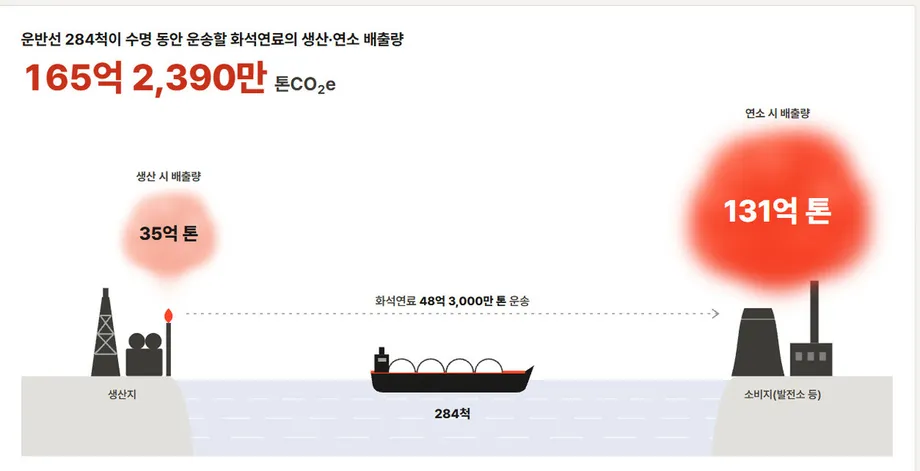
Transport infrastructure represented 294 of the 313 assessed commitments, or about 94%. Those commitments included 284 vessels carrying fossil fuels, alongside terminals and pipelines.
A ship's climate footprint extends beyond the fuel used to move it across the ocean. The oil or gas it carries also produces greenhouse gases when extracted, processed and eventually burned. The researchers calculated this wider footprint separately, calling it embedded emissions.
Across the vessels' expected working lives, production and combustion of their cargoes could generate an estimated 16.5239 billion tonnes of greenhouse gases. The calculation depends on how much fuel the ships transport and how long they operate, connecting Korean shipbuilding support to energy consumption in other countries.
For Korean shipyards, financing LNG carriers can help secure valuable orders. LNG is natural gas cooled into a liquid so that it occupies less space and can be shipped overseas. Its supply chain requires specialised vessels and equipment, creating business for manufacturers while also supporting continued gas production and use.
The economic study identifies LNG carriers, refining and petrochemical projects as areas exposed to stranded asset risk. A stranded asset is equipment or infrastructure that loses value earlier than expected, for example because demand falls or climate policies reduce its use. Public loans, guarantees and insurance can place some of that financial exposure with government institutions.
Oil and gas support grew after the coal pledge
South Korea announced in 2021 that it would stop public financial support for new overseas coal power projects. Oil and gas financing continued, and new commitments by the three institutions rose from 5.07 trillion won in 2021 to 13.53 trillion won in 2024, about 2.7 times as much.
KEXIM's commitments grew faster, increasing from 1.33 trillion won to 8.95 trillion won during the same period, about 6.7 times as much. A bank representative attributed the increase to efforts to secure domestic energy supplies and rising demand for financial support for Korean companies winning LNG carrier and power plant contracts.
Export credit agencies help domestic businesses sell products and services abroad through loans, guarantees and insurance. A guarantee can protect a lender if a borrower fails to repay. Insurance can protect an exporter against specified losses, helping transactions proceed when commercial participants consider the risks too high.
Solutions for Our Climate's fossil finance analysis places Korea's annual fossil fuel export finance at about $10 billion during 2020–2022, compared with $805 million for clean energy. Using those figures, fossil fuel support was more than 12 times clean energy support.
The November economic study examines a broader energy financing portfolio worth 61.3 trillion won, also expressed as $45.4 billion, during 2020–2024. It finds that 74.5% went to fossil fuel activities, including oil and gas engineering, procurement and construction contracts and overseas fossil fuel projects.
Mozambique brings the dispute into court
Mozambique illustrates how Korean financing can affect emissions in a country with a much smaller industrial footprint. The lifetime emissions study estimates that supported fossil fuel facilities there could produce up to 3.91 million tonnes annually. That equals about 26.5% of Mozambique's 2024 emissions from fossil fuels and electricity.
Coral North, a planned floating LNG project off the northeastern Cabo Delgado coast, has become a focus of legal opposition. Solutions for Our Climate describes planned production of about 3.5 million tonnes of LNG annually and projected lifetime greenhouse gas emissions of 489 million tonnes.
Korea Gas Corporation holds a 10% stake, Samsung Heavy Industries is expected to build the production vessel, and KEXIM and K-SURE were expected to provide $1.8 billion in additional financing. The project connects Korean public finance, shipbuilding and gas procurement in a single overseas development.
Mozambican environmental campaigners and Korean youth climate activists sought an injunction against KEXIM and K-SURE on May 29, 2025. Their application asked a Korean court to prevent financial commitments, including loans, guarantees and insurance, on grounds including climate damage and environmental rights. The court's decision and the final financing outcome were not specified.
Solutions for Our Climate also raised concerns that the environmental assessment inadequately examined effects on marine species. For fishing communities, access to fishing grounds and the health of marine ecosystems are immediate concerns alongside the project's contribution to warming.
Key decisions across five years
The debate has moved from restrictions on coal to legal challenges over gas, international negotiations and competing industrial strategies. The main developments span several years:
- 2020–2024: KEXIM, KDB and K-SURE made 347 overseas fossil fuel financing commitments worth 48.45 trillion won.
- 2021: South Korea announced an end to public support for new overseas coal power projects.
- 2024: Korea and Türkiye opposed a proposal to extend OECD export credit restrictions from coal to all fossil fuels, according to Solutions for Our Climate.
- February 3, 2025: The Korea Capital Market Institute published its study of financial institutions' financed emissions disclosure.
- May 29, 2025: Campaigners filed an injunction application seeking to block Korean public financing commitments to Coral North.
- November 17, 2025: Solutions for Our Climate and GESI published their economic assessment of shifting public export finance toward clean energy.
The OECD proposal required unanimous agreement, giving opposition from Korea and Türkiye enough weight to stop its adoption. During the first week of COP30 in Belém, 79 civil society organisations urged President Lee Jae-myung to join the Clean Energy Transition Partnership, which commits participants to redirect international public finance toward clean energy and away from fossil fuels without sufficient emissions controls.
What a different financing strategy could deliver
Solutions for Our Climate and GESI's export finance assessment models a scenario in which public export finance grows in line with global investment trends consistent with the International Energy Agency's pathway to net zero emissions and limiting warming to 1.5°C.
Under that scenario, finance could support 9.555 trillion won in domestic value added in 2035, compared with 4.098 trillion won under business as usual. The difference is 5.457 trillion won, or 133%. Value added measures the economic value created through production, after accounting for purchased inputs.
Projected employment reaches 110,616 full time equivalent jobs, 115% above the business as usual scenario. A full time equivalent measures work equal to one person employed full time, allowing different working arrangements to be compared on a common basis.
Clean energy industries account for 79,406 of those jobs, compared with 5,812 under business as usual, about 13.7 times as many. Battery manufacturing provides the largest contribution, with activity extending into equipment, production systems, infrastructure and related services.
The scenario combines a shift in the financing portfolio with growth in finance and stronger domestic industrial capabilities. Its projected benefits therefore depend on the scale of support and how much equipment and expertise Korean companies supply.
Boram Kim, GESI senior researcher and lead author, described the connection between climate policy and the export economy:
Aligning export-credit policies with global decarbonization goals is therefore both a climate imperative and an economic necessity for sustaining Korea's export-driven growth.
Kim also explained that limited domestic sourcing of clean technologies could constrain initial gains. Building Korean supply chains would help more of the resulting employment and economic value stay in the country.
Why the agencies' emissions accounts matter
Korean public institutions face a second challenge beyond choosing projects: measuring the emissions associated with their financial support. The lifetime footprint study estimates emissions from supported facilities. Financial accounting assigns an institution a share of project or company emissions according to its financial participation.
The Korea Capital Market Institute explains that approach in its financed emissions study, written by researcher Choi Soon-young and published on February 3, 2025. It describes the Partnership for Carbon Accounting Financials, or PCAF, as the main international framework for calculating these emissions.
In simple terms, a bank calculates the share of a company's or project's financing it provides and applies the relevant accounting rules to allocate emissions. This allows readers to see pollution associated with lending and investment alongside the much smaller footprint of operating offices and buying electricity.
Across the institutions examined in the institute's disclosure analysis, financed emissions averaged 555 times operational emissions. The disclosed calculations covered about 79.5% of financial portfolios. Those findings show why measuring office energy use alone captures only a small part of many financial institutions' climate exposure.
As of October 2024, 205 of PCAF's 530 member institutions worldwide, or 38.7%, had disclosed financed emissions. Korea had 22 members and eight institutions making disclosures. Only 15.7% of the disclosures assessed met every mandatory PCAF disclosure item, while 8.5% met both mandatory and recommended items.
Disclosure and lending policy remain unfinished
Data quality is a practical obstacle. The Korea Capital Market Institute found an average quality score of 3.6 on PCAF's scale from one to five, where one represents the strongest data. Much of the accounting relied on estimates rather than emissions measured and independently verified by borrowers.
The institute recommends better corporate emissions information and an integrated database. Clear information about which assets are covered, how estimates are calculated and which sectors produce the most emissions would make financial disclosures more useful.
KEXIM and other institutions declared support in 2021 for the Task Force on Climate-related Financial Disclosures recommendations. According to the lifetime footprint study, the three public institutions still had no obligation to disclose financed emissions and had not published those figures. KEXIM and K-SURE said they would consider disclosure in light of government policy and other factors.
South Korea also plans to obtain 29.8 million to 34 million tonnes of annual emissions reductions through overseas projects to help meet its 2035 national climate target. At the same time, its public institutions continue supporting overseas fossil fuel infrastructure with long operating lives.
The footprint researchers recommend publishing the agencies' emissions and restricting new fossil fuel financing. The economic analysis adds a concrete industrial choice: continued backing for oil and gas contracts, or expanded support for clean energy supply chains that its modelling associates with more employment and domestic economic value by 2035.
Key Points
- Three Korean public institutions committed 48.45 trillion won to overseas fossil fuel projects during 2020–2024.
- Researchers estimate 2.9346 billion tonnes of lifetime emissions from the facilities covered by their analysis.
- Transport infrastructure accounted for 94% of assessed financing commitments, including 284 vessels.
- New annual commitments rose from 5.07 trillion won in 2021 to 13.53 trillion won in 2024.
- Campaigners sought a court injunction against Korean public financing for Mozambique's Coral North LNG project.
- A clean energy financing scenario projects 110,616 jobs and 9.555 trillion won in domestic value added in 2035.
- Researchers recommend emissions disclosure, restrictions on new fossil fuel support and stronger clean energy investment.