A Looming Zero Catch State in the East Sea
South Korea faces the total collapse of its domestic catch of the Pacific flying squid by the 2040s as rapidly warming seas and intense marine heat waves reshape the East Sea. A joint research team from Pukyong National University (PKNU) in Busan and the National Institute of Fisheries Science published these findings on October 5, 2026, in the journal Communications Earth and Environment (doi:10.1038/s43247-026-04110-w). The study, titled Cascading fishery collapse associated with thermal habitat degradation, marine heatwaves, and predator influx, was authored by Park and colleagues, including PKNU ocean engineering professors Kim Kyung-hoi and Lee In-cheol, alongside National Institute of Fisheries Science researcher Yoon Seok-jin.
Contents
- A Looming Zero Catch State in the East Sea
- From Cheap Street Food to a Luxury Item
- How La Nina and Marine Heat Waves Drive Out Squid
- Hungry Predators and a Northward Retreat
- Bankruptcies on Ulleung Island and Empty Harbors
- Bluefin Tuna Surge as Cold Water Species Vanish
- South Korea Shifts Its Hunt to the South Atlantic
- Key Points
The researchers combined data on East Sea surface temperatures, atmospheric conditions, ocean currents, wind patterns, oceanic chemical composition, and fishery catch statistics from 1993 to 2025 with international climate models known as the Coupled Model Intercomparison Project Phase 6 (CMIP6). To project when the domestic squid harvest will hit zero metric tons, the team evaluated Shared Socioeconomic Pathways (SSP), which are global climate scenarios that calculate how population shifts, economic growth, and technology affect greenhouse gas emissions.
Under the SSP5-8.5 scenario, where society maintains an economy dependent on fossil fuels and greenhouse gas emissions surge, East Sea catches of Pacific flying squid (Todarodes pacificus) are projected to drop to zero metric tons by 2043. Even when accounting for climate model uncertainties, the SSP5-8.5 model indicates a 90 percent probability that East Sea catches will hit zero by 2053. Under the SSP2-4.5 scenario, which assumes moderate emissions mitigation, the harvest reaches zero by 2045. Even under the SSP1-2.6 scenario, which assumes aggressive emissions reductions, widespread renewable energy deployment, and sustainable economic growth, the domestic squid fishing grounds are forecast to collapse to zero metric tons by 2048.
Kim Kyung-hoi, corresponding author of the study and an ocean engineering professor at PKNU, explained the team's approach to linking oceanographic data with the declining harvests reported by fishing crews.
In simple terms, we asked whether changes in the ocean could help explain the changes fishermen were seeing in their catches.
From Cheap Street Food to a Luxury Item
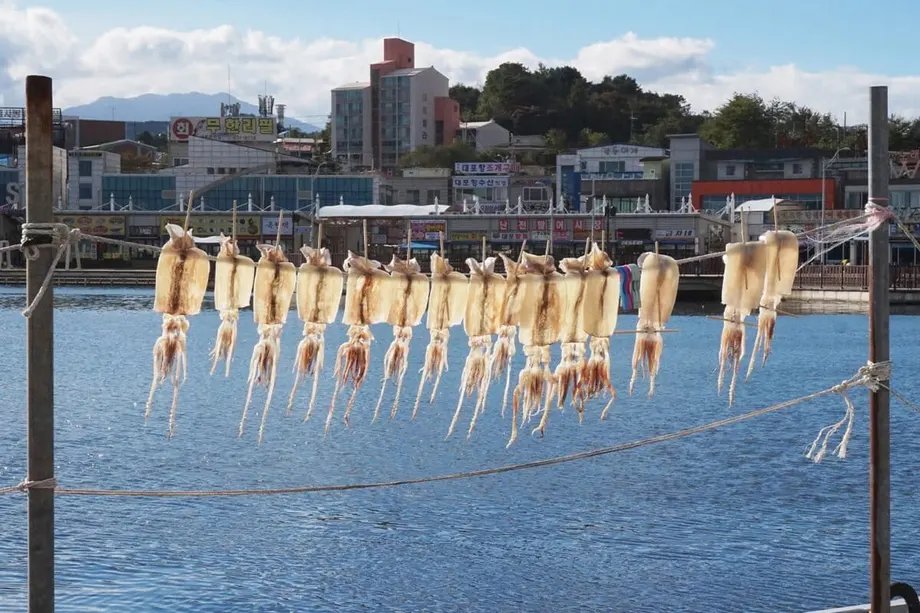
The Pacific flying squid has served for decades as an affordable, everyday dietary staple across the Korean Peninsula, commonly stir-fried with spicy chili flakes, steamed with water and soju, sliced raw for sashimi, or dried as a snack served with beer. Today, data from South Korea's national statistics service shows that domestic harvest volumes have fallen to just one-sixteenth of the levels recorded in 2002. Along the East Sea coast of Gangwon Province, North Gyeongsang Province (Gyeongbuk), and Busan, which together account for around 85 percent of the domestic Pacific flying squid harvest, catches in the 2020s have plunged by 85 percent compared with the 1990s average. For every 100 metric tons landed annually during the 1990s, fishing boats in the 2020s have hauled in only about 15 metric tons.
- 1999: National squid harvest hits a peak production volume of 225,122 metric tons.
- 2000: Ulleung Island records an annual squid catch of 11,315 metric tons.
- 2010: National squid catch stands at 160,000 metric tons.
- 2015: Ulleung Island squid catch drops to 1,852 metric tons.
- 2020: Ulleung Island catch falls further to 1,172 metric tons.
- 2023 to 2025: Prominent national fisheries fail to produce even 10 percent of the 1999 peak annual yield.
- 2025: Ulleung Island annual catch drops to 141 metric tons, a 98.8 percent decrease over 25 years.
- January to September 2026: National squid catch reaches only 24,000 metric tons, while Ulleung Island lands just 54 metric tons.
Kim Tae-won, a professor at the Department of Ocean Sciences at Inha University in Incheon who was not involved in the PKNU study, recalled his high school years in the 1990s when squid was one of the major fishery resources in the East Sea.
It was abundant, affordable and a familiar part of everyday meals. Squid is one of South Korea's most important and culturally significant fishery resources. I think this study highlights that climate change is a real threat not only to marine ecosystems but also to our dinner tables.
As domestic catches have plummeted, consumer and wholesale prices have surged. Between 2022 and 2026, the retail price of a medium-sized fresh squid from the South Korean coast rose by more than 40 percent, according to the Korea Agro-Fisheries and Food Trade Corporation. Wholesale auction prices climbed 56 percent over a four-year period ending in late 2026. At a large supermarket in Sejong City in November 2026, two frozen squid fetched 9,700 won even after a 30 percent discount, while a single large dried domestic squid cost up to 13,000 won. Shopper Han Young-kwang in Janggun-myeon, Sejong City, noted that fresh squid has become too expensive to touch, pushing consumers toward frozen alternatives. At the Noryangjin Fisheries Wholesale Market in Seoul, merchant Lim Hee-yoon stated in November 2026 that no fresh domestic squid deliveries had arrived for about a month because boats were catching none.
Kim Kyung-hoi noted that the shrinking harvest affects the entire coastal supply chain.
It is a familiar part of Korean food culture, and its availability matters to consumers, fishermen, processors, and coastal businesses.
How La Nina and Marine Heat Waves Drive Out Squid
The East Sea is warming far faster than the global ocean average, acting as a natural laboratory that demonstrates how climate change transforms marine ecosystems. Over the past decade, sea surface temperatures surrounding the Korean Peninsula rose by 0.7 degrees Celsius (1.26 degrees Fahrenheit), more than double the global average. Longer historical records from the National Institute of Fisheries Science show that while the annual average sea surface temperature across all South Korean waters rose 1.36 degrees Celsius between 1968 and 2022, the East Sea rose 1.82 degrees Celsius during that span, and reached a 2.04 degrees Celsius increase between 1968 and 2025, nearly triple the global average over the same period.
Subsurface waters are heating up as well. A 2024 study published by the National Institute of Fisheries Science in the Journal of Climate Change Research found that water temperatures at a depth of 50 meters in the southern East Sea, a primary habitat for Pacific flying squid, averaged 2 to 4 degrees Celsius warmer in the 2010s than in the 1990s. Around Ulleung Island, the number of days per year with sea surface temperatures of 20 degrees Celsius or higher more than doubled from between 70 and 80 days in the 1970s to roughly 160 days in the 2020s. Looking ahead, an August 2026 marine climate outlook from the Korea Meteorological Administration forecast that southern East Sea surface temperatures between 2091 and 2100 will rise another 1.8 to 2.5 degrees Celsius compared with the 2015 to 2024 average.
The PKNU and National Institute of Fisheries Science study found that this long-term warming is compounded by early-summer La Nina events. La Nina is a recurring climate pattern in the Pacific Ocean where trade winds strengthen and push warm surface water toward Asia while cooler water rises in the eastern Pacific. When an early-summer La Nina intensifies, a low-pressure, cyclonic atmospheric circulation develops over the northwestern Pacific. This wind pattern pushes the Tsushima Warm Current northward, sending a massive influx of warm water into the East Sea from autumn through winter and triggering intense marine heat waves, which scientists define as periods where seawater temperatures remain abnormally higher than the historical average for at least five consecutive days.
Kim Kyung-hoi explained how chronic ocean warming interacts with these periodic weather patterns to degrade squid habitats.
Our findings suggest that squid face several connected pressures. Long-term warming is making traditional fishing grounds less suitable, while marine heat waves, periods of unusually warm seawater lasting at least five consecutive days, add episodes of intense heat stress. Our analysis suggests that changes in winds and ocean circulation help carry more warm water into the East Sea. However, the message is not simply that 'La Nina causes squid to disappear.' Long-term warming provides the background pressure, and climate variability can intensify unfavorable conditions in particular years.
Hungry Predators and a Northward Retreat
The Pacific flying squid thrives in water temperatures between 13 and 23 degrees Celsius. When a marine heat wave strikes the East Sea in September, the average sea surface temperature climbs to 24.4 degrees Celsius, subjecting the squid to acute thermal stress. At the same time, warming waters have drawn in a surge of predatory fish, particularly the Japanese amberjack (Seriola quinqueradiata), also known as yellowtail, which thrives in warm water temperatures between 20 and 30 degrees Celsius. The PKNU study found that domestic catches of Japanese amberjack have risen alongside ocean temperatures, adding heavy predation pressure on the remaining squid stocks.
In its published conclusion, the joint research team warned that the combination of heat stress and predator migration can rapidly destroy a fishery.
Our findings show that fisheries collapse can accelerate rapidly when species are forced out of their habitats by high temperatures and this is compounded by an influx of active predators. The case of the East Sea warns that, in the absence of proactive climate-adaptive management, other major marine ecosystems worldwide are likely to experience similar declines in fishery resources.
Rather than going biologically extinct, the Pacific flying squid is shifting its range northward toward cooler Russian coastal waters, past Siberia, and toward the Arctic Ocean, or retreating into deep offshore waters. Mature squid measuring 15 centimeters or longer, which are the primary target for commercial boats, are leading this move away from the Korean coast. Jung Suk-geun, a professor at Jeju National University's Department of Marine Life Science, pointed out that squid catches across Asia have dropped in a sequential geographic wave, falling first in Taiwan, then along the Pacific coast of Japan, then in the Korea Strait, and finally along South Korea's eastern coast.
This is obviously due to ocean warming caused by climate change and global warming.
While the East China Sea has generally maintained its squid spawning grounds and fishing crews in Europe's North Sea are catching more squid and octopus than in past decades, the northward shift in Northeast Asia has created friction at sea. Kim In-hyeon, a maritime law professor at Korea University, noted that as squid migrate north, Chinese squid vessels have been operating in North Korean waters and approaching the maritime border with South Korean waters, while domestic fishers accuse large Chinese fleets of overfishing the shrinking stocks. Meanwhile, Kim Kyung-hoi noted that commercial catch records are not a direct count of every squid in the ocean, meaning further scientific tracking is needed, while Kim Tae-won explained how sensitive cephalopods are to shifting thermal boundaries.
Squid are highly mobile species, and their migration, feeding, growth, and reproduction are strongly influenced by water temperature. Even relatively small changes in ocean temperature can alter their migration routes, spawning grounds, and habitat suitability. While some squid populations are declining, others may be expanding their ranges or increasing in abundance as ocean conditions change. A further decline in squid could disrupt ecological interactions and potentially lead to a reduction in biodiversity.
Bankruptcies on Ulleung Island and Empty Harbors
The ecological transformation of the East Sea has devastated coastal communities that rely on small fishing vessels unable to chase squid into distant offshore or Russian waters. In the northern East Sea ports of Dongmyeong and Daepo in Sokcho, as well as Geojin and Ayajin in Goseong County, squid jigging boats frequently stay tied up at the docks during peak season or return empty. A local fisheries industry official in the Sokcho and Goseong region described the projection of a zero-catch state in the 2040s as a virtual death sentence for coastal fishing villages, noting that raw fish markets, dried seafood shops, and local tourism businesses are suffering a chain reaction of losses.
The crisis is mimicking the collapse of the walleye pollock (Gadus chalcogrammus), once a dominant East Sea catch that fell to zero metric tons in the 2000s. Jung Suk-geun described the East Sea as the most vulnerable among the marginal seas in East Asia, pointing out that cold-water species such as walleye pollock and sailfin sandfish (Arctoscopus japonicus) have virtually vanished from the sea, while squid fisheries on Ulleung Island have suffered widespread bankruptcy.
The species changes severely impacted the fishing industry in South Korea. Squid fisheries in South Korea's eastern Ulleung Island have completely gone bankrupt.
According to figures released in November 2026 by the Ulleung County Office and the Ulleungdo and Dokdo Marine Research Base of the Korea Institute of Ocean Science and Technology (KIOST), Ulleung Island's annual squid harvest collapsed by 98.8 percent over 25 years, falling from 11,315 metric tons in 2000 to 141 metric tons in 2025, representing just 1.2 percent of its former volume. During the first nine months of 2026, Ulleung boats landed only 54 metric tons, a 98 percent drop compared with 16 years earlier. At Jeodong Port and Dodong Port on Ulleung Island, where fleets of squid boats once lit up the night sea with bright fish-attracting lamps and piled squid high at auction markets, fishers have abandoned their vessels and harbor facilities in debt despite government relief subsidies.
Speaking on November 6, 2026, Gyeongbuk Provincial Council member Jung Yoon-tae of the People Power Party warned that Ulleung County lacks substantial support even as North Gyeongsang Province pursues a 560 billion won fishery transformation initiative running through 2030.
Currently, there are only two seafood processing companies left in Ulleung County. An 'Ulleung-type fisheries transformation comprehensive plan' is needed, including the development of new income-generating fish species and the exploration of alternative fishery models.
Ulleung County Governor Nam Han-kwon also stated that securing new income sources for local fishers is urgent. In October 2026, Ulleung County launched a pilot farming project for black rockfish (Sebastes thompsoni), known locally as bulbollak, after earlier aquaculture trials with shrimp, red sea cucumber, and Korean rockfish failed to provide a stable replacement for squid revenue.
Bluefin Tuna Surge as Cold Water Species Vanish
As squid and pollock vanish from the warming East Sea, warm-water Pacific bluefin tuna are surging into coastal nets. Along the eastern coast of Gangwon Province, the bluefin tuna catch jumped from just 39 metric tons in 2021 to 438 metric tons in the first half of 2026 alone, an more than elevenfold increase that rapidly exhausted the region's catch allowance. Off the coast of North Gyeongsang Province, boats in Uljin and Yeongdeok landed 190 metric tons and 43 metric tons of bluefin tuna in a single day, respectively.
Following urgent requests from North Gyeongsang Province in June 2026, the Ministry of Oceans and Fisheries raised the bluefin tuna catch quota for stationary set-net fisheries from 350 metric tons to 520 metric tons. Even with the expanded limit, many coastal fishers have been forced to halt operations or release fish because they lack individual tuna quotas. Furthermore, transitioning from squid to bluefin tuna requires entirely different fishing gear, harvesting techniques, processing facilities, and low-temperature cold-chain distribution networks, preventing debt-ridden squid fishers on Ulleung Island and the mainland coast from easily switching targets.
South Korea Shifts Its Hunt to the South Atlantic
To offset the domestic collapse, South Korea has expanded its distant-water squid fishing fleet on the high seas. According to data from the Ministry of Oceans and Fisheries, while South Korea's squid catch in domestic coastal waters dropped by 45.3 percent between 2020 and 2025, its squid catch from the high seas rose by 36.9 percent over the same period. Between 2020 and 2024, South Korean boats hauled in an average of 50,641 metric tons of squid per year from open seas, up nearly 60 percent from the previous four-year period, outpacing the domestic coastal average of 38,278 metric tons.
According to estimates from the United Nations Food and Agriculture Organization (FAO), South Korea ranked fifth in the world in high-seas squid catch volume in 2023, trailing only China, Peru, Argentina, and Chile. About 99.8 percent of South Korea's high-seas squid harvest consists of Argentine shortfin squid (Illex argentinus) caught in the Southwest Atlantic Ocean, and the South Korean government has sought to secure additional deep-sea fishing permits in foreign waters around Brazil and Argentina. Jang Young-soo, a professor of marine business and economics and former president of PKNU, explained that distant-water squid is primarily seasoned, fried, or stir-fried for restaurant side dishes and processed food products, whereas domestically caught fresh squid is favored for dishes highlighting natural flavor, such as sashimi. Jang noted that while imports and distant-water harvests help stabilize domestic prices to some extent, coastal and distant-water operators still face aging vessels, high fuel prices, and severe labor shortages, calling for stronger fuel subsidies and higher incentives in the state-led fishing vessel buy-back program.
It is a complex crisis that goes beyond a simple decrease in catch volume.
However, the rapid expansion into the Southwest Atlantic has drawn scrutiny from international marine watchdogs. The Britain-based Environmental Justice Foundation (EJF), in its Global Squid Report 2026, identified unregulated fishing by South Korean vessels in the Southwest Atlantic, pointing to overfishing, weak supply chain traceability, and harsh working conditions for crews. Because of the ongoing sovereignty dispute between the United Kingdom and Argentina over the Falkland Islands, located 500 kilometers off the southern coast of South America, the Southwest Atlantic lacks a Regional Fisheries Management Organization (RFMO) treaty framework, and South Korean domestic laws on catch limits and at-sea transshipment do not govern those waters.
Dominic Thomson, director of squid fisheries at the EJF, noted that South Korean distant-water vessels spend an average of six months at sea on a single voyage—half the duration of Chinese squid boats, yet still an extended period without port oversight.
Climate change and rising coastal water temperatures are driving cold-water species, including squid and pollock, away from Korean waters, and their role in the expansion of South Korea's distant-water squid fleet cannot be ignored. Simple measures like limits on trip length make a real difference. They improve officials' access to vessels through inspections in port, they let crew contact families, and they give crew a chance to raise the alarm if they are being abused. There are no legal limits on trip length or catch, and no rules against other destructive fishing practices, such as shark finning or the harming of sea birds. These regulations work well where an RFMO regulation is in place, but the South-west Atlantic squid fishery does not have one.
Jang Young-soo urged the South Korean government to expand electronic monitoring and transparent catch disclosure on its vessels while preparing for future international regulation in the South Atlantic.
South Korea must actively participate in the process of establishing a new regional fisheries oversight at the beginning to secure its fishing quota in advance. At the same time, the government must take the lead in pioneering a stable fishing environment for distant-water fisheries through active diplomacy, such as bilateral fishing agreements with South American coastal nations.
Key Points
- A joint study by Pukyong National University and the National Institute of Fisheries Science projects South Korea's East Sea catch of Pacific flying squid will fall to zero metric tons between 2043 (high emissions) and 2048 (low emissions).
- East Sea surface temperatures rose 2.04 degrees Celsius between 1968 and 2025, nearly triple the global average, while early-summer La Nina events push the Tsushima Warm Current northward to trigger autumn and winter marine heat waves.
- Warming waters have driven squid northward toward Russian waters while bringing an influx of predators such as Japanese amberjack and warm-water species like Pacific bluefin tuna.
- Ulleung Island's squid catch collapsed by 98.8 percent from 11,315 metric tons in 2000 to 141 metric tons in 2025, with only 54 metric tons caught between January and September 2026, leaving local fisheries bankrupt and only two processing firms operating.
- To meet demand, South Korea increased its high-seas squid catch by 36.9 percent between 2020 and 2025, relying for 99.8 percent of that volume on Argentine shortfin squid from the unregulated waters of the Southwest Atlantic.