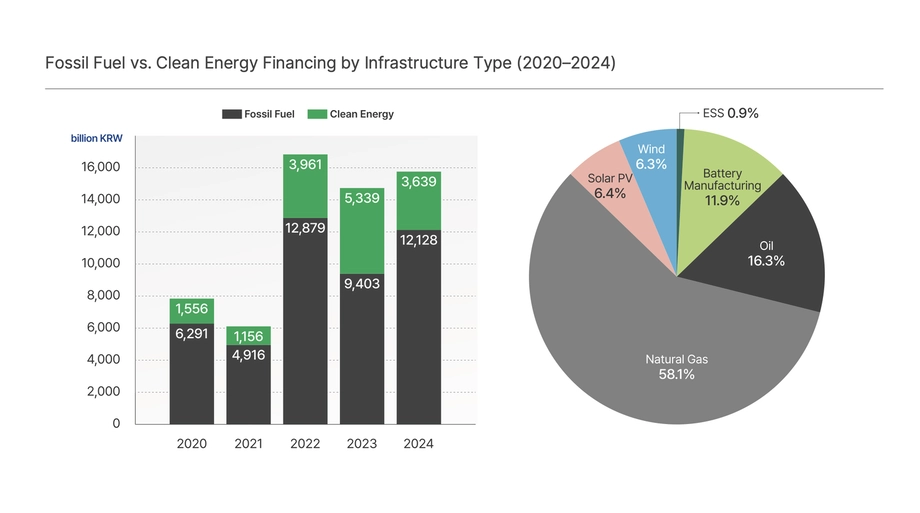
$27.7 Billion for Fossil Fuels, $5.806 Billion for Climate Action
South Korean public financial institutions provided $27.7 billion for overseas fossil fuel projects between 2018 and 2022, compared with $5.806 billion in international climate finance during the same period, according to an analysis by environmental group Green Korea. The fossil fuel total was about 4.8 times larger, placing South Korea third among Group of 20 economies, behind Japan and China.
Contents
- $27.7 Billion for Fossil Fuels, $5.806 Billion for Climate Action
- What the Loss and Damage Fund Pays For
- Payments Have Increased, but Large Balances Remain
- Why the Fossil Fuel Comparison Matters
- Loans Can Leave Disaster Recovery With a Debt Bill
- Nepal Shows How Far Available Funding Falls Short
- Green Aid Falls After a Rapid Expansion
- Who Should Pay Under the Next Global Goal?
- What South Korea Faces at COP31
- Key Points
The financing supported projects including gas development in Mozambique and coal power plants in Vietnam and Indonesia. Those investments sit alongside a much smaller stream of money intended to help developing countries reduce emissions, prepare for climate disasters and recover from damage already suffered.
South Korea's payments into two international climate funds have also drawn criticism. Green Korea's figures place the country near the bottom of donor rankings for the share of promised money actually paid. More recent government figures show that payments have increased, with further contributions planned for 2027.
The debate reaches beyond whether Seoul eventually completes its pledges. Its budget for green development assistance fell by about 40% in 2026, while poorer countries face recovery bills far larger than the support provisionally available to them.
Nepal illustrates the scale of the shortage. Its government estimated that recovery from flooding linked to a glacial lake would require $4.8 billion. A provisional allocation of $20 million from the international loss and damage fund amounts to roughly 0.4% of that need.
At COP31, the United Nations climate conference in Antalya, Türkiye, developing countries are pressing for more finance. South Korea faces demands to explain both how quickly it will deliver existing promises and how much it will contribute next.
What the Loss and Damage Fund Pays For
The United Nations Framework Convention on Climate Change explains that the loss and damage fund was established through decisions 2/CP.27 and 2/CMA.4 to help developing countries particularly vulnerable to climate change. Its mandate covers economic and non-economic harm caused by extreme weather and changes that develop gradually.
Economic losses include things with a monetary cost, such as damaged homes, roads and crops. Non-economic losses can include harm to health, cultural heritage or a community's connection to a place. The fund addresses damage that communities are already experiencing.
Governments put the fund into operation at COP28 and the fifth meeting of parties to the Paris Agreement. It serves both the climate convention and the Paris Agreement, and its governing board works under the guidance of their member governments.
The board appointed Ibrahima Cheikh Diong as its first executive director for a term of four years beginning November 1, 2024. This institutional structure gives vulnerable countries a dedicated channel for seeking help, although the money pledged remains much smaller than the requests described in Green Korea's analysis.
Payments Have Increased, but Large Balances Remain
South Korea promised $7 million to the Fund for Responding to Loss and Damage by 2027. Green Korea's snapshot for May 31, 2026, recorded payments of $2.15 million, or 30.7%, ranking South Korea 20th among 25 donor countries; later figures supplied by the finance ministry to lawmaker Lee Choon-seok put cumulative payments at $4.575 million.
The later payment total represents about 65.4% of the pledge, leaving $2.425 million to be paid. In the May comparison, 17 countries, including Germany, the United Kingdom and Japan, had already completed their pledges.
The Green Climate Fund presents a similar sequence. South Korea pledged $300 million for its second replenishment period, covering 2024 through 2027. Green Korea recorded $70 million paid by September 2026, or 23.3%, placing the country 34th among 35 pledging countries and subnational governments; later ministry figures put payments at $80 million.
The government plans to pay the remaining $220 million in 2027. South Korea had already paid its earlier Green Climate Fund commitments of $100 million for the initial funding round and $200 million for the first replenishment in full. Its current pledge therefore follows completed earlier contributions, while most of the current round still awaits payment.
Why the Fossil Fuel Comparison Matters
Green Korea's comparison covers five years, from 2018 through 2022, allowing the fossil fuel and climate finance totals to be assessed over the same period. The difference was $21.894 billion: overseas fossil fuel financing averaged $5.54 billion a year, compared with about $1.16 billion for international climate finance.
Public financial institutions supported fossil fuel projects through instruments including loans and investments. Such support helps projects obtain the money needed for construction and operation. In Mozambique, that meant gas development; in Vietnam and Indonesia, it included coal power generation.
Climate finance pursues a different set of objectives. It can help countries replace polluting energy, protect communities from climate hazards or recover after destruction. South Korea's financing record consequently shows public resources supporting both emissions reduction and activities that produce emissions.
Green Korea argues that the balance should change to reflect South Korea's economic capacity and contribution to climate change. Its criticism concerns the direction of public finance as well as the amount paid into international funds.
Loans Can Leave Disaster Recovery With a Debt Bill
South Korea's bilateral climate finance breakdown included $764.8 million in loans and $236.5 million in grants, according to Green Korea. Bilateral finance means assistance provided directly between countries, rather than through a shared international fund.
Loans accounted for about 76.4% of those two categories combined, and were more than three times the value of grants. A loan must be repaid under its agreed terms. A grant does not carry that repayment obligation.
For a government rebuilding roads, water systems or homes after a disaster, the difference affects future budgets. Borrowing brings money into the country now, but repayments can take resources from other services later. Grants allow recovery spending without adding that repayment bill.
Green Korea is calling for a larger grant share so that countries suffering climate damage do not have to rely so heavily on new debt. That demand adds another measure of climate support: how much help reaches a country without creating a future financial obligation.
Nepal Shows How Far Available Funding Falls Short
Nepal's estimated damage from flooding linked to a glacial lake was $2.7 billion, while its recovery requirement was $4.8 billion. Damage measures what was lost or harmed; recovery needs cover the work and spending required to rebuild.
The provisional $20 million allocation would cover about one dollar for every $240 in estimated recovery needs. The remaining requirement would be $4.78 billion. For affected communities, a gap of that size can mean waiting longer for housing, transport links and public services to be restored.
A glacial lake can form as meltwater collects near a glacier. If the material holding the water back gives way, a sudden flood can rush downstream. Communities below the lake may face destructive flows of water and debris.
The wider fund faces a shortage too. Green Korea put total pledges at about $800 million, compared with $2.8 billion in applications from developing countries. Applications were therefore 3.5 times the pledged amount, before considering whether all promised contributions had reached the fund.
Adaptation finance faces another large gap. The United Nations Environment Programme's Adaptation Gap Report 2026 projects that even tripling international public adaptation finance by 2035 would meet only 20% to 29% of developing countries' needs. Adaptation means preparing for climate effects, for example through flood protection, heat planning or more resilient infrastructure.
Green Aid Falls After a Rapid Expansion
South Korea's budget for carbon neutrality and green official development assistance rose from 4.5 billion won in 2022 to 47.1 billion won in 2025. It then fell to 28.2 billion won in 2026, a reduction of 18.9 billion won, or about 40%.
The government's proposed allocation for 2027 is 34 billion won. That would restore some spending, but remain 13.1 billion won below the 2025 level. The green aid reduction occurred alongside a roughly 18% cut in total official development assistance, even as the government's broader budget expanded.
The sequence shows how quickly commitments and budgets have shifted:
- 2022: The green development assistance budget stood at 4.5 billion won.
- 2024: At COP29 in Baku, then environment minister Kim Wan-seop pledged to expand contributions, including green development assistance.
- 2025: The green assistance budget reached 47.1 billion won.
- 2026: The allocation fell to 28.2 billion won.
- 2027: The government proposes 34 billion won and plans to pay the remaining $220 million of its current Green Climate Fund pledge.
Democratic Party lawmaker Lee Yong-woo has called on the government to carry out its international climate cooperation commitments. Independent lawmaker Lee Choon-seok has urged it to prepare a contribution plan covering several years before the next funding round.
Who Should Pay Under the Next Global Goal?
Governments agreed at COP29 in 2024 to pursue a climate finance goal of $1.3 trillion a year for developing countries by 2035. Within that larger ambition, developed countries are to lead the mobilisation of at least $300 billion annually.
South Korea occupies a contested position in the financing debate. It is outside Annex II of the climate convention, the list associated with obligations to provide financial support to developing countries. It nevertheless contributes voluntarily to international climate funds and faces pressure to give more because of its economic size and emissions.
European Commission Joint Research Centre figures cited in the debate put South Korea's greenhouse gas emissions at 696.06 million tonnes in 2025, ranking it 12th worldwide. Its emissions per person were 13.3 tonnes, compared with 7.1 tonnes in Türkiye.
Sejong University chair professor Jeon Eui-chan also pointed to South Korea's development assistance spending of 0.20% of gross national income, compared with an OECD average of 0.26%. Gross national income measures the income earned by a country's residents and businesses, providing a way to compare aid contributions across economies of different sizes.
The finance ministry has said discussions about who will supply the new climate finance are continuing. It has not announced South Korea's contribution to the new goal or its next Green Climate Fund replenishment pledge.
What South Korea Faces at COP31
COP31 opened in Antalya on November 9, with developing countries demanding that finance receive formal attention. Disagreement over the agenda delayed the opening plenary by about 90 minutes. The Group of 77 developing countries and China has pointed to falling development assistance and withdrawals or reductions in Green Climate Fund contributions.
Climate and Environment Minister Kim Sung-hwan is scheduled to deliver South Korea's national statement during the high level meetings on November 16 to 18. The immediate decisions concern future contributions, the delivery of existing pledges and the role of international cooperation in the government's green transition plans.
Green Korea has called for larger contributions and faster payments. In its statement, the environmental organisation expressed its criticism directly:
The Korean government must recognize how irresponsible and shameful its bottom-tier record of climate finance payments is,
The organisation's requested changes connect three parts of the same debate: paying promised money, increasing support that does not require repayment and reducing the imbalance between overseas fossil fuel finance and climate assistance. Nepal's recovery bill shows why the timing and form of that money matter to countries seeking help now.
Key Points
- South Korea provided $27.7 billion for overseas fossil fuel projects in 2018 through 2022, against $5.806 billion in international climate finance.
- Later government figures put loss and damage fund payments at $4.575 million of a $7 million pledge.
- South Korea has paid $80 million of its current $300 million Green Climate Fund pledge and plans to pay the balance in 2027.
- The green development assistance budget fell about 40% in 2026; the proposed 2027 increase would leave it below the 2025 level.
- Nepal's provisional $20 million allocation covers about 0.4% of its estimated $4.8 billion recovery requirement.
- COP31 discussions are pressing governments to address both existing payment commitments and future climate finance.