A familiar food faces a changing sea
South Korea's coastal and offshore catch of common squid fell from 189,160 tons in 2009 to 13,546 tons in 2024, a decline of 92.8%, according to the National Institute of Fisheries Science. A recovery to about 31,000 tons in 2025 brought some relief, but researchers warn that warming seas could push the regional fishery toward zero catches between 2043 and 2048.
Contents
- A familiar food faces a changing sea
- How far has the catch fallen?
- Three pressures are acting together
- Why La Niña matters in the East Sea
- What the 2040s projection means
- Fishing communities are losing their mainstay
- South American imports fill part of the gap
- Imported squid faces its own climate swings
- Why shoppers are still paying more
- Key Points
The pressure is already reaching household budgets. The Korea Agro-Fisheries & Food Trade Corporation recorded an increase of more than 40% in the price of a medium fresh squid caught locally between 2022 and 2026. For a food commonly stir-fried with chili, steamed or dried as a snack, the change is turning an everyday purchase into a more expensive choice.
Researchers at Pukyong National University in Busan examined fishing records and ocean conditions from 1993 to 2025. Their fishery collapse study, published in Communications Earth & Environment, identifies three connected pressures: steadily warming habitat, bursts of extreme ocean heat and the arrival of more Japanese amberjack, a predator that eats squid.
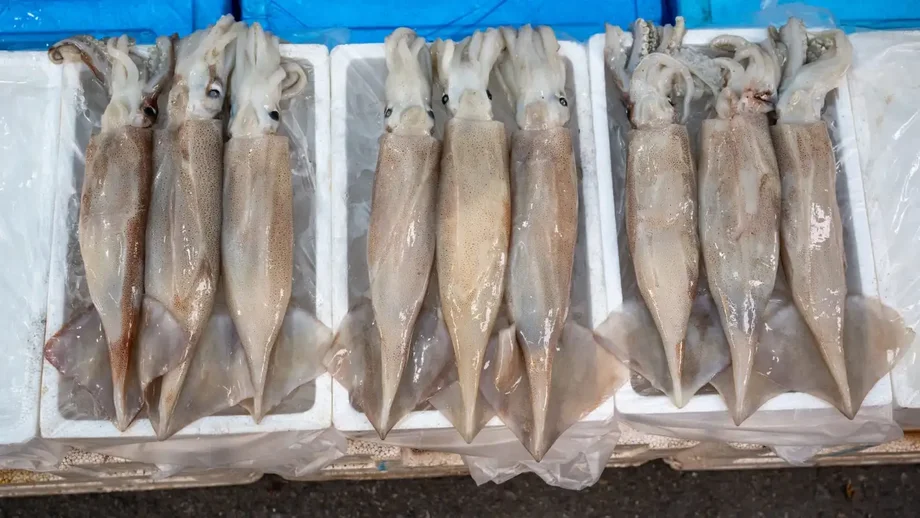
The species at the center of the research is Todarodes pacificus, known as Japanese flying squid or Pacific flying squid. Its changing fortunes connect several parts of the same story: the temperature of the East Sea, the survival of coastal businesses and the growing use of squid imported from South America.
How far has the catch fallen?
South Korea's decline has unfolded over decades. National statistics cited in accounts of the fishery put the catch at roughly one-sixteenth of its 2002 level. The more detailed comparison from the National Institute of Fisheries Science shows especially steep losses between 2009 and 2024: 95.7% in the East Sea, also known as the Sea of Japan, and 91.4% in the South Sea.
The Ministry of Oceans and Fisheries estimated that the domestic coastal and offshore catch rose 128.5% in 2025, reaching about 31,000 tons. Relatively low water temperatures helped fishing grounds form in the central East Sea during spring and in the central and southern West Sea during summer.
Even that improved catch was only about 16% of the 189,160 tons landed in 2009. Put simply, fishers caught roughly one ton in 2025 for every six tons caught in 2009. A strong recovery from a very poor year still left the industry far below its earlier scale.
The main dates show both the long decline and the recent fluctuation:
- 1993–2025: The period covered by the new study's fishing and environmental observations.
- 2009: South Korea's coastal and offshore common squid catch reached 189,160 tons.
- 2024: The catch fell to 13,546 tons.
- 2025: The fisheries ministry estimated a recovery to about 31,000 tons.
- 2043–2048: The range of years in which the researchers' models project possible zero catches under different emissions outcomes.
Three pressures are acting together
Sea surface temperatures around the Korean Peninsula have risen by about 0.7 degrees Celsius over a decade, more than twice the global average increase cited in the research coverage. For squid, temperature helps determine where they can feed, grow, reproduce and travel.
The Pukyong team describes gradual habitat degradation as one route toward collapse. Water that once provided suitable conditions becomes less suitable as its usual temperature rises. Squid may then change their movements, leaving familiar fishing grounds less productive.
Marine heatwaves add a sharper stress. These are periods when seawater stays unusually warm for at least five consecutive days. A fishery can therefore face both a rising background temperature and shorter episodes of much more intense heat.
Japanese amberjack, or Seriola quinqueradiata, adds a third pressure. The fish favors warmer water and preys on squid. Its domestic catch has increased alongside rising temperatures and falling squid catches. The study links this influx of predators with the wider deterioration of conditions for squid.
The researchers used a statistical method that examines connected pathways between changes. Their analysis links warming with declining catches through habitat conditions, heatwave stress and the changing predator population. This helps explain why the downturn can become abrupt even when the background warming develops gradually.
Why La Niña matters in the East Sea
La Niña is a recurring climate pattern involving cooler than usual surface water in the central and eastern tropical Pacific. Although that cooling happens far from Korea, associated changes in winds and ocean circulation can affect other seas.
The study identifies a connection between intensified La Niña conditions in early summer and stronger marine heatwaves in major squid fishing grounds during the following autumn and winter. A cooler tropical Pacific can therefore coincide with unusually warm conditions in the East Sea.
Kim Kyung-hoi, the study's corresponding author and a professor of ocean engineering at Pukyong National University, described the mechanism:
Our analysis suggests that changes in winds and ocean circulation help carry more warm water into the East Sea.
Longer lasting warming supplies the background pressure, while climate swings can make particular seasons more difficult for squid. The improvement in South Korea's 2025 catch, partly attributed by the fisheries ministry to relatively low temperatures, shows how much conditions can still vary from year to year.
What the 2040s projection means
The Pukyong team's climate models project an increased risk of the regional squid fishery reaching zero catches during the 2040s across several emissions scenarios. The estimates place that outcome between 2043 and 2048, depending on future emissions.
Zero catches would mean the disappearance of squid landings from the fishery being studied. Squid populations elsewhere may follow different courses as migration routes, spawning areas and suitable temperatures shift. Researchers expect movement toward northern waters to be part of that change.
Kim Tae-won, a professor in Inha University's Department of Ocean Sciences who was not involved in the study, explained why squid can respond quickly to a changing ocean:
Squid are highly mobile species, and their migration, feeding, growth, and reproduction are strongly influenced by water temperature.
The exact future size and location of squid populations remain uncertain. Kim Kyung-hoi has called for more research to track them in the East Sea, where fishing records provide information about landings while population surveys would help show how many squid are present and where they are moving.
Fishing communities are losing their mainstay
Ulleung Island, off South Korea's eastern coast, illustrates the human cost of the decline. Jung Suk-geun, a professor of marine life science at Jeju National University who studies climate effects on fisheries, described the condition of squid fisheries there:
have completely gone bankrupt.
Jung said fishers along the eastern coast have abandoned facilities despite government subsidies, with some still carrying debts. The loss of catches leaves less income to support fishing operations and repay money borrowed when the industry was more productive.
Processors and coastal businesses face pressure too. Their work depends on a reliable flow of squid, whether for preparation, drying, storage or sale. Lower local supplies affect more than the people who take boats to sea.
The ecological changes extend beyond squid. Jung said cold water walleye pollock and sailfin sandfish have virtually disappeared from the East Sea. At the same time, catches of Japanese amberjack have increased. These shifts are changing the mix of species that fishing communities can expect to catch.
South American imports fill part of the gap
South Korea has increasingly turned to imported squid. The Ministry of Food and Drug Safety's imported food statistics show that shipments from Peru reached 47,000 tons in 2025, up 109.7% from the previous year. Imports from Ecuador reached 16,000 tons, increasing from a very small base.
The two countries together supplied 63,000 tons, about twice the fisheries ministry's estimated domestic coastal and offshore squid catch of 31,000 tons that year. The trade includes jumbo flying squid, a different species from the Pacific flying squid at the center of the Korean study.
Food manufacturers and restaurants use South American jumbo flying squid in stir-fries, soups and fried dishes. Bodies and fins are processed for different uses, including scored pieces with a pinecone appearance that are common in Chinese style dishes such as malatang.
South Korea's government has also sought more permits for fishing in distant foreign waters, including around Brazil and Argentina. Fishing abroad and purchasing imports offer ways to obtain supplies while domestic fishing grounds become less dependable.
Those alternatives leave Korean buyers exposed to changes in other oceans. Peru's jumbo flying squid landings fell 67% during January through August 2024 compared with the same period a year earlier, according to a 2026 Organisation for Economic Co-operation and Development report on Peru's fisheries industry.
Imported squid faces its own climate swings
Peru's decline was linked to changes in squid distribution during El Niño. This Pacific climate pattern brings warmer surface water near the equator. Off Peru, it can weaken upwelling, the movement of cold water rich in nutrients toward the surface, changing feeding conditions and squid habitat.
Peruvian government data later estimated that the country's jumbo flying squid catch rose 252% in 2025, while exports increased 210.6%. Authorities raised allowable catch quotas after signs that stocks were recovering following the 2023–2024 El Niño.
South Korea's growing reliance on these supplies connects its food market to both Korean ocean warming and climate variability across the Pacific. A recovery in Peru can improve availability, while another disruption there can tighten supplies for buyers already facing reduced domestic catches.
Other regions show different patterns. Squid spawning grounds in the East China Sea have generally persisted, according to Jung, while fishers in the North Sea have reportedly been catching more squid and octopus. Changing temperatures are redistributing opportunities and losses unevenly.
Why shoppers are still paying more
South Korea's price increases extend beyond fresh squid. The Fisheries Economic Institute of the National Federation of Fisheries Cooperatives recorded a rise in the consumer price of domestic frozen squid from 6,985 won per kilogram in 2014 to 15,622 won in 2023, an increase of 123.7%.
The institute identified falling domestic coastal and offshore catches as the main driver. That frozen squid series covers a different product and period from the more than 40% increase recorded for a medium fresh local squid between 2022 and 2026. Both show a substantial increase in the cost of buying domestic squid.
Greater overseas catches have also taken time to reach buyers as lower prices. An industry official said the import unit price of Peruvian frozen squid increased during January through September 2025 compared with the same period a year earlier. Demand, processing, distribution costs and supply conditions all affect the final price.
The Pukyong study calls for fisheries management that responds to climate conditions and crosses national boundaries. For South Korea, that means confronting a problem wider than one poor fishing season: familiar grounds are changing, imports have their own vulnerabilities and coastal businesses are already absorbing the losses.
Key Points
- South Korea's coastal and offshore common squid catch fell 92.8% between 2009 and 2024.
- The estimated 2025 catch recovered to about 31,000 tons, still roughly 84% below the 2009 level.
- A Pukyong National University study links the decline to warming habitat, marine heatwaves and an influx of Japanese amberjack.
- Models project possible zero catches in the regional fishery between 2043 and 2048 under different emissions outcomes.
- Peru and Ecuador supplied a combined 63,000 tons of squid imports in 2025.
- Higher prices and shrinking local supplies are affecting consumers, fishers, processors and coastal businesses.