A familiar comparison for an invisible exposure
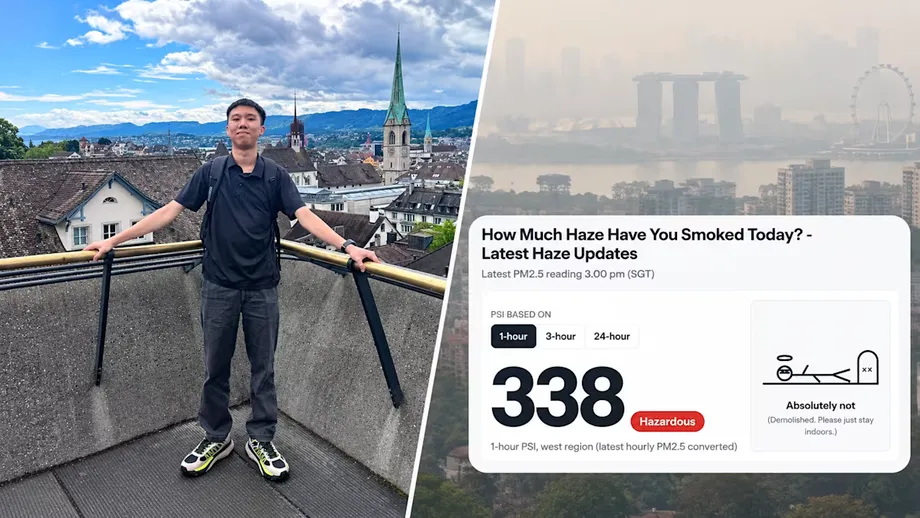
At 4pm on October 14, a website built by Nanyang Technological University student Zi Heng estimated that Singapore's average fine particle pollution over the previous 24 hours amounted to roughly 4.4 cigarettes of exposure. Its second calculation was more striking: if the latest hourly pollution level lasted an entire day, the equivalent would reach 9.4 cigarettes.
Contents
- A familiar comparison for an invisible exposure
- How does haze become a cigarette number?
- Why the different haze readings can be confusing
- Five regions and hourly updates
- Schools were already changing the day
- When would school closures be considered?
- The dates families needed to watch
- A joke becomes a public communication project
- Key Points
Zi Heng, a 21-year-old Data Science and Artificial Intelligence student, created How Much Haze Have You Smoked Today? to help people understand the numbers they check before going outside. He built it himself in a week, initially for family and friends who found Singapore's different haze readings overwhelming.
The calculator attracted around 2,000 views a day as of October 14 after he shared it on Reddit. Its popularity coincided with practical changes across Singapore, where several schools cancelled outdoor activities as fine particle concentrations climbed into the very high range in the west.
The website brings together official National Environment Agency (NEA) data, regional pollution readings and Zi Heng's own calculations. The cigarette figure is an approximate comparison that assumes continuous exposure to outdoor air at an average breathing rate. An individual's actual exposure depends on where they spend their time and the air they breathe.
How does haze become a cigarette number?
Berkeley Earth, an environmental research organisation, estimates that breathing air containing 22 micrograms of PM2.5 per cubic metre for 24 hours is roughly comparable to smoking one cigarette. Zi Heng uses that relationship to translate pollution concentrations into a more familiar number.
PM2.5 means tiny airborne particles measuring 2.5 micrometres or less across. Their small size allows them to travel deep into the lungs. A concentration in micrograms per cubic metre describes how much of this material is present in a given volume of air.
The calculation is straightforward: divide the average PM2.5 concentration for a full day by 22 to obtain the approximate cigarette equivalent. The website's 4.4 figure described the preceding 24 hours. Its 9.4 figure extended the latest hourly concentration across a hypothetical full day.
The second figure was about 2.1 times the first, using 9.4 divided by 4.4. In plain language, the latest hour was more polluted than the preceding day's average. The two numbers describe different time periods: one looks back over a day, while the other shows what a day at the latest concentration would amount to.
Zi Heng presents the comparison as a way to communicate exposure, with warnings explaining its limits. It is approximate rather than a personal medical assessment. Smoking remains harmful regardless of the amount of haze outside.
Why the different haze readings can be confusing
Singapore residents encounter both the Pollutant Standards Index (PSI) and PM2.5 concentrations. PSI expresses air quality on an index scale, while PM2.5 readings express the concentration of fine particles. Their numbers therefore have different meanings even when they describe the same period of polluted air.
Time adds another complication. NEA's official 24-hour PSI reflects conditions across a longer period, while an hourly PM2.5 reading captures more recent conditions. A sudden deterioration can therefore appear more sharply in the hourly figure.
Zi Heng, explaining why he wanted a simpler display, described the problem through an everyday decision about exercise.
I find that the 24h PSI is a little like trying to drive a car while looking at the rear-view mirror and doesn't help with whether I should go for a run now," he said. "The one-hour PM2.5 readings are also decent, but it is confusing because the scale of it differs from the 24h PSI.
His website displays his own estimates of PSI over one and three hours alongside NEA's official 24-hour PSI. The shorter estimates are calculated from PM2.5 concentrations. Readers therefore need to pay attention to both the period covered and who produced each figure.
Five regions and hourly updates
The tracker breaks pollution levels down across northern, southern, eastern, western and central Singapore. That regional detail matters when pollution is much heavier in one part of the island than another. An island average combines conditions across locations, while a regional reading gives residents information closer to where they are.
Zi Heng draws data directly from NEA's application programming interface, or API. An API lets software retrieve data automatically, allowing his website to update without someone manually copying each new reading.
According to Zi Heng, the data generally updates within one to two minutes after the start of each hour. He said he had sometimes observed NEA's public haze website taking around 10 minutes to update. That timing comparison comes from his observations.
The official readings and the student's calculations appear together, making the labels beside each number especially important. Zi Heng said he placed warnings close to the readings to explain what users were seeing.
"I have listed quite a lot of warnings near all my readings! The last thing I would want is to mislead anyone," he said.
Schools were already changing the day
Western Singapore's hourly PM2.5 concentration reached 288 micrograms per cubic metre at 3pm on October 14 and 251 at 4pm. Both readings exceeded 250, the threshold for the very high concentration range.
At those levels, NEA advises the public to minimise outdoor activity for the next hour. Children, older people, pregnant women and people with chronic lung or heart disease are advised to avoid outdoor activity.
Maris Stella High School cancelled outdoor sports activities, Nan Hua High School cancelled at least one co-curricular activity, and Pasir Ris Secondary School cancelled its football activity. Pasir Ris Secondary also told teachers that students should minimise activities after school and eat indoors during recess.
CHIJ (Kellock) informed parents that outdoor activities, including physical education and outdoor play, would be suspended on October 15 and 16. Pupils bringing packed food would eat in classrooms. Those buying food or receiving meals ordered in advance would return to classrooms after eating.
St Andrew's School (Junior) told parents that pupils could attend in physical education attire until December 31. Together, the changes show how haze readings can affect ordinary routines, from sports sessions to where children spend their breaks.
When would school closures be considered?
The Ministry of Education (MOE) uses different measures for adjusting daily activities and considering closures. Schools adjust the level and nature of activities according to hourly PM2.5 readings, which can change through the day. Decisions about the following day's operations also take account of the 24-hour PSI forecast.
An October 10 notice to parents said that when the 24-hour PSI exceeds 200, lessons would continue in enclosed, well-ventilated spaces with air purifiers operating. Schools would avoid outdoor activities and strenuous indoor exercise, minimise activities after school and arrange for students to eat indoors during recess.
Education Minister Desmond Lee said MOE could consider school closures and postponing national examinations if the next day's forecast entered the hazardous range, with a 24-hour PSI above 300. Any closure decision would be announced through schools and official MOE channels by around 8pm the previous evening.
The closure arrangements could cover MOE kindergartens, primary and secondary schools, and special education schools. Junior colleges, the centralised institute and the junior college sections of Integrated Programme schools would remain open with additional haze protection measures.
Students affected by closures would move to learning at home, while MOE kindergartens would provide activities for home. Schools and care facilities would still receive students who needed to attend. Student care and Kindergarten Care centres would operate from 7am to 7pm during closures.
The dates families needed to watch
The announcements followed a sequence of precautions, worsening hourly readings and scheduled changes to school activities:
- October 10: A notice set out school precautions for a 24-hour PSI above 200. Desmond Lee explained the conditions under which closures could be considered.
- October 14, 3pm: Western Singapore's hourly PM2.5 reading reached 288 micrograms per cubic metre.
- October 14, 4pm: The western reading was 251. The student's tracker showed cigarette equivalents of 4.4 for the previous day and 9.4 if the latest hourly level continued for 24 hours.
- October 15 and 16: CHIJ (Kellock) scheduled the suspension of outdoor activities.
- Around 8pm on the preceding evening: MOE's stated announcement time for any decision to close schools the next day.
The school measures described were cancellations and precautions, with wider closures dependent on the forecast and a ministry decision. Families therefore needed to watch school messages as well as changes in pollution readings.
A joke becomes a public communication project
Zi Heng said the cigarette calculator began as a joke among friends and was initially a secondary feature. Positive reactions from family and friends persuaded him to share the website more widely.
The student, who said he has never smoked, hopes the comparison will make younger people take haze more seriously. His aim is to turn an unfamiliar pollution measurement into something whose danger people already recognise.
Zi Heng described that intention while explaining his opposition to smoking.
I am a firm believer in not smoking. It does indeed feel ironic to equate the haze to cigarettes, but perhaps we should view the haze to be as dangerous as cigarettes, as I feel some youngsters might be underestimating the danger the haze brings.
He plans to keep the website running indefinitely, including after the haze clears. For residents, its main practical contribution is putting several readings in one place and giving the scale of pollution a familiar reference. Official health guidance and school announcements supply the instructions for what to do when conditions worsen.
Key Points
- NTU student Zi Heng built a haze tracker in one week to make pollution readings easier to understand.
- At 4pm on October 14, it estimated 4.4 cigarette equivalents over the previous 24 hours, or 9.4 if the latest hourly level lasted a full day.
- The comparison uses Berkeley Earth's estimate of one cigarette equivalent for 24 hours at 22 micrograms of PM2.5 per cubic metre.
- The website combines NEA data with the student's own estimates for PSI over one and three hours.
- Very high hourly PM2.5 readings in western Singapore prompted schools to reduce outdoor activities.
- MOE could consider closures if the next day's forecast 24-hour PSI exceeded 300, with decisions announced around 8pm the evening before.