A year of experiments produces a portable prototype
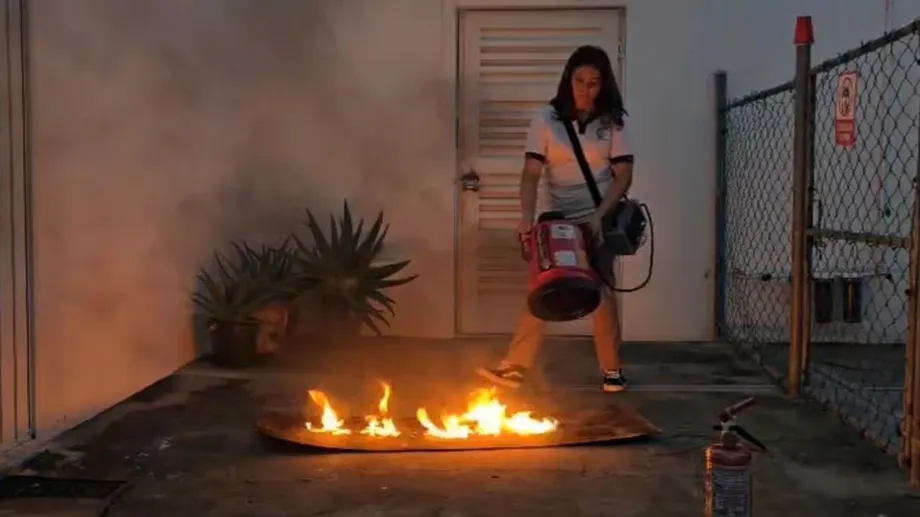
Ángela Karime Venegas Hernández, an electronics student at CETIS 78 in Altamira, in the Mexican state of Tamaulipas, has developed a portable device that she says can extinguish small flames in five to eight seconds. Called Vortex Tech, it uses a 12 volt battery and sound at 30 hertz rather than water or chemical powder.
Contents
- A year of experiments produces a portable prototype
- How a video became a working invention
- What is inside Vortex Tech?
- Why moving air can extinguish a flame
- What the reported tests show
- Where a device without extinguishing chemicals could help
- From Tamaulipas to an international science fair
- A patent ambition and an automatic version
- Key Points
Venegas and her adviser, José Arturo Hernández Muñoz, spent about a year developing five versions of the device. She says it has undergone more than 100 tests, including experiments involving wood, flammable liquids, electrical equipment and cooking grease. Its reported effective range is about two metres.
The project won first place in the upper secondary school category at ExpoCiencias Tamaulipas 2025 and later earned silver at a national competition involving approximately 270 projects. Those achievements helped take a classroom experiment toward an international presentation in Indonesia.
Venegas is described as 16 in accounts published in August and September 2026, while an account describing her arrival in Indonesia gives her age as 17. Her device remains an experimental prototype, with the reported results involving small flames under controlled conditions. Venegas says its intended role is to complement conventional extinguishers in places where water or powder could damage valuable objects or equipment.
How a video became a working invention
Venegas began with a simple question: could she extinguish a candle without blowing on it, pouring water over it or touching it? Hernández, who is both her adviser and her uncle, said experimental videos prompted their interest in building an acoustic extinguisher.
Venegas traced the idea more specifically to a video showing a sonic cannon about four metres long, which she associated with the United States Defense Advanced Research Projects Agency, or DARPA. The demonstration encouraged her to test whether a smaller device could produce a similar effect.
The first working result took two months, excluding the research that came before construction. Even then, the initial prototype struggled to extinguish a small flame. Venegas and Hernández changed materials and adjusted the acoustic structure repeatedly before reaching the fifth version now being presented publicly.
Hernández also helped inspire her interest in science competitions. At family meals, he would describe people he had met and places he had visited through such events. Venegas wanted experiences of her own, and the project gave her a reason to pursue them.
What is inside Vortex Tech?
Vortex Tech combines a battery, a frequency generator, a power amplifier, a loudspeaker and a modified bucket that forms the body of the sonic cannon. Each component has a specific job: the battery supplies electricity, the generator sets the frequency, the amplifier increases the electrical signal and the speaker turns that signal into movement of the air.
Venegas explained that the bucket was deliberately altered to serve as part of the device, rather than simply taken from a shop. In translation, she said:
The bucket is something that we modified, not one that we found in a store.
The speaker directs its output toward a circular opening. The design is described as producing vortex rings, moving loops of air shaped roughly like doughnuts. These rings disturb the air around the flame.
The operating frequency of 30 hertz means 30 cycles each second. Frequency describes how quickly the pressure changes repeat; it is different from loudness. The prototype also depends on the strength and direction of those changes, the shape of the outlet and the distance from the fire. Playing a low note is only one part of the process.
Why moving air can extinguish a flame
A flame needs fuel, heat and oxygen to keep burning. Sound travels through air as changes in pressure. When a suitable acoustic device directs those changes at a small flame, it can alter the flow of air and disrupt the region where burning occurs.
Descriptions of Vortex Tech refer to moving oxygen away from the flame and separating hot air from the fuel. More detailed explanations describe a local disturbance: vibrations and turbulence can shift the flame away from its fuel supply and increase heat loss until combustion stops.
The air in the surrounding room still contains oxygen. The useful effect happens close to the flame, where the device changes the conditions that allow burning to continue. A candle offers a straightforward example because its flame depends on a steady supply of fuel vapour rising from the heated wax.
Sound affecting flames has a long history. A review published in the journal Fire in 2025 traces observations of the human voice influencing flames to J. Tyndall in 1867 and discusses later acoustic extinguishing experiments. Venegas has applied that existing physical principle to a portable student project through repeated design changes and testing.
What the reported tests show
Venegas says Vortex Tech has extinguished small fires involving several different fuels in approximately five to eight seconds. Reports also describe operation at distances of up to two metres. These figures give the project a more concrete performance target than a demonstration involving only a single candle.
The test descriptions do not provide flame dimensions, sound pressure measurements or a breakdown of successful and unsuccessful attempts for each fuel. Those details would help explain how consistently the device performs and which conditions give the best results.
The 2025 Fire review identifies early fires as the more suitable application for acoustic suppression and describes limits when burning extends into solid material. A visible flame may be disturbed by moving air, while heat and burning within the material require a different response.
Wood, flammable liquids, electrical equipment and cooking grease present different fire conditions. Naming those categories gives a useful picture of the student's experiments, but a practical emergency device would need its performance assessed for the precise fuels, sizes and situations in which it is intended to operate. Further development therefore involves more than increasing its range.
Where a device without extinguishing chemicals could help
Venegas identifies laboratories, offices, museums and classrooms as possible settings for the technology. Their shared concern is damage to the contents of a room: water can affect equipment or collections, while discharged powder can leave material that requires extensive cleaning.
Vortex Tech sends no liquid or chemical powder toward the flame. That gives the design a potential advantage where even a small fire and the response to it could damage electronics, laboratory instruments or objects on display. Its battery also supports the aim of making it portable.
Descriptions of the prototype say it leaves no residue and does not harm people nearby during operation. Published test details remain limited, and safety assessment is part of the development work needed before use in an actual emergency. Power requirements, acoustic exposure and reliable operation would all matter in the proposed settings.
Venegas says the system is intended to work alongside traditional extinguishers. Anyone facing a fire should follow established emergency procedures and use suitable certified equipment. Trying to reproduce the experiment with an ordinary household speaker can be dangerous because the result depends on a carefully arranged combination of frequency, power, direction and distance.
From Tamaulipas to an international science fair
The project is listed on the platform of the Latin American Society of Science and Technology, known as SOLACYT, under a Spanish title meaning Fire Suppression System Using Acoustic Waves. Venegas is identified as the contestant and Hernández as the adviser, with the work placed in applied science.
Venegas has participated in seven state and national competitions. Her first place at ExpoCiencias Tamaulipas 2025 preceded the national silver award among about 270 projects. Mexico's Directorate General of Industrial Technological Education and Services, or DGETI, also congratulated her in connection with representing the state internationally.
The project's development and competition route can be outlined as follows:
- 2025: Vortex Tech won the upper secondary school category at ExpoCiencias Tamaulipas.
- During roughly a year of development: Venegas and Hernández built five prototypes, with the first taking two months to extinguish a small flame.
- After the state competition: The project earned silver at a national event involving approximately 270 projects.
- October 2026: Venegas was selected to present the project at the International Science and Invention Fair in Indonesia.
The International Science and Invention Fair, or ISIF, is described as organised by the Indonesian Young Scientist Association with Universitas Indonesia. The detailed 2026 schedule places the online competition on October 6 to 9 and the physical event on October 12 to 17 at the university in Depok, near Jakarta. Other accounts give October 13 to 18 or October 14 to 16 and describe the destination as Jakarta.
An account from around the event describes Venegas having arrived in Indonesia and sharing photographs from the university. Financial assistance for attending science fairs came from Altamira official Armando Martínez Manríquez and the Tamaulipas education secretariat. Such support helped turn a competition invitation into an opportunity to present the device abroad.
A patent ambition and an automatic version
Venegas hopes to seek a patent for Vortex Tech. She is also developing a second concept: an acoustic extinguisher that would detect a flame automatically and activate without waiting for someone to operate it.
An automatic version would add another task to the existing engineering work. The system would have to recognise a flame and trigger the acoustic device reliably, while the extinguisher itself would still need to perform within its intended operating conditions. No completion date or patent filing date has been given.
Venegas developed an interest in electronics during her second semester of upper secondary school, despite initially expecting little interest in the subject. Building Vortex Tech changed that relationship. She is considering electronics or mechatronics, a field combining mechanical systems, electronics and control, and expects to pursue engineering.
Her immediate achievement is tangible: five prototypes, more than 100 reported tests, state and national recognition, and an international presentation opportunity. Her next challenge is to turn the small flame experiments into a more thoroughly tested device for the specific spaces she wants to protect.
Key Points
- Ángela Karime Venegas Hernández developed Vortex Tech at CETIS 78 in Altamira, Tamaulipas, with adviser José Arturo Hernández Muñoz.
- The fifth prototype uses a 12 volt battery and sound at 30 hertz to disturb small flames.
- Venegas reports more than 100 tests, extinguishing times of five to eight seconds and an effective range of about two metres.
- The project won a state competition in 2025 and silver at a national event involving approximately 270 projects.
- The device remains experimental and is intended to complement conventional extinguishers.
- Venegas hopes to seek a patent and develop a version that detects flames and activates automatically.