Ninety families relocated to land below a protective dike
A Philippine flood control project backed by two contracts worth Php 157 million moved 90 families from Pulo Island to a former fish pond where their main street lies about 1.9 meters below a protective dike, Human Rights Watch said in findings published on October 12, 2026. Four years after the relocation, residents describe flooding throughout the year, difficulty reaching work and services, and the departure of relatives who had hoped to keep the community together.
Contents
- Ninety families relocated to land below a protective dike
- Why officials wanted Pulo Island removed
- Meetings took place, but residents describe no choice
- Warnings about the island lacked a shared assessment
- Full compensation depended on demolishing homes
- The destination floods despite promises to raise it
- Flooding is disrupting work and family ties
- Housing oversight was missing from the process
- An investigation and another delta project are pending
- Key Points
The families were moved in 2022 from the Pampanga River to Barangay Candelaria in Macabebe, Pampanga province. Human Rights Watch's Pampanga relocation findings allege failures in consultation, access to information and selection of a suitable housing site. The Department of Human Settlements and Urban Development has expressed concerns about the location, while the Commission on Human Rights says it will investigate.
The findings draw on interviews with 35 residents, nine local authorities and climate experts between July and August 2026, alongside satellite imagery and measurements obtained from photographs. Human Rights Watch also published a video on flooded homes documenting the community's situation.
Lian Buan, Southeast Asia researcher at Human Rights Watch, said the relocation had undermined the safety it was supposed to deliver:
Philippine authorities in Pampanga have threatened the safety and livelihoods of Pulo Island residents by relocating them to a low-lying area as part of a flawed flood control project.
The dispute concerns both the decision to remove the island and what happened afterward. Public works engineers say removal would increase the river's capacity and protect communities. Residents say the destination left them facing persistent floodwater without a meaningful choice about where to live.
Why officials wanted Pulo Island removed
Department of Public Works and Highways (DPWH) engineers Tomas Edison Olalia and Alvin Diaz told Human Rights Watch that the late Macabebe mayor, Anette Balgan, requested the dredging and relocation. Dredging removes soil, sediment and other material to create more space for water to flow. The engineers said removing Pulo Island would help prevent flooding and improve safety for its residents and other communities along the river.
The department awarded two contracts in 2019 and 2020, worth a combined Php 157 million, or about $2.6 million, for the island's removal through its annual flood mitigation program. Dredging and relocation activities extended from 2020 to 2023.
Letters between the former mayor, the department and residents described the community as informal settler families living in a danger zone. The engineers said Balgan sought action under a 2017 policy directing local governments to remove illegal structures from danger areas, including riverbanks, shorelines and waterways where housing threatens residents or the wider community.
The proposal had a much longer history. In the early 1990s, the Japan International Cooperation Agency funded the Pampanga Delta Development Project Phase I, which envisaged resettling 1,851 households. That project was never completed. Pulo residents opposed relocation and stayed, and Olalia and Diaz said island removal had already been proposed under that earlier plan.
Meetings took place, but residents describe no choice
Government officials began meeting affected families in 2018, sometimes using Kapampangan, the local language. Residents interviewed by Human Rights Watch nevertheless said their concerns did not meaningfully influence the decision. None felt they had been given a choice about moving.
The distinction matters: holding meetings does not by itself establish that residents received understandable information, could propose alternatives or had their objections considered. DPWH officials acknowledged that their staff did not conduct detailed consultations, describing their role as technical assistance.
Residents said they learned about the proposed relocation site in 2021 and immediately questioned its suitability. They said authorities presented no alternative solutions. Many ultimately agreed because officials said the destination would allow their closely connected community to remain together.
Mary Grace Liguid, a 38 year old resident, described the pressure surrounding the move:
We had no choice. People just arrived measuring our houses, our lands. We had no choice but to agree, because you can't be left there.
The demolition agreements distributed in 2021 were in English, which was not the residents' preferred language. Some said they received no help from a lawyer or another adviser to understand the forms. Human Rights Watch found that the combination of limited information and a decision residents believed was already settled fell short of meaningful consultation.
Warnings about the island lacked a shared assessment
Residents said they heard different explanations for their removal. Government documents stated that the island obstructed river flow. Community members also recalled being told that it was shaped like a cone, was eroding underneath and could collapse.
Olalia and Diaz said the warning about erosion beneath the island did not come from their office. Macabebe's current municipal engineer said the local government lacked the capacity to produce such an assessment. Residents could not recall discussing a risk assessment with officials or considering measures that might have allowed them to remain.
Human Rights Watch's satellite analysis found that the island's surface area declined from 25 hectares in 1984 to 23.7 hectares in 2020, a loss of 1.3 hectares, or 5.2 percent, over 36 years. That measurement describes changes in visible surface area. It does not, by itself, establish conditions beneath the island or settle whether collapse was possible.
The information gap is therefore more specific than a disagreement over whether flooding was dangerous. Residents say they were not given an accessible basis for comparing the risks of staying with the risks of moving to the proposed site.
Full compensation depended on demolishing homes
The compensation process required residents to surrender their existing homes before receiving the full assessed payment. After signing demolition forms, families could receive 70 percent of the assessed value by traveling to Metro Manila to cash their checks. The remaining 30 percent depended on submitting photographs and videos proving demolition.
Human Rights Watch said residents were expected to demolish immediately after the initial payment. Many reported feeling rushed because rumors suggested the allocated funds might run out. Those fears circulated without adequate official information; the findings do not establish that funding was actually about to expire.
Esmeralda Tubig, a 46 year old daycare teacher, described how the payment arrangement collided with uncertainty about housing and income:
We were panicking. First of all, you'd demolish your house without complete payment, then you have your daily life to think about. We didn't know where we'd get our livelihood, then suddenly we also did not know where we'd live.
Few families owned the land beneath their houses. Many were agricultural tenants who supplied labor while landowners supplied capital, with both sharing the harvest. Residents paid local property taxes on residential land rather than rent. Human Rights Watch noted that the Philippine Right-of-Way Act still provides compensation for structures belonging to people without legal claims to the land.
Residents said they received no other compensation, including for crops. One turned trees into charcoal to earn money before moving. The National Resettlement Policy Framework also calls for a pathway to secure tenure at a destination, such as a lease or another recognized right to use property. The findings do not establish whether all relocated families obtained such security.
The destination floods despite promises to raise it
Residents said local authorities promised to raise the former fish pond to the height of the adjacent dike road. The dike is an elevated barrier intended to prevent river floodwater from reaching nearby homes, and the road along its top is the community's main route toward town.
The embankment work never brought the relocation site to that level, according to Human Rights Watch. An engineer involved in the project said the dike's design did not allow the site to be raised to the same height. This leaves a central unresolved conflict between what residents say they were promised and what the engineer says the design permitted.
Human Rights Watch used photogrammetry, a method of obtaining measurements from photographs, to estimate that the site's main street is about 1.9 meters below the dike road. During a visit with light rain, it measured 20 centimeters of water on that street.
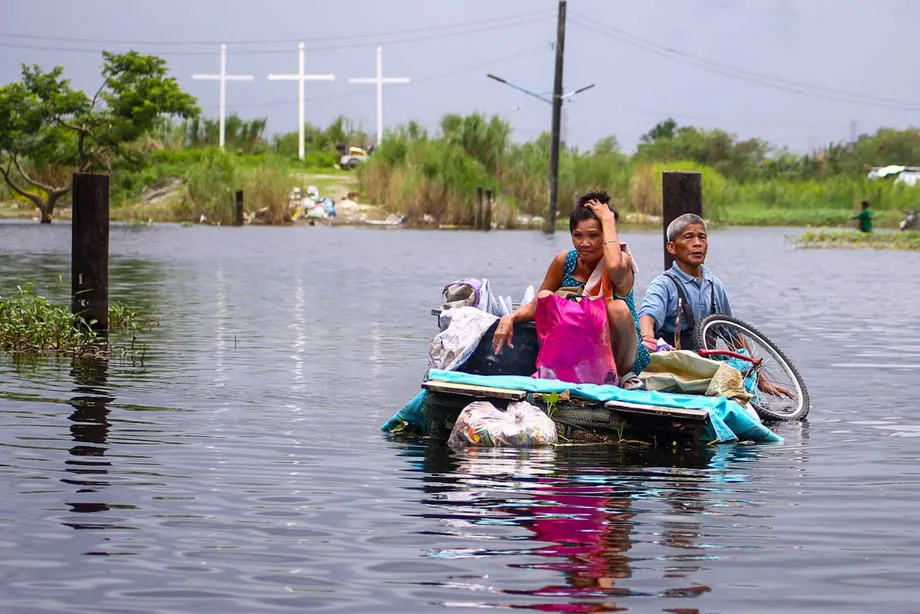
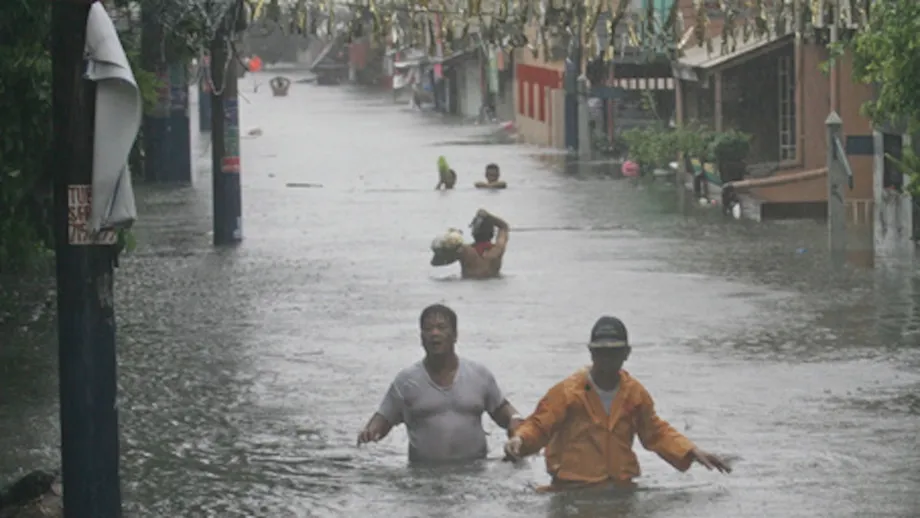
The organization also described water reaching knee to thigh height at high tide during its July 12 to 14 visit. These observations concern different conditions and should not be read as a single uniform flood depth. Researchers observed children wading and older people unable to leave flooded homes. Residents said they regularly had to cross floodwater to reach the road.
Flooding is disrupting work and family ties
The move was supposed to preserve a community in which many families are related. Persistent flooding has instead prompted some relatives to leave, according to Human Rights Watch, because of its effects on daily life and livelihoods.
Access is part of the housing problem. A home may remain standing while floodwater between its doorway and the road prevents residents from reaching employment or services. The accounts of older people confined indoors and families wading to the dike show why assessing a destination requires more than checking the buildings themselves.
Human Rights Watch describes Pampanga, on Luzon, as experiencing the country's most severe flooding, worsened by storms, rising sea levels and limited dam capacity. Macabebe lies within the Pampanga Delta, an area of low swampy land extending across parts of Pampanga, Bulacan and Bataan.
The organization cites 6.6 million people displaced by floods and sea level rise in the Philippines between 2015 and 2025. That national figure places Pulo's relocation within a much larger challenge, but does not resolve whether this particular destination was safe. Its central finding is that moving people away from one exposed location must not leave them facing foreseeable risks at another.
Housing oversight was missing from the process
The Department of Human Settlements and Urban Development and the National Housing Authority normally lead planned relocation, assess whether destinations are feasible and can provide financing for new houses. Human Rights Watch found that other agencies with housing and rights responsibilities were not involved in the Pulo project.
Interior department guidelines also provide for monitoring by the Presidential Commission on Urban Poor when informal settlers are affected, alongside oversight by a local committee involving multiple agencies or a local housing board. The Commission on Human Rights has its own oversight role concerning adequate housing and humane treatment.
Ferdinand Zambrano, project development officer at the local human settlements office, described the missing safeguards:
There was no check and balance.
The human settlements department told Human Rights Watch that the reported physical characteristics raised concerns about suitability for permanent housing, pending further assessments at the site. That response is a warning, not a completed technical determination.
Human Rights Watch said the relocation was inconsistent with international standards reflected in the United Nations Guidance on Protecting People from Disasters and Environmental Change through Planned Relocation. The guidance treats relocation as a last resort to protect life and health, calls for meaningful community participation and seeks to preserve social cohesion and kinship ties.
The Philippines' obligations under the International Covenant on Economic, Social and Cultural Rights include protecting rights associated with housing and livelihoods. Human Rights Watch argues that those duties also require protection from reasonably foreseeable climate risks. Its findings are an institutional assessment, not a court judgment.
An investigation and another delta project are pending
The Commission on Human Rights said it would conduct an investigation and that an earlier referral could have helped ensure proper safeguards. No investigation timetable, completed site assessment or agreed remedy is identified in the October 12 findings.
Human Rights Watch sent letters seeking responses on September 21. The human settlements department and the rights commission replied. DPWH, the Macabebe municipal office and the Presidential Commission on Urban Poor did not respond to those letters, although public works engineers had spoken during the research.
Current mayor Leonardo Flores, Balgan's brother, referred inquiries to disaster risk reduction officer Jomel Cruz, who had been municipal administrator during the project. Cruz said the files handed over by the former administration contained no documents concerning it. That account does not establish whether records remain elsewhere.
The sequence of decisions and unresolved actions is:
- 2018: Officials began meetings with Pulo families.
- 2019 and 2020: DPWH awarded two island removal contracts totaling Php 157 million.
- 2021: Residents learned about the destination and received demolition agreements.
- 2022: Ninety families were relocated; dredging continued into 2023.
- July and August 2026: Human Rights Watch conducted interviews and site research.
- October 12, 2026: The findings were published, with a rights investigation promised.
The proposed Pampanga Delta Development Project Phase II is undergoing feasibility studies, with Macabebe inside its project area. Human Rights Watch says it could further affect the relocation site, but the findings do not establish what works would occur there or whether another move would be required.
The case also sits against substantial national spending. Human Rights Watch cites Php 1.93 trillion spent on flood control since 2011, including Php 545 billion from July 2022 to May 2025. The latter is approximately 28.2 percent of the cited total. Although at least 45 officials have faced charges concerning other flood projects, the engineers interviewed were not implicated, and Human Rights Watch did not investigate corruption in the Pulo project.
The organization is calling for authorities to develop a better solution with residents and for climate donors to press for compliance with human rights standards. A solution has not yet been agreed.
Key Points
- Ninety Pulo Island families were relocated in 2022 to a former fish pond in Macabebe.
- Human Rights Watch says the process lacked meaningful consultation, adequate information and a suitable destination.
- The main street is about 1.9 meters below the dike road, with residents reporting flooding throughout the year.
- Families received 70 percent of assessed compensation before demolition and the remaining 30 percent after proving their homes were demolished.
- The housing department has raised suitability concerns, and the Commission on Human Rights has promised an investigation.
- No agreed remedy or investigation deadline is identified; another delta development project remains under feasibility study.