Three agreements amid hundreds of demands
Only three of 460 principal contractor workplaces asked to negotiate with subcontractor unions had completed collective agreements by October 1, according to Ministry of Employment and Labor figures obtained by Kim Wi-sang, a People Power Party lawmaker on the National Assembly's Climate, Energy, Environment and Labor Committee. The agreements represent 0.65% of workplaces receiving demands since South Korea's revised labor law took effect on March 10.
Contents
- Three agreements amid hundreds of demands
- What the law changes in practice
- Where negotiations are moving and where they stop
- Demand grew faster than completed agreements
- What the first settlements achieved
- Why unions are holding some procedures back
- Government bodies face the same employer test
- Control over work separates municipal cases
- Unions challenge the government's picture
- Key Points
The requests covered 261 private sector workplaces and 199 public sector workplaces, involving 185,235 union members. More than half of the workplaces, 238 or 51.7%, had no further procedural action by unions after the initial demand. Procedures were continuing at the remaining 222 workplaces, or 48.3%.
The first settlement came at Hyundai Steel's Dangjin plant on September 10, involving the steelmaker and four subsidiaries. Hangang EMP, a construction waste treatment company in Gimpo, followed on September 16. Jeju Free International City Development Center, known as JDC, subsequently became the first public sector organization to complete an agreement under the new framework.
Those results show a large gap between requesting negotiations and securing an agreement. They do not, however, mean that all 457 other workplaces rejected bargaining. Some had entered substantive talks, others were waiting for decisions about their legal obligations, and many unions were watching earlier cases or pursuing discussions with government before taking further action.
The distinction matters because the central dispute is often about who must negotiate. The revised law allows workers employed by a subcontractor to seek bargaining with a principal contractor that actually controls their working conditions, even without a direct employment contract.
What the law changes in practice
The Yellow Envelope Law amended Articles 2 and 3 of the Trade Union and Labor Relations Adjustment Act. Its bargaining provisions extend employer responsibility to an organization that substantially controls or determines working conditions, rather than treating the company named on an employment contract as the only possible bargaining counterpart.
For outsourced workers, that can mean negotiating directly with an organization that controls the workplace, operating systems or work instructions. A subcontractor may formally employ the workers while lacking authority to change the conditions at the center of their demands.
The amendments also widened the scope of labor disputes to include business management decisions affecting working conditions and changed rules governing individual liability for damages arising from strikes. The October workplace figures concern bargaining progress, not the results of those other changes.
Employer status is therefore a practical legal test: does the organization have the authority to change the particular working condition under dispute? The decisions involving government bodies show that providing funds, managing a contract and controlling daily work do not necessarily produce the same result.
Where negotiations are moving and where they stop
Of the 222 workplaces with continuing procedures, 171 were proceeding through bargaining channel unification. This process establishes union representation and the channel through which bargaining will take place when multiple unions seek negotiations.
The ministry's figures recorded 142 workplaces at the bargaining stage, equivalent to 30.9% of all 460 workplaces receiving demands. Of those, 81 were conducting formal bargaining procedures, including introductory meetings, while 61 were holding working discussions about agendas or schedules. Neither category means that an agreement has been completed.
Elsewhere, 29 workplaces had not completed basic steps such as publishing a bargaining demand notice, and four were considering publication. At 27 workplaces, a labor relations commission decision had not yet been formally delivered. Three had applications for review, five were awaiting commission judgments, and employer status had been rejected at 12.
These figures describe different procedural stages and legal outcomes. They should not be added together as if each were a separate measure of employer refusal. The strongest conclusion is narrower: signed agreements remain rare, while a larger group has reached negotiations or is still working through the procedures needed to establish them.
Demand grew faster than completed agreements
An earlier ministry assessment, released on June 22, 2026, covered the first roughly 100 days through June 19. It counted 1,161 subcontractor unions representing about 164,000 members that had asked 439 principal contractor workplaces to bargain. Each principal contractor received an average of 2.6 demands.
Compared with that assessment, the October count of 460 workplaces was 21 higher, an increase of about 4.8%. Reported union membership rose from approximately 164,000 to 185,235, a difference of about 21,235, or roughly 13%. The membership comparison is approximate because the earlier figure was rounded.
Demand was concentrated near implementation. The June assessment recorded 363 principal contractor workplaces in March, with another 42 added in April and 23 in May. Unions affiliated with the Korean Confederation of Trade Unions accounted for 47.0% of the requesting unions, the Federation of Korean Trade Unions for 43.6%, and unaffiliated unions for 9.4%.
By June 19, labor relations commission procedures had been pursued at 141 workplaces, and employer status had been recognized at 103. Formal bargaining had begun at just 10 workplaces, including Incheon Metropolitan City Medical Center. Another 42 workplaces had voluntarily begun procedures without commission proceedings, while 256 had no subsequent action after a demand.
The sequence shows progress from a small number of formal negotiations toward a wider bargaining pipeline, although the June and October categories are not identical measures. The key milestones were:
- March 10: The revised law took effect.
- June 19: The initial assessment counted demands at 439 principal contractor workplaces and formal bargaining at 10.
- September 10: Hyundai Steel and four subsidiaries completed the first agreement.
- September 16: Hangang EMP signed the second agreement, announced the following day.
- October 1: The ministry recorded demands at 460 workplaces and three completed agreements.
What the first settlements achieved
At Hyundai Steel's Dangjin plant, the September 10 signing involved Hyundai Steel and labor and management representatives from Hyundai ITC, Hyundai IEC, Hyundai IMC and Hyundai ISC. The milestone demonstrates that bargaining involving a principal contractor and several subsidiaries can reach a completed agreement. Specific provisions of that settlement were not detailed.
The Hangang EMP agreement provides a more concrete account of what direct bargaining can address. The company and the Hangang Ready-Mixed Concrete Transport Workers' Union agreed on job security and improved treatment for subcontracted workers employed by staffing agencies. They also reached agreement on allowances tied to vehicle dispatch, a central workplace dispute.
The union had requested negotiations on April 22. Following a labor relations commission ruling concerning bargaining channel unification, formal negotiations began in August, with an agreement signed on September 16. That sequence took nearly five months from the demand to completion, even in a case that became an early example of success.
Shin Dong-sul, head of the Bucheon branch office of the Jungbu Regional Employment and Labor Office, said his office had supported the process from the initial request through signing. He described the agreement's results:
This agreement is a case in which labor and management at both the prime contractor and the subcontractor achieved job security and better working conditions for subcontracted workers through dialogue.
Hangang EMP was the first company of its size category to complete such an agreement and the second settlement after Hyundai Steel. JDC's agreement extended the list into the public sector, although its signing date and detailed terms were not specified.
Why unions are holding some procedures back
The ministry attributes much of the inactivity at 238 workplaces to union decisions about sequencing. In construction, unions have prioritized bargaining with large companies, while other workplaces wait to see how those negotiations develop before advancing their own procedures.
In the public sector, demands are concentrated in areas including care services and household waste collection. The ministry says some unions have paused labor relations commission proceedings while discussions between unions and government continue, including a consultative body on care services.
This explanation broadly matches the June assessment, which also found inactivity concentrated in private construction and public care services. At that point, the ministry argued that waiting for earlier commission decisions or government consultations did not necessarily indicate uniform delay or refusal by principal contractors.
The June assessment also offers evidence about concerns that the law might produce excessive fragmentation of negotiations. Bargaining unit separation had been decided at 29 workplaces and approved at 12. Nine approvals separated units by business division. The ministry said approved cases generally resulted in two bargaining units, rather than numerous small units.
That evidence explains part of the procedural delay, but it does not establish whether every pause is voluntary or whether the waiting strategy will produce agreements. The October data provide no timetable for the 238 paused cases to resume.
Government bodies face the same employer test
Central government institutions themselves have become bargaining targets. Ministry figures obtained by People Power Party lawmaker Park Soo-min recorded 15 collective bargaining demands against central administrative bodies through September 17. Four institutions, the National Tax Service, Ministry of SMEs and Startups, Korea Post and Korea Customs Service, had been recognized as employers and were conducting formal bargaining.
An examination of six labor relations commission decisions concerning government bargaining demands showed how specific workplace authority affected the outcome. In the National Tax Service case, the agency had accepted a request to improve mechanisms for blocking abusive callers during consultations involving an outsourced call center union. Its acknowledgment of responsibility for workplace improvements, including a ceiling leak, also supported the employer finding.
The Ministry of Health and Welfare, Ministry of Personnel Management and Ministry of the Interior and Safety were not recognized as employers in the cases described. The relevant distinction was whether they possessed the means and authority to change the conditions demanded by the unions. The Chungnam Regional Labor Relations Commission nevertheless recommended dialogue between the personnel ministry and the postal workers' union.
A separate account identified the Ministry of SMEs and Startups, Ministry of Science and ICT and Korea Customs Service as accepting initial regional commission findings and entering bargaining without requesting review. This is a different list from the four institutions recorded as conducting formal bargaining through September 17. The accounts use different procedural measures and should not be treated as a single fixed total.
Park Soo-min argued that uncertainty within central government made it difficult to expect private companies to respond confidently using ministry guidance alone. Park Ji-soon, a professor at Korea University's law school, warned that using voluntary consultations as evidence of employer responsibility could discourage organizations from opening dialogue. Those are criticisms of how the rules operate, rather than findings that consultation automatically creates a bargaining obligation.
Control over work separates municipal cases
Government guidance had taken a narrow approach to public sector employer status, reasoning that working conditions are often determined by laws and budgets that agencies merely implement. Labor relations commission decisions nevertheless show that public institutions can qualify when they exercise discretion over specific conditions.
In August, the National Labor Relations Commission overturned an initial regional decision involving Bupyeong District in Incheon. It was the national commission's first finding that a local government could be a principal contractor employer under the revised framework. Decisions recognizing Gyeongsangnam Province and Changwon City followed. A regional commission had already recognized Chuncheon's employer status in June in a case involving outsourced household waste collection and transport workers.
The labor ministry explained that Bupyeong's task instructions to a private contractor demonstrated substantive control and decision making authority over how employees worked. The finding rested on the district's actual powers, not simply its status as a public body.
A similar distinction appeared in the Ministry of SMEs and Startups case. The ministry directly managed and could change systems affecting abusive caller blocking, call center working conditions and automated telephone announcements. Those powers supported recognition of employer status.
By contrast, the Gyeonggi Regional Labor Relations Commission found that Hwaseong's financial support for a sports council did not establish direct or final authority over sports instructors' allowances and recruitment. Funding under local ordinances and budgets was insufficient on its own.
Taken together, these cases indicate that neither public funding nor outsourcing alone settles the issue. The decisive question is what an institution can actually change. Kim Wi-sang criticized the gap between restrictive government guidance and institutions choosing to negotiate, arguing that inconsistent standards could create confusion for public bodies and subcontracted workers.
Unions challenge the government's picture
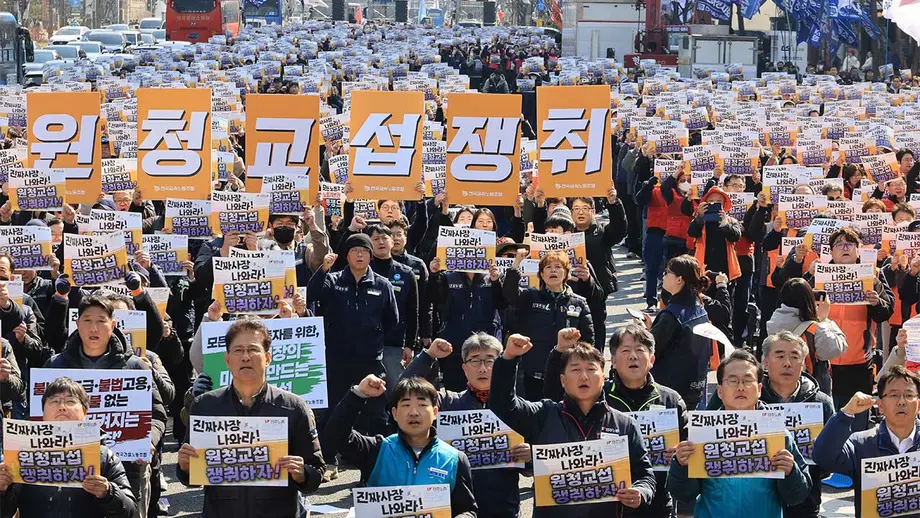
The Korean Confederation of Trade Unions presented a much more critical assessment at an October 13 press conference outside Cheong Wa Dae Sarangchae. It counted 644 workplaces among its affiliates where principal contractor bargaining had been requested, with actual negotiations underway at just 22, or 3.4%.
That count differs from the ministry's 460 workplaces and 142 cases at a bargaining stage. The figures cover different populations and use different descriptions of progress. The union tally concerns workplaces among its affiliates, while the ministry distinguishes formal bargaining from working discussions. Without matched definitions and a common workplace list, the two datasets cannot be reconciled directly.
KCTU chairman Yang Kyeong-su argued that implementing rules and interpretive guidance gave employers ways to avoid bargaining. He pointed to subcontracted shipbuilding workers protesting at Hanwha Ocean and demanded withdrawal of the rules and guidance.
Kim Kwang-chang, head of the service workers' federation, cited further barriers after employer status was established. He said CJ Logistics took six months to begin negotiations following a court judgment recognizing its status. Nonghyup distribution workers described winning at a regional commission before the national commission ruled that wages were not an issue for principal contractor bargaining. Kim also alleged that the SK Intex branch encountered refusal after an introductory meeting because the principal contractor denied employer status.
The confederation also challenged ministry guidance on the scope of labor disputes issued on September 3. Its criticism points to a second layer of disagreement: recognition of an employer does not necessarily resolve which subjects can be negotiated or become the basis of industrial action.
The ministry has pledged to guide both labor and management and support negotiations under statutory procedures. No date has been announced for revising the disputed guidance, resolving the pending cases or publishing the next comprehensive progress assessment. For now, the evidence shows three completed agreements, a growing negotiating pipeline and continuing disputes over employer responsibility, bargaining subjects and procedural delay.
Key Points
- By October 1, 460 principal contractor workplaces had received bargaining demands involving 185,235 union members.
- Three workplaces had completed agreements, a settlement rate of 0.65%.
- Procedures were continuing at 222 workplaces; 238 had no further union procedural action after the initial demand.
- The ministry recorded 81 workplaces in formal bargaining and 61 in discussions about agendas or schedules.
- Hyundai Steel, Hangang EMP and JDC supplied the first completed agreements, including the first public sector settlement.
- Government and municipal cases turn on actual authority over the working conditions at issue.
- The KCTU reported negotiations at 22 of 644 workplaces in its own tally and demanded withdrawal of disputed rules and guidance.