A December Test for AI That Can Act Inside KakaoTalk
Kakao plans to begin a closed beta test of Kanana Space in December 2026, bringing an assistant into KakaoTalk that can summarize unread work messages and send replies through voice requests. Unveiled on October 13 at the if(kakao)26 developer conference in Yongin, South Korea, the service anchors a broader plan to connect personal memory, custom agents and transaction tools inside the messenger.
Contents
- A December Test for AI That Can Act Inside KakaoTalk
- An Assistant Available Across the Messenger
- From Unread Messages to a Sent Reply
- Shopping Plans Keep Final Payment With the User
- Kanvas Adds Agents Built by Users
- Different Models for Different Jobs
- Project Mosaic Connects Memory With Permissions
- A KRW 550.6 Billion Value Estimate, With Limits
- The Schedule and the Longer Projections
- Key Points
Advance applications opened on October 13. Kakao also outlined a small test of its PC agent creation tool, Kanvas, before the end of 2026, followed by a space for connecting personal agent teams to KakaoTalk in the first half of 2027. The intended reach is 50 million users, although that figure describes Kakao's service ambitions rather than the size of the initial test.
The distinction between the December trial and a wider release matters. Reports consistently describe a closed beta for selected users in December; one also describes a launch following that test. No precise date for general availability has been announced in these accounts, and shopping, reservations and money transfers are presented as an expansion of the assistant's planned capabilities.
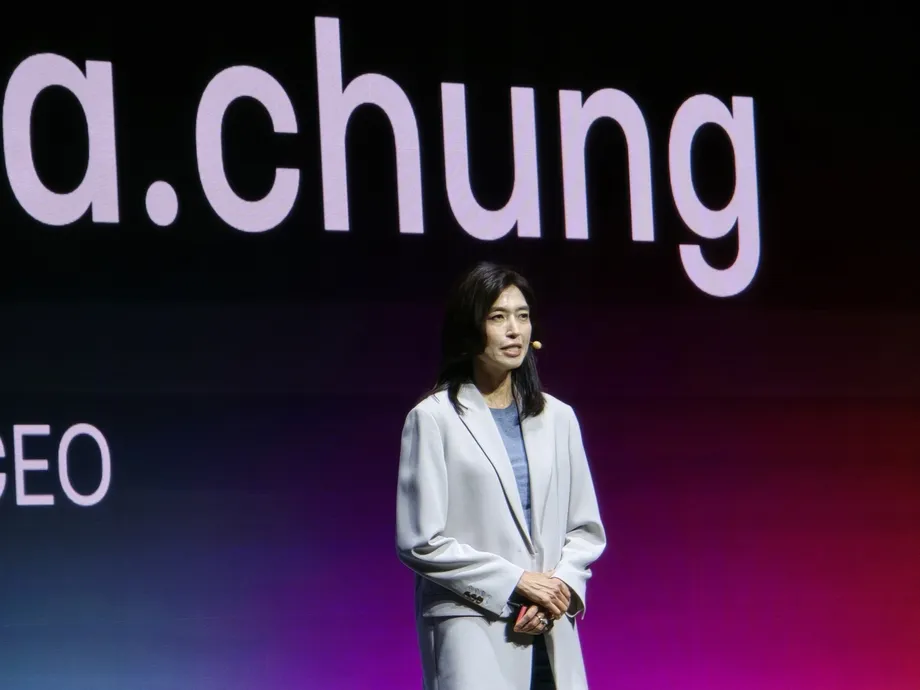
Shina Chung, Kakao's chief executive, framed the change as a move beyond generating useful text toward completing requested work. Speaking at the conference, she described a different standard for judging AI:
"The key metric for the quality assessment of generative AI is moving from whether it can put out good answers to whether it can complete requested tasks," Chung said.
An Assistant Available Across the Messenger
Kanana Space is designed as an AI layer that users can call from anywhere in KakaoTalk, rather than a separate conversation window or dedicated tab. A swipe with two fingers brings up Ryan, the Kakao Friends character, through which users can make requests by voice or text.
That design separates the proposed service from existing products such as ChatGPT for Kakao and Kanana in KakaoTalk. The focus is direct conversation and access to actions without leaving the screen where a user is already working. Kakao plans to extend the experience beyond voice to other forms of input.
Initial examples include sending messages, managing schedules, searching the web and changing settings. Kim Dae-nyeon, Kakao's design executive, said the intended experience would make AI assistance accessible without requiring people to learn a new way of using the app.
Chung described the broader shift as moving from a graphical user interface to a language user interface. In practical terms, users would describe what they want instead of finding a menu and selecting each step themselves. That changes the assistant's responsibility: it must identify the intended task, locate the right information and act in the correct place, rather than merely return an answer.
From Unread Messages to a Sent Reply
The work messaging demonstration provides a concrete example of that sequence. A user asks Kanana Space to identify work related information among unread messages. The assistant then summarizes items requiring attention and changes to schedules from relevant KakaoTalk conversations.
A followup voice request can tell it to reply in a particular project chat, saying that the user will review the matter and respond by the morning. The proposed workflow links reading, sorting and sending within the messenger, without making the user move the summary into another application.
Other demonstrations extended that use of context. Kanana Space showed recommendations for workout clothes based on weather and workout data, along with schedule planning informed by KakaoTalk message history. These examples illustrate the company's intended multimodal experience, meaning an assistant that can work with several kinds of information rather than text alone.
They also expose a practical distinction between a demonstration and a dependable service. Summarizing a conversation requires identifying relevant material; sending a reply requires selecting the correct recipient and preserving the user's intent. Kakao says it plans stronger checks on agent plans and execution, but the announcement does not establish how accurately the December version will perform these tasks.
Shopping Plans Keep Final Payment With the User
Kakao's transaction examples begin with a short request whose meaning depends on past activity. Asking for the item ordered last time could lead the assistant to find a previous bottled water purchase, locate the product again, apply a coupon and prepare the steps needed for checkout.
A lunch request could draw on a person's usual food preferences and delivery location. The point is to reduce the need to repeat information that the service can retrieve with permission. It is also why personal memory and access to other services are central parts of the strategy, rather than optional additions to a voice interface.
The planned task range includes orders, gifts, reservations and money transfers. However, preparing a transaction is not the same as independently authorizing it. The account describing the purchase flow says the user retains the final decision over payment. That boundary is especially relevant when a brief instruction could refer to more than one product or destination.
Coupang Eats was identified as Kakao's first partner for integration between agents. Such a connection would allow Kakao's assistant and a partner service's agent to coordinate a task. A service using that partnership is expected to appear first, but no definite release date or detailed operating arrangement was given.
Kanvas Adds Agents Built by Users
Kakao is also preparing Kanvas, the PC tool described as Canvas in its broader strategy, to let users create and run personal AI agents. Rather than only interacting with Kakao's general assistant, users would describe a job and have the tool combine the necessary tools and skills into an agent.
The proposed agents would work within permissions granted by the user and ask for confirmation at important stages. Kakao presented repeated tasks as a central use case and plans to let people share the agents they build. A small closed beta is planned before the end of 2026, although one account describes that timing as the earliest possible start.
Chung gave tax filing as an example: an agent could gather the documents needed for a complex return and proceed toward payment. This was an illustration of the intended capability, not confirmation that a tax filing service is already available or approved for use.
In the first half of 2027, Kakao plans to provide a space in KakaoTalk where personal teams of agents can connect. Support is intended to extend beyond agents made with Kanvas to those built using other frameworks. That would make KakaoTalk both an access point for Kakao's own assistant and a place to assign work to agents developed elsewhere.
Different Models for Different Jobs
Serving 50 million people would require more than a capable conversational model. Kakao says its foundation model strategy addresses response quality, speed and operating cost together, with optimization across the models and the infrastructure that runs them.
An AI conductor would select a suitable model and external tools according to the request. The options include frontier models, flagship models, smaller language models and models that run on the user's device. This routing approach avoids treating a routine instruction and a complex planning task as if they require the same computing resources.
Kakao expects flagship models to handle most services processed on servers. Smaller language models would handle clear, repetitive requests quickly, while device models would take on work that can be completed on a smartphone. The announcement does not provide the proportions assigned to each category or comparative figures for cost and response time.
The company also said it uses a distillation technique involving multiple teacher models to preserve the quality of smaller models. Distillation trains a smaller model using guidance from more capable models. The intended benefit is less demanding operation without losing too much capability, though no benchmark results were supplied in the accounts of the announcement.
The architecture therefore supports the product plan in a specific way: an assistant expected to perform frequent everyday actions needs an affordable route for simple jobs, while retaining access to stronger models when a request requires more judgment.
Project Mosaic Connects Memory With Permissions
Project Mosaic is the personalization component meant to connect a user's scattered memories and experiences into useful context. Kakao wants that context to travel across KakaoTalk, Kanana Space, Kanvas and other agents, so people do not have to explain earlier decisions or ongoing work every time they change services.
The stated access rule is narrower than giving every agent the same information. Mosaic would provide each agent only what it needs for the task and what the user has authorized it to access. Agents with different roles could then collaborate while drawing on relevant shared context.
That distinction matters when a task crosses services. A shopping agent may need a purchase history and delivery address, while an agent handling schedules needs information about commitments. The proposed system aims to carry useful context between them without making all personal information available to every participant.
Kakao says it will strengthen safety checks covering both the plan an agent creates and the actions it executes, alongside expanding infrastructure for large service volumes. Details such as memory retention periods, permission controls, correction of mistaken memories and remedies for an incorrect action were not set out in the announcement accounts. Those are unresolved implementation questions, not features that can be assumed from the stated design.
A KRW 550.6 Billion Value Estimate, With Limits
At the same event, Kakao presented research conducted with the KAIST Digital Economy Research Center between December 2025 and August 2026. It estimated that Kakao's AI services and technology would generate KRW 550.6 billion in annual socioeconomic value in 2026.
The study measures estimated additional value above the existing KakaoTalk platform, not Kakao revenue or profit. It also covers a broader collection of AI products and technology, so the total should not be treated as a valuation of the newly announced Kanana Space.
The researchers used a framework called STEPS, grouping benefits into social and public benefit, technology innovation, everyday convenience, partner growth and shared inclusion. Technology innovation accounted for KRW 223.4 billion, including KRW 154.9 billion attributed to the Kanana model family and KRW 68.5 billion to PlayMCP, which aims to reduce developers' service distribution and audience access costs.
Everyday convenience accounted for KRW 184.9 billion: KRW 83.2 billion from Kanana in KakaoTalk and KRW 101.7 billion from ChatGPT for Kakao. Together, technology innovation and everyday convenience contributed KRW 408.3 billion, about 74% of the KRW 550.6 billion estimate.
Social and public benefits were estimated at KRW 91.5 billion, with the AI public assistant associated with an average saving of 53.2 minutes per document issuance. Partner growth contributed KRW 50.8 billion, including benefits attributed to Kakao's customer consultation manager helping small businesses cover gaps in customer service.
Shared inclusion was assessed separately rather than assigned a monetary value. Users aged 60 and above were estimated to save 74.7 minutes a month, compared with 39.7 minutes across users, approximately 1.9 times as much. The finding supports Kakao's accessibility argument, but does not establish how much time the future Kanana Space will save.
The Schedule and the Longer Projections
The announced sequence separates a near term assistant test from a wider agent ecosystem. The key dates are:
- December 2025 to August 2026: Kakao and KAIST conducted their AI value study.
- October 13, 2026: Kakao unveiled the strategy at if(kakao)26 in Yongin and opened advance applications for Kanana Space.
- December 2026: A Kanana Space closed beta is planned for selected users.
- Before the end of 2026: Kakao plans a small Kanvas closed beta, with timing described in one account as possible as early as that period.
- First half of 2027: Kakao plans a space connecting personal agent teams within KakaoTalk.
The research also projects annual socioeconomic value in 2030 under three scenarios: KRW 939.8 billion if current trends continue, KRW 1.2721 trillion if the announced roadmap proceeds as planned, and KRW 1.8225 trillion if ecosystem integration and network effects develop fully.
Those figures are approximately 1.7, 2.3 and 3.3 times the 2026 estimate. They were calculated using a growth model that assumes an initially faster expansion gradually settles into a more stable rate. They are conditional projections, not guaranteed outcomes or forecasts of Kakao's earnings.
The immediate test is more concrete: whether Kanana Space can reliably turn a spoken instruction into the correct action while preserving user control. The December beta is the next announced step toward assessing that experience. Wider availability, detailed transaction coverage and the operating rules for shared memory have not yet been specified.
Key Points
- Kanana Space is planned as an assistant accessible throughout KakaoTalk by voice or text.
- Advance applications opened on October 13, 2026, ahead of a December closed beta for selected users.
- Demonstrated tasks include summarizing unread work chats, sending replies and planning schedules.
- Future transaction plans include orders, gifts, reservations and transfers, with final payment decisions retained by users.
- Kanvas would let users create agents, while support for personal agent teams in KakaoTalk is planned for the first half of 2027.
- Project Mosaic would share relevant memory with agents within user permissions.
- The KRW 550.6 billion research estimate covers Kakao's broader AI activity, not Kanana Space alone or company revenue.