Lower Platform Fees and New Benefits Under Consideration
President Prabowo Subianto is considering a draft presidential decree that would cut Indonesia's ride-hailing commission cap from 20% to 10% and require platforms to pay for drivers' accident and death insurance. As of January 14, 2026, the proposals remain under consideration, with no approval or implementation date given.
Contents
- Lower Platform Fees and New Benefits Under Consideration
- What a 10% Commission Cap Would Change
- Insurance Costs Would Shift Toward Platforms
- Driver Protests Have Built Political Pressure
- Fewer Trips and Longer Days
- Companies Warn About Business Sustainability
- Why the Existing Legal Framework Leaves Gaps
- Parliament Is Preparing a Separate Transport Law
- Singapore Focuses on Licensing and Safety
- Malaysia and Vietnam Use Different Legal Structures
- Putting National Rules Into Practice
- What the Changes Could Mean for Drivers and Customers
- Key Points
About seven million delivery and transport riders work in Indonesia's ride-hailing industry. The draft would also require companies and workers to share health, old-age and pension premiums, allow government review of agreements between platforms and drivers, and protect workers' right to unionize.
GoTo and Grab would face substantial changes to their business models. The rules would also reach beyond passenger transport to logistics businesses, including Hong Kong-based Lalamove and J&T Express, which is listed on the Hong Kong stock exchange.
The proposal could become Indonesia's largest government intervention in digital transportation to date. Drivers have held nationwide protests over pay, working conditions and recognition of their contribution to the economy, while platforms warn that lower commissions and additional insurance costs could threaten their ability to operate.
Indonesia accounted for 37% of the ASEAN taxi market in 2024, according to research firm Mordor Intelligence. Changes in Southeast Asia's largest ride-hailing market would therefore affect a substantial part of the region's transport business.
Reported merger discussions between Indonesia's GoTo and Singapore-based Grab add another concern. Critics warn that combining the companies could concentrate market power and leave drivers at a disadvantage. The proposed protections address several grievances that have driven worker protests during this period of possible industry consolidation.
What a 10% Commission Cap Would Change
Ministerial Decree KP 1001/2022 currently allows platforms to retain up to 20% of each fare as commission. Commission is the portion of a customer's payment kept by the company for services such as access to its app and payment processing.
The proposed 10% ceiling would halve that maximum share. For the same fare, a driver would retain 90% rather than 80% before paying other expenses. The benefit to daily earnings would also depend on the number of orders, promotional pricing and any other deductions.
Indonesia is currently the only Southeast Asian country that imposes commission caps on ride-hailing services using motorcycles. A further reduction would tighten the limits on revenue that major platforms can collect from those trips.
Drivers say actual deductions sometimes exceed the advertised commission because additional fees and promotional pricing reduce their income. Their concern is therefore about the total amount removed from earnings, rather than the headline percentage alone.
The draft would authorize government review of agreements between online transportation workers and companies. Regulators would gain greater access to contract terms, potentially helping them address unfair conditions and unclear fee structures. The proposal also expressly protects union organization, giving drivers a stronger basis to pursue collective bargaining.
Insurance Costs Would Shift Toward Platforms
Platforms would have to fully cover accident and death insurance under the draft. At an estimated cost of about $1 per driver each month, covering approximately seven million riders would represent roughly $7 million monthly, or $84 million annually, if all were covered at that estimated rate.
Health, old-age and pension premiums would be shared between companies and workers. These payments support protection against medical expenses and provide financial support later in life, extending benefits commonly associated with formal employment to people working through apps.
Ride-hailing companies have long argued that drivers are independent contractors rather than employees working full time. That classification has allowed companies to maintain a flexible workforce without paying the benefits usually attached to employment.
The draft would require benefits without appearing to reclassify drivers as employees. Workers could therefore gain protections while remaining outside the traditional employment model, placing their rights somewhere between those of employees and independent contractors.
Driver Protests Have Built Political Pressure
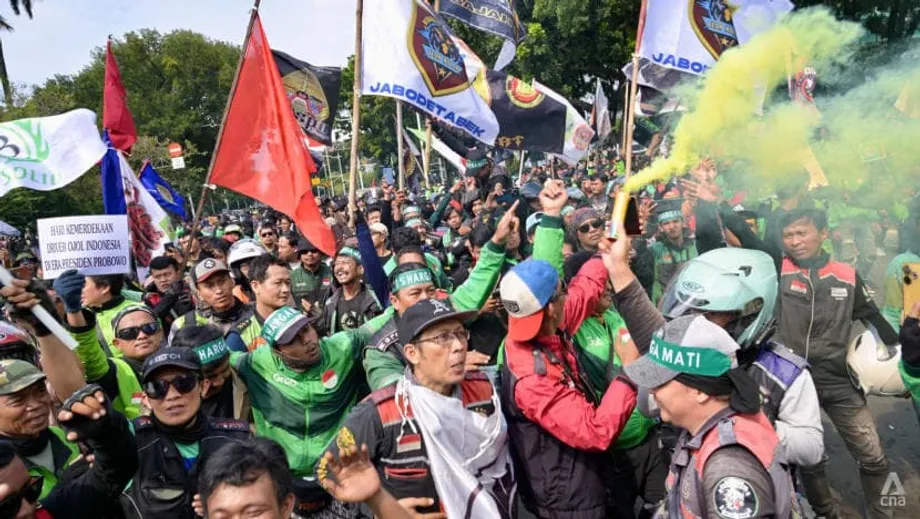
Thousands of drivers staged a nationwide strike in May 2025, switching off their apps for 24 hours in an action described as an "off-bid" strike. Demonstrations took place in Jakarta, Surabaya, Bandung and Yogyakarta. Union leaders expected more than 25,000 drivers using cars and motorcycles to participate.
Protesters carried placards reading "Don't be greedy, 10% is enough for the applicator" and chanted "United ride-hailing drivers cannot be defeated." Their demands covered both earnings and the rules governing platform work:
- Pass an Online Transportation Law.
- Reduce platform commissions to 10%.
- Regulate tariffs for food and goods deliveries.
- Audit app providers.
- Abolish membership programs that charge drivers extra for priority in the algorithm.
Raden Igun Wicaksono, General Chairperson of Garda Indonesia, one of the country's largest driver associations, said the demands were directed at the Transportation Ministry and President Prabowo. He argued that existing ministerial decrees lacked sufficient enforcement mechanisms.
Wicaksono described the weakness he sees in those rules:
cannot legally bind app providers if they violate, either civilly or criminally.
Drivers also participated in widespread protests led by students in August. The death of a motorcycle taxi rider during those protests intensified scrutiny of gig workers' vulnerability and likely added urgency to the government's consideration of stronger protections.
Presidential spokesperson Prasetyo Hadi has called drivers "heroes of the economy." The administration's attention reflects their importance to everyday commerce and their growing political influence.
Siwage Dharma Negara, a senior fellow at the ISEAS-Yusuf Ishak Institute in Singapore, described motorcycle taxi drivers as an increasingly visible political force. Repeated demonstrations over commissions and rights have brought their grievances to wider public attention.
The sequence of regulation and worker mobilization spans several years:
- 2009: Law No. 22/2009 created the transport classification framework under which motorcycles cannot be classified as public transportation.
- 2017: A Transportation Ministry decree established basic parameters for online transportation services.
- 2022: Ministerial Decree KP 1001/2022 set the current commission framework allowing deductions of up to 20%.
- May 2025: Drivers organized a nationwide strike lasting 24 hours.
- August 2025: Drivers joined wider protests led by students, during which a motorcycle taxi rider died.
- January 14, 2026: The proposed presidential decree remains under consideration, alongside preparations for legislation on online transportation.
Fewer Trips and Longer Days
Ride-hailing provides crucial income for millions of Indonesians in a country with substantial unemployment and underemployment. Drivers nevertheless report declining earnings as competition, operating costs and management through algorithms place pressure on their work.
Fairwork researchers found that Indonesian ride-hailing drivers often struggle to secure even four to five trips a day, compared with five to 10 before 2020. Fewer trips can force drivers to spend longer waiting and working to earn the income they previously made in a shorter day.
Driver surveys put typical daily earnings at 100,000 to 150,000 rupiah, approximately $6 to $10, for a working day lasting 10 to 12 hours. Fuel, maintenance, taxes and platform commissions leave many drivers struggling to meet their expenses.
Industry surveys indicate that nearly 70% of drivers work more than eight hours a day, while almost 80% work six or seven days a week. Those schedules leave little time for rest, especially when income depends on securing another order.
Drivers complain about flat fares, systems that combine two orders, and features that give some riders priority for jobs. Algorithms are the automated rules an app uses to allocate orders and calculate prices. Workers say these systems are poorly explained and consistently work against them.
One striker linked the pressure to earn more with the safety of fellow drivers:
got into accidents because they have to chase their income
The complaint connects low pay with long hours and risk on the road. Accident insurance would provide financial protection after an incident, while the dispute over fares and job allocation concerns the working conditions that drivers encounter each day.
Companies Warn About Business Sustainability
An industry source who had seen the draft warned that the proposed obligations would be difficult for companies to absorb, particularly the increase in annual spending on insurance.
The source described the concern in these terms:
Most of the players in the industry cannot sustain these changes
A second person familiar with the proposals said premiums paid by platforms could reduce margins and limit the number of drivers companies can accommodate. That would create a difficult tradeoff: drivers could gain stronger benefits while some lose access to earning opportunities.
Gojek's public policy head, Ade Mulya, said reducing the regulated 20% commission was "not a viable solution" because the fees support initiatives for drivers. Grab Indonesia's head of public affairs, Tirza Munusamy, described its commission structure as "necessary" to maintain service quality and warned that large reductions could threaten an ecosystem supporting millions of people.
Platforms say commissions pay for technology development, insurance from third parties for drivers and passengers, and assistance programs including free engine oil changes and tires. Their argument is that the money supports services and operating costs as well as profits.
Gojek Indonesia president Catherine Hindra Sutjahyo warned that a 10% cap could backfire if the company could no longer subsidize promotional discounts. Fewer discounts could reduce transactions, leaving drivers with fewer orders and potentially lower total earnings despite retaining a larger share of each fare.
Drivers and companies consequently differ over how costs and risks should be divided. Platforms describe a business that must balance the interests of customers, workers and companies. Drivers say they carry too much of the risk while receiving insufficient pay and protection.
Why the Existing Legal Framework Leaves Gaps
Indonesia regulates online transportation mainly through ministerial decrees rather than comprehensive legislation. The Transportation Ministry's 2017 decree set basic parameters but left substantial gaps in worker protection.
Law No. 22/2009 prevents motorcycles from being classified as public transportation. That creates a legal gray zone for motorcycle taxi services: platforms operate outside traditional transportation regulation, while drivers lack protections ordinarily available to transportation workers.
Drivers say the existing 20% commission ceiling is weakened by additional charges and complicated pricing arrangements. Government review of agreements, together with auditing of app providers, could help regulators examine how deductions work in practice.
Enforcement would still require sufficient resources and regulatory capacity. Reviewing a contract is one task; checking whether millions of transactions follow its terms is another. Effective oversight would need to connect the written rules with what drivers actually receive.
Unclear algorithms present a further challenge. Government access to agreements could help address complaints about pricing and allocation of trips, but meaningful transparency may require more specific technical rules than a presidential decree would usually contain.
Parliament Is Preparing a Separate Transport Law
The House of Representatives, or DPR, is preparing legislation dedicated to online transportation services. Its aim is to give the sector a comprehensive legal framework separate from current traffic and road transport rules.
Lasarus, chairman of the House's infrastructure and transportation Commission V, said the legislation would provide online transport platforms with their own legal basis. Several commissions are involved, reflecting the range of responsibilities and government bodies connected to the sector.
Lasarus described the intended consultation with drivers:
every article and clause will be discussed and consulted with all online transport drivers, not just for the benefit of one group.
Commission V member Adian Napitupulu said some ride-hailing companies deduct between 30% and 50% from drivers' earnings through additional charges that he argues lack a clear legal foundation. Those alleged deductions exceed the current headline commission ceiling of 20%.
Adian calculated that delivery service charges, multiplied across 4.2 million sellers using platforms, could generate as much as Rp92 billion, about $6 million, each day for companies. His calculation illustrates the scale of the charges lawmakers want to examine.
A presidential decree can be implemented more quickly than comprehensive legislation, which requires a longer parliamentary process. The decree could therefore address urgent concerns while lawmakers develop a broader legal framework.
Singapore Focuses on Licensing and Safety
Singapore requires online taxi drivers to obtain a Vocational License after completing safety training and passing a medical examination. The Land Transport Authority uses a quota system to limit ride-hailing vehicle numbers and prevent the market from becoming saturated.
Work accident insurance is mandatory, and Grab has partnered with Futuready Insurance to provide coverage. These measures concentrate on entry requirements, safety and protection after an accident.
High living costs still put pressure on drivers. Minimum income protection has not been a major focus of policy, leaving a difference between permission to work safely and the ability to earn enough from that work.
Malaysia and Vietnam Use Different Legal Structures
Malaysia regulates the sector through the Land Public Transport Act 2010, administered by the Land Public Transport Agency, or APAD. Drivers must hold a public service vehicle license, known as a PSV license, and vehicles must be registered with a legal entity or cooperative.
The government provides incentives such as tax breaks for companies employing elderly drivers. Weak supervision in the field nevertheless leaves many drivers working outside the official system without adequate protection.
Vietnam's Decree 10/2020/ND-CP stresses the integration of drivers into legal entities such as cooperatives. A cooperative is an organization through which members can organize their work collectively. Xanh SM, a local provider of electric taxi services, offers training and insurance for its driver partners.
Strong competition between platforms and market saturation have still forced many Vietnamese drivers to work more than 15 hours daily to earn a decent income. Critics describe those conditions as a new form of economic exploitation.
Across these regional approaches, licensing, vehicle standards and some insurance coverage are common priorities. Minimum income guarantees, limits on working hours and protection against a platform closing a driver's account on its own have received less attention. Indonesia's proposed decree could place greater weight on workers' financial welfare and organizing rights.
Putting National Rules Into Practice
Indonesia's geography adds practical difficulty to enforcement. National rules must operate across thousands of islands, with local authorities differing in resources and priorities.
Consistent implementation would require coordination among national ministries and regional governments. New regulatory bodies dedicated to the sector could also form part of that coordination. The wider scope covering logistics businesses means oversight would extend beyond passenger trips to delivery work.
Government review of agreements would give regulators a means to examine platform conditions, but its usefulness would depend on how thoroughly companies' practices are checked. Drivers' complaints about extra fees show why the total deduction from an order matters alongside the formal commission rate.
Worker classification remains a central legal issue. Extending benefits without changing employment status could create a different category of protected platform work. That approach may offer other countries an example of how to retain flexibility while requiring companies to contribute to workers' security.
The government's challenge is to protect workers while maintaining businesses capable of providing jobs and services. The final rules, the resources available for enforcement and platform responses would determine how that balance works in practice.
What the Changes Could Mean for Drivers and Customers
Drivers would keep more of each fare under a lower commission cap, while insurance and shared social security payments would provide support that most currently lack. If implemented effectively, those changes could make gig work a more sustainable source of income.
Platforms would need to adjust their business models and operations. Possible responses include changing prices, improving efficiency elsewhere or developing new revenue sources to cover the cost of benefits. A possible GoTo and Grab merger adds further complexity to those decisions.
Consumers could face higher prices in the short term if companies pass on costs. Over a longer period, greater financial security for drivers could support a more stable transport service, including workers better able to maintain their vehicles and provide dependable service.
Indonesia's approach could position it as a leader in gig worker protection among emerging economies. Other countries facing similar disputes over digital platform work would have an example of a large market seeking to combine worker benefits, continued flexibility and business sustainability.
The draft addresses immediate concerns about deductions, insurance and organizing rights while Parliament prepares broader legislation. Its practical effect would depend on the final provisions and on whether national protections translate into enforceable conditions for drivers throughout the country.
Key Points
- As of January 14, 2026, President Prabowo Subianto is considering a decree to cut the ride-hailing commission cap from 20% to 10%.
- Platforms would fully pay accident and death insurance and share health, old-age and pension premiums with workers.
- About seven million delivery and transport riders work in Indonesia's ride-hailing industry.
- The draft would allow government review of driver agreements and protect the right to unionize.
- Logistics businesses including Lalamove and J&T Express would also fall within its scope.
- Drivers' protests seek lower deductions, delivery tariff rules, audits and an Online Transportation Law.
- Companies warn that lower commissions and higher insurance costs could reduce transactions or access to work.
- Parliament is preparing separate legislation to give online transportation its own legal framework.
- Indonesia held 37% of the ASEAN taxi market in 2024, while possible GoTo and Grab consolidation adds to concerns about market power.