Local Communities Reach a Threshold Once Seen as Distant
Japan had 27 municipalities where foreign nationals made up more than 10 percent of residents in January 2025, with the Hokkaido village of Shimukappu reaching 36.6 percent. The figures bring a demographic change into view much earlier at the local level than a national research institute's projection that foreigners would account for 10.8 percent of Japan's population by 2070.
Contents
- Local Communities Reach a Threshold Once Seen as Distant
- Where Foreign Residents Are Concentrated
- A Small Factory's Dependence on Vietnamese Workers
- Why the Labour Shortage Is Driving Recruitment
- The Pressure on Public Finances and Skills
- How Japan's Immigration System Developed
- From Technical Training to Longer Employment
- Tighter Controls Meet Economic Demand
- How Demographic Information Changes Attitudes
- Cities Build Their Own Ways to Include Residents
- What Robots and Artificial Intelligence Can Do
- The Choice About Lasting Settlement
- Key Points
Foreign residents nationwide numbered 3.76 million at the end of 2024, an increase of 350,000 from the previous year and the largest annual rise on record. In July 2025, then Justice Minister Keisuke Suzuki said Japan should assume its foreign population would exceed 10 percent around 2040, roughly 30 years earlier than the institute's estimate.
Factories, tourist resorts and communities with established foreign populations are at the centre of this change. Employers need workers as Japan's population ages, while local governments must respond to questions about housing, discrimination, language access and everyday coexistence. Some residents welcome their new neighbours. Others express unease about the speed of change or concerns about unfamiliarity with local customs.
Japan's foreign population generally hovered around 600,000 until the 1960s. A revision of the Immigration Control and Refugee Act in 1990 allowed people of Japanese descent to live in Japan as permanent residents, helping numbers rise more visibly. The foreign population later fell after the global financial crisis and again during the COVID-19 pandemic.
Demographers describe the current surge as a third expansionary phase, with unusually rapid growth and a wider range of national origins. For a country long associated with ethnic and cultural homogeneity, the practical decisions are already arriving in villages and cities: how to recruit workers, help them settle and maintain trust among neighbours.
Where Foreign Residents Are Concentrated
Shimukappu, which includes the Tomamu resort area, had 582 foreign residents in a population of 1,590. Five other municipalities had foreign resident shares above 20 percent. They included Akaigawa village and Kutchan town in Hokkaido, Ikuno Ward in Osaka, and Oizumi town in Gunma Prefecture.
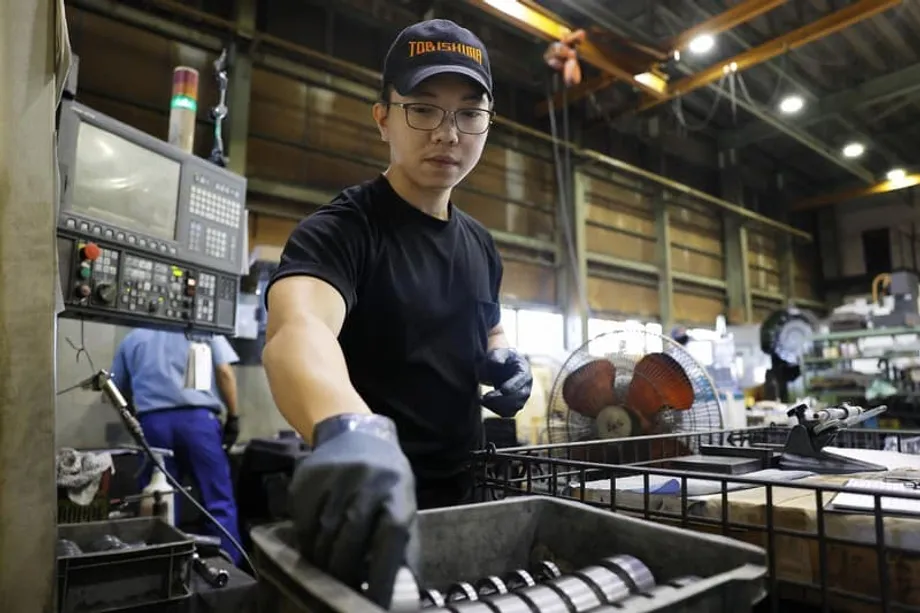
Tobishima in Aichi Prefecture shows how manufacturing shapes settlement. The village overlooks Ise Bay and had 4,713 residents in January 2025, including 501 foreign nationals, or 10.6 percent of its population. Many foreign workers are employed by small and midsize factories through the technical intern training or specified skills programmes. Others work in used car sales.
Foreign workers in uniforms cycle through Tobishima on weekday evenings. On weekends, foreign nationals make up nearly half the passengers on local buses. Residents say their numbers have grown faster over the past few years, making the demographic change visible in ordinary journeys and neighbourhood encounters.
A female farmer aged 54 described foreign residents as cheerful helpers in garden work and hardworking employees. A male farmer aged 78 said he had noticed no particular problems despite their rapid increase. Other residents complained that some foreign drivers ignored traffic rules.
A woman aged 75 who works for herself appreciated the labour foreign residents provide but worried about a growing number of people unfamiliar with Japanese customs. Another woman, aged 83, said sudden changes in her surroundings made her uneasy. Those reactions show how appreciation for workers can sit alongside anxiety about neighbourhood change.
Japan's demographic shift is uneven. Two villages, including Nishimeya in Aomori Prefecture, reported no foreign residents. Industrial employment, resort work and established communities help explain why some places have passed the 10 percent threshold while others have experienced little change.
A Small Factory's Dependence on Vietnamese Workers
Tobishima Seisakusho, near Nagoya Port, produces parts for refrigeration and cooling equipment. Beyond nearby warehouses and factories, the plant stands amid quiet farmland. Four of its 21 employees are Vietnamese nationals working under technical internship or specified skills visas.
Company president Hideki Ito, 73, described the four workers as essential to the survival of the business.
They're a valuable asset, a treasure," Ito said. "If they were to quit, the company couldn't survive.
Ito said younger Japanese residents had moved to cities, leaving local employers struggling to recruit. Even when the company hires Japanese workers, some leave within a year. He described accepting foreign workers as a response to that recruitment problem.
"Considering the company's future, having young Japanese workers would be much more preferable, but that's simply not feasible. We had no choice," said Ito.
The company began accepting Vietnamese workers in 2017 after hearing about their diligence through word of mouth, then gradually increased their numbers. Ito said their pay and bonuses were almost the same as those of Japanese employees.
The four workers live together on company premises. Nguyen Manh Ha, 28, has worked there for about six years. He sends 120,000 to 150,000 yen each month to his family in Vietnam and spends about 20,000 to 30,000 yen on himself. Ha described both satisfaction with his job and a wish to remain.
I enjoy my work," Ha said. "If possible, I would like to work in Japan forever.
Why the Labour Shortage Is Driving Recruitment
Japan's population aged 15 to 64 is projected to decline by 15 million between 2020 and 2040. This is the age group commonly used to measure the potential workforce. Even a sudden reversal in the falling birthrate would not fill the immediate gap, because children take years to reach working age.
Research by the Japan International Cooperation Agency estimates that Japan will need 4.19 million migrant workers in 2030 to sustain economic growth. At the current rate of growth in migrant worker numbers, it would still face a shortfall of 770,000. A separate study estimates that Japan could be short of 11 million workers by 2040.
Japan has historically had some of the lowest migration flows relative to population among countries in the Organisation for Economic Co-operation and Development, or OECD. Recent policy changes have expanded recruitment from abroad as rapid population ageing puts pressure on the labour market.
Japan's unemployment rate has remained low for the past 15 years, and vacancies per applicant reached a high in fiscal year 2018 not seen for 45 years. A high number of vacancies relative to applicants means employers have more jobs available than people seeking them. Those conditions help explain why businesses increasingly seek workers overseas.
Labour migration is one policy option alongside raising productivity and increasing employment among people already living in Japan. The shortage also extends beyond Japan: labour shortages cost the world's 30 largest economies an estimated $1.3 trillion in lost gross domestic product each year.
Japan's ageing figures show the scale of its challenge. More than one person in 10 is aged 80 or older. Almost a third of the population is over 65, an estimated 36.23 million people, and the number reaching their 100th birthday is higher than ever. Japan consistently has the world's oldest population.
Older workers already play a substantial role. In 2022, almost half of Japanese firms relied on workers older than 70. The World Economic Forum's Future of Jobs Report 2023 found that only 35 percent of companies globally prioritised workers older than 55.
The Pressure on Public Finances and Skills
Japan's shrinking workforce affects more than recruitment. Fewer workers can mean a smaller tax base, while an older population needs more spending on healthcare and pensions. In 2020, the International Monetary Fund described that financial pressure.
the ageing and shrinking population will strain Japan's public finances, as age-related spending such as on healthcare and pensions rises while the tax base shrinks.
Japan still has the second largest gross domestic product among the Group of Seven countries despite its ageing population. Gross domestic product, or GDP, measures the value of goods and services produced in an economy. Maintaining that output becomes harder when employers cannot find enough people.
Fumio Kishida, who was prime minister in January 2023, warned about the combined pressures of falling birth rates and a growing elderly population.
Japan is standing on the verge of whether we can continue to function as a society,
The government introduced the Guideline of Measures for Ageing Society in 2018 to encourage older people to remain in the workforce. Kishida also pledged $7.6 billion earlier in 2023 to train workers for jobs requiring higher skills over the following five years.
Technology, digitalisation and training are part of the response, alongside employing older people. Some assessments argue that filling the labour gap will remain slow without relaxing strict immigration laws. The scale of the projected shortage explains why employers are looking for several solutions at once.
How Japan's Immigration System Developed
Modern Japanese immigration policy traces its roots to the Immigration Control and Refugee Act of 1952, implemented following the United States occupation, and the subsequent revision in 1990. Japan has traditionally focused on skilled migrants and international students rather than creating broad labour migration channels for occupations requiring fewer formal qualifications.
Work visa categories include professor, journalist, specialist in the humanities and entertainer. Family categories include dependent, spouse of a Japanese national and spouse of a permanent resident. Most visa categories are uncapped, giving the system flexibility in the number of foreign nationals admitted each year.
Most skilled immigrants enter under the Engineers/Specialists in Humanities/International Services programme. It covers a wide range of occupations, including engineers, architects and translators. International students are also central to Japan's strategy for attracting and retaining global talent: most skilled labour migrants first entered Japan as students.
Japan historically lacked labour migration channels for occupations requiring fewer skills. The Technical Intern Training Programme, first created in the 1960s to develop skills that workers could take back to developing countries, expanded into the main route through which firms employed foreign workers with low or medium skill levels.
Technical trainees mainly work in manufacturing, construction and agriculture, and their stay is limited to five years at most. The Specified Skilled Worker Programme, introduced in 2019, created a potentially longer route for migrants with trade qualifications in designated sectors, including nursing care.
The main developments span several decades:
- 1952: The Immigration Control and Refugee Act formed the basis of modern immigration policy following the United States occupation.
- 1960s: Technical intern training began as a means of developing and transferring skills.
- 1990: A legal revision allowed people of Japanese descent to live in Japan as permanent residents.
- 2019: The Specified Skilled Worker Programme opened a new employment route in designated sectors.
- 14 June 2024: The National Diet passed legislation to replace technical intern training with the Training and Employment System.
- July 2025: Then Justice Minister Keisuke Suzuki said Japan should prepare for a foreign population exceeding 10 percent around 2040.
From Technical Training to Longer Employment
The National Diet's law of 14 June 2024 renamed the Technical Intern Training Programme as the Training and Employment System, or TES, following domestic and international criticism. Under the previous arrangement, trainees signed contracts before arriving in Japan and were prohibited from changing employers after arrival.
The restriction was intended to support training, but critics described it as a violation of the "freedom of occupational choice". Workers who cannot change employers have fewer options when employment conditions are poor.
The Ministry of Health, Labour and Welfare found labour standards violations at 70 percent of the 9,829 workplaces it inspected following consultations and reports from interns. The inspection results show why working conditions became a central issue in the reform.
The revised system focuses on developing skilled workers and keeping them in Japan for longer. It relaxes restrictions on changing jobs, allowing workers to move to another employer in the same field after one to two years of employment.
The Specified Skilled Worker Programme has two tiers. The second is intended for workers with higher skill levels and permits family reunification, unlimited renewals of residency and a possible route to permanent residency. For workers hoping to build a lasting life in Japan, those provisions connect employment with the ability to live with family.
The programme's scope and its connection to training remain constraints. As of March 2024, the account of the system listed 15 designated fields, including electronics, information, construction and agriculture. Most were described as unviable options for trainees, while TES includes caps on foreign workers in each field.
Japan has only recently begun developing an integration policy to support labour migrants and has struggled to provide a clear route to lasting employment for foreign workers. Skilled migrants who choose Japan, however, tend to remain for the long term.
Tighter Controls Meet Economic Demand
Prime Minister Sanae Takaichi's coalition government with the Japan Innovation Party has called for tighter controls on foreigners. In a policy speech, Takaichi said illegal activity and rule breaking by some foreigners had created public anxiety and a sense of unfairness.
Takaichi supports foreign workers in specified fields facing labour shortages, subject to strict requirements for Japanese language ability, training and oversight. She opposes mass settlement of immigrants and the large scale granting of political rights to foreign residents.
Her policies have so far contained limited detail, while her political framing presents foreigners as a potential danger to national cohesion requiring strict control. Employers such as Tobishima Seisakusho describe foreign workers as essential, placing economic demand alongside a political call for stronger restrictions.
The government plans a comprehensive review of immigration policy, including possible caps. A newly established task force will survey the social effects of the demographic change and use its findings to inform policy decisions. No timetable for those findings or decision on caps was given.
The review focuses on preventing divisions between foreign nationals and Japanese citizens, drawing comparisons with social divisions in other developed G7 countries. Limits on foreign immigration would be considered if signs appeared of social friction exceeding levels the government judged acceptable.
Japan's strong perception of ethnic and cultural homogeneity helps explain why immigration remains unpopular in public opinion polling. Demographic pressures nevertheless push policymakers to recruit immigrants as a possible answer, or at least a way to reduce the economic damage associated with ageing.
How Demographic Information Changes Attitudes
A survey experiment involving 1,000 Japanese voters tested whether information about population ageing and its consequences changed support for immigration. Participants exposed to that information showed an increase of 10 percentage points in support compared with the comparison group.
Younger people and urban respondents reacted more positively. Elderly and rural respondents reacted less positively. Follow up interviews found that people favouring restrictions saw population decline as making Japan vulnerable to increased immigration, while others were more concerned with economic competitiveness than identity.
Those findings help explain why the same population figures can lead voters toward different policy preferences. Some focus on the workers needed to maintain businesses and services. Others worry that a smaller Japanese population will be more exposed to cultural change.
Successive governments have acknowledged population decline and introduced initiatives to bring foreign residents or workers into Japan. Liberal Democratic Party governments have nevertheless been reluctant to create programmes with the scale and commitment to integration needed to make a substantial difference. Those initiatives have consequently had only modest success.
The demographic picture also includes a record figure of 3.6 million foreign born residents, around 3 percent of the population, alongside the 3.76 million foreign residents counted at the end of 2024. The foreign born share remains much lower than in many other developed economies.
The growing foreign population has been accompanied by a record number of babies described as "foreign" being born in Japan. Chinese, Filipino and Brazilian mothers top the list. Those births have partly offset the decline in newborns with Japanese parents.
Cities Build Their Own Ways to Include Residents
Kawasaki and Hamamatsu have developed local policies for growing populations of residents who are not citizens, amid limited national support and regulation. Their work addresses cultural friction, ethnic discrimination and discrimination in employment, making integration a matter of daily administration rather than population forecasts alone.
Kawasaki's experience includes the inequalities faced by Korean residents shaped by Japan's colonial past. Many younger Koreans born in Japan have settled permanently and taken part in grassroots politics to address discrimination. Immigrants from other countries have also continued to make the city their home.
In March 2024, Kawasaki had about 50,000 foreign residents, including 17,000 Chinese nationals, 5,900 Vietnamese, 5,400 Filipinos and 7,600 Koreans. The changing composition of that population has affected how the city organises representation.
The Kawasaki City Representative Assembly for Foreign Residents, established in 1996, gives foreign residents a forum to advise the mayor. It moved participation beyond community membership into a role in decision making. In 2019, the assembly revised its appointment and recruitment rules to reflect changes in the foreign resident population.
The assembly has proposed 49 policy measures. They address housing discrimination, hate speech regulations, restrictions on welfare pensions for elderly residents who are not citizens, limited university access and insufficient public information in foreign languages.
Hamamatsu, a major manufacturing centre, had around 30,000 foreign residents in September 2024, including Brazilian, Vietnamese, Filipino, Chinese and Korean nationals. Nearly half had lived in the city for more than 15 years, showing how foreign employment can develop into lasting community membership.
The Council of Municipalities with Large Migrant Populations, established in 2001, expanded to 15 municipalities by 2021. It connects local action with national ministries, supports cooperation and information sharing, and has lobbied business leaders and national agencies to protect foreign residents' rights. It also serves as a centre for policy development and collaboration among member municipalities.
What Robots and Artificial Intelligence Can Do
Japan is pursuing technological responses alongside foreign recruitment. Its ageing and shrinking population creates economic and social difficulties, but also an opportunity to develop technology that helps maintain services and production with fewer available workers.
Software, robotics and other technologies are changing work across agriculture, manufacturing and services, as well as occupations involving physical labour and office work. Two approaches stand out: automating tasks and helping workers perform them more effectively.
Automation gives a task to a machine or system. In countries with many jobseekers, debate often centres on the risk of jobs disappearing. In Japan, a major reason to automate is that there are no longer enough people to perform needed work.
Helping workers do more, sometimes called augmentation, takes a different approach. Artificial intelligence software, hardware, robots that assist people and automated systems can increase efficiency or let people without specialist skills perform more specialised tasks. These systems are being developed and used across many kinds of work.
The International Monetary Fund says automation is likely to eliminate very few occupations entirely in the coming decades, while affecting portions of almost all jobs to some degree. Its reach is expected to extend beyond repetitive manufacturing tasks into services and other activities, changing how people work.
Japan's declining labour force and limited immigration create strong incentives to automate, making the country a useful setting for studying changes in employment. IMF staff calculations found that greater robot density in manufacturing was associated with higher productivity and local gains in employment and wages.
Those calculations excluded crisis periods and produced results opposite to those of a similar exercise using United States data. Japan's experience suggests that the effect of robots depends partly on whether employers already struggle to find workers.
Technology cannot fully replace human labour in every sector. Japan's rapidly shrinking workforce, growing demand for healthcare and elderly care, and declining service quality where staff are scarce may nevertheless push automation, robotics and artificial intelligence into daily life faster than in many other advanced economies.
The Choice About Lasting Settlement
Japan's recruitment needs increasingly raise a question beyond the number of workers admitted: whether people can establish lasting lives in the communities that depend on them. Automation and artificial intelligence can provide relief, but reliance on foreign labour is expected to continue because no single response addresses the full demographic challenge.
Tsukasa Sasai, a demography professor at Fukui Prefectural University, argues that coexistence is already necessary for Japan to function.
Japan is already a society that cannot survive without coexistence with foreigners," Sasai said. "Creating an environment where foreigners can successfully establish themselves as part of the workforce would offer significant benefits to Japanese society.
Local authorities have become immediate responders where national management of migration has fallen short, providing security and support for both Japanese and foreign residents. Successive prime ministers, meanwhile, have said they have "no intention of adopting what is commonly referred to as an immigration policy".
Japan has instead pursued gradual recruitment and better retention under existing arrangements, increasing numbers while avoiding a potentially contentious public referendum. The speed of demographic change puts pressure on that incremental approach and on the government's ability to explain its decisions to the public.
Some estimates suggest immigrants would need to make up at least 10 percent of the population to provide a viable response to ageing. That scale has been described as difficult to achieve given preferences for ethnic and cultural homogeneity and the likelihood of public backlash.
A strategic immigration policy would connect labour market needs with demographic goals, while integration measures would address international norms and treaties. Kawasaki's representation forum and Hamamatsu's municipal network show what local governments are already doing as recruitment develops into lasting residence.
Japan's demographic direction for the coming decades places limits on how quickly its workforce can recover. Continuing to increase foreign resident numbers without explicitly explaining the strategy risks a point at which the public demands greater accountability.
The municipalities already above 10 percent offer practical experience of both the opportunities and strains of change. Employers depend on foreign staff, workers seek secure futures, and neighbours want confidence in shared rules. Managing those relationships requires planning, community support and attention to cultural differences, alongside decisions about visas and employment.
Key Points
- Japan had 27 municipalities with foreign resident shares above 10 percent in January 2025. Shimukappu led at 36.6 percent.
- Foreign residents numbered 3.76 million at the end of 2024, up 350,000 in the largest annual increase on record.
- Then Justice Minister Keisuke Suzuki said Japan should prepare for a foreign population exceeding 10 percent around 2040, rather than the 2070 horizon of the institute's projection.
- The population aged 15 to 64 is projected to fall by 15 million between 2020 and 2040.
- Japan International Cooperation Agency research estimates a need for 4.19 million migrant workers in 2030, with a projected shortfall of 770,000 at the current pace.
- Legislation passed on 14 June 2024 replaced technical intern training with the Training and Employment System and relaxed restrictions on changing employers.
- The higher tier of the Specified Skilled Worker Programme permits family reunification, unlimited residency renewals and a possible route to permanent residency.
- Takaichi's government supports recruitment in fields facing shortages while calling for stricter controls and reviewing possible caps.
- Kawasaki and Hamamatsu have developed local representation and cooperation measures for foreign residents.
- Robotics, artificial intelligence, training and older workers are part of Japan's response, alongside foreign recruitment.