Shoppers and the state share a fast start
Thailand's revived co-payment scheme generated 11.236 billion baht in spending within its first five days, according to the Finance Ministry, as nearly 800,000 shops joined a program intended to support households and local businesses before the end of 2025.
Contents
- Shoppers and the state share a fast start
- How much each shopper can receive
- Registration filled quickly, with deadlines still ahead
- More shops and services enter the network
- What qualifies, and how payment works
- Everyday goods dominate the first day's spending
- From household savings to orders for suppliers
- Why an immediate discount encourages purchases
- Digital records support checks on misuse
- A familiar program returns for the final quarter
- What to Know
Consumers contributed 5.689 billion baht and the government covered 5.546 billion baht through subsidies applied when purchases were made. By day five, 799,205 shops had been approved nationwide, extending the program across cities, towns and rural communities.
Known locally as Khon La Khrueng and branded in this round as Let's Go Halves Plus, the scheme pays half the cost of eligible purchases within daily and total limits. It operates from 6 a.m. to 11 p.m. each day and runs through December 31.
Spending reached 1.9 billion baht on the opening day and 6.37 billion baht over the first three days. Friday, October 31, recorded the highest spending during that initial period, at 2.31 billion baht. The five day total was about 12.8 percent of the Finance Ministry's expectation that the program would generate at least 88 billion baht in circulation before year end.
During the early days, 9.44 million users made purchases across 667,624 stores, producing 43.33 million transactions. The early figures also put the number of people who had used their benefits at 14.55 million, equivalent to roughly 72.7 percent of the 20 million entitlements. Those participation figures accompanied the rapid increase in spending and merchant approvals.
The government's contribution is an immediate discount at checkout, while shoppers still contribute their own money. That combination explains why the value of purchases is larger than the public subsidy alone: every eligible payment brings household spending and government support into the same transaction.
How much each shopper can receive
Registered taxpayers receive 2,400 baht in government credits through the G-Wallet inside the Paotang mobile app. People who do not file income tax receive 2,000 baht. Eligibility starts at age 16.
The daily spending allowance described by the program is 400 baht, divided equally between the shopper and the state. At that ceiling, the customer pays 200 baht and the government contributes another 200 baht. Users can spend less than the ceiling and continue participating on later days.
A purchase of 300 baht, for example, costs the shopper 150 baht out of pocket, with the other 150 baht covered by the subsidy. The reduction appears immediately when the payment is completed, making the benefit visible rather than requiring a later reimbursement.
The daily ceiling and the total credit allowance serve different purposes. The ceiling limits how much support can be used in one day, while the 2,000 or 2,400 baht credit determines the government contribution available to each participant across the program. Spreading the allowance over several days helps sustain purchases instead of concentrating all the spending in a single visit.
Registration filled quickly, with deadlines still ahead
All 20 million registration slots were taken within ten hours on the opening day. Participants must make their first payment by November 11 to keep their benefits active. Unused rights are to be reallocated to others after that deadline.
November 11 is the deadline for starting to use the benefit, while December 31 is the end of the spending period. Once participants have started, they do not have to spend the maximum amount each day to continue using the scheme.
The rollout and remaining dates, as of November 5, are:
- Opening registration day: all 20 million slots filled within ten hours.
- First spending day: purchases reached 1.9 billion baht.
- Friday, October 31: spending reached 2.31 billion baht, the peak during the first three days.
- First three days: accumulated spending reached 6.37 billion baht.
- First five days: accumulated spending reached 11.236 billion baht.
- November 7: food delivery integration is scheduled to begin.
- November 11: participants must make their first payment to retain their rights.
- December 19: merchant registration closes.
- December 31: the program ends.
These dates leave separate windows for consumers and businesses. Shoppers already registered face an early deadline to activate their benefits, while eligible merchants can continue joining until December 19.
More shops and services enter the network
Around 500,000 shops were approved at launch, including roughly 100,000 merchants returning from earlier phases. Another 100,000 were awaiting approval at that point. The approved total subsequently rose to 799,205 by day five.
The government has encouraged grocery shops, market vendors, massage and spa operators, motorcycle taxi drivers, taxi drivers and other transport providers to register. The aim is to make the subsidy usable for routine purchases and services, rather than limiting it to one type of shop.
Officials have been sent to help small operators complete registration. The administration has also sought to ease concerns about tax scrutiny, which could discourage micro businesses from joining. Merchant registration remains open until December 19, allowing the network to expand while consumer spending is already under way.
For a participating business, the sale combines a payment from the customer with a government contribution. For households, a larger merchant network creates more places to use the allowance, including neighborhood groceries, wet markets, food stalls, salons and transport services.
What qualifies, and how payment works
Eligible purchases include food and drinks, goods from blue flag shops selling low price staples, general retail, selected services and public transport. Service providers covered by the scheme include spas, massage businesses, hair salons and nail salons.
Lottery tickets, alcoholic beverages, cigarettes, gift cards, cash cards and other prohibited items are excluded. Participants also cannot use the subsidy to pay in advance for services they will receive later. These limits direct the support toward everyday consumption and local businesses.
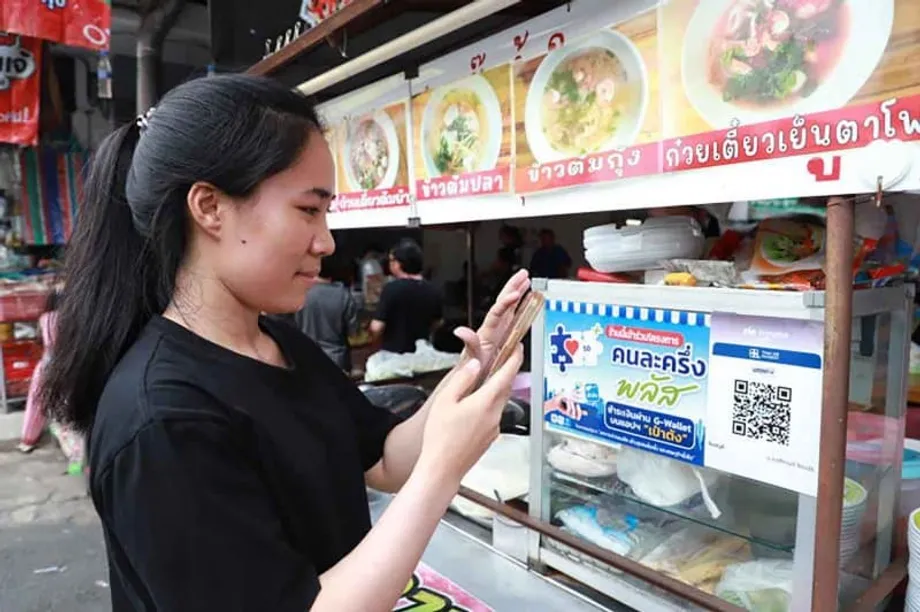
For purchases at a physical shop, users must be present and scan the merchant's QR code using Paotang. The payment window is 6 a.m. to 11 p.m. A QR code is the scannable pattern that connects the customer's payment to the participating merchant.
Food delivery is scheduled to become available from November 7 through Grab, Lineman, Shopee and Robinhood. The planned integration will allow users to order meals through approved platforms and still receive the co-payment benefit. It creates a controlled exception to the usual requirement to be physically present at the shop.
As of November 5, that delivery service was still a scheduled expansion. The existing shop payment rules, the daily ceiling and the restrictions on eligible purchases remained central to how participants could use their credits.
Everyday goods dominate the first day's spending
Blue flag shops led spending on the opening day with 709 million baht, followed closely by food and drink outlets with 697 million baht. General shops received 474 million baht.
Smaller amounts went to services, at 10 million baht; OTOP vendors, at 8 million baht; and public transport, at 3 million baht. OTOP stands for One Tambon One Product, a program promoting goods made locally.
Blue flag shops and food and drink outlets together accounted for 1.406 billion baht, about 74 percent of the opening day's approximately 1.9 billion baht in spending. The figures show that groceries, staples and meals were the main uses of the scheme at the start, although other retail and service categories were also participating.
The provinces with the greatest concentration of spending on day one were:
- Bangkok
- Chonburi
- Nakhon Ratchasima
- Samut Prakan
- Pathum Thani
- Nonthaburi
- Songkhla
- Nakhon Si Thammarat
- Chiang Mai
- Khon Kaen
The list includes Bangkok and nearby provinces alongside major locations in the north, northeast and south. The nationwide merchant network also gives shoppers in towns and rural communities places to use the benefit.
From household savings to orders for suppliers
The Finance Ministry expects this round to inject at least 88 billion baht into the grassroots economy before the end of the year. The program has a budget of 44 billion baht and covers 20 million entitlements.
The 88 billion baht expectation reflects spending supported by both government contributions and consumers' own payments. Households get a lower immediate cost, while street vendors, family shops and local service providers receive sales. Taxi and motorcycle taxi drivers can receive fares, and salons and massage clinics can gain customers.
Leaders from the Thai SME Confederation estimate that about 200 billion baht could move through the economy as the money passes onward. Their estimate includes activity beyond the initial purchase, such as shops ordering more stock from suppliers and processors buying inputs from farmers.
A multiplier describes that chain of spending. Money received by a retailer can pay for goods from a warehouse or factory, which can then support purchases from producers. The ministry's 88 billion baht expectation concerns circulation from this round, while the business group's larger estimate includes the subsequent movement of funds through those supply chains.
The daily cap also shapes the pace of spending. By spreading the benefit across multiple days, the design seeks to keep money moving through communities over time rather than generating a single burst of purchases.
Why an immediate discount encourages purchases
The co-payment design uses several familiar patterns in how people make spending decisions. It offers support at the moment of purchase instead of handing out cash directly, and it gives users a limited period in which to use their allowance.
Present bias means people tend to put extra weight on a benefit they can receive now. The immediate saving on a 300 baht purchase, which reduces the shopper's payment to 150 baht, makes the reward easy to see and reduces the discomfort of paying.
Mental accounting describes the way people place money into different categories in their minds. A subsidy may feel like bonus money rather than ordinary income, encouraging a participant to use the daily benefit instead of leaving it unused.
Loss aversion means people dislike losing something they feel is already available to them. A subsidy covering 50 percent of an eligible purchase feels like a gain, while allowing the entitlement to expire can feel like a loss. The December 31 end date gives that decision a fixed deadline.
Nudges and choice architecture refer to how rules and the arrangement of options guide decisions. Clear eligibility rules and a list of participating merchants simplify the choice of where to spend and direct support toward small and medium businesses and domestic services.
Scarcity and salience also matter. The number of rights is limited, the program has a fixed end date, and the 50 percent contribution is visible at checkout. Together, those features make the allowance noticeable and create an incentive to use it during the spending window.
Digital records support checks on misuse
Paotang records consumer payments, while merchants use the Thoong Ngern app. This digital payment infrastructure makes transactions easier to audit and allows the government to monitor spending patterns.
The payment data can help officials adjust future policy according to how people actually use their benefits. That ability to track spending is one reason co-payment has become a preferred tool for stimulus delivered within a fixed period.
Participating businesses face compliance checks. Massage and spa operators must ensure that the location recorded in Thoong Ngern matches the address on their business license.
Authorities have warned against overcharging, claiming money without a real sale and selling prohibited items. Shops breaking the rules face legal penalties. The Finance Ministry says it will reclaim funds from businesses that violate the conditions and pursue legal action where warranted.
The digital trail helps investigators identify warning signs, including transactions that may require closer examination. The restrictions on cash cards, gift cards and advance services sit alongside the requirement for genuine purchases at participating businesses.
A familiar program returns for the final quarter
Khon La Khrueng ran in five phases between 2020 and 2022 during the pandemic, using a combined budget of roughly 234.5 billion baht. Those phases helped soften living costs and support small businesses during a difficult period.
The government retained the technical infrastructure, including Paotang for consumers and Thoong Ngern for merchants. Keeping those systems in place made it easier to launch a fresh round rather than build a new payment network.
The current administration revived the scheme as a Quick Big Win measure to support spending in the final quarter of 2025. This round has 20 million entitlements, a 44 billion baht budget and planned access through food delivery platforms.
Policymakers have weighed co-payment against direct cash transfers. Co-payment directs money toward domestic shops and services and reduces the amount flowing to imports. Direct cash transfers give recipients money without requiring the same matched purchase at an eligible merchant.
Researchers have suggested minimum spending thresholds and tighter deadlines for using benefits as ways to speed up participation. For this round, officials chose a daily cap, a fixed spending period ending December 31 and a straightforward subsidy covering 50 percent at checkout.
The launch has also coincided with stronger sentiment indicators. The Future Consumer Confidence Index rose in recent readings, and the Thai Chamber of Commerce's survey recorded an increase in consumer confidence for the first time in months.
Investor confidence assessments have highlighted government stimulus measures, with the co-payment scheme frequently cited as support for spending in the final quarter. The early transaction totals provide a measure of purchases already made, while the ministry and business groups have set out their expectations for further circulation before year end.
What to Know
- Spending reached 11.236 billion baht in five days, according to the Finance Ministry, with consumers contributing 5.689 billion baht and the state 5.546 billion baht.
- By day five, 799,205 shops had been approved nationwide. Merchant registration remains open until December 19.
- The program covers 20 million entitlements and has a budget of 44 billion baht.
- Registered taxpayers receive 2,400 baht in credits; people who do not file income tax receive 2,000 baht. Eligibility begins at age 16.
- The daily allowance is 400 baht, split between a shopper payment of 200 baht and a government contribution of 200 baht.
- Participants must make their first payment by November 11. Spending is available from 6 a.m. to 11 p.m. through December 31.
- Food delivery through Grab, Lineman, Shopee and Robinhood is scheduled to begin November 7.
- Blue flag shops led opening day spending with 709 million baht, followed by food and drink outlets with 697 million baht.
- The Finance Ministry expects at least 88 billion baht in circulation by year end. Thai SME Confederation leaders estimate about 200 billion baht as funds move through suppliers and producers.
- Authorities can reclaim funds and pursue legal action against merchants that overcharge, invent sales or sell prohibited items.