One financial center, two cities and a new rulebook
Vietnam is advancing an International Financial Center across Ho Chi Minh City and Danang, pairing a planned 172 trillion dong construction program, roughly $7 billion, with special rules for foreign investment, taxes and financial services. The National Assembly approved the framework in June 2025, with an effective date of September 1, 2025.
Contents
- One financial center, two cities and a new rulebook
- How a shared center would operate
- Ho Chi Minh City builds on its existing market
- Danang prepares a testing ground
- What changes for foreign investors
- Tax incentives, visas and access to land
- The timetable from approval to expansion
- Competing with established Asian hubs
- New services and opportunities for businesses
- What the project could change for Vietnam
- At a Glance
Ho Chi Minh City is set to anchor banking and capital markets across 783 hectares, while Danang will test green finance and digital financial services during a pilot from 2025 to 2028. English will be the official working language. Vietnam wants the project to help secure a place at rank 75 in the Global Financial Centers Index by 2035 and among the top 20 by 2045.
As of October 10, 2025, the plans described a September construction start in Ho Chi Minh City and initial operations during 2025. Confirmation that construction or operations had begun was not given. The core development was expected to take about five years, making the launch of financial activities and the completion of buildings separate stages.
The government's account of the National Assembly resolution sets out the legal foundation: special policies, dedicated governance and a framework connecting Vietnam with international markets while retaining domestic oversight.
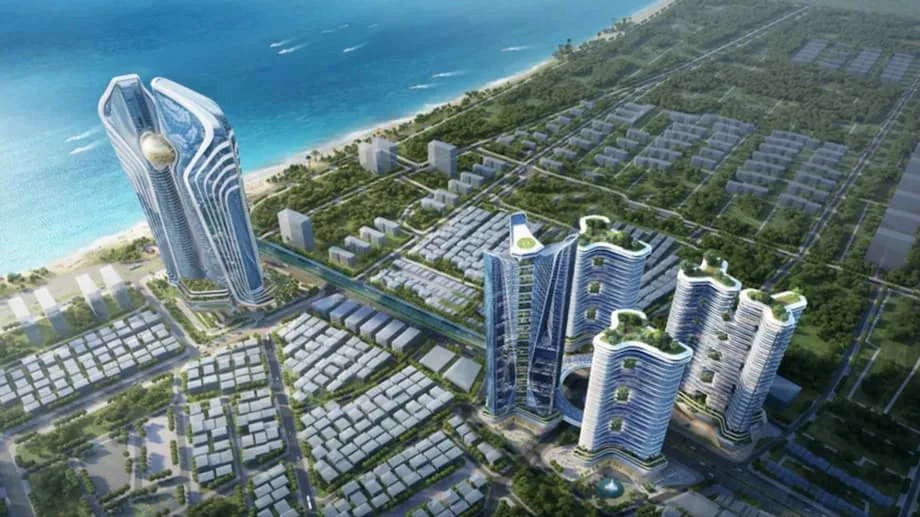
The ambition also has a visible coastal dimension. In Danang, an empty tract beside a white sand beach faces a bay envisioned as a future financial address. Another site seven kilometers away offers views reminiscent of San Francisco Bay. Local concepts extend to artificial islands in Danang Bay inspired by Dubai's Palm Islands, although those ideas remain conceptual and would require environmental and engineering review.
How a shared center would operate
Vietnam calls its approach one center, two destinations. Ho Chi Minh City and Danang would operate under a unified management model with an executive agency and a supervisory agency. A dedicated court and an arbitration center would handle disputes.
The resolution allows international common practice to apply even where it differs from existing Vietnamese law, subject to core legal principles and national security. The purpose is to give businesses predictable rules for international finance while preserving state oversight.
Members would work within a separate legal and regulatory environment inside Vietnam, with rules intended to mirror major financial hubs. Banks, securities firms, asset managers, insurers, financial technology companies and supporting services would be eligible to participate.
Foreign currency transactions between members would face fewer restrictions. Dealings with businesses elsewhere in Vietnam would remain more tightly controlled, including limits affecting foreign currency, investment and settlement. This separation, often called ring fencing, is intended to protect financial stability by controlling how money moves between the center and the wider domestic economy.
An intersectoral steering committee led by the Prime Minister is overseeing implementation. An action plan assigns roughly 50 tasks to 12 ministries and local authorities, covering legal drafting, infrastructure, recruitment and training, and investor outreach. Pilot phases are intended to let authorities adjust the arrangements while keeping rules consistent between the cities.
Ho Chi Minh City builds on its existing market
Ho Chi Minh City, Vietnam's commercial capital and home to the Ho Chi Minh Stock Exchange (HOSE), will host the flagship hub. Its planned footprint covers downtown Ben Thanh Ward in District 1 and the Thu Thiem New Urban Area. The city generates about one quarter of national gross domestic product, giving it an existing concentration of business activity from which to attract global banks, funds and insurers.
A core site of 9.2 hectares in Thu Thiem is intended to house regulators, supervisory bodies and specialized courts. The broader development will focus on banking, asset management, capital markets, financial technology and derivatives trading. Derivatives are contracts whose value depends on an underlying asset or price and can be used to manage financial risk.
Officials also plan commodity and carbon exchanges. These would support trading and pricing in goods and carbon markets, alongside tools for managing exposure to changing prices. The wider objective is to bring more financing and financial services into an established commercial center.
Of the estimated 172 trillion dong investment, about 16 trillion dong is earmarked for the first two to three years. That includes 2 trillion dong from the state budget for government facilities. The remaining financing is expected from domestic and foreign strategic investors.
The development therefore depends on both public construction and private participation. Government facilities would provide the administrative core, while banks, investors and other businesses would supply much of the activity needed to make the district function as a financial center.
Danang prepares a testing ground
Danang will specialize in green finance, digital financial services and controlled experiments involving crypto assets and other international activities. Its pilot from 2025 to 2028 is intended to test regulation and technology before a wider rollout.
Local authorities have outlined a regulatory sandbox, a controlled setting where selected services can be tried under supervision. One proposed trial would allow tourists to make payments using stablecoins, digital assets designed to maintain a stable value. Participants would face Know Your Customer (KYC) and Anti Money Laundering (AML) requirements, which involve checking customer identities and monitoring transactions for illicit activity.
A proposed compensation fund would protect users in the event of cyber incidents. These protections form part of the planned testing arrangements for digital services rather than a general opening of the domestic economy to unrestricted crypto activity.
The core financial district is being developed near Vo Van Kiet and Vo Nguyen Giap streets. Danang is preparing sites near the coast and airport, drawing on its international airport, deep sea port and position on a strategic transport corridor.
Digital infrastructure plans include 5G networks and blockchain platforms for testing digital assets and non fungible tokens. Such tokens are digital records used to identify particular assets. Planners also point to Vietnam's time zone as a bridge between trading hours in major markets, allowing services to complement those in larger Asian hubs.
What changes for foreign investors
Companies joining the center would gain more freedom to invest with overseas partners and obtain financing from overseas creditors through simpler procedures. Foreign currency could be used for many activities within the center, and members would have greater flexibility in managing offshore accounts.
Companies formed inside the center would face no foreign ownership limits. Foreign investors could establish entities without approvals commonly required elsewhere in Vietnam. Entities wholly owned by foreign investors would be among those able to use the more flexible currency and offshore account arrangements.
Contracts between members could adopt foreign law where permitted and designate arbitration to settle disputes. Arbitration allows parties to submit a disagreement to an agreed decision maker outside the ordinary court process. The dedicated court and arbitration center would provide specialized options for handling financial cases.
Official documents would be issued in English and Vietnamese, while English would serve as the working language for filings and internal rules. This is intended to make it easier for international teams and service providers to operate.
Businesses dealing with Vietnamese entities outside the center would encounter stricter rules. Those controls are intended to limit regulatory arbitrage, where firms arrange transactions to take advantage of differences between rulebooks. Members would also face strong compliance duties, including international AML and KYC standards.
Tax incentives, visas and access to land
The Ministry of Finance has drafted incentives aimed at attracting major tenants and skilled workers. New projects in priority sectors could qualify for a corporate income tax rate of 10 percent for 30 years, with a full exemption for up to four years and a 50 percent reduction for up to nine further years.
Projects outside the priority list could receive a 15 percent rate for 15 years, with up to two years of exemption followed by a 50 percent reduction for up to four years. Companies would have to record income from projects inside the center separately to claim these benefits.
Managers, experts, scientists and other highly skilled personnel working in the center would receive exemptions from personal income tax on salaries and wages through the end of 2030. The package is designed to help recruit the specialist workforce needed by financial firms and their service providers.
Immigration and labor policies include long term visas, residency pathways and relaxed work permit quotas for qualified professionals. Land policies promise extended use terms, priority access to land banks cleared for development and clearer property ownership rules for foreign investors.
The incentives address several costs of establishing a business at once: taxation, recruitment, relocation and premises. English as the working language is another part of that effort to reduce friction for international operations.
The timetable from approval to expansion
Vietnam's schedule combines a legal launch in 2025 with construction, testing and longer term competitive goals. Ho Chi Minh City's initial operations were targeted for the same year that its major building program was scheduled to begin, while Danang's pilot would continue through 2028.
The main dates and targets are:
- June 2025: The National Assembly approved the resolution establishing the International Financial Center in Ho Chi Minh City and Danang.
- September 1, 2025: The framework took effect.
- September 2025: Ho Chi Minh City scheduled the start of construction, with initial operations targeted during 2025 and about five years expected for the core build.
- 2025 to 2028: Danang is scheduled to run its pilot before broader expansion.
- End of 2030: The proposed personal income tax exemption for qualifying skilled personnel would run through this date.
- 2035 and 2045: Vietnam targets rank 75 and then a place among the top 20 in the Global Financial Centers Index.
The first construction phase in Ho Chi Minh City would concentrate on the Thu Thiem administrative core. Danang's timetable puts more weight on testing products and technology, giving the two locations different immediate tasks within the shared framework.
Competing with established Asian hubs
Ho Chi Minh City entered the Global Financial Centers Index in 2024 at rank 105. The target of rank 75 by 2035 would represent a climb of 30 places from that starting position, followed by a much larger advance to reach the top 20 by 2045.
Singapore and Hong Kong already have deep capital markets, trusted legal systems and large concentrations of financial talent. Vietnam's plan seeks to compete partly through lower costs for offices, staffing and technology services, combined with tax incentives and clearer rules.
Reaching the ranking targets will require larger markets with more liquidity, meaning investors can buy and sell without difficulty or sharp price swings. Stronger disclosure and corporate governance, dependable clearing and settlement, more derivatives and closer alignment with international accounting and prudential standards are also part of the task. Clearing and settlement are the processes that complete trades and transfer money and assets.
Physical and digital connections matter alongside financial rules. Long Thanh International Airport near Ho Chi Minh City, improvements to urban transit and nationwide broadband form part of the wider infrastructure agenda. Vietnam also needs a deeper domestic investor base and more participation by institutions to support trading and price discovery, the process through which buyers and sellers establish market prices.
New services and opportunities for businesses
Financial technology is a central part of the proposed center. Regulators plan sandboxes for digital banking, electronic identity verification, payments and international remittances. Electronic KYC allows customer identity checks to be conducted digitally, while remittances move money across borders.
Danang's planned stablecoin and crypto trials would sit within that supervised approach, backed by compliance requirements and proposed protection against cyber incidents. Vietnam also wants international investors to use the center as a cost effective base for ASEAN operations involving digital payments, artificial intelligence and blockchain applications.
Green finance would provide another specialization. Commodity and carbon exchanges are intended to support pricing, risk management and financing for the energy transition. Green bonds, which raise money for environmental projects, and sustainability linked loans, whose terms are tied to agreed sustainability goals, could operate within the new framework.
Companies could become members through registration, licensing or recognition by the administrative unit, subject to requirements concerning financial strength and reputation. Eligible businesses include commercial banks, securities companies, asset managers, insurers, payment firms, financial technology startups, rating agencies and professional service providers.
Some institutions, including Fortune 500 financial firms and leading domestic financial institutions, may qualify through recognition. Participation would bring both access to special rules and obligations: separate income accounts for tax purposes, compliance checks and restrictions when transacting with entities outside the center.
What the project could change for Vietnam
Vietnam wants the financial center to diversify an economy with a strong manufacturing base. Businesses could gain better access to foreign capital, more sophisticated ways to manage risk and a larger pool of financial expertise.
Jobs could extend beyond banking into law, accounting, consulting, data services, cybersecurity and property services. Tourism, retail and hospitality around the financial districts could also benefit from the arrival of companies, employees and visitors.
Looser capital controls bring risks that require close supervision. Money laundering and attempts to exploit different regulations could grow if oversight falls behind. Separate rules inside the center could also draw resources away from the rest of the economy if coordination is weak.
Property speculation could raise housing costs in the core districts. Large real estate commitments and the conceptual artificial islands carry financial and environmental risks. Transparent enforcement, effective supervision and reliable crisis management will be needed to sustain confidence as Vietnam moves from legal approval to construction and financial activity.
At a Glance
- Vietnam approved one International Financial Center with hubs in Ho Chi Minh City and Danang in June 2025. Its framework took effect on September 1.
- Ho Chi Minh City's planned development covers 783 hectares and costs an estimated 172 trillion dong, roughly $7 billion, including a core of 9.2 hectares in Thu Thiem.
- Danang's pilot runs from 2025 to 2028, focusing on green finance, digital services and controlled trials involving crypto assets.
- Members would receive more flexible foreign currency and investment rules, with stricter controls on dealings outside the center.
- Draft incentives include corporate tax rates of 10 percent or 15 percent and salary tax exemptions for qualifying skilled workers through 2030.
- English would be the working language, supported by dedicated dispute resolution institutions and international compliance requirements.
- Vietnam targets rank 75 in the Global Financial Centers Index by 2035 and the top 20 by 2045.