Nearly 130,000 edits to widen the picture of Korea
Grapesurgeon, a Korean American volunteer who edits Wikipedia under a pseudonym, has made close to 130,000 edits across accounts and ranks around 641st worldwide by edit count. Of roughly 42,000 articles related to Korea on the English Wikipedia, he says he has changed most at least once. His work reaches far beyond the subjects that usually bring South Korea to international attention.
Contents
- Nearly 130,000 edits to widen the picture of Korea
- A weak biography became a lasting interest
- Why some subjects receive less attention
- The years spent building an article on Sejong
- His objection to a country reduced to its problems
- Thousands of articles, very few regular editors
- How an edit travels beyond Wikipedia
- Why he keeps his identity private
- AI assistance brings different approaches
- Small contributions can make a practical difference
- Highlights
K pop, Squid Game and the nuclear standoff with North Korea draw enormous interest. Korean history, literature, architecture and everyday life often receive less attention. For Grapesurgeon, that uneven picture is a reason to keep working on the world's most used reference work, where a missing paragraph or an incomplete biography can shape what readers think they know.
He has created or substantially expanded hundreds of articles, including entries on Sejong the Great, the royal palaces Gyeongbokgung and Changdeokgung, the March First Movement and independence leader Kim Ku. Much of this work is quiet: finding a source, checking a detail, translating a passage or filling a gap that readers might never notice was there.
As of October 10, 2025, his mission is to give people looking up South Korea more depth, accuracy and context. He says too many articles about Korea are biased, incomplete or missing. His response is to build a fuller account of the country's heritage, one contribution at a time, while encouraging more people to join a small community of volunteers.
A weak biography became a lasting interest
Grapesurgeon was born in the United States and raised in South Korea. His interest in Korean studies began on Wikipedia itself, when he encountered a weak article about Kim Ku. Trying to improve the biography drew him into the history behind it. More reading revealed how much essential information was absent from the English encyclopedia.
He stayed, learning the rules and habits of Wikipedia's volunteer community while working on subjects that attracted fewer contributors. Articles about current politics and social controversies often bring intense debate and many editors. His attention goes instead to premodern history, historic places and foundational figures whose English articles need more work.
That choice gives his contributions a particular purpose. A reader arriving through entertainment news can find a broader map of Korean culture and history. A student searching for a ruler or a palace can encounter an account supported by published research, rather than a thin entry that leaves the most useful questions unanswered.
Grapesurgeon prefers his contributions to speak for him. His pseudonym also protects his privacy and safety, concerns that remain part of his work even though he mostly avoids the most heated political subjects.
Why some subjects receive less attention
English Wikipedia is strongest where published sources and international interest are abundant. For Korea, those areas often include popular culture, the Korean War, North Korea and modern social issues. Articles on important rulers, cities and literary traditions can be comparatively thin, outdated or poorly sourced.
Volunteer attention and access to sources help explain the imbalance. Many contributors work with material published in English. Fewer can read Korean, and fewer still have time to translate or bring together academic research. A subject can be important in Korea yet receive little attention in an encyclopedia maintained by volunteers working in another language.
Korean sources can fill some of those gaps. A bilingual contributor can turn a published historical study into a readable summary, add a missing citation or check a detail that an English reader would struggle to verify independently. English sources remain useful because they make the supporting material accessible to a wider audience.
The demand for a neglected subject can appear suddenly. Grapesurgeon wrote an article about ddakji, a traditional Korean game played with folded paper tiles. After the game appeared in Squid Game, the article's views surged to around 350,000. Interest rose again with each new season.
Ddakji illustrates the value of having an article ready before a subject becomes internationally popular. A modest cultural entry can become the place where a large audience learns what it has just seen on screen. The research done beforehand gives that curiosity somewhere useful to go.
The years spent building an article on Sejong
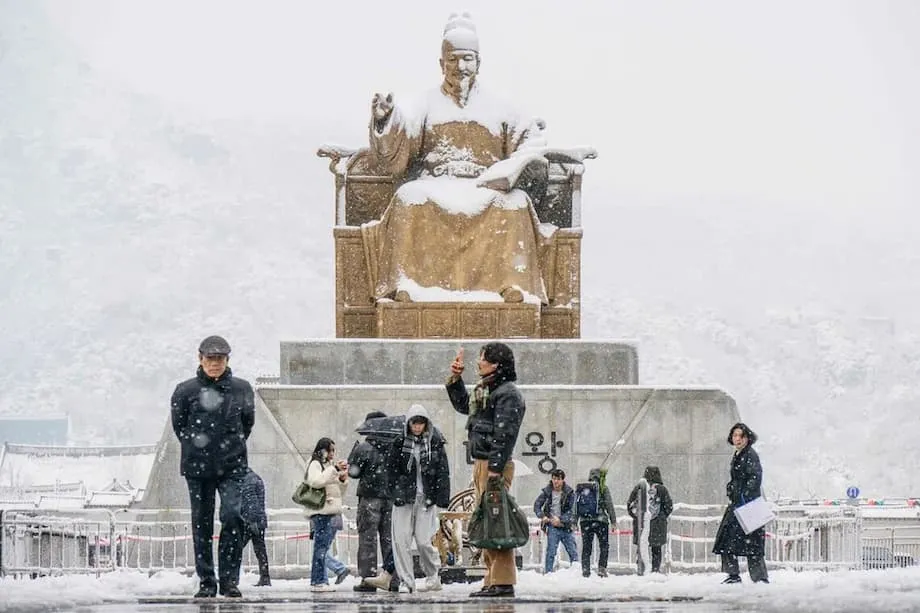
Sejong the Great, who reigned from 1418 to 1450, is the subject of Grapesurgeon's proudest contribution. Sejong is credited with commissioning Hangul, the Korean alphabet, and with advances in science, government and culture. Writing a detailed English article about his reign required years of gathering material.
Comprehensive English scholarship on Sejong is limited and scattered across specialized books and academic journals. Grapesurgeon collected every English source he could find and translated key material from Korean. He spent countless hours working through books and papers, including passages that had never appeared in English.
The resulting article is one of the most detailed public resources on Sejong available in English. Its value, for the editor, lies in access rather than ownership. Wikipedia does not allow contributors to own articles, even when they have done much of the work on them.
Grapesurgeon wanted scholarship that might otherwise remain behind a paywall or a language barrier to reach a high school student in Manila, a college freshman in Nairobi or a curious reader in Manchester. Describing his work on the Sejong article, the volunteer editor put his motivation plainly:
I am proud to have made all of this available to the public for free.
His project brings together two jobs that readers may take for granted: finding dependable research and explaining it in accessible language. The article makes material from scattered publications available in a free reference, where someone can begin learning without access to specialized books or academic subscriptions.
His objection to a country reduced to its problems
Grapesurgeon argues that online discussion of South Korea often focuses on social pressure and controversy, then treats those subjects as a summary of the nation. He objects particularly to commentary that mocks ordinary South Koreans without explaining the historical and geopolitical forces that shaped their circumstances.
Colonial history, war, division, and economic and security pressures are part of that context. In his view, leaving them out produces a distorted account of modern life. Countries seen from a distance through a handful of familiar stories can face the same problem.
The volunteer editor explained his objection to directing ridicule at people living with problems they did not cause:
Average people do not deserve to be mocked for problems they did not create.
Wikipedia aims for neutrality, and its volunteers must work with what reliable sources have published. Thin or uneven English coverage can therefore leave articles thin or uneven too. Grapesurgeon's response is to add sourced context and improve neglected subjects, giving readers more information with which to understand Korea.
Translation is central to that effort, but it requires care. A useful contribution must accurately represent the publication it draws on and allow others to check it. Adding a paragraph from a relevant historical study, with a dependable citation, can improve an article without turning it into an editor's personal argument.
Thousands of articles, very few regular editors
Grapesurgeon estimates that fewer than ten regular editors work on Korea topics outside popular culture and North Korea. Only some of them speak Korean. Against roughly 42,000 articles related to Korea, that leaves a small group handling a large amount of maintenance, research and expansion.
Those volunteers also deal with routine cleanup, vandalism and discussions about Wikipedia's policies. An article needs more than an initial draft: its citations may need checking, its wording may need revision, and new contributions may need review. Time spent maintaining existing material is time unavailable for subjects that still lack adequate coverage.
Wikipedia's rules set limits on what contributors can publish. Editors cannot add personal opinions or new analysis. Claims must be supported by reliable sources. Notability rules help determine whether a subject merits a separate article, meaning whether published coverage provides a sufficient basis for an encyclopedia entry.
Those requirements protect quality while making the work slow. When scholarship is difficult to find in English, building an English article becomes harder. Korean publications can help, provided the translation is accurate and the information can be verified.
Grapesurgeon encourages reliable Korean sources while favoring English sources where possible for accessibility. A larger community able to read Korean and summarize published research would spread work now concentrated among a handful of regular contributors.
How an edit travels beyond Wikipedia
Wikipedia's reach extends beyond people opening its pages. Search engines summarize its content, digital assistants repeat information from it, and large language models use it in training and retrieval. Retrieval means looking up material to help answer a question, rather than relying only on information learned during training.
An incomplete or inaccurate article can therefore affect what people encounter in classrooms, newsrooms and software used by millions. A carefully sourced improvement can travel through those same routes. Grapesurgeon, the volunteer editor working across Korea articles, described that reach in these words:
Directly and indirectly, a huge portion of the world learns about Korea through Wikipedia.
That influence makes sourcing a central part of his mission. A citation added to a history article can support information later repeated in search results, AI answers and social media conversations. Readers encountering those answers may never see the volunteer work behind them.
His efforts connect a very small task with a much larger audience. Checking a date or explaining a historical event improves one page first. When other services draw on that page, the benefit can extend well beyond its direct visitors.
Why he keeps his identity private
Grapesurgeon mostly stays away from the most contentious political articles, but he still chooses a pseudonym. He worries about growing risks for volunteers who contribute to sensitive subjects, including expanding government surveillance and control, and increasingly harsh online behavior.
Public boundaries can shift. A subject considered acceptable today may become taboo later, creating uncertainty for contributors whose real names remain attached to their work. Explaining those concerns, Grapesurgeon said:
It is becoming less safe to edit Wikipedia.
Wikipedia editors around the world have faced doxing, harassment and, in some cases, legal threats. Doxing involves exposing someone's private identifying information. An open editing system allows contributions to be examined, while pseudonyms give volunteers a way to protect their personal identities.
Each contributor chooses how much risk to accept. For some, using a pen name makes difficult work possible. Grapesurgeon's preference for less heated subjects and his decision to remain anonymous are both part of how he manages that risk.
AI assistance brings different approaches
Grapesurgeon urges caution with text generated by artificial intelligence on the English Wikipedia. Its community is skeptical of machine written prose, and careless AI use in discussions can even be prohibited. Contributors are expected to write in their own words, quote precisely and verify claims.
AI can invent facts or misstate what a source says. Those mistakes make it harder to trace information back to dependable evidence. The editor's advice is to check research obtained through such tools and write the final text independently, rather than paste generated prose into English Wikipedia articles.
The Korean Wikipedia has shown greater openness to assistive technology. WikiVault, introduced on April 25, 2025, combines machine translation, research support and article drafting. It is an optional feature for registered users, designed to assist editors rather than replace them.
WikiVault helps translate English material into Korean while addressing differences between Wikipedia templates and awkward phrasing in honorifics, the language forms used to express respect. Its writing assistance proposes text based on sources approved by the user and formats citations.
The tool also uses Wikidata for titles and supports work on mobile devices. It relies on the large language model gemini 2.5 flash. Community feedback recorded on its page was mostly positive, alongside bug reports and improvements. Editors can consult the WikiVault tool documentation for details.
The two approaches place human checking at the center of the work. Grapesurgeon's warning concerns accuracy and traceability; WikiVault's design gives users a role in approving sources and reviewing assistance. In either setting, the editor remains responsible for what reaches the article.
Small contributions can make a practical difference
South Korea has thousands of Wikipedia articles that could benefit from clearer prose, stronger citations or fresh summaries of published research. Grapesurgeon argues that newcomers can make a difference in days rather than years by beginning with manageable tasks and learning the basic rules.
He recommends WikiProject Korea, a community forum where volunteers organize work, review drafts and exchange advice. Choosing a small area of interest gives a new contributor room to learn without taking on an entire major article at once.
His practical advice reflects both the research and the cooperation that Wikipedia requires:
- Begin with a paragraph or section before attempting a complete rewrite. Learn how citations and templates work.
- Avoid the most controversial articles until you understand the policies and discussions on talk pages.
- Be patient and collegial. Use talk pages to discuss disagreements, provide sources and assume good faith.
- Support every claim with a reliable source and keep personal opinions out of articles.
- Use relevant, reliable Korean sources, and provide English sources when possible to make the evidence more accessible.
- Use AI cautiously. Verify research assistance, write in your own words and do not paste machine written prose into English Wikipedia articles.
- Join the project community to find tasks, advice and mentors.
Disagreements are normal and can be productive when contributors cite evidence and discuss changes in good faith. A lasting answer to the coverage gap requires more people who can read Korean material, summarize it accurately and build articles that withstand scrutiny.
The results can be modest and concrete: a biography gains dates and citations, a city article gains a history section, or a palace entry gains architectural details and references. Together, those improvements let readers encounter a country with more depth than the handful of stories that dominate international attention.
Highlights
- Grapesurgeon has made close to 130,000 edits across accounts, ranks around 641st worldwide by edit count and says he has edited most of roughly 42,000 Korea articles on English Wikipedia.
- His work includes Sejong the Great, Gyeongbokgung, Changdeokgung, the March First Movement and Kim Ku.
- He spent years building the Sejong article from English publications and translated Korean material.
- The ddakji article reached around 350,000 views after Squid Game brought attention to the traditional paper tile game.
- He estimates fewer than ten regular editors focus on Korea topics outside popular culture and North Korea.
- He argues that accurate context matters because Wikipedia informs readers, search engines, digital assistants and AI systems.
- He uses a pseudonym for privacy and safety and warns of increasing risks for volunteers.
- WikiVault, introduced on April 25, 2025, offers optional translation and writing assistance, while Grapesurgeon urges caution with AI prose on English Wikipedia.
- New contributors can help through small, carefully sourced edits and cooperation with WikiProject Korea.