A legal route for village oil crews, with a firm deadline
Indonesia is giving existing community oil wells four years to meet safety and environmental standards under Ministerial Regulation No. 14 of 2025, issued in June. The policy seeks to bring an estimated 30,000 wells into a supervised system while preserving village incomes and preventing more deadly fires, explosions and pollution.
Contents
- A legal route for village oil crews, with a firm deadline
- Who will manage the wells?
- How the oil will be sold
- A history of deadly accidents
- What safer operations require
- Keeping oil out of land and streams
- How groundwater monitoring could work
- What villages and national production stand to gain
- Why enforcement will be difficult
- Communities face a financial and governance test
- The next steps toward compliance
- At a Glance
As of October 3, 2025, the Ministry of Energy and Mineral Resources was still finalizing the technical guidelines that would explain how operators must meet those standards. Existing eligible wells can continue operating during the transition while improving their practices. Wells that fail to comply face closure after the four year window.
The regulation covers wells originally drilled by companies and later left idle, provided they were drilled before June 2025. It excludes new drilling. Authorities have already begun closing unregistered sites, particularly wells close to homes, schools and public roads, and enforcement will continue during the transition.
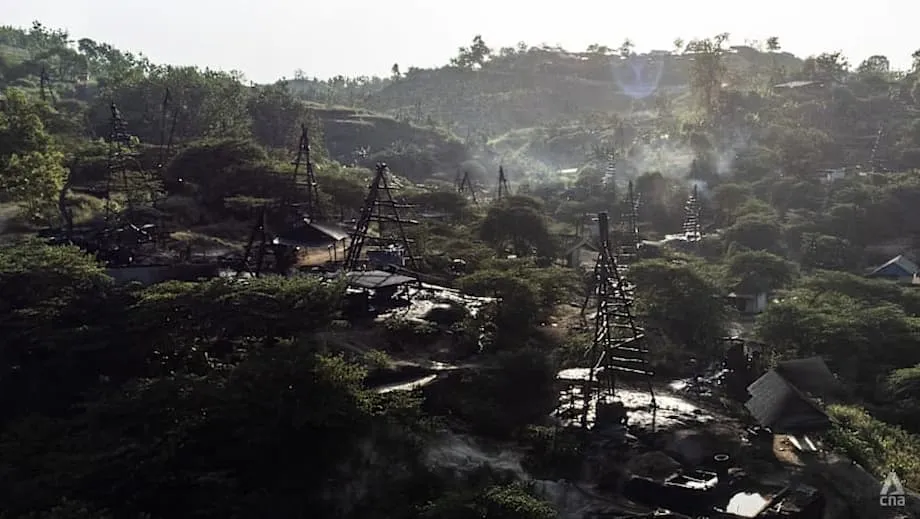
In Wonocolo, East Java, wooden derricks, ropes, pulleys and improvised engines show how deeply oil extraction is woven into village life. Pools of thick crude sit alongside operations that have supported families for generations. Income from the wells helps pay school fees and buy food, but workers and nearby residents also face fires, uncontrolled releases from wells and oily streams.
For decades, the state tolerated this informal economy because it provided jobs and crude for local traders. The new framework changes that arrangement: communities gain a route to legal operation, but must accept recognized management, supervised production, traceable sales and investment in safer equipment.
The central challenge is making those requirements workable across remote sites with limited records and small crews. Legal status will depend on what happens at the well, from handling pressure and preventing spills to maintaining equipment and recording where the oil goes.
Who will manage the wells?
Ministerial Regulation No. 14 of 2025 sets out cooperation in managing oil and gas working areas to increase production. For community wells, management must move from informal crews into regional owned enterprises, cooperatives or micro, small and medium enterprises, commonly called MSMEs.
Communities are encouraged to establish cooperatives or MSMEs with local shareholders so that profits remain in the district. Governors will designate a single managing entity for each region. That entity will then partner with a production sharing contract contractor, usually shortened to PSC contractor, for oversight and technical guidance.
A PSC contractor operates within Indonesia's formal oil and gas system under an agreement for sharing production. Under the community well scheme, these contractors will provide a connection between village operators and that system, including technical support and a required buyer for their crude.
Joint verification teams involving local governments, regulators and contractors will inventory wells and decide which qualify. Their work must establish where wells are located, their histories and whether they fall within the scheme's eligibility rules.
Officials have said participating businesses must be credible, demonstrate sound governance and have enough capital to maintain safe operations. Ministry guidance indicates that cooperatives or small and medium enterprises will need access to several billion rupiah for equipment, training, site safety, spill response and documentation.
A small village store organized as a cooperative would therefore lack the financial capacity expected of an oil operator unless it could secure adequate resources. The government's aim is to prevent short lived businesses from taking control of hazardous assets and to establish organizations capable of maintaining technical standards.
How the oil will be sold
Oil produced under the program must be sold to PSC contractors, with prices tied to the Indonesian Crude Price, or ICP. The ICP provides the benchmark value used to calculate payments, giving community businesses a defined basis for their earnings.
Officials have outlined an arrangement in which 80 percent of the ICP value goes to the community entity and 20 percent goes to the contractor for processing and operational support. The formula is intended to strengthen villagers' bargaining position, reduce losses to middlemen and make sales traceable.
Formal sales would also reduce theft and clandestine deals while bringing village production into national accounting. In many cases, crude supplied to PSC contractors would move into Pertamina's processing and distribution system, connecting small producers with the state energy company's supply chain.
A cooperative with a formal contract can hire workers openly and plan investment in safer equipment. A clear pricing formula can also improve access to credit because banks can estimate revenue with more confidence. Communities would still need to finance the upgrades required to keep operating.
The 80 percent share gives local entities a strong financial reason to maintain production. Whether that income supports jobs and local services will depend partly on how boards handle maintenance, training and safety decisions. Continuing to pump oil must sit alongside the responsibility to stop work when conditions become dangerous.
A history of deadly accidents
Indonesia's community oil fields combine resourcefulness with serious danger. A blast in Aceh killed 28 people in 2018. Fires have repeatedly broken out in Java and Sumatra, showing the risks faced by workers and settlements near informal extraction sites.
In Central Java's Blora region, a fire at an illegal site in 2025 burned for days, killed at least three people according to local officials and forced hundreds to evacuate. Residents reported an explosion before flames rose into the night sky. Fire crews struggled to reach the well because of steep terrain.
Accidents can occur when wells are drilled or entered again without proper design, when gas accumulates, or when escaping crude reaches an ignition source. A blowout is an uncontrolled release of oil or gas from a well. Managing the pressure inside a well is therefore a basic part of protecting workers and nearby residents.
The main stages leading to the new framework are:
- Since 2008, roughly 1,400 old wells have entered legal operations, producing about 1,600 barrels of oil a day.
- In 2018, an explosion in Aceh killed 28 people.
- In June 2025, the government issued Ministerial Regulation No. 14 of 2025, creating a four year transition for eligible community wells.
- During 2025, the Blora fire killed at least three people and displaced hundreds.
- As of October 3, 2025, technical guidelines were still being finalized and authorities had begun closing unregistered sites.
The transition gives existing eligible operators time to improve, while new illegal wells remain subject to enforcement. Some crews have nevertheless begun digging new holes in the hope that they will later be recognized. Wells drilled after the cutoff do not qualify.
What safer operations require
The ministry's planned technical guidelines focus on good engineering practices, safer well operations and reduced pollution. The detailed requirements were still being prepared, but established industry practices show the work involved in controlling the hazards described at community sites.
Well integrity comes first. A well needs sound casing and cementing to separate oil bearing layers from groundwater. Casing is the lining placed inside a well, while cement helps seal the spaces around it. Periodic integrity tests and clear records of previous work help operators assess whether those barriers remain effective.
Crews also need blowout preventers or other pressure control devices and training in how to use them under stress. Flammable gas requires careful management, including venting or flaring equipment where needed. Gas detection alarms can warn workers before dangerous concentrations build up.
Fire precautions extend to the layout and daily running of a site. Exclusion zones around active rig floors, control of ignition sources, grounded electrical systems and clear evacuation routes reduce the chances of a small incident becoming a disaster. Foam and extinguishers need to be readily accessible.
Workers require training in permits for activities that generate heat or sparks, procedures for isolating equipment before maintenance, and petroleum spill handling. Storage tanks should sit within containment berms, barriers designed to catch escaping oil. Even a simple weekly checklist can help prevent missed maintenance or unsafe practices.
PSC contractors are expected to mentor community operators using their safety management systems, documented procedures and access to engineers who can assess well conditions. Sustained coaching at the site will matter alongside classroom training. Regular audits will need to check whether crews follow procedures when supervisors are absent.
Keeping oil out of land and streams
Spills from small oil operations can seep into soil, while oily residues left on the ground can wash into ditches during rain. In some districts, the smell of petroleum hangs in the air. Produced water, the water brought to the surface during oil extraction, can be salty and contain traces of hydrocarbons, and sometimes flows into streams.
Regulators want preventive measures at well sites and better monitoring of groundwater and surface water. Tanks and transfer points should be placed in lined containment areas large enough to hold the contents of the largest tank. Drip trays, absorbent mats and properly connected hoses can limit smaller leaks.
Operators also need plans for collecting and treating produced water, with records showing where it goes. Logbooks covering volumes, spills and maintenance create accountability. Concrete pads beneath pumps and valves are a relatively modest improvement that can make cleanup easier and reduce the area affected by a spill.
These measures have a direct purpose for nearby villages: keeping oil and contaminated water away from the land and water people depend on. The cost of installing containment and managing waste is part of the financial burden that cooperatives and small businesses must prepare to carry.
How groundwater monitoring could work
Groundwater is a lifeline for rural communities. Operators are expected to prevent contamination and demonstrate that their wells do not harm aquifers, the underground layers that hold water. Monitoring must work alongside sound well construction because both the barriers and the surrounding water need attention.
At the Duri oil field in Riau, an operator established a program using shallow monitoring wells around injection sites. Chemical testing and stable isotope analysis were used to confirm that fluids injected deep underground were not mixing with drinking water aquifers.
Stable isotope measurements of hydrogen and oxygen helped distinguish groundwater derived from rain from deeper formation waters. In simple terms, the measurements provided a way to identify different water origins and check that the barriers separating them were holding.
That level of testing is sophisticated and may be expensive for small operators. A simpler approach could involve districts placing a few sentinel monitoring wells near clusters of community oil wells. Sentinel wells serve as observation points where water can be sampled for early signs of a problem.
Routine checks of conductivity, chloride and hydrocarbons can provide warnings. Conductivity measures how readily water carries an electrical current and can help track changes associated with dissolved salts. If unusual results appear, authorities can investigate before contamination spreads.
Over time, the ministry's technical guidelines could specify tests for areas facing greater risks and explain how results enter a shared database. Such arrangements would give local authorities a clearer record of conditions around operating wells.
What villages and national production stand to gain
In parts of Java and Sumatra, many households depend on small wells or related trades. Some studies suggest that in certain villages, as many as one in five residents rely on oil work for part of their livelihood. Formalizing that economy is a central purpose of the policy.
Indonesia produces around 580,000 to 600,000 barrels of oil a day, below the much higher levels of past decades as fields have matured. The government still aims for one million barrels a day by around 2029 to 2030. Community wells are a small part of that effort.
Estimates suggest that properly managed community wells could contribute at least 10,000 barrels a day. Compared with current national production of 580,000 to 600,000 barrels, that would amount to roughly 1.7 percent. The scale helps explain why village wells can contribute without carrying the national production target themselves.
The old well program offers a precedent. Since 2008, about 1,400 wells have been brought into legal operations, producing approximately 1,600 barrels a day. Against the estimate of 30,000 community wells, those 1,400 represent less than 5 percent, illustrating the amount of work required to extend formal management.
The new regulation aims to speed that process by creating a consistent framework and clarifying the responsibilities of contractors and local entities. Directing crude into formal supply chains can reduce imports at the margin, while the ban on new community wells is intended to slow the spread of unsafe sites and direct investment toward existing wells.
Indonesia's wider energy strategy also includes reviving mature fields and applying technology to aging assets. At the same time, new geothermal projects have been announced in several provinces with Indonesian and regional investors, as part of a broader effort to use one of the world's largest geothermal resources.
Why enforcement will be difficult
An estimated 30,000 community wells are spread across Java, Sumatra, Kalimantan and other regions. Many lie in plantations or forests, far from paved roads. Crews come and go, records are thin, and some sites become difficult to reach during the rainy season.
Cataloguing every site will require travel budgets, staff and time. Verification teams must record well histories and establish eligibility while authorities track who is drilling, where crude is going and how safely operations are being run.
Governors' appointment of managing entities and contractors' monitoring responsibilities provide the planned structure. Its effectiveness will depend on how quickly the ministry finishes its guidelines and how many people local governments assign to inspections.
Police and prosecutors will also need to coordinate with regulators to deter new illegal drilling and respond quickly to accidents. Authorities have started sealing new sites, particularly near villages and schools. That work continues while eligible existing wells move through the transition.
The experience of bringing 1,400 old wells into legal operation shows that formal management is possible. Expanding it across a much larger network requires consistent inspections, training and steady funding. Regular public reporting on accidents, enforcement and production would help residents judge whether the system is improving conditions.
Communities face a financial and governance test
Reaction in oil villages is mixed. Many operators welcome legal certainty, formal contracts and the prospect of better prices. Workers who have spent years around fumes want basic protections. Others worry that the financial and administrative requirements will exclude them.
Four years allows time to make changes, but pressure control equipment, spill containment, well histories and crew training all require money and organization. Some small crews lack the capital or paperwork needed to establish a qualifying cooperative or business.
The ministry has said it will provide technical guidelines and capacity building, including training with help from PSC contractors. Getting those programs into the field promptly would give operators more time to change daily habits. Standard procedures for lifting and pumping are among the practical steps that can produce gains when consistently followed.
Cooperatives must also provide fair representation, transparent accounts and clear safety responsibilities. Boards will need to respect rules for stopping unsafe work and reinvest in training and maintenance. District officials and contractors will need to review incident trends and intervene when risks rise.
Community leaders, religious figures and district officials can encourage compliance and discourage dangerous shortcuts. Their support matters where oil work is closely connected to household income and where closure would affect more people than the crew working at a well.
The next steps toward compliance
The first milestone is an inventory of existing community wells. Joint teams must map sites, document their histories and decide eligibility. The ministry's technical guidelines will then provide the details needed for training, equipment purchases and the application of good engineering practices.
Officials also need to finalize sales mechanisms with PSC contractors and, in many cases, arrangements for integration into Pertamina's supply chain. No publication date for the technical guidelines was given. The policy's stated transition period is four years, while the wider national oil production target is set for around 2029 to 2030.
Enforcement will remain a test throughout that period. New illegal wells are outside the scheme, and wells that fail to meet requirements face shutdown after the transition. Regular audits, accident investigations and public safety updates will shape whether communities regard the process as fair.
The government's goal is to preserve livelihoods while increasing legal output and reducing danger. Meeting it requires standards that rural operators can put into practice, enough money to sustain improvements and coordination with environmental policy. Incidents at small wells can damage water quality and community health even when production gains are modest.
At a Glance
- Ministerial Regulation No. 14 of 2025, issued in June, gives eligible existing community wells four years to meet safety and environmental standards.
- The scheme covers wells drilled before June 2025 by companies and later abandoned. New drilling is excluded.
- Regional owned enterprises, cooperatives or MSMEs must manage wells under arrangements involving governors, verification teams and PSC contractors.
- Officials outlined payments based on the Indonesian Crude Price, with 80 percent going to community entities and 20 percent to contractors.
- Participating cooperatives and businesses need credible governance and access to several billion rupiah for safe operation.
- About 30,000 community wells are estimated to exist. Roughly 1,400 old wells have entered legal operation since 2008.
- Community wells could contribute at least 10,000 barrels a day, compared with national production of around 580,000 to 600,000 barrels.
- Deadly accidents include the 2018 Aceh blast, which killed 28 people, and the 2025 Blora fire, which killed at least three and displaced hundreds.
- As of October 3, 2025, technical guidelines were still being finalized, while enforcement against unregistered and new illegal sites had begun.