More than 90 million hectares greened, with difficult choices ahead
China's Great Green Wall has been credited with greening more than 90 million hectares, while the government plans another 70 million hectares of tree and shrub cover between 2016 and 2050, an area similar in size to continental France. Across northern China, the effort has stabilized drifting sand, created jobs and opened land to new businesses. In Inner Mongolia, it has also restricted the movements of herders whose livelihoods and culture depend on seasonal grazing.
Contents
- More than 90 million hectares greened, with difficult choices ahead
- How grazing restrictions changed daily life
- Why more greenery can put water under pressure
- A straw grid and a belt across three deserts
- New livelihoods grow around restored land
- Dust storms persist despite gains over decades
- Restoration depends on quality and shared land pressures
- Solar panels become part of the desert barrier
- Matching restoration and grazing to local conditions
- Key Points
Launched more than four decades ago, the project began as a response to deserts advancing under pressure from intensive farming, grazing, mining and a warming climate. Its methods now extend beyond planting trees. Grassland restoration, shrubs, straw grids that hold sand in place and solar installations that reduce wind and shade seedlings all form part of the work.
China's national forestry administration says the Taklamakan, the country's largest desert, is now encircled by vegetation belts. Officials present the wider initiative as a pillar of national climate and land policy, linking expanded forest cover to climate goals and efforts to curb the dust storms that batter cities each spring.
The Kubuqi Desert in Inner Mongolia illustrates both the gains and the tensions. A United Nations assessment in 2015 found that planting an area equivalent to 840,000 football pitches created tens of thousands of jobs and eased poverty in nearby communities. Crops, tourism businesses and solar energy facilities followed the green corridors.
Pastoral families have experienced another side of the transformation: fences, checkpoints, smaller herds and restrictions on pastures used for generations. The central challenge is to protect land and improve incomes while retaining the flexibility of grazing systems built around changing rainfall and grass growth.
How grazing restrictions changed daily life
Herders in Inner Mongolia describe a landscape increasingly divided by fences and checkpoints. Dedicated patrols enforce grazing bans, and many families have reduced their herds or begun keeping animals in small enclosures. Ethnic Mongolians, roughly 17 percent of the region's population, say a way of life based on nomadism and seasonal migration has receded.
Protests and detentions have followed where pastures long used by local communities became inaccessible. Some researchers argue that earlier policies overstated the contribution of grazing to desertification, the process by which land becomes degraded and increasingly desertlike. They point to mining, intensive agriculture and drought linked to climate change as other major pressures.
Activists say herders have been asked to carry much of the cost of repairing ecosystems they did not primarily damage. Heavy industrial water use, poorly planned farming and extraction projects have also scarred land at scale. For families accustomed to moving animals as rain and grass shifted, a blanket ban removes the flexibility that helped balance grazing pressure with available forage.
Enghebatu Togochog, a Mongolian rights advocate in exile, argues that the campaign has reorganized the region's economy and culture to benefit outside interests more than local herders.
"The sole beneficiaries are the Chinese, especially the state and the companies," he said.
Monitoring also affects discussion of the policies. Visitors to sensitive areas report being shadowed by local staff, discouraging candid conversations. Tighter enforcement, fewer grazing options and a reduced voice in land management have eroded trust. Many communities want rules that respond to rainfall, plant cover and the traditional knowledge of moving herds with the seasons.
Why more greenery can put water under pressure
Ecologists caution that planting a desert requires careful choices about species and water. Plants poorly suited to dry conditions can fail after a few seasons. Irrigation can drain shallow aquifers, the underground layers that hold water, while thirsty trees can use supplies faster than rainfall replenishes them.
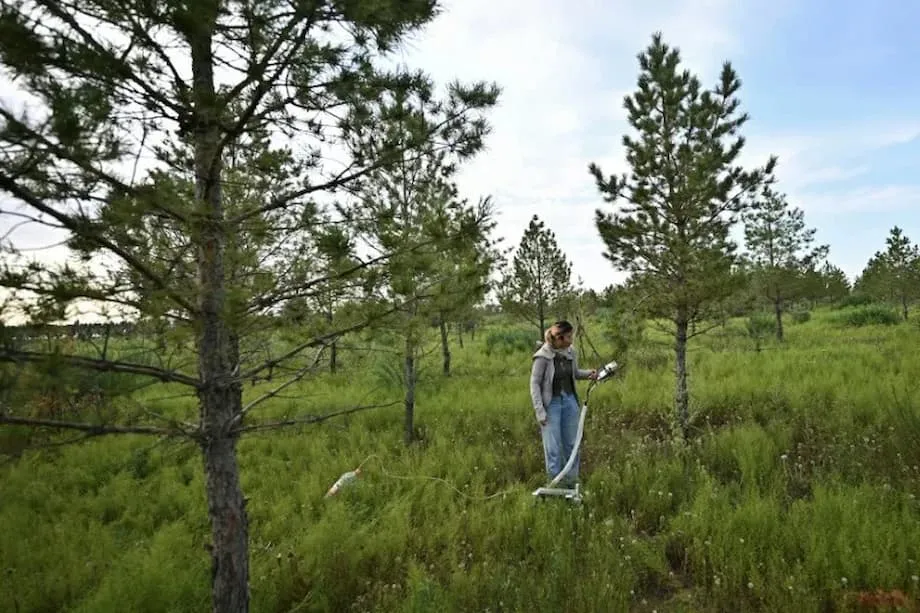
Zhang Yanping, an environmental scientist who samples stands planted long ago in Kubuqi, warned about vegetation that consumes more water than the landscape can replace.
"A plant that consumes too much water can deplete the water table and lead to further degradation," she said.
Deserts have ecological functions of their own. Sand can store water, specialized plants and animals survive in harsh conditions, and reflective surfaces influence local climates. Several experts argue that restoration should stop damaged land from expanding while protecting desert ecosystems that function well.
Wang Shuai, a geography professor at Beijing Normal University, supports a selective approach focused on damaged areas and moving sand.
The instinct to convert desert into greenery is not always the right one," he said. "Deserts have important ecological functions, like water conservation and biodiversity. It is not necessary to eliminate them, just to prevent their expansion.
Kubuqi's experience makes water use a practical question for every new planting. A tree or shrub must survive the local conditions and help stabilize the ground without exhausting the water on which the surrounding ecosystem depends. Choosing vegetation suited to dryness is therefore part of maintaining the restoration itself.
A straw grid and a belt across three deserts
Workers using the straw checkerboard method lay bundles of straw in a grid over bare sand. The technique, pioneered in China, creates a rough surface that slows wind close to the ground and traps moving grains. Seedlings then have a better chance to take root.
Once the sand is stable, planters introduce hardy shrubs and trees adapted to limited water. Sacsaoul, for example, can survive on scant moisture and anchor dunes with deep roots. The order matters: first reduce sand movement, then establish vegetation capable of holding the ground.
In Inner Mongolia's Alxa, officials completed a continuous sand control belt across the Badain Jaran, Tengger and Ulan Buh deserts. Stretching about 1,856 kilometers, it connects local barriers into a broader ecological shield.
Zhang Youyong, chief engineer at the local forestry and desert control bureau, explained how straw grids and planting work together.
"We use the straw checkerboard method to first lock the shifting sand, followed by planting drought resistant trees such as sacsaoul. This approach helps us build an effective sand prevention and control system, ultimately strengthening the ecological barrier," he said.
Large belts can reduce wind erosion and the amount of sand reaching farmland and towns. Keeping them effective requires maintenance over many years and species suited to local microclimates, the conditions that vary from one small area to another. Mixed plantings, natural regrowth where possible and careful water budgeting help vegetation survive beyond its first green flush and beyond the period when planting incentives are available.
New livelihoods grow around restored land
Kubuqi's greening has changed how people earn a living. The United Nations review linked the work to tens of thousands of jobs and reduced poverty. Officials and local entrepreneurs describe a chain of opportunities: stable dunes support shrubs with market value, sheltered areas allow crops to grow, and better access brings visitors.
Cistanche is one crop benefiting from that change. Prized in traditional medicine, the parasitic herb attaches to the roots of a host plant and thrives in sandy soils. Near Dengkou county, farmer Bai Lei says growing it helped turn sand into an economic opportunity.
Bai recalled what the area looked like before the plantings.
"Before, everything here was desert," she said.
Tourism has also expanded. Feng, a former farmer, now runs quadbike outings on tracks near restoration areas. He describes a turning point after grazing restrictions allowed seedlings to mature and spread seed.
Feng said the changes had improved both local resources and household prosperity.
Resources are more abundant, and our lives are more prosperous," he said. "We can hold our heads up with pride.
Income gains have been uneven. Some households that benefit from planting and tourism once depended on mobile herding. Others now maintain shelterbelts, strips of vegetation that slow wind, or work with solar operators. The transition can provide employment while changing the daily practices and cultural traditions that previously organized community life.
Dust storms persist despite gains over decades
Northern China's spring skies still turn yellow during severe dust events. National data show fewer severe spring sandstorms than in the late twentieth century, yet recent years have brought spikes. Climate change adds heat and drying that place further stress on grasslands, making the task more demanding even where restoration has progressed.
During a visit to Inner Mongolia, President Xi Jinping urged officials to remain focused. He linked recent increases in dusty weather to climate forces and called for perseverance in a struggle that would be demanding and continue for many years.
Official statistics say more than half of treatable desertified land is now under effective control. Remote sensing studies, which examine land using observations such as satellite images, also suggest that dunes retreated in some regions from the late 1990s to the mid 2010s. Progress nevertheless varies by place.
The main periods described in the project's development show how long restoration and assessment take:
- More than four decades ago: the Great Green Wall began as an effort to halt advancing deserts in northern China.
- Late twentieth century: national data provide the comparison period for the subsequent decline in severe spring sandstorms.
- Late 1990s to mid 2010s: remote sensing studies suggest that dunes retreated in some regions.
- 2015: a United Nations assessment linked Kubuqi's planting to tens of thousands of jobs and poverty reduction.
- 2016 to 2050: the government plans another 70 million hectares of tree and shrub cover.
Independent assessments warn that reported gains can combine natural regrowth, young plantations and areas without a continuous canopy. Counting them together can overstate lasting forest cover. Evaluating success therefore requires checking how vegetation survives, how much ground it protects and how it affects soil moisture and groundwater.
Restoration depends on quality and shared land pressures
Planting that lowers water tables or reduces soil moisture can weaken a landscape's resilience, its ability to withstand drought and other stress. Natural regeneration and assisted recovery often store more carbon and require less maintenance than plantations containing a single species. Assisted recovery means helping existing vegetation return rather than replacing it entirely with planted trees.
Beyond China, the United Nations Convention to Combat Desertification promotes Land Degradation Neutrality. The framework aims to balance losses and gains in land condition so that recovery keeps pace with degradation. It connects the question of how much land is restored with the question of how much is being damaged elsewhere.
Analysts studying Mongolia and China's northern provinces recommend policies that reflect their shared climate and dust sources. Heavy grazing pressure in some places, land conversion and mining are recurring drivers of degradation on both sides of the border.
Coordination could strengthen early warning for dust events, restore corridors that allow herders to move animals and align restoration work between the two countries. The aim is to keep gains in one country from being offset by losses in the other. Mobile herding and dust movement both make land management a concern that extends beyond individual project boundaries.
Solar panels become part of the desert barrier
Developers in Kubuqi and the nearby Ordos region have built vast photovoltaic fields, installations that convert sunlight into electricity. Their panels also reduce wind near the ground and shade seedlings. Ultra high voltage transmission lines can carry the electricity to urban corridors.
Project plans describe linked solar bases extending for hundreds of kilometers along sandy margins. Their capacity targets would put Inner Mongolia at the center of China's renewable electricity expansion. Some proposals describe a Great Solar Wall across stretches of Kubuqi that would produce tens of billions of kilowatt hours a year once complete. A kilowatt hour is a measure of electrical energy.
Elevated panels can be combined with vegetation and small crop plots underneath. This approach turns erosion control areas into places that also generate electricity and support farming, spreading the possible benefits across several activities.
Engineers are testing bifacial modules, which collect reflected light as well as direct sunlight, and tracking systems that adjust panel tilt as the sun moves. Energy storage and green hydrogen pilots are also emerging as ways to make daytime generation useful when electricity is needed at night.
Solar development promises jobs and lower emissions, but placement matters. Panels must be located carefully to protect scarce water and avoid shading native plants so heavily that they struggle to survive. The proposals describe production ambitions, but no completion date for the Great Solar Wall was given.
Matching restoration and grazing to local conditions
Decades of trials have refined restoration methods. Mixed plantings perform better than belts of a single species. Local plants, including sacsaoul and shrubs adapted to drought, survive better than fast growing species introduced from elsewhere. Where seed sources remain, allowing natural regrowth can take longer initially but produce more durable results.
Water budgeting means comparing what plants will consume with the water the landscape can supply and replenish. It helps prevent plantations from using groundwater faster than it is recharged. Monitoring must continue beyond a short project cycle, and maintenance funding must last beyond the early years if new vegetation is to remain healthy.
Chinese academics have also argued that policies sometimes overstated the role of herds in desertification and understated the value of mobile grazing. Where rainfall varies, moving animals gives plants time to recover and helps keep pressure within what the land can support.
Authorities in several restored zones already allow seasonal grazing after plants become established and begin producing seed. Expanding that adaptive approach, with local input and thresholds based on scientific evidence, could reduce conflict while protecting new vegetation.
Herder knowledge, satellite monitoring and surveys on the ground can help managers judge when grazing is appropriate and when land needs longer to recover. For Inner Mongolia, the practical task is to combine the protection gained from restoration with rules that recognize changing conditions and the people whose livelihoods depend on them.
Key Points
- The Great Green Wall is credited with greening more than 90 million hectares; China plans another 70 million hectares of tree and shrub cover between 2016 and 2050.
- The national forestry administration says vegetation belts now encircle the Taklamakan, China's largest desert.
- A 2015 United Nations assessment linked Kubuqi's planting to tens of thousands of jobs and poverty reduction.
- Grazing bans have reduced herd sizes and seasonal mobility in Inner Mongolia, bringing cultural strain and disputes over access to pasture.
- A sand control belt of about 1,856 kilometers connects the Badain Jaran, Tengger and Ulan Buh deserts.
- Severe spring sandstorms have declined compared with the late twentieth century, but recent spikes and climate pressure persist.
- Solar developments combine electricity production with sand control, planting and some farming.
- Durable restoration depends on suitable species, water supplies, continuing maintenance and grazing rules responsive to local conditions.